TANK T-38
amphibious reconnaissance tank
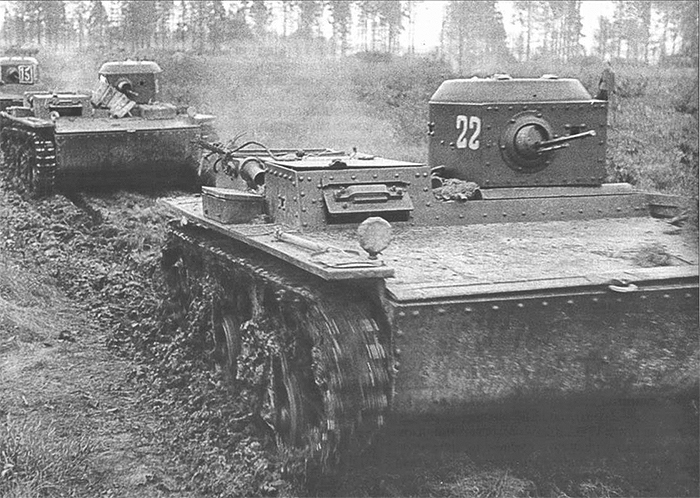
a column of T-38 tanks, source: Aviarmor.net with permission, edited
Origins
The T-38 came about as a direct response to the shortcomings of the older amphibious light tank T-37, which had become apparent during practical service. Another attempt to replace the T-37 had been made with the TM project, but it ultimately failed to meet the army's expectations and was rejected. Following that experience, Soviet designers decided against developing an entirely new vehicle from scratch, and instead pursued a thorough modernisation of the existing T-37 design.
Development work began in 1935 at the design bureau of Moscow Factory No. 37, with N. A. Astrov appointed as chief designer. The primary goals of the redesign were to improve the vehicle's driving characteristics and its performance on water. Like its predecessor the T-37, the hull of the new tank was constructed from flat steel plates joined by riveting and welding. The overall layout of the vehicle changed only in limited ways. The hull was made wider and lower, which improved stability when travelling across uneven terrain. The most visually striking change was the relocation of the turret from the right side of the hull to the left.
Design
The running gear remained unchanged, consisting of four small spoked road wheels with rubber tyres on each side. The wheels were suspended and sprung by two paired bogies — the front bogie linking the first and second road wheels, and the rear bogie linking the third and fourth. At the front was a sprocket wheel with lightening holes cut into it, while at the rear was an idler wheel, again of spoked design. The upper run of the track was supported by two small return rollers.

a captured T-38 in Finnish Army service, source: Waralbum.ru with permission, edited
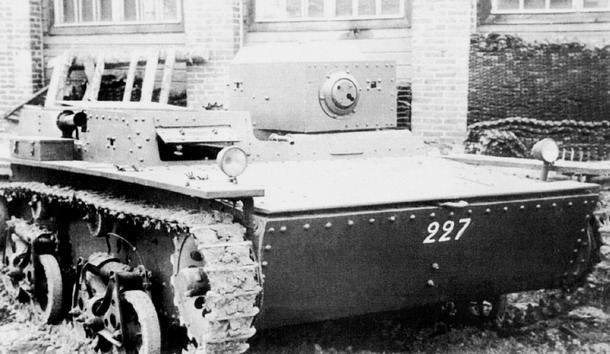
The shape of the hull was tailored for swimming, reflected in its tall front plate fitted with a foldable wave deflector at the bow. The hull roof extended rearward from the bow, rising only very gently, with the crew compartment emerging from it slightly. On the right side sat a boxy superstructure housing the driver's position. In the original version this structure had a rounded front face, but later production simplified it to a strictly flat-sided design.
The rotating turret was positioned to the left, and was of the same design as that on the older T-37. It had a tubular shape from which a flat front plate projected. The turret roof tapered conically toward the commander's hatch, which was a single circular piece — flat only along its hinged front edge — and opened toward the front of the tank. Mounted in the turret's front plate was the tank's sole weapon: a 7.62 mm DT machine gun, with a carried ammunition supply of 1,512 rounds. The crew consisted of two men — a driver and a commander, who also served as loader, gunner, and signaller, and when required, radio operator. The two crewmen communicated with each other directly. Communication with other tanks was in the vast majority of cases handled by flag signals, as only a portion of the tanks were fitted with a radio — the 71-TK-1 set.
Hull armour was 9 mm on all sides except the floor and roof. The floor was only 4 mm thick and the roof 6 mm. Turret armour followed the same pattern — 9 mm on all sides and 6 mm on the roof. The rear of the hull housed a GAZ-AA engine, the same type used in the T-37. With a displacement of 3.3 litres, it produced a maximum output of 40 horsepower at 2,200 rpm. Above the engine, on the right side of the hull, a low intake tube protruded from the roof to supply air — as on the T-37, this was raised above hull level to prevent water from entering the engine during swimming. The tank was fitted with a four-speed forward gearbox and one reverse gear, housed in the front of the hull. When afloat, drive was transferred to a three-bladed propeller mounted centrally on the rear hull plate, with steering handled by a rudder. The vehicle weighed 3.3 tonnes and could reach a maximum road speed of around 40 km/h, or up to 6 km/h when swimming.
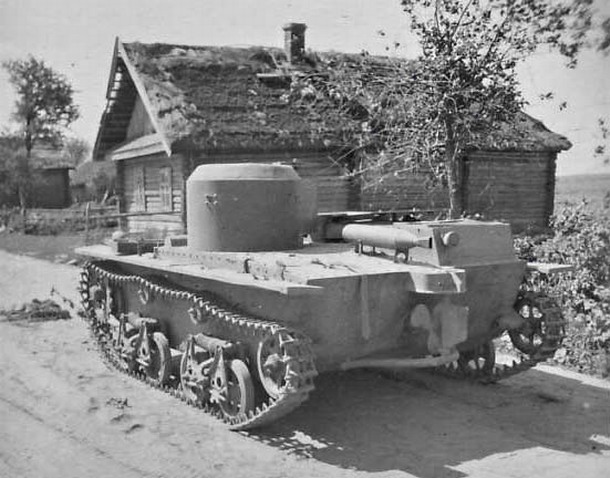
rear view of a T-38 tank, source: Aviarmor.net with permission, edited
On 29 February 1936 the T-38 was officially accepted into Red Army service and series production began. By the end of 1936 a total of 1,046 tanks had been delivered. Output dropped sharply the following year, with only 182 examples completed. Production was then halted entirely, and not a single tank of this type was built throughout 1938. The reason was the army's dissatisfaction with its performance in service — practical experience had shown that the new vehicle had actually solved very few of the problems that had plagued the older T-37. The difficulties were most pronounced during swimming operations.
One of the design changes introduced on the T-38 compared to the T-37 was a reduction in hull height, which lowered the centre of gravity and improved cross-country stability on land. In the water, however, this change proved to be more of a liability. The bow sat quite low, and water had a tendency to wash over it and into the crew compartment — particularly in choppy conditions, but also on calm water during sharp manoeuvres such as braking with the propeller in reverse. In such situations the bow could easily dip below the surface and the tank would begin to take on water. The same happened when entering the water from a steep bank. Even raising the foldable bow wave deflector did little to prevent this.
Performance on land left much to be desired as well. The engine, originally derived from a passenger car, was underpowered and the tank struggled with rough terrain. The chronic overloading of the engine led to frequent overheating. During summer 1937 manoeuvres involving T-38 tanks, 19 out of 31 vehicles suffered breakdowns related to engine overheating. In 11 of those cases the damage was severe enough to require a complete engine replacement.
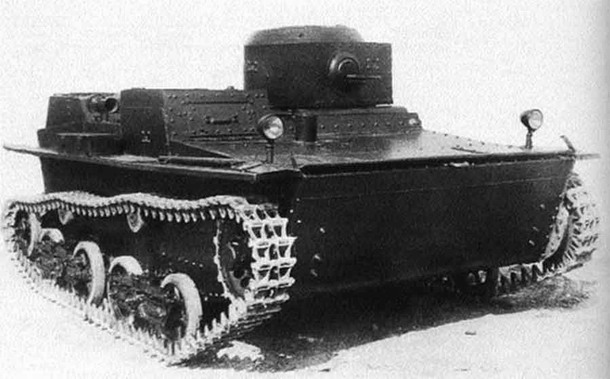
probably the T-38M-1 prototype, source: Aviarmor.net with permission, edited
Modernised T-38M
Based on these troubling experiences from 1937, an order was issued to address the identified faults. Production was first scaled back and then stopped altogether while the design bureau of Factory No. 37 drew up two modernisation proposals. Both were presented in 1938 — one designated T-38M-1, the other T-38M-2. Both prototypes brought the same or similar improvements. The bow was raised by 100 mm on the M-1 and by 75 mm on the M-2. Both shared a more powerful GAZ-M1 engine producing 50 horsepower at 2,800 rpm, and both adopted the bogie suspension from the Komsomolec artillery tractor. The T-38M-1 additionally featured a new steering system, which the military authorities considered overly complex.
The modernisation programme concluded with the approval in January 1939 of a new production tank designated T-38M. According to some sources the T-38M-2 design was selected for production; others suggest that the final vehicle combined the best features of both the M-1 and M-2 proposals. The T-38M weighed 3.8 tonnes, but thanks to its new engine its maximum speed rose to 46 km/h. Production resumed in February 1939, but only 112 of the modernised tanks were built before the programme was permanently wound down — the far more capable amphibious tank T-40 was already in development. In total, across 1936, 1937 and 1939, 1,340 tanks of both T-38 variants were produced.
Special Variants
In 1937 a flamethrower variant of the T-38 was under development. The vehicle, designated OT-38 (OT = ogněmjotnyj tank, meaning flamethrower tank), was entrusted to the Kompresor plant. Only a prototype was ever built and tested, however, after which the entire project was cancelled — the T-38 had proven unsuitable for this role.
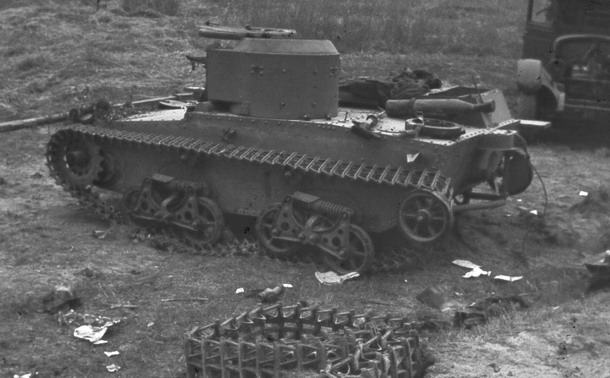
a wrecked T-38 tank, source: Waralbum.ru with permission, edited
Another interesting variant was a radio-controlled version of the tank. This unmanned vehicle was operated wirelessly from another tank, and was originally intended to carry a flamethrower in addition to its regular armament — making it a combat vehicle rather than simply a remotely-detonated bomb, as was the case with many other remote-controlled machines of the era. Again, however, only a prototype was completed before the programme was shut down. There is some confusion in the sources regarding the designation of this radio-controlled T-38 variant, with names such as TU-38, T-38TU, and T-38TT all appearing in the literature. To add to the confusion, some sources suggest that one of these designations referred not to the remotely controlled tank itself, but to the controlling tank from which the operator directed it.
The history of another T-38 variant — one armed with a 20 mm ŠVAK cannon — is equally unclear. The prototype or prototypes of this version were most likely built in the autumn of 1941. The aim was obviously to give the tank some capacity to engage lightly armoured enemy vehicles, specifically German ones at that stage of the war. Fitting the heavier weapon required a redesigned turret front plate. This modified tank is generally referred to as the T-38Š, though whether this was ever its official designation is uncertain. Given how little is known about this version, it seems probable that only one or two prototypes were ever built, and that they failed their trials. Objectively, this is hardly surprising — committing production capacity to yet another light tank of doubtful combat value was the last thing the Soviets could afford in the autumn of 1941. One of the T-38Š prototypes can still be seen today at the Central Museum of the Armed Forces in Moscow.
Combat History
The T-38 made its combat debut in Poland in 1939. Its weaknesses were not yet particularly evident there, since fighting against exhausted and poorly equipped Polish forces was relatively straightforward. The attack on Finland during the Winter War posed a sterner test, and it became fully apparent that a light tank with minimal armour and weak armament had very limited ability to make a meaningful contribution to the fighting. The war against Nazi Germany proved catastrophic for these tanks — the vast majority of T-38s were lost within the first months of combat against the Wehrmacht. After 1941 the survivors were rarely committed to battle, serving mainly as training vehicles for new tank crews. Even so, there are recorded instances of their use as late as 1944.
a T-38 tank, source: Waralbum.ru with permission, edited
Besides the Red Army, T-38 tanks were also used by the Finns and the Germans. Finland captured 17 or 18 T-38s during the Winter War, with additional examples obtained during Operation Barbarossa. Unlike the Germans, who used captured T-38s only as cargo tractors or recovery vehicles, the Finns actually deployed theirs in combat. The Finns eventually retired their captured tanks in 1944, though fifteen of them went on to enjoy a rather unusual second career — they were converted into mock-ups of T-34 and KV-1 tanks and continued to serve as training vehicles for Finnish soldiers.
Overall, the T-38 does not come out of any assessment particularly well. At least in its original version, the tank suffered from much the same ailments as its predecessor the T-37, and therefore failed even its basic initial expectations. It was lightly armoured and lightly armed, meaning it could only engage enemy infantry without anti-tank weapons. Its amphibious capability was certainly a genuine asset — the tank was primarily designed for reconnaissance, and the ability to cross rivers and lakes under its own power was well suited to that role. However, its reconnaissance value was almost entirely undermined by the absence of a radio in most vehicles, without which it had no reliable means of relaying information to other units in a timely manner.
Technical Data
|
T-38 |
T-38M |
Weight |
3.5 t |
3.8 t |
Length |
3.78 m |
3.78 m |
Width |
2.33 m |
2.33 m |
Height |
1.63 m |
1.63 m |
Engine |
GAZ-AA |
GAZ-M1 |
Max. power |
40 hp |
50 hp |
Max. speed |
40 km/h |
46 km/h |
Fuel capacity |
115 l |
115 l |
Range – road |
230 km |
230 km |
Armour – sides |
9 mm |
9 mm |
Armour – roof |
6 mm |
6 mm |
Armour – floor |
4 mm |
4 mm |
Armament |
1 x 7.62 mm DT machine gun |
1 x 7.62 mm DT machine gun |
Crew |
2 men |
2 men |

ARTICLE
CONTENTS:
Reproducing text from the Tankist website without the written consent of the operator is prohibited.