TANK T-40
the floating tank that eventually forgot how to swim
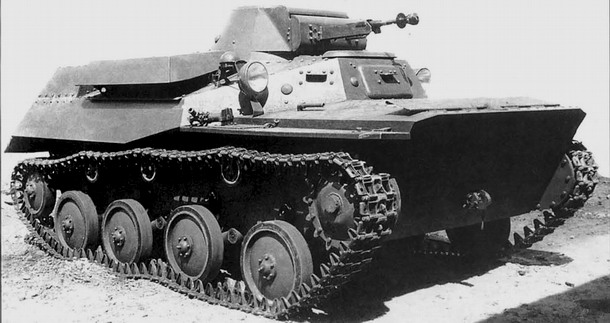
T-40 tank, source: Armchairgeneral.com with permission, edited
Origins of the Tank
By 1938 it had become clear that even the new T-38 had failed to meet the Soviet Army's requirements for a light amphibious reconnaissance vehicle. In April of that year, the design bureau of Moscow's factory No. 37, led by N. A. Astrov, began work on a new tank to replace both the ageing and technically obsolete T-38 and T-37. After the dispiriting experience of trying to modernise those older types, it was decided to build an entirely new vehicle from scratch this time. The new tank project received the factory designation 010, but it entered history under its later official name: T-40.
The new tank was to have armour up to 13 mm thick and be armed with machine guns of 7.62 mm and 12.7 mm calibre. Its weight was not to exceed 4,800 kg. The vehicle design, including a wooden mock-up, was completed in August 1938, though many design elements remained unresolved — particularly the engine and the running gear. No suitable domestic engine was available at the time, so the designers eventually decided to use an imported Dodge unit, while planning for a domestic GAZ engine in future series production. As for the running gear, the designers debated for some time between the traditional paired bogie system and the more modern torsion bar arrangement. Soviet engineers had insufficient experience with torsion bar suspension, so the project was prepared in both variants, with trials of the prototypes to decide between them.
Prototypes
The tank's technical drawings were completed at the end of 1938 and prototype construction began immediately. The first two test vehicles, fitted with the bogie-type running gear, were completed on 10 April 1939. The first torsion bar prototype followed on 1 May. Three further test vehicles were subsequently built, though some sources give different dates for the prototypes. All were fitted with the aforementioned Dodge engines — two different types producing 76 and 85 horsepower respectively. After factory trials, two of the vehicles were handed over for army testing — one with the bogie suspension and one with torsion bars.
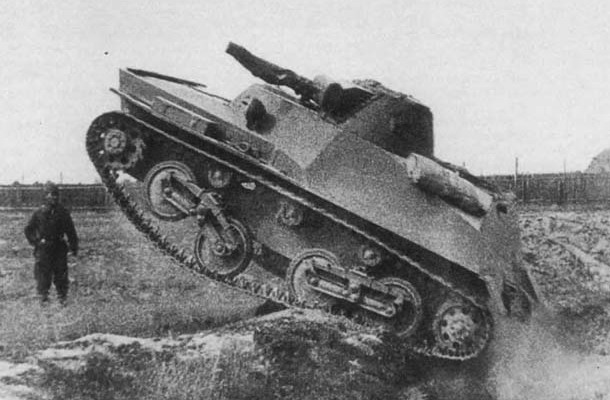
T-40 prototype with paired bogie suspension, source: Aviarmor.net with permission, edited
During army trials each vehicle covered more than two thousand kilometres on roads, cross-country, and on water. The trials concluded that the torsion bar suspension was the more suitable choice for series production. They also revealed a range of minor and more significant shortcomings, and the parent factory in Moscow was tasked with addressing them. On the whole, however, both prototypes performed very well, and the army's assessment confirmed that the new vehicle surpassed the older T-38 and offered broader combat potential. Based on the army's findings, factory No. 37 made several improvements, including the installation of the newly available GAZ-202 engine — a modified tank version of the civilian GAZ-11 unit.
On 19 December 1939 the T-40 was officially accepted into service with the Red Army, and the Moscow factory was tasked with delivering three modified vehicles for further testing by 1 March 1940, producing a first series of 15 tanks by 1 August 1940, and being ready to begin series production by 1 October 1940, completing at least a hundred tanks before the end of the year. Preparing for series production was not straightforward, however, as the T-40 was a considerably more complex vehicle than the T-38 it was replacing. Nevertheless, the factory managed to deliver the required three test examples in April, only slightly behind schedule. Factory trials followed immediately, after which several further modifications were implemented, mainly to iron out issues with the new engine.
By August 1940 a further six tanks had been completed, already conforming to the planned production configuration. During September and October these vehicles undertook a special endurance run from Moscow via Smolensk, Minsk, and Kyiv and back to Moscow — a total distance of nearly three thousand kilometres. The army was satisfied with the results and series production was approved on the original schedule. Despite every effort, however, the factory failed to deliver the required hundred tanks by the end of 1940, managing only 41.
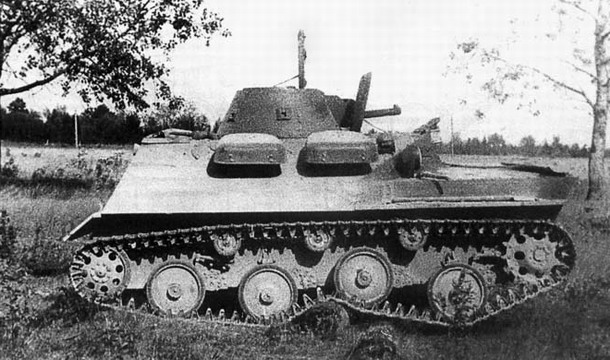
T-40 prototype with torsion bar suspension, source: Flickr.com, Public domain, edited
Technical Description
The series T-40 thus ultimately had running gear consisting of four road wheels on each side, each independently suspended and sprung by a torsion bar. The wheels were solid, fitted with rubber tyres around the rim to dampen noise and vibration from contact with the tracks. Some later vehicles also appeared with spoked road wheels. The idler wheel was at the very rear, while the toothed drive sprocket was at the front. The upper run of the track rested on three small return rollers. The tracks were 260 mm wide.
The hull was quite complex in shape and is not easy to describe concisely. It had to be adapted for swimming, which is reflected in the high front wall of the lower hull. At its bow was a folding trim vane to help the tank negotiate choppy water. Connecting to this front plate was the upper hull deck, whose central panel was nearly horizontal while the side panels sloped gently downward from the centreline toward the track mudguards.
Behind this deck rose the raised crew compartment. Its centre was positioned asymmetrically, slightly to the left of the vehicle's centreline. The front wall of the compartment was angled and formed by three plates. The centre plate ran parallel to the tank's bow and contained the driver's main vision port — a large rectangular opening closable by a single-piece cover with an observation slit. The side plates angled away from the centre toward the hull sides, sloping in both the horizontal and vertical planes. These side plates also contained vision slits for the driver and small circular firing ports for use with personal weapons.
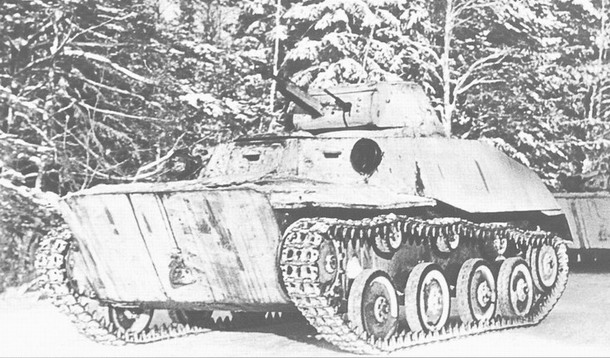
T-40 in winter camouflage, source: Armchairgeneral.com with permission, edited
Behind and slightly to the left of the driver's position was the tank's turret. It was circular in plan with conically sloped walls, which improved its resistance to enemy fire. The front face of the turret projected forward noticeably, and in it both of the tank's integral weapons were mounted coaxially — a 7.62 mm DT machine gun on the left and a 12.7 mm DShK heavy machine gun on the right. Ammunition stowage was 2,016 rounds for the lighter machine gun and 450 to 500 rounds for the heavy one. In addition to these fixed weapons the crew had their personal sidearms and a supply of F-1 grenades. The effective range of the DT was around 1,000 metres and of the DShK around 4,000 metres. The armour-piercing B-32 round for the heavy machine gun left the barrel at 850 m/s and could penetrate 16 mm of vertical armour at 300 metres — not a spectacular figure, but compared to the older T-37 and T-38 it represented an enormous qualitative leap forward. The gun mount allowed elevation up to +25°, making it theoretically possible to engage low-flying aircraft.
Welding was used extensively in joining the hull plates, particularly in the lower hull sections that were submerged during swimming and therefore had to be perfectly watertight. Even so, the T-40 retained a significant number of riveted joints. Armour thickness on the T-40 ranged from 13 mm on the hull front walls down to 6 mm on the roof plates and as little as 4 mm in places on the hull floor. The crew consisted of two men — the driver and the commander, who simultaneously served as loader, gunner for both machine guns, and radio operator or signal flag operator. Each crew member had his own entry and exit hatch in the roof above his station, but the fighting compartment was connected throughout, so that if, for example, the driver's hatch jammed, both men could exit through the commander's turret hatch. Like the older T-37 and T-38, the T-40 was not fitted with a radio as standard. When one was provided, it was the 71-TK-3 type with a range of 16 km.
To the right of the turret was a prominent pentagonal air intake cover for the engine, designed to prevent water entering the engine compartment. The original 010 prototypes had two intake openings, each with its own cover; in the series tanks this was replaced by a single larger cover. The rear of the hull was relatively tall with slightly sloped side walls. The rear deck was divided into two sections: the right section was horizontal before dropping sharply into the rear hull wall, while the left section sloped downward toward the rear from the back edge of the turret. The right half was kept higher because it contained a ventilation and service access opening for the engine — one that could not be allowed to flood during swimming.
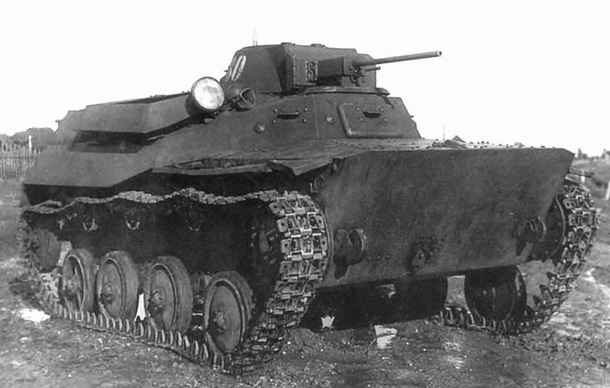
T-40S land version with ShVAK cannon — note the one spoked road wheel, source: Aviarmor.net with permission, edited
The rear hull wall was formed by upper and lower halves. Cut into the centre of the lower half was a fairly large recess housing the four-bladed propeller and twin rudder. Both were recessed into the rear wall and therefore well protected from damage when travelling over rough terrain. When the tank entered the water, the driver switched drive from the wheels to the propeller, and the tank was steered using the rudder.
In the rear of the hull, alongside the engine, were two fuel tanks of one hundred litres each. The 3.48-litre six-cylinder GAZ-202 produced a maximum of 70 horsepower at 3,400 rpm. The gearbox was positioned in the hull nose and offered four forward gears and one reverse. With this setup the T-40 could reach 45 km/h on a road and swim at up to 6 km/h on water. The tank's total weight was 5.5 tonnes.
The "Land" T-40S
Production of the T-40 continued into 1941, and by 22 June of that year — the day war broke out with Nazi Germany — a total of 222 tanks had been completed. The devastating German advance and enormous losses in armoured vehicles of all kinds forced the Soviets into an urgent production change. Combat experience had shown that tanks made almost no use of their swimming capability in practice. In the interest of simplifying production and increasing output, it was therefore decided that new T-40s would no longer be fitted with the components required solely for amphibious operation — the rudder, propeller, propeller shaft, and associated parts. The recess in the rear hull wall was retained, but its openings were blanked off. Tanks produced in this configuration began rolling off the production lines in the second half of July 1941 and received the designation T-40S (S = sukhoputny = land).
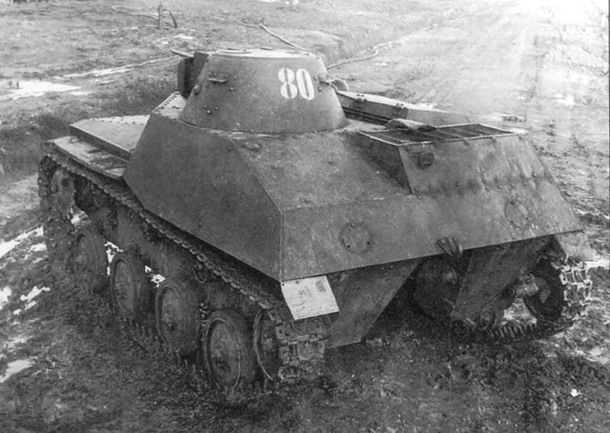
rear view of the T-40S, source: Aviarmor.net with permission, edited
The Upgunned T-30 Variant
Once the tank was permanently stripped of its ability to swim and there was therefore no longer any need to respect strict weight limits, the logical next step was to strengthen its armour and armament. Combat experience was making it increasingly clear that what was needed above all were vehicles capable of destroying enemy armour — a requirement that the T-40 with its DShK machine gun, for all its qualities, simply could not meet. In August a further design change was introduced. The lower section of the rear hull wall was now produced without the propeller recess and formed by a flat plate instead. Hull and turret frontal armour was increased to 15 mm (some sources give 20 mm). The DShK machine gun was replaced by the rapid-firing 20 mm ShVAK cannon, with 750 rounds carried on board. The upgraded tank received the factory designation 030 and is sometimes referred to by the army designation T-30. According to many sources, however, this designation was unofficial — just like T-40S — and all three variants officially shared the single designation T-40 throughout. Photographs confirm that some of these late-production vehicles (the so-called T-30) were fitted with spoked road wheels.
Also worth noting is an earlier, unsuccessful attempt to rearm the T-40, which took place as early as July 1941. The factory was ordered to try fitting a 23 mm BT-23 cannon in the tank's turret. The installation was actually carried out, but the solution proved unworkable and no further attempts were made.
Production of the T-40 was halted sometime towards the end of 1941 in favour of the newer T-60. The total number of vehicles built is unclear — figures ranging from 487 to 709 appear in the literature, usually without distinguishing between the individual variants.
Combat Deployment
The T-40 probably saw its combat debut in the closing stages of the Winter War with Finland. Its main combat involvement, however, came during the Great Patriotic War against Germany. Given the acute shortage of armoured vehicles of all kinds, the Soviets deployed it as a conventional combat tank rather than in its intended role as a reconnaissance vehicle, which contributed to the enormous losses suffered by the type. By the end of 1941 the T-40 had become a rarity rather than a commonly available vehicle. By mid-1942 the last surviving examples had been withdrawn from the front and sent to tank schools, where they served as training aids.
Technical Specifications
|
T-40 |
T-30 |
Weight |
5.5 t |
5.8 t |
Length |
4.03 m |
4.03 m |
Width |
2.23 m |
2.23 m |
Height |
1.90 m |
1.90 m |
Engine |
GAZ-202 |
GAZ-202 |
Maximum output |
70 hp |
70 hp |
Maximum speed |
45 km/h |
45 km/h |
Fuel capacity |
200 l |
200 l |
Range – road |
300 km |
300 km |
Armour – walls |
10–13 mm |
15 mm |
Armour – roof |
6 mm |
6 mm |
Armour – floor |
4 mm |
4 mm |
Armament |
1 x 12.7 mm DShK machine gun 1 x 7.62 mm DT machine gun |
1 x 20 mm ShVAK cannon 1 x 7.62 mm DT machine gun |
Crew |
2 men |
2 men |

ARTICLE
CONTENTS:
Reproducing text from the Tankist website without the written consent of the operator is prohibited.