SALONPANZER
if you have to go to war, at least travel in a proper carriage
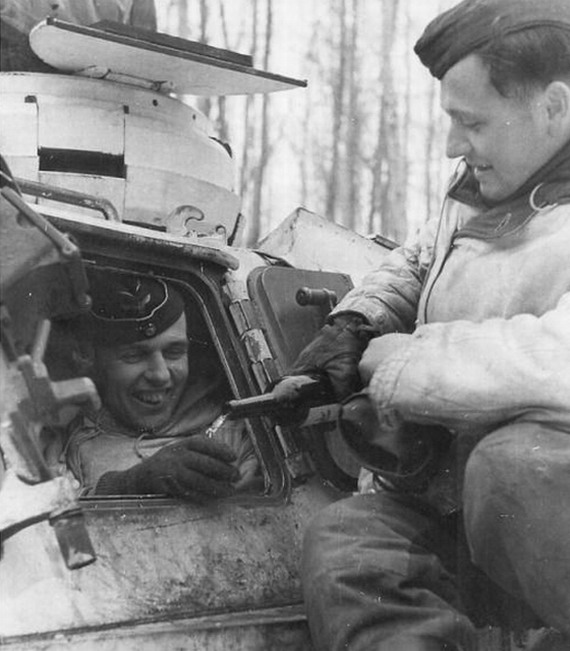
the salon tank Panzer III belonging to Baron Willibald Hans Joachim von Brückenstein; the Baron is having his butler pour him a glass of Château Haut-Brion Grand Cru, vintage 1907, source: Flickr.com with permission of the publishing user, edited
Hermann Leopold August von Oppeln-Bronikowski, Baron Geyr von Schweppenburg, Hans-Karl Freiherr von Esebeck, Wilhelm Ritter von Thoma, Hans-Jürgen von Arnim, Willibald von Langermann und Erlencamp… you may ask what all these men had in common. They were all senior officers of the German armoured forces during the Second World War, and every one of them came from an old, distinguished, and in many cases noble family. And they were far from alone. The German Wehrmacht and Waffen-SS were absolutely teeming with "vons" of every variety. There was even a Prussian prince, Karl Franz (full name Karl Franz Josef Wilhelm Friedrich Eduard Paul), and the son of the Grand Duke of Hesse, Prince Wilhelm Ernst Alexis Hermann — who actually fell in combat on the Eastern Front.
In theory, young men from aristocratic families were equal before the law to ordinary Germans, and their lineage was not supposed to affect their military obligations. As the old saying goes, however, all are equal but some are more equal than others. Hitler was well aware that he could not treat the nobility the same way as common farmers and simply compel their service by force. The great families would not stand for that and might start making trouble. At the same time, Hitler was very keen to have such people serving in the German army, as they lent it a certain aura of chivalry, of nobility, perhaps even of invincibility. The Führer therefore decided to try to attract the German aristocracy into the Wehrmacht not with the stick but with the carrot — and he set his sights specifically on the armoured branch.
Why the armoured branch in particular, you ask? Because noble gentlemen's interest in serving in tanks was by far the lowest of any arm. Aristocratic families generally pride themselves on their long history and their traditions — and that coloured their view of the military accordingly. Noblemen firmly preferred the old and venerable branches of service: infantry, cavalry, and artillery. Sitting astride a horse in a starched uniform and pointing one's sabre to show ten thousand infantrymen which way to charge — now that was the dignified service to the Fatherland that blue-blooded gentlemen were prepared to perform. But tanks? They are ugly, filthy, and they stink. The interior is dark, deafeningly loud, and either freezing cold or suffocatingly hot. If they at least offered the comfort of a carriage or a motorcar, but no — inside everything is cramped, hard, and thoroughly uncomfortable. Absolutely no class whatsoever.
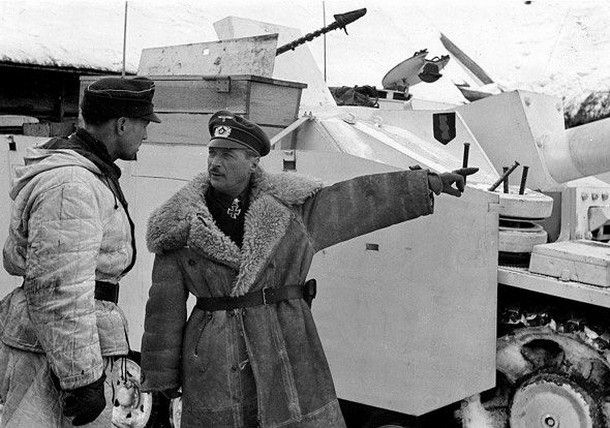
Baron Hyazinth Graf Strachwitz von Groß-Zauche und Camminetz was well known for his passion for luxury furs, and therefore had a wardrobe installed in his salon tank, source: Flickr.com with permission of the publishing user, edited
Hitler, however, regarded tanks as a symbol of the regeneration of the German army and proof of the prowess of German industry. He wanted the armoured branch to serve as a sort of showcase for the Wehrmacht — and he therefore wanted the elite serving in it, aristocrats included. But how to attract noble officers to the tanks? As ever, Hitler was helped by his wily and loyal servant Goebbels. Goebbels correctly understood exactly what kind of men they were dealing with. These were men from the very highest strata of society, from wealthy families, who had mostly been born and raised in grand ancestral seats, castles, and stately homes. They were accustomed to a certain standard, a certain comfort, a certain atmosphere. Ordinary tanks were simply not good enough for these men. If the army wanted to lure them into the armoured branch, it would have to offer them tanks commensurate with their expectations.
It was perfectly common, and not only in Germany, for wealthy officers to procure better equipment at their own expense than the army provided. They had their uniforms tailored, their service pistols engraved with ornate decoration, and they rode on their own expensive saddles. So why not offer fighting vehicles similarly "tailored" to the individual — or more precisely, fighting vehicles with a certain range of premium optional extras, to the taste of their occupant? In this case, of course, at the army's expense. It would cost something, but it might just work. And work it did.
Word soon spread in German aristocratic circles that the army was looking for new officers for the armoured branch and was offering genuinely interesting possibilities for making those ugly tin cans rather more liveable. If a member of a noble family signed up for tank service, he could choose the colours and patterns in which the interior of his tank would be decorated, select from several types of carpet to be laid on the floor of the fighting compartment, and have the interior furnished with additional decorations of his own choosing — subject only to the condition that the decoration in question actually fitted inside and did not endanger the crew.
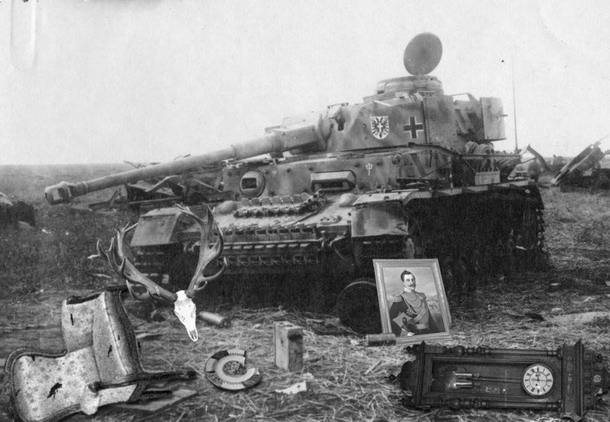
painting family coats of arms on the armour of their salon tanks backfired badly on many noblemen. Soviet soldiers quickly worked out that tanks decorated in this way concealed many valuables and began specifically targeting them. This was the result — an immobilised and thoroughly looted Salonpanzer IV, source: Flickr.com with permission of the publishing user, edited
The interiors of these aristocratic tanks — officially dubbed salon tanks, or in German Salonpanzer — soon abounded with damask upholstery, portraits of ancestors in gilded frames, mirrors, crystal glassware, family coats of arms, coloured curtains, bookshelves, display cabinets for medals, exotic animal furs, chandeliers, and sometimes hunting trophies with antlers on the walls — though antlers were officially prohibited, as their sharp points posed a hazard to the crew. A gramophone occasionally made an appearance aboard as well. The uncomfortable little hard seats were replaced with upholstered armchairs, and Baron von Strachwitz, known for his passion for luxury furs, even had a wardrobe fitted in his command tank, the Panzer III.
Certain specific arrangements also applied to the rest of the crew of such a salon tank. For a start, the nobleman in question could bring his "own" people — trusted retainers, for instance — who after the appropriate training would form the crew of his tank. If he did not bring his own men, soldiers meeting certain criteria were assigned to the crew: completed secondary education with a school-leaving certificate, sound teeth, good standards of personal hygiene, and so forth. Only tank types with a five-man crew were used as aristocratic tanks — initially the Panzer III and Panzer IV, and later the Panther, Tiger, and Königstiger. Only these vehicles allowed the radio operator to be replaced by a butler, who would be continuously at the nobleman's (the tank commander's) disposal. The other crew members were to make themselves available to their noble commander only once all their regular military duties had been attended to.
Some noble gentlemen, however, found this arrangement unsatisfactory. On record, for example, is the complaint of Baron von Kretschmer that the other soldiers constantly pretended to be maintaining the tank, leaving every decent piece of work to fall on the butler alone — who was consequently overwhelmed. As an example, the Baron cites an incident from April 1942: while the butler was engaged in painting a portrait of the Baron after a victorious engagement, he was unable to tend the onions on the stove, which consequently burnt so badly that the resulting chicken-à-la-pheasant was entirely inedible. A cook must unconditionally be added to the crew!
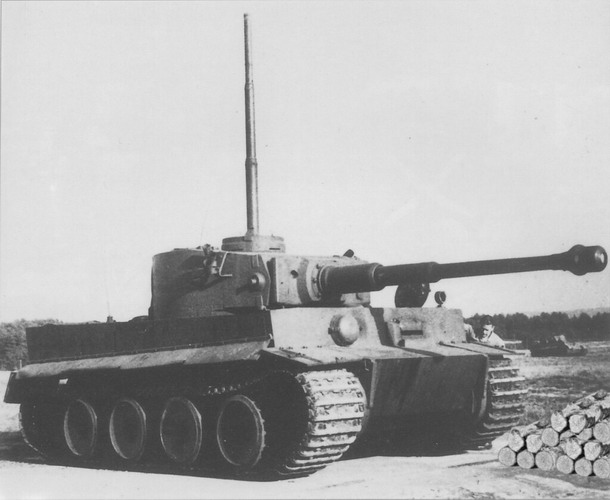
for the right gentlemanly atmosphere and comfort, many aristocrats had fireplaces installed in their Salonpanzers. So it was with this salon Tiger — the chimney is raised and the supply of firewood is ready, source: Flickr.com with permission of the publishing user, edited
The heavier tank types introduced later in the war — particularly the Panther and the Tiger — offered considerably more generous interior space. Aboard their salon versions one could therefore find, as a matter of course, well-stocked minibars with French cognac, smoking tables, coffee machines, grandfather clocks, porcelain tea services, and the like. Certain particularly highly placed noblemen even pushed through the installation of a fireplace. Fitting a fireplace into a fighting vehicle was by no means a trivial undertaking. Particular care had to be taken to insulate the hearth from the fuel tanks and ammunition, and of course to provide for the extraction of smoke from the interior. A chimney was used for this purpose, placed sometimes directly in the roof of the fighting compartment and sometimes above the engine compartment. The installation of fireplaces in tanks was carried out by companies including Haas+Sohn (which, incidentally, continues to manufacture fireplaces to this day). One of their creations can be seen in the photograph above.
Tanks with fireplaces offered a wonderful atmosphere and pleasant warmth in winter months — but they proved to be treacherous. Russian soldiers very quickly discovered that certain special tanks in the German lines were full of luxury goods and valuables. When they noticed that these vehicles often sported chimneys, they began specifically hunting them out and targeting them (the better to loot them afterwards). The only solution was to remove the chimney and fit it only when the fireplace was actually in use, which was typically in areas away from the combat zone. A similarly revealing effect was produced by the family coats of arms which noblemen frequently had painted on the armour of their tanks. After the first unfortunate experiences with this, they soon abandoned the practice.
A shower and a lavatory were also among the most sought-after optional extras. In this case the internal modifications were rather more complex, and obtaining the necessary space required reducing the on-board ammunition stowage. The waste drainage from both the lavatory and the shower presented no great difficulty — everything simply drained straight under the tank. The water supply was more of a challenge, and heating it more so still. If a tank was equipped with a shower, a large boiler was fitted at the rear of the engine compartment, drawing heat directly from the engine to warm the water. Problems arose when the frosts set in: the boiler then had to be either drained or kept continuously heated to prevent the water from freezing. Fuel consumption in salon tanks during the winter months was consequently enormous.
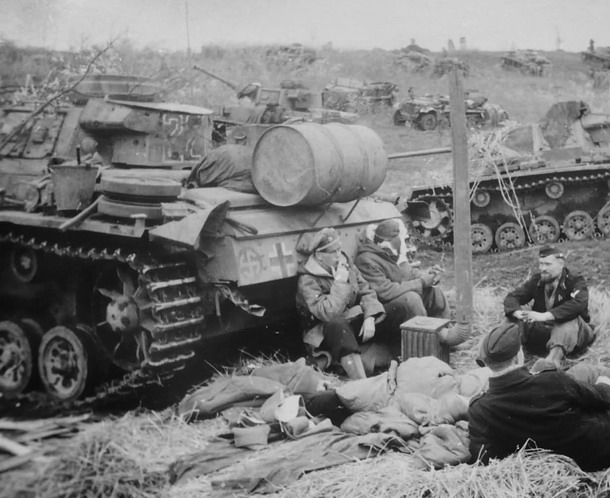
the most sought-after optional extra in salon tanks was undoubtedly the shower — which came with a large hot-water boiler, seen here at the rear of this Salonpanzer III. The noble gentleman is most likely showering at this moment, which is why the rest of the crew is waiting outside. This particular nobleman was evidently not entirely without consideration for his men: he has lent them his portable camp stove, and has even offered at least one of them a cigar, source: Flickr.com with permission of the publishing user, edited
The noble commander of a salon tank required comfort not only on the move and in battle, but also during moments of rest. If he so wished, his tank could be fitted with a folding bed, complete with a light mattress and thinner quilts. When the exhausted aristocrat unfolded his bed, the other crew members naturally had to sleep outside to give him sufficient room — and to avoid disturbing him with their snoring. Sometimes, however, the men had to vacate the tank during the day as well, when the noble gentleman felt like a little afternoon nap after his schnapps.
One might suppose that service aboard such a salon tank was quite an ordeal and that soldiers would not have been exactly queuing up for it. The opposite, in fact, was true. Aristocratic tanks were magnificently supplied with better-quality food, cigarettes, alcohol, and the like. The luxury of the salon tanks also, of course, attracted the local ladies in captured cities far more readily than ordinary tanks did. Moreover, vehicles with a noble commander were not usually sent on the most dangerous combat operations, so their crews' chances of surviving the war were considerably higher than those of regular tank crews. There was certainly no shortage of volunteers for service aboard these vehicles among the rank and file. The posting also offered certain opportunities for modest personal enrichment. Officially it was understood that if the nobleman fell in battle, the premium fittings of his tank would pass to his family. In practice, however, a considerable portion of the equipment had a way of simply disappearing, and the surviving crew members had absolutely no idea how or where. It is hardly surprising that in several cases an investigation was actually launched into whether the deceased nobleman had genuinely been killed by the enemy at all.
As the reader will now appreciate, Goebbels' idea of luxury tanks for the nobility worked. The prospect of creating a personalised little nest, surrounded by luxury, and then going out to harvest laurels and glory on the battlefield appealed to hundreds and thousands of noble gentlemen, who on that account joined the ranks of the German Panzerwaffe. As the war progressed and the situation at the front deteriorated, however, Hitler began to view the aristocrats in his army differently. The prestige and nobility they were supposed to lend it no longer mattered to the Führer. He began instead to focus on the costs associated with converting the salon tanks and keeping them supplied with cognac and cigars. The problems and expenses were, in short, gradually beginning to outweigh the perceived benefits.
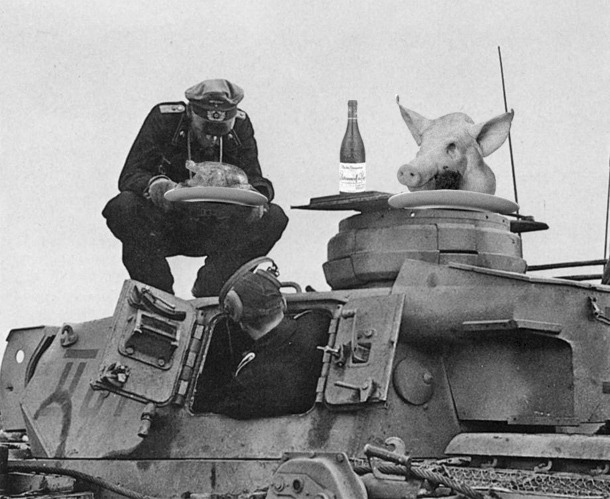
Salonpanzer III — once the Baron has finished listening to Mozart (why else would he be wearing headphones), the butler stands ready to serve the first course of lunch, source: Flickr.com with permission of the publishing user, edited
At the start of 1944 the Führer therefore ordered a significant reduction in the premium supply arrangements for salon tanks. Barons and counts pulled long faces when, instead of French cognac, they had to wet their throats with locally produced alcohol — mostly vodka — and smoke cigars that arrived ever drier and more shrivelled. Sometime in the second half of 1944, the Führer quietly reversed his earlier order shielding salon tanks from the most dangerous missions. He now ordered them sent precisely into the riskiest operations, in order to gradually rid himself of these overpriced warriors. Not a single salon tank survived to the end of the war — which is why no such vehicle can be found in any military museum today. Though in one case it was a very close-run thing, as we shall now explain.
In connection with salon tanks, one further episode deserves mention. At the end of April 1943, near Djebel Djaffa in Tunisia, British forces succeeded in disabling a heavy tank of the Tiger type, bearing the turret number 131. Although this swiftly became a matter of state secrecy, we now know for certain that this was a salon tank belonging to Count Karl Balthasar von Neukirchen und Kaunitz. The intriguing vehicle naturally attracted well-deserved attention from its captors, and word of it quickly reached the very highest levels of the British monarchy, up to and including King George VI himself. Despite the efforts of Prime Minister Winston Churchill to prevent it, the King personally travelled to Tunisia in June 1943 to see with his own eyes what such a gentleman's tank looked like. Churchill therefore at least joined the trip, in the hope of preventing the worst.
Exactly as Churchill had feared, George VI was utterly enchanted by the salon tank and immediately began wondering whether something similar might be introduced in the British army as well. After all, the British aristocracy was considerably larger than the German one, and its members surely deserved fighting vehicles befitting their station. The pragmatic Churchill could calculate all too well how financially ruinous this little German joke called the Salonpanzer must be for Hitler, and he shuddered at the thought of the British military budget having to set aside a similarly handsome round sum for such extravagance. The army needs money for fighters, bombers, ships, and proper tanks — it cannot be squandering funds on such "debaucheries"! But how to convince a king who was already asking the officers present whether there was room in such a tank for a jewellery box?
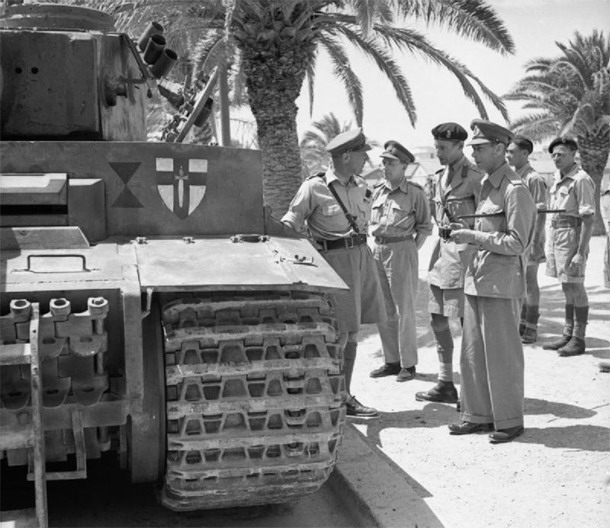
King George VI of Great Britain came in person to Tunisia to inspect the captured Salonpanzer Tiger; the family coat of arms of Count Karl Balthasar von Neukirchen und Kaunitz is clearly visible on the vehicle's front plate, source: Flickr.com with permission of the publishing user, edited
The Prime Minister therefore took the King aside and, over a cup of tea, steered the conversation into what appeared to be a casual discussion of how severely the war had disrupted the supply of luxury goods to Britain. French wines, Caribbean rum, fine tobacco, exotic fruits, spices, Oriental fabrics and carpets — all were available in far smaller quantities than before the war, and the aristocracy was suffering. "And now, Your Majesty, just imagine," Churchill said, suddenly grave, "that half of all these precious things would have to be dispatched to the front as part of the supply arrangements for aristocratic tanks! And more alarming still is the thought that some of these treasures might then actually fall into enemy hands, should the enemy succeed in capturing a few such tanks!" No further elaboration was needed. The two statesmen concluded a gentlemen's agreement that day in Tunisia: the existence of the German salon tanks was to become a state secret. The captured Tiger number 131 was stripped of all its premium fittings and shipped to England as an essentially ordinary tank. That vehicle can be seen today in the museum at Bovington. A pity — it could have been the sole surviving example of a Salonpanzer, but history, alas, had other ideas.
1st April 2023, HAPPY APRIL FOOLS' DAY!

Reproducing text from the Panzernet website without the written consent of the operator is prohibited.