KOMSOMOLEC
an artillery tractor with a builder's name
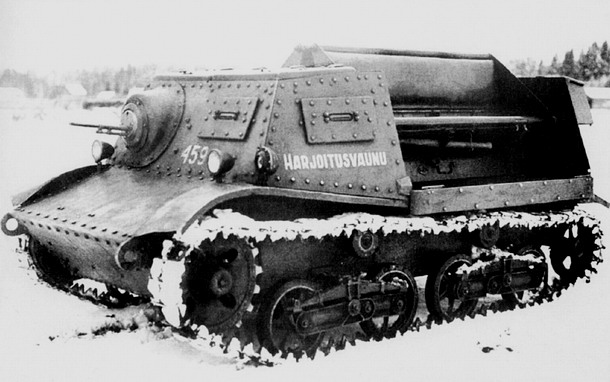
Komsomolec tractor captured by the Finnish Army, source: Waralbum.ru with permission of the operator, edited
Origins
In the mid-1930s the Red Army called for the development and production of a light fully tracked artillery tractor that would surpass the limited capabilities of the horse teams then in common use, in terms of power, speed and cross-country mobility. Two principal factors drove this decision. The first was the steadily increasing weight of artillery systems — not only of the guns themselves but of the ammunition loads being carried. Horse teams were simply no longer adequate for the task. The second was the growing importance of anti-tank artillery, which by its very nature operated directly on the front line and was therefore exposed to enemy fire — an environment in which horses were far too vulnerable.
The vehicle was intended primarily to tow the Model 1930 37 mm anti-tank gun, the Model 1932 45 mm anti-tank gun and the Model 1927 76.2 mm regimental gun. It had to be light, fast and capable of crossing the same terrain as tanks — which made it self-evident that it would need to be fully tracked.
The Soviet industry's first response to the army's requirement came in 1935 with the Pionyer tractor, based on components of the T-37 tank. This vehicle failed to meet army expectations, however, as it was too unstable, underpowered, and offered very little room for the gun crew being transported. At the end of 1936, therefore, designers at Moscow Factory No. 37 under the leadership of N. A. Astrov developed a new tractor, the T-20 Komsomolec — factory designation 020 or A-20.
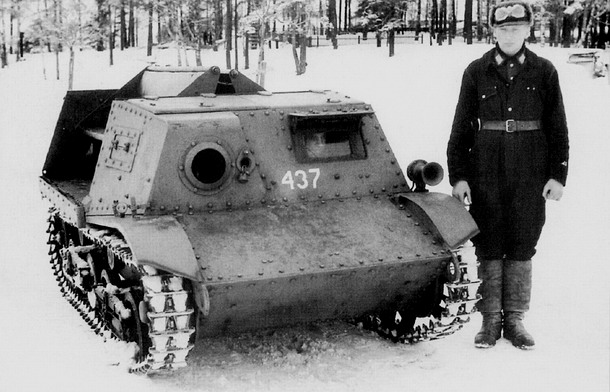
Komsomolec, first production variant — note the different design of the right side of the front wall, source: Aviarmor.net with permission of the operator, edited
Design Description
The Komsomolec incorporated a large number of parts from the newer T-38 light tank — including gearbox components, tracks, road wheels, track return rollers and more. The running gear on each side consisted of a front toothed drive sprocket with four lightening holes, four road wheels paired and suspended in two bogie assemblies (spoked wheels with rubber tyres), and a rear idler wheel of the same design as the road wheels. Two return rollers supported the track from above.
The hull was constructed from steel plates 7 to 10 mm thick, joined by welding and riveting. The nose of the hull was formed by two sharply sloped plates; the upper one carried two headlights and was flanked by the track mudguards. The cab front wall rose from the upper nose plate. Behind it sat the only two permanent crew members — the driver and the commander. The driver sat on the left and looked out through a rectangular aperture in the wall ahead of him, closed by a single-piece cover with a vision slit. In calm conditions the driver could open the cover entirely for a better view; in danger he would close it and use only the slit. Two further vision ports of the same design were in the side walls of the cab.
The commander sat on the right and also served as machine gunner, operating a DT machine gun of 7.62 mm calibre mounted in a flexible ball mount in front of his seat — the tractor's only integral armament. The commander's position was equipped with a full set of driving controls, allowing him to take over the vehicle if the driver was wounded or killed. Both crew members entered and exited through their own individual hatches in the roof above their stations. The fully enclosed cab and the provision of a weapon represented a significant improvement over the earlier, unsuccessful Pionyer tractor.
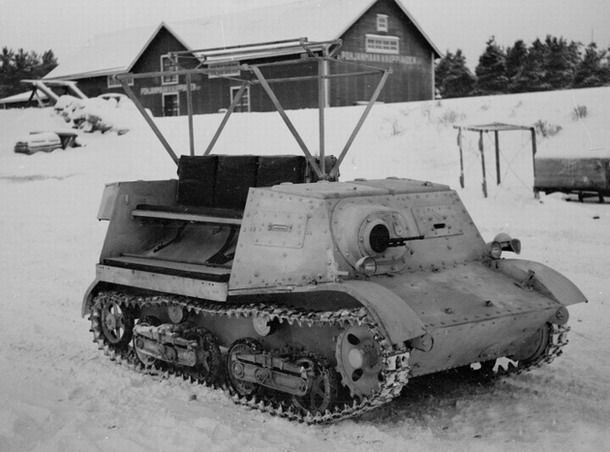
Komsomolec with canvas frame erected, source: Waralbum.ru with permission of the operator, edited
Behind the cab were two rows of seats for the gun crew, three places on each side. The soldiers sat sideways to the direction of travel, facing away from each other. In bad weather or on longer moves, a frame could be erected over this area and a waterproof canvas cover hung from it, creating a tent-like shelter — even fitted with small windows for visibility. With the canvas up, the vehicle's height increased from its standard 1.58 m to 2.23 m. The seat blocks could be rearranged to create a cargo space at the rear, allowing the Komsomolec to carry up to 500 kg of supplies instead of six soldiers.
The tractor's total weight was 3,460 kg. The powerplant was a four-cylinder GAZ-M1 engine with a maximum output of 50 hp. The gearbox provided four forward speeds and one reverse. An additional reduction gearbox, taken from the GAZ-AAA truck, gave the Komsomolec two operating ranges — high speed and high torque. In the lowest torque setting it could tow loads of up to 3,000 kg, though only at 2 to 2.5 km/h.
The fuel tank held 115 litres, sufficient for approximately 150 km of road travel — less cross-country, as one would expect. The maximum speed the Komsomolec could achieve on a road was a respectable 47.5 km/h. Average towing speed, however, was only around 15 to 20 km/h on roads, dropping to 8 to 11 km/h cross-country. These figures nonetheless fully met expectations. The tractor could cross a 1.4-metre wide trench and climb a slope of up to 30°.
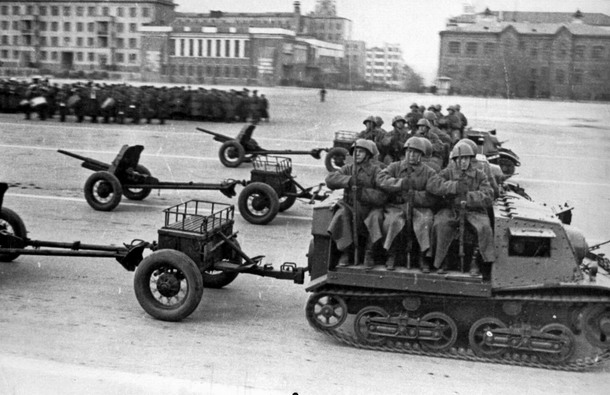
Komsomolec tractors towing guns during a parade, source: Aviarmor.net with permission of the operator, edited
Army trials of the Komsomolec ran from August to November 1937. Although the tests revealed certain shortcomings, the overall results were positive, and after the identified deficiencies were corrected the vehicle was approved for series production — which began before the end of 1937. The Komsomolec was manufactured at Moscow Factory No. 37, with components also produced in Gorky and Stalingrad.
Production continued until July 1941, when it was discontinued for obvious reasons and the factory's capacity was redirected to the far more urgently needed light tanks. A total of 7,780 vehicles were built. Several design changes were introduced during the production run, giving rise to three distinct basic models of the T-20, which differ in various details — though the most easily identifiable difference in photographs is the design of the front armour panel in front of the commander's position.
On the earliest vehicles the armour on the right side protruded forward, forming a stepped section with angular sides, in which the machine gun was mounted in a flexible ball mount. On the later variant the front armour was flat, with a rounded circular collar riveted onto it, the machine gun ball mount located at its centre. The final and most numerous model likewise had a riveted collar on a flat front plate, but this time the collar was oval rather than circular when viewed from the front — the machine gun was installed on the right side of the oval, with an aiming port to the left.
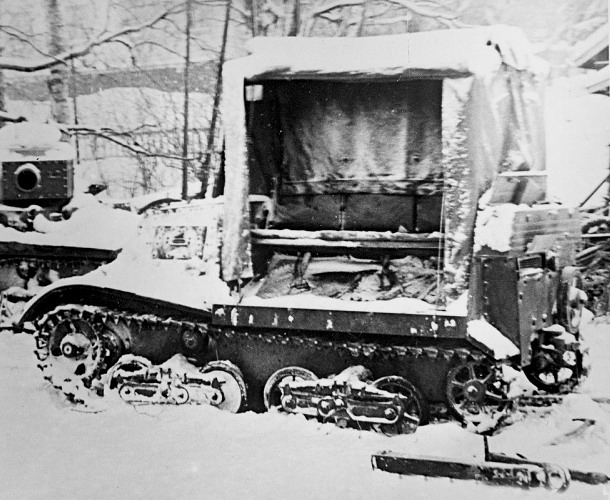
wreck of a Komsomolec tractor with canvas frame still erected, source: Waralbum.ru with permission of the operator, edited
The Komsomolec was well received in the Red Army and served until 1945. Enormous losses, however, steadily reduced its numbers, and only just over 500 examples survived to see the end of World War II. The high attrition rate was partly due to the Soviets occasionally deploying them directly in combat as machine-gun "tanks" out of desperation. Captured examples were also used by the Germans and Finns. In German service the T-20 was designated Gepanzerter Artillerie Schlepper 630(r), where the letter "r" indicated its origin — russisch (Russian).
The Komsomolec also served as the basis for two conversions into self-propelled anti-tank guns. The first was carried out by the Soviets themselves: in 1941 they mounted a 57 mm ZIS-2 gun on the T-20 chassis, driven by the desperate shortage of self-propelled weapons for combating German armour. The resulting vehicle, designated ZIS-30, is described in a dedicated section of this website. The second conversion was the work of the Germans, who fitted a number of captured tractors with the light 37 mm PaK 36 anti-tank gun.

ARTICLE
CONTENTS:
Reproducing text from the Tankist website without the written consent of the operator is prohibited.