ZIS-30
a tank destroyer born of necessity
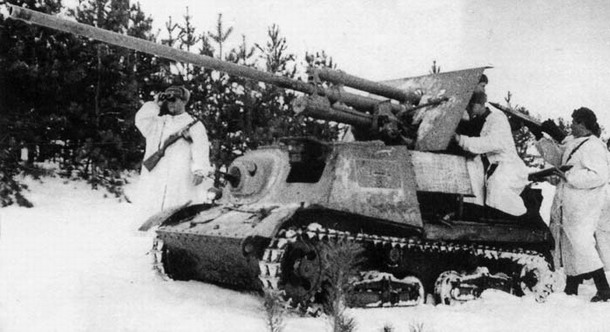
ZIS-30, source: Aviarmor.net with permission of the operator, edited
Origins
Within the very first weeks after the invasion of the Soviet Union, Red Army losses began to climb to staggering proportions — not only in infantry but in armoured vehicles as well. Already in July 1941 the responsible Soviet authorities were forced to consider how this trend could be reversed. The result was an order from the People's Commissar of Armaments for the urgent development of self-propelled anti-tank guns capable of stopping the flood of German armour. Designers were given a truly punishing deadline: just two weeks.
The original intention had been to mount these guns on wheeled truck chassis, most likely to save time in development and production. The design team from Factory No. 92, headed by P. F. Muravyev, was also working to fulfil this order and drew up proposals for two self-propelled anti-tank guns designated ZIS-30 and ZIS-31. The ZIS-31 followed the brief exactly — it was built on the wheeled chassis of a GAZ-AAA truck and armed with a 57 mm gun. The second vehicle, the ZIS-30, was however built on the fully tracked artillery tractor T-20 (also known as the A-20 and widely referred to by the name Komsomolec).
Military trials showed that the original wheeled-chassis requirement had been misguided. The ZIS-31 prototype struggled with rougher terrain and the chassis coped very poorly with the recoil forces generated by the gun. The ZIS-30 on its tracked base proved clearly superior. The Komsomolec was a light artillery tractor that in its original form was used to tow guns and transport infantry, manufactured by Moscow Factory No. 37. By the time the ZIS-30 was being designed, however, that factory had already ceased tractor production and switched to building the far more urgently needed tanks. The ZIS-30 prototype therefore had to be built around a used Komsomolec withdrawn from a front-line unit.
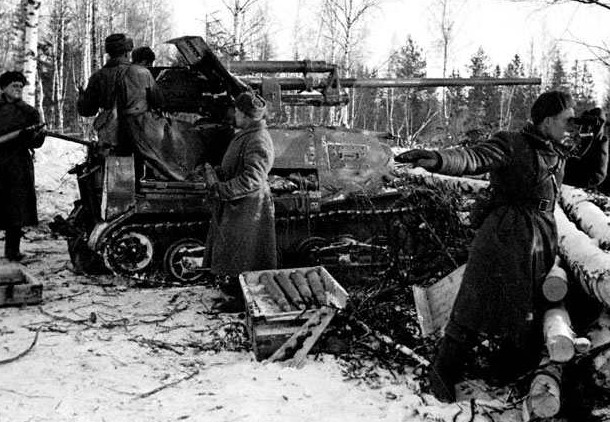
ZIS-30 in action, source: Aviarmor.net with permission of the operator, edited
Design Description
Converting the tractor into a self-propelled gun was not a complicated task — as the record-breaking development time itself suggests. The chassis and cab were left unchanged. Behind the cab, in the space that on a standard tractor was used to carry troops, a platform was built and on it the 57 mm ZIS-2 gun was mounted. The gun was served by two men — a loader and a gunner, seated one on each side of the weapon. The gun crew had virtually no protection whatsoever. Low steel plates were fitted along the sides of the platform, but these offered no meaningful protection at all — and in any case they were folded outward before firing to avoid obstructing the gunners. The only sensible protection available to the crew was the gun's own frontal shield.
The gun mounting had only limited traverse, meaning the driver had to reposition the entire vehicle for any significant change of target. The vehicle's compact dimensions allowed only a minimal ammunition load to be carried on board, so in practice a support vehicle carrying additional rounds was expected to accompany it. The small chassis also created another problem: the vehicle was insufficiently stable when firing, making it necessary to fit two fold-down support legs at the rear.
After accelerated trials of the prototype, series production of the ZIS-30 was approved and began on 21 September 1941 — and it ran at full capacity, with 101 self-propelled guns rolling off the production lines by 15 October. The Soviets pulled off a genuinely remarkable feat that somewhat challenges the widespread image of Soviet inflexibility: from the issuing of the order, through design, construction and prototype testing, to the completion of the first hundred new vehicles, barely three and a half months had passed. It must be said, however, that the end result reflected this in more ways than one.
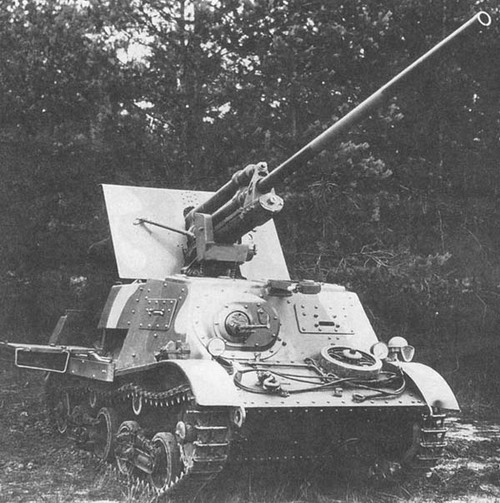
ZIS-30, source: Topwar.ru with permission of the operator, edited
The vehicle was only minimally armoured, had a limited operational range, was unstable, and communication between the driver and the gun crew was very difficult. Despite all this, the ZIS-30 was a welcome addition to the fight against German armour at the time. During the production period several proposals were made to replace the armament, and prototypes with 45 mm and 76 mm guns were tested in turn — but neither made it into production. The series-production ZIS-30s served with Red Army tank brigades until the summer of 1942.

ARTICLE
CONTENTS:
Reproducing text from the Tankist website without the written consent of the operator is prohibited.