TANK T-37
amphibious reconnaissance tank
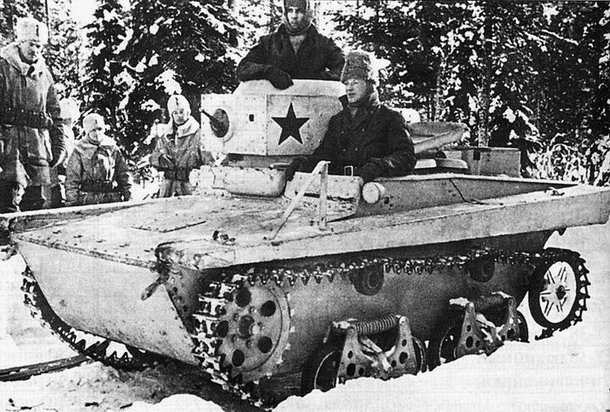
T-37 tank in Finland during the Winter War, source: Aviarmor.net with permission, edited
Origins of the Tank
In the early 1930s, when the Red Army was searching for a light amphibious tank to carry out reconnaissance tasks, its attention fell on the British Carden-Loyd amphibious design. In 1932 the Russians purchased eight examples of these tanks and began working on their own version. Two factories and their design teams worked simultaneously on two competing prototypes, designated T-33 and T-41. After both failed their trials, however, the two teams merged their efforts and continued work on a single combined design. Their creation passed army testing, and on 11 August 1933 it was approved for series production under the official designation T-37.
It might seem that developing the T-37 was a straightforward matter of simply copying the British vehicle — but the designers' task was in fact considerably more challenging than that. The army specification required that as many already-manufactured automotive components as possible be used in the new tank, including the engine. The goal was clear: keep production costs as low as possible. The designers were therefore effectively building a tank around a pre-determined engine and other given components, and had to adapt the entire vehicle design accordingly.
Technical Description
The tank's running gear was very similar to its British model. On each side it consisted of four small spoked road wheels with rubber tyres around the rim. The road wheels were paired in bogies — the front two and the rear two on each side were linked together. The drive sprocket was at the front: a toothed wheel with five circular lightening holes. At the very rear was the spoked idler wheel. Both the drive sprocket and the idler were raised above the level of the road wheels. The upper run of the track rested on two small return rollers that guided it back to the driven front sprocket.
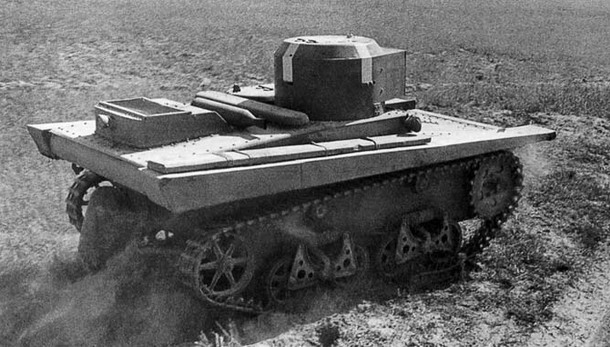
T-37 tank, source: Aviarmor.net with permission, edited
The hull was constructed from steel plates joined primarily by riveting. Armour thickness was 9 mm at the front and sides and 6 mm at the rear. The hull shape was entirely designed for swimming and was essentially boat-like in form. The hull roof rose gently from the bow to approximately one third of the vehicle's length, where the front wall of the crew fighting compartment began. This was followed by a flat section, in the right half of which sat the tank's fully rotating turret.
The rear section housed the engine compartment, whose roof plate sloped gradually toward the hull rear. Rising from its centre, however, was a rectangular frame that was open at the top and protected only by a grille. The opening in this frame served as the air intake and provided maintenance access to the engine. Its raised position was intended to prevent water entering the engine during swimming. Alongside the frame, on the engine deck, was the exhaust pipe, mounted perpendicular to the vehicle's centreline — both the frame and the exhaust are clearly visible in the photograph above.
The manually traversed turret was positioned asymmetrically to the right of the vehicle's centreline. It was shaped as a circular tube from which a flat front plate projected forward. In this plate was mounted the tank's sole weapon, a 7.62 mm DT machine gun. The gun mount was not centred in the front turret wall but offset slightly to the right, with the gunner's vision port to its left. The turret roof tapered conically to a circular hatch. Ammunition stowage for the machine gun was 2,142 rounds.
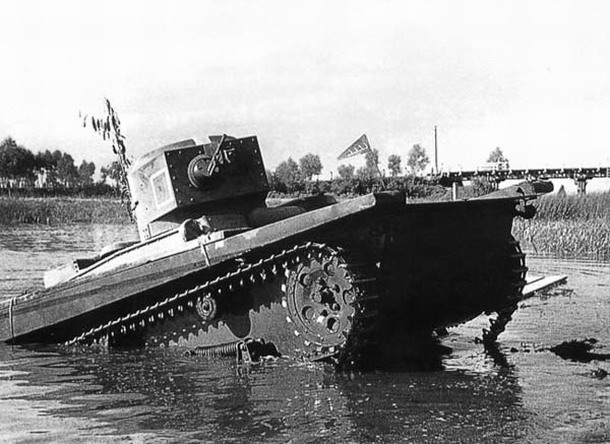
T-37 driving out onto the bank, source: Aviarmor.net with permission, edited
The crew consisted of two men. The driver sat in the hull to the left of the turret, observing through a larger vision port in the wall in front of him and a smaller one in the left side wall. He entered and exited through his own hatch in the hull roof directly above his seat, closed by a single-piece cover that hinged rearward. The second crew member was the commander, who simultaneously served as machine gunner and loader. His station was of course in the turret, where four small vision ports — one forward, one rearward, and one on each side — gave him all-round observation. The commander entered and exited through the turret roof hatch, also closed by a single-piece cover hinged to the rear.
The engine had been specified from the outset: the GAZ-AA automotive unit of 3.3 litres displacement, producing a modest maximum of 40 horsepower. The tank's low speed matched the engine's limited output, reaching a maximum of 35 km/h on a road. The engine and gearbox were housed in the rear of the hull and connected to the front drive sprockets by a driveshaft. The gearbox offered four forward gears and one reverse. Drive could be switched from the wheels to a propeller for swimming. The three-bladed propeller was positioned in the centre of the rear hull wall and drove the tank through the water, with a small rudder in front of it for steering. The engine's modest output imposed strict limits on the tank's maximum weight and consequently on its armour thickness — though weight was critical for another reason too: the vehicle had to stay afloat.
Several design changes were introduced during the production run. The original curved frontal armour plate in front of the driver's position was replaced by a simpler flat plate that was easier to manufacture. On later tanks the original flat mudguards were replaced by taller hollow ones that served as additional buoyancy floats. The turret design also changed: early vehicles had a conically tapering turret roof, while later tanks had a turret with a flat roof that was only sloped at the front.
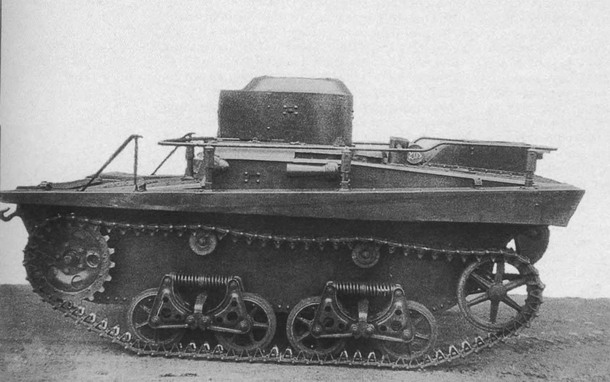
command T-37-TU — note the frame antenna, source: Aviarmor.net with permission, edited
The T-37 was not fitted with a radio as standard. Crew members communicated directly with each other, while communication with other tanks was handled using signal flags — a responsibility that fell to the tank commander. To signal, he had to lean half out of the turret hatch so as to be clearly visible. It is obvious that this kind of communication was completely impractical under combat conditions. Radios were fitted only to vehicles assigned to commanders — a 71-TK-1 type set. Command vehicles can be identified by the frame antenna mounted on struts around the raised section of the hull. These command vehicles were designated T-37-TU, and a total of 643 were built.
Modified Variants
In 1934, trials were conducted of a flame-thrower variant of the T-37, designated OT-37. It was not particularly successful: the on-board supply of incendiary fuel was a mere 36 litres and the effective range was only around 25 metres. Despite this, 75 examples were produced between 1935 and 1936. Another interesting conversion of the T-37 was a remote-controlled demolition carrier. The vehicle carried no crew and was controlled by radio from another tank. Once guided to its target, the explosive charge on board was detonated remotely, destroying the vehicle in the process. Only a very small number of these were ever built.
The most remarkable modification of the tank was probably one developed in 1935: its adaptation as an airborne vehicle. The tank was suspended beneath the fuselage of a TB-3 heavy bomber using quick-release attachments operable from the bomber's cockpit. Tests of the airborne release were conducted over lakes near Moscow. In the first two attempts the impact with the water surface punched through the tank's floor and both vehicles sank — fortunately with no crew on board. Although the Soviets later found a way to release the tank safely during a low-angle approach, they abandoned further experiments in this area. One likely reason was the rather awkward crew arrangement: it was not safe to be inside the tank during the water impact, so the plan called for the bomber to land on the bank after releasing the tank and drop off the crew, who would then climb into the vehicle. (What was to happen if there was no suitable bank nearby, or how exactly the crew was supposed to reach a tank floating on the water possibly dozens of metres from shore, I was unable to determine.)
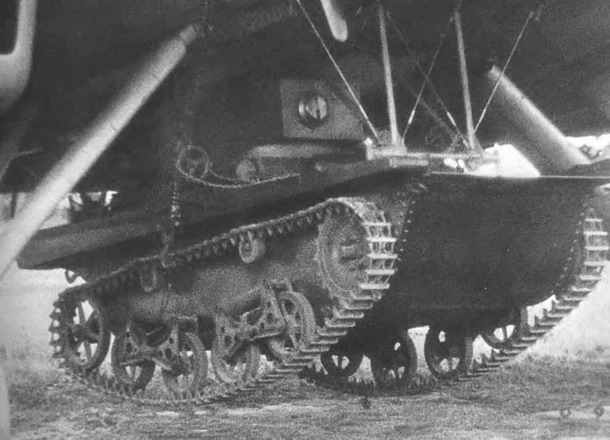
T-37 suspended beneath a TB-3 bomber, source: Aviarmor.net with permission, edited
Series production of the T-37 ran from 1933 to 1936 and yielded a total of 2,627 vehicles. Tanks began reaching combat units from 1933, replacing the older T-27.
Combat Deployment
T-37s were committed to combat during the Soviet invasion of Poland in September 1939. Even then it was becoming clear that the tank was incapable of performing the tasks that modern warfare demanded of it. The Polish army, however, lacked modern anti-tank weapons and tactics. The Finnish Army proved a far harder opponent. During the Winter War the Soviets suffered heavy losses in armoured vehicles, including this type. The Finns captured several dozen T-37s during the fighting and used them until 1944. Operation Barbarossa effectively ended the T-37's combat career — the tank was hopelessly outclassed by modern German opponents, and very quickly began to be withdrawn from frontline units to second-line service.
The T-37 suffered from a range of shortcomings that made it unpopular with its crews. It carried no artillery weapon and could therefore only effectively engage enemy infantry. Its armour matched that limitation — it was capable of withstanding small arms fire at best. The vehicle was fairly unreliable and had notoriously poor brakes. A design flaw allowed water to enter the brake mechanisms during swimming, after which the brakes would fail entirely and the tank became uncontrollable. The opposite problem also occurred — brakes seizing and refusing to release. This fault was experienced first-hand by one of the tank's designers, Astrov, when a seized brake nearly cost him his life during a test drive. The tank's high centre of gravity had a detrimental effect on its stability across uneven terrain. All in all, the T-37 must be counted among the less successful of Soviet tank designs.
Technical Specifications
Weight |
3.2 t |
Length |
3.75 m |
Width |
2.10 m |
Height |
1.82 m |
Engine |
GAZ-AA |
Maximum output |
40 hp |
Maximum speed |
35 km/h on road 7 km/h on water |
Fuel capacity |
100 l |
Range – road |
185 km |
Range – cross-country |
115 km |
Turret armour |
6 mm |
Hull armour |
6–9 mm |
Armament |
1 x 7.62 mm DT machine gun |
Crew |
2 men |

ARTICLE
CONTENTS:
Reproducing text from the Tankist website without the written consent of the operator is prohibited.