PIONYER
the little one that failed to impress
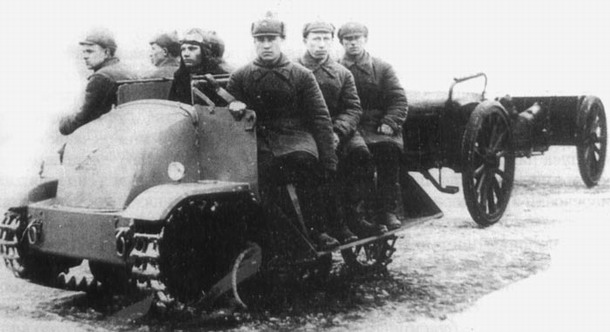
fully loaded Pionyer tractor, source: Aviarmor.net with permission of the operator, edited
Origins
In the mid-1930s the Red Army called for the development and production of a light artillery tractor that would surpass the limited capabilities of the horse teams then in common use, in terms of power, speed and cross-country mobility. Two principal factors drove this decision. The first was the steadily increasing weight of artillery systems — not only of the guns themselves but of the ammunition loads being carried. Horse teams were simply no longer adequate for the task. The second was the growing importance of anti-tank artillery, which by its very nature operated directly on the front line and was therefore exposed to enemy fire — an environment in which horses were far too vulnerable.
The vehicle was intended primarily to tow the Model 1930 37 mm anti-tank gun, the Model 1932 45 mm anti-tank gun and the Model 1927 76.2 mm regimental gun. It had to be light, fast and capable of crossing the same terrain as tanks — which made it self-evident that it would need to be fully tracked.
Designers at the Scientific Automobile and Tractor Institute (Nauchny Avtotraktorniy Institut — NATI), led by A. S. Shcheglov, built the Pionyer tractor in 1935 to meet the army's specification. The tractor used a large number of components from the already-produced T-37 light tank — most notably the powerplant, gearbox, road wheels with their bogie assemblies and tracks.
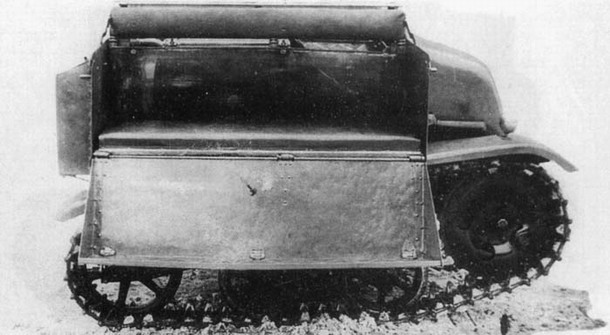
side view of the Pionyer tractor — it is almost unbelievable that seven soldiers could fit on this vehicle, source: Flickr.com, Public domain, edited
Design Description
The running gear on each side consisted of just two road wheels, of spoked design, both mounted in a single bogie that provided their suspension and springing. At the front was a large-diameter toothed drive sprocket fitted with circular lightening holes. At the rear was a large spoked idler wheel with its own separate spring.
At the front of the vehicle the hull formed a pronounced rounded nose. Track mudguards ran along its sides, with headlights mounted on them. The driver sat behind the front bonnet. Along the sides of the vehicle were seats for the six-man gun crew being transported, three on each side, seated with their backs to the vehicle's centreline and sideways to the direction of travel.
The Pionyer's powerplant was a GAZ-AA engine delivering a maximum of 40 hp. The 1.5-tonne vehicle could reach an impressive unladen speed of 50 km/h. The Pionyer had no integral armament and no meaningful armour protection — though neither of these would in itself have been a fatal shortcoming. Far more significant was the vehicle's serious instability, a consequence of its short length and narrow width. The automotive engine was also not designed for service in a tracked vehicle or for towing heavy loads. Despite all this, the tractor was approved for series production, which began at Moscow Factory No. 37 in 1936 and continued into the following year. A total of 50 vehicles were built.
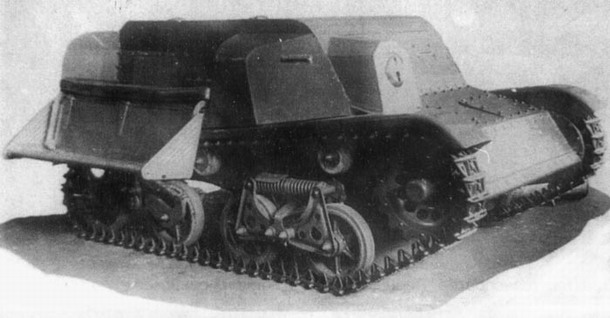
prototype of the Pionyer B1 tractor, source: Aviarmor.net with permission of the operator, edited
Variants B1 and B2
The army's reaction to the introduction of the Pionyer was far from enthusiastic — weak engine, poor stability, inadequate space for the troops being transported and no crew protection whatsoever. The designers at NATI attempted to address at least some of these failings and drew up two new armoured variants, generally referred to as Pionyer B1 and Pionyer B2, which differed from each other in various details of their chassis and hull construction.
The modernised variants featured fully enclosed armoured cabs and even a built-in machine gun. Both were also built on a lengthened chassis with three road wheels on each side instead of the original two. The new prototypes were an improvement on the original production vehicles, but they never entered production — the Pionyer was superseded by an entirely new tractor, the Komsomolec.

ARTICLE
CONTENTS:
Reproducing text from the Tankist website without the written consent of the operator is prohibited.