BA-11
armoured car on the ZIS-6 chassis
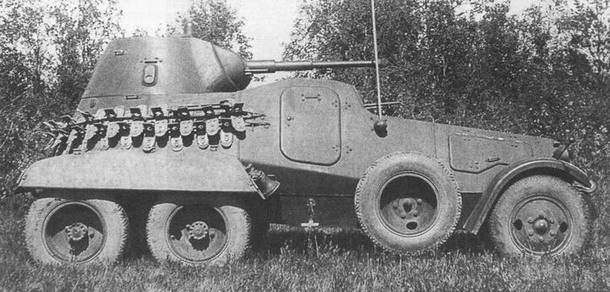
BA-11 armoured car, source: Wikimedia, Public domain, edited
Origins of the Vehicle
In the late 1930s, designers at the Moscow ZiS Factory (Zavod imeni Stalina — the Stalin Factory) were working on a new medium armoured car based on the ZIS-6 truck chassis. The idea of using this chassis for an armoured vehicle was not entirely new — as early as 1935 the same Moscow factory had produced the BA-5 prototype. That vehicle had failed its army trials, but development work continued.
The decision to build the new vehicle was taken at the end of 1937, though most of the actual work was carried out during 1938. In order to speed up development it was decided that the Moscow factory would prepare the chassis while work on the hull would proceed in parallel at the Izhora Factory in Leningrad. The vehicle design was completed in May 1938 and a full-scale wooden mock-up was finished in August of the same year. On the basis of the technical drawings and the mock-up, army officials approved the construction of a verification prototype, which was to be ready by 1 December 1938. This deadline was missed by a considerable margin.
The first chassis was not completed at the Moscow factory until 20 December. At the start of 1939 the chassis underwent test drives covering a total of 887 km, after which it was finally sent to the Leningrad factory in March 1939 for the hull to be fitted. The prototype was completed there and underwent further trials from May to September 1939, during which it covered more than four thousand kilometres on roads, tracks and open terrain.
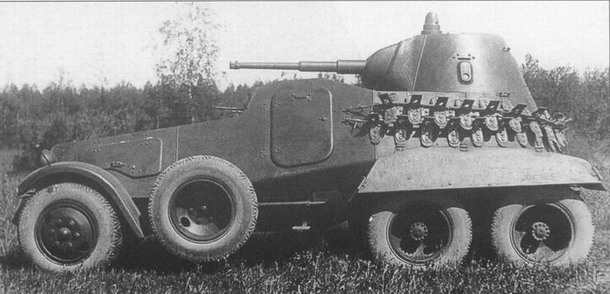
BA-11 armoured car, source: Wikimedia, Public domain, edited
Description of the Design
The BA-11, as the new vehicle was officially designated (BA standing for "Bronevoy avtomobil"), was built on the ZIS-6 truck chassis mentioned above. The chassis had, however, been shortened by more than 60 cm compared to the original truck. The leaf springs were strengthened and a number of smaller modifications were made to the steering mechanism, differentials, brakes and so on. The chassis had three axles, with the two rear ones driven and the front one steerable. The rear axle wheels were doubled, giving the vehicle a total of ten wheels. Two spare wheels were also carried on the sides of the hull, mounted so that they could rotate freely, helping the vehicle navigate difficult terrain that might otherwise cause chassis damage or leave it stuck. As with other Soviet vehicles of the period, the BA-11 was also equipped with light tracks that could be fitted over the wheels of the two rear axles when needed. Otherwise the tracks were carried slung on the sides and rear of the hull.
The hull was built from steel plates ranging from 6 to 13 mm in thickness. The main plates were joined by welding, while certain internal fittings such as door and hatch hinges were attached by rivets. In its basic layout the BA-11 hull was essentially the same as that of the series armoured cars of the BA-3, BA-6, BA-9 and BA-10 families. Compared to all of those vehicles, however, the walls were more steeply angled, giving better resistance to enemy fire. The engine compartment occupied the front. From the narrow front plate the hull widened towards the rear before opening into the crew cabin. On the sides of the engine compartment were large openings for service access to the powerplant. The prototype's front plate had two elongated, horizontally oriented air intake openings; on later production vehicles these two openings were replaced by a single large opening fitted with louvres.
In the cabin sat the driver and the radio operator/machine gunner side by side. The driver occupied the left-hand seat, as was customary, and looked out through a vision port that could be closed with an armoured cover in dangerous situations, leaving only a slit for observation. A hull-mounted DT machine gun of 7.62 mm calibre was installed on the right. The driver and radio operator each used their own door in the side walls of the hull to enter and exit. The doors were also fitted with observation slits.
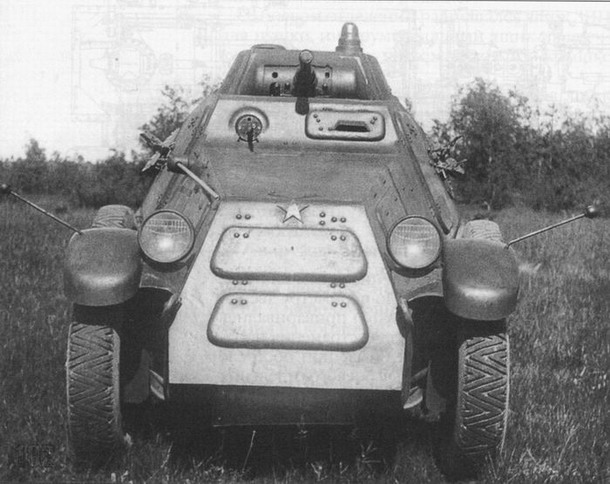
front plate of the BA-11 armoured car prototype, source: Wikimedia, Public domain, edited
At the rear of the hull was a conical turret. The main armament, a 45 mm cannon, was mounted in the turret's front wall, with a second DT machine gun of 7.62 mm to its right. Ammunition stowage amounted to 114 rounds for the cannon and 3,087 rounds for the machine guns. Twenty F-1 hand grenades were also carried on board. The entire rear half of the turret roof was occupied by a large semicircular hatch through which the two turret crew members entered and exited. A telescopic periscope and a cabin ventilator fan emerged from the front section of the turret roof. Both side walls of the turret featured slit vision ports and closable pistol ports for firing personal weapons; a further pistol port was also provided in the rear wall. The turret housed two of the vehicle's four-man crew — the loader and the commander, who also served as the cannon gunner.
Internal communications were handled by a TPU-2 intercom system, to which only the driver and the commander were connected. External communications were provided by a 71-TK-1 radio set, whose whip antenna was mounted on the right side of the hull at roughly the point where the engine bonnet met the crew cabin. The antenna could be folded forward towards the nose of the vehicle when required. Production BA-11s were powered by ZIS-16 petrol engines developing 99 hp. The first prototype, however, was still fitted with the weaker ZIS-5 engine producing a maximum of 73 hp at 2,600 rpm — and testing of the prototype generated, among other requirements, the demand for a more powerful powerplant.
The prototype's test results were not spectacular, but were broadly positive overall. The new vehicle did lag behind the BA-10 in manoeuvrability, both because of its greater length and because of the heavier load on the front axle, which made steering more demanding. The BA-11 also failed to solve the long-standing problem of Soviet heavy armoured cars — the tendency of the engine to overheat. Despite this, an initial production run of 15 vehicles was ordered in December 1939, to be delivered by April 1940. Production proceeded slowly, however, and the first batch was not completed until the summer of that year. The production vehicles were fitted with the more powerful ZIS-16 engines, which allowed them to reach 62 km/h on the road. Their combat weight was 8.13 tonnes. With a fuel supply of 150 litres the vehicle could cover up to 320 km on road and approximately 180 km off-road. The army selected three of the delivered vehicles for intensive further testing, and in November 1940 the final decision was taken not to continue production.
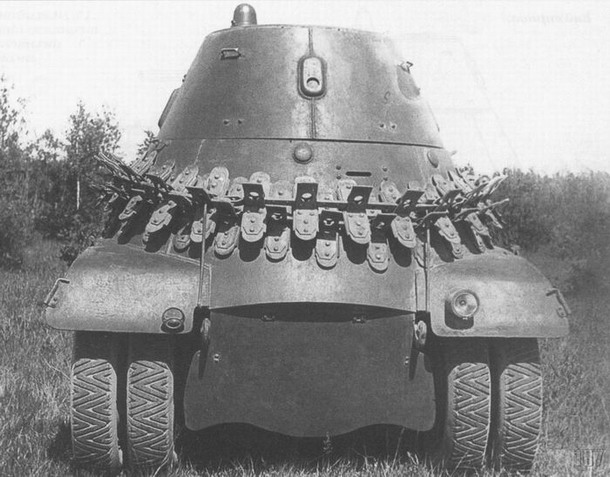
rear view of the BA-11 armoured car, source: Wikimedia, Public domain, edited
The Diesel Variant BA-11D
In the autumn of 1940 a ZIS-D7 diesel engine developing 97 hp was experimentally installed in one of the production vehicles. The designers hoped above all to reduce fuel consumption and thereby extend the vehicle's range. This was indeed achieved, though at the cost of a reduction in speed. With the diesel engine and unchanged tank capacity, the vehicle's range increased to 420 km on road. A further advantage was the lower flammability of diesel fuel, which would certainly have been welcomed by any future crew. The vehicle's weight rose to 8.65 tonnes, however, and top speed dropped from 62 km/h to just 49 km/h. The diesel variant received the designation BA-11D. Prototype trials ran from October to December 1940 and resulted in rejection. The BA-11D was therefore most likely built as a single prototype only, although some sources suggest that a small production run was completed in 1940.
Combat Deployment
Photographs confirm that the BA-11 did see actual combat. This was most likely only during the first weeks and months of the Great Patriotic War against Nazi Germany. Some vehicles were lost in action; the remainder probably went out of service very quickly due to a lack of spare parts.
Technical Specifications
|
BA-11 |
BA-11D |
Weight |
8.13 t |
8.65 t |
Length |
5.29 m |
5.29 m |
Width |
2.39 m |
2.39 m |
Height |
2.49 m |
2.49 m |
Engine |
ZIS-16 |
ZIS-D7 |
Maximum power |
99 hp |
97 hp |
Maximum speed |
62 km/h |
49 km/h |
Fuel capacity |
150 l |
150 l |
Armour |
6–13 mm |
6–13 mm |
Armament |
1 × 45 mm cannon 2 × DT machine gun, 7.62 mm |
1 × 45 mm cannon 2 × DT machine gun, 7.62 mm |
Crew |
4 men |
4 men |

ARTICLE
CONTENTS:
Reproducing text from the Tankist website without the written consent of the operator is prohibited.