BA-10
the last of the GAZ-AAA family
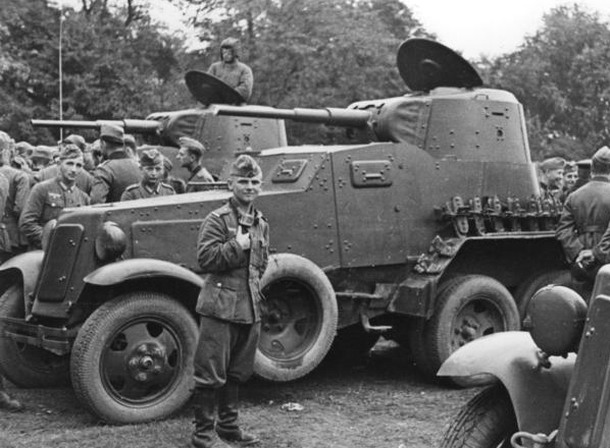
BA-10 armoured car at the meeting of Russian and German forces in occupied Poland, source: Bundesarchiv Bild 101I-013-0068-08, Wikimedia, Creative Commons, edited
Origins of the Vehicle
The BA-10 (BA standing for "Bronevoy avtomobil") was the successor in the lineage of armoured cars comprising the BA-3, BA-6 and BA-9, all built on the Ford Timken and GAZ-AAA truck chassis. The BA-10 was the last and most advanced vehicle in this series. It was developed in 1938 at the Izhora Factory in Leningrad under the direction of A. D. Kuzmin.
Description of the Design
In its basic layout the BA-10 closely resembled its immediate predecessor, the BA-6M. The GAZ-AAA truck chassis was again used as the foundation, with three axles — the two rear ones driven and the front one steerable. The front bumper and front wheel mudguards with their headlights were carried over from the truck, giving the vehicle something of a civilian appearance. Between the front mudguards was the narrow front plate, fitted with two closable rectangular air intake openings for the engine. The engine compartment widened towards the rear from this plate. On the sides were further ventilation and service openings fitted with closable covers.
Behind the engine compartment was the cabin housing the driver and the radio operator. Here one finds the first clearly visible feature distinguishing the BA-10 from the older BA-6M: the stepped profile of the cabin's front wall. The wall was offset in a step, with its right half pushed forward. A DT machine gun of 7.62 mm calibre was mounted in this protruding section. The driver's vision port was in the left half of the wall; in dangerous situations it could be closed with an armoured cover, leaving only a narrow slit to see through. The driver therefore sat on the left and the radio operator/machine gunner to his right. These two men entered and exited through doors in the side walls of the cabin. Compared to the BA-6M, the doors were enlarged, presumably to make emergency evacuation easier. They extended all the way to the cabin roof and were fitted, as was customary, with closable vision ports.
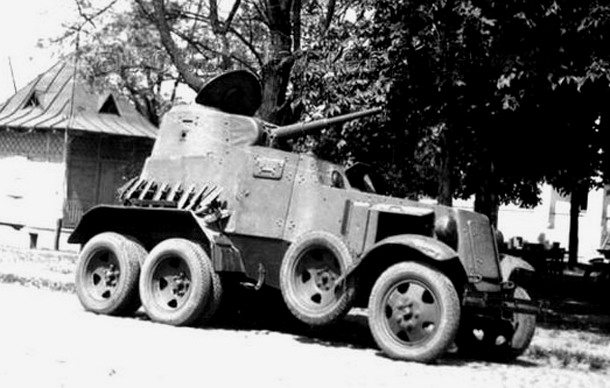
BA-10 armoured car, source: Topwar.ru with permission of the operator, edited
The cabin roof rose slightly towards the rear before dropping back down to meet the flat platform at the rear of the hull, where the turret was mounted. The turret was designed along similar lines to that of the BA-6M, with conically sloped walls that offered better resistance to enemy fire. A rounded gun mantlet projected from the front wall of the turret, housing the main armament — again a 45 mm cannon, model 1934 (according to some sources later replaced by an updated model 1938 cannon of the same calibre). A second DT machine gun of 7.62 mm was installed to the right of the cannon. 49 rounds of ammunition were carried for the cannon and 2,079 rounds for the machine guns.
The side walls of the turret featured closable slit vision ports with circular pistol ports below them for firing personal weapons. In the rear wall was a closable square-shaped opening that was probably used for loading cannon ammunition. The entire rear half of the turret roof was taken up by a semicircular hatch for crew entry and exit, fitted with a large single-piece cover that opened towards the front. A circular ventilation hole was built directly into this cover. A periscopic cannon sight protruded from the left front section of the turret roof. The turret housed two further crew members — the cannon loader and the commander, who also served as the gunner.
The hull plates were joined by welding. The rivets whose heads are visible on the hull surface served only to attach internal components such as hinge brackets for vision port and door covers, internal bracing, beams and similar fittings. At the most heavily armoured points — the hull front — the steel plates reached a thickness of 15 mm, comparable to the armour of light tanks of the period. Among the less visible improvements of the BA-10 over the BA-6M was a more effective engine cooling system, which eliminated the unpleasant heating of the crew cabin that had plagued earlier vehicles. Hydraulic shock absorbers and various other refinements were also added. The powerplant, however, remained unchanged — the GAZ-M1 four-cylinder petrol engine with a maximum output of 50 hp. The vehicle was also equipped with a type 71-TK-1 radio.
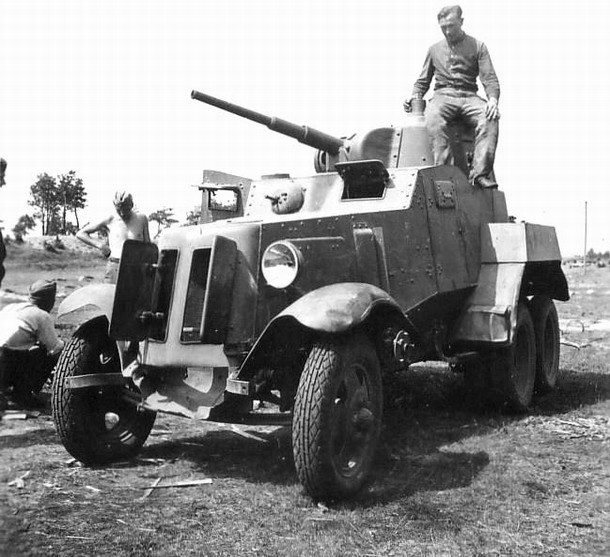
BA-10M armoured car — note the fuel tanks above the mudguards, source: Aviarmor.net with permission of the operator, edited
The spare wheels mounted on the sides of the engine compartment could rotate freely, helping the vehicle negotiate significant obstacles that might otherwise cause it to become stuck. Light tracks slipped over the wheels of the two rear axles were also available for improving cross-country performance, just as on the older BA-3 and BA-6. The BA-10 had a combat weight of 5.14 tonnes and could reach a top speed of 53 km/h. A fuel supply of 118 litres gave a road range of around 300 km and an off-road range of approximately 220 km. The BA-10 prototype underwent brief trials and series production was ordered very quickly. It ran from 1938 through to December 1939, producing 489 vehicles in 1938 and 904 in the following year, for a total of 1,393 units. In December 1939 it was replaced on the production line by the modernised BA-10M.
The BA-10M Modernisation
The BA-10M brought several improvements, most of which took place internally and were invisible to the casual observer. There was, however, one change by which the two variants can be told apart in photographs — the relocation of the fuel tanks from inside the vehicle to the rear mudguards. A persistent complaint running through the entire BA-3, BA-6 and BA-9 lineage had been the deeply unfortunate positioning of the petrol tanks, which were suspended from the cabin ceiling directly behind the driver's and radio operator's seats. If the tanks were hit in combat and penetrated, petrol poured directly onto the heads of both men — and should it ignite (which in combat conditions was far from unlikely) those crew members had virtually no chance of survival.
This was precisely the reason for the change. The BA-10M can therefore be recognised by the rectangular tanks sitting on top of both rear mudguards. Each tank held 54.5 litres, giving the BA-10M a total fuel capacity of 109 litres. Production of the BA-10M began in December 1939 and ended in November 1941, during which time 1,918 vehicles were built. Combined production of both BA-10 variants therefore reached 3,311 units.
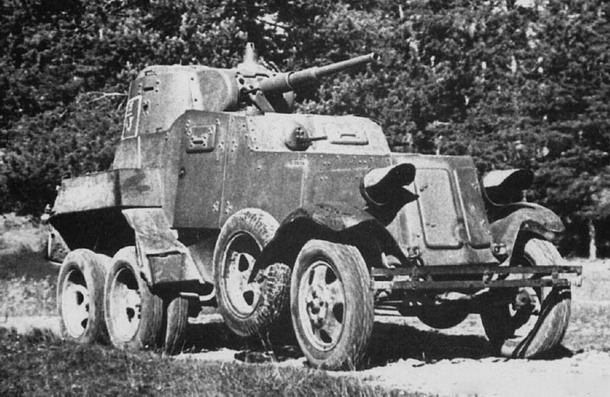
BA-10M armoured car — note the fuel tanks above the mudguards, source: Aviarmor.net with permission of the operator, edited
Railway Version
Approximately 20 examples of a railway variant were built, designated BA-10ZhD. The vehicle was fitted with special steel rims placed over the standard rubber tyres — but only on the front wheels and the rearmost pair. On the rear axles the outer wheels also had to be removed, with the rims fitted to the inner wheels only. The middle pair of wheels remained in their standard road-going configuration. The BA-10ZhD could reach a speed of 90 km/h on the rails.
Combat Deployment
The BA-10 armoured cars saw their baptism of fire in the summer of 1938 during the fighting with Japanese forces at Lake Khasan. A year later they fought again against the Japanese at the Khalkhin Gol river. In 1939 they took part in the invasion of Poland and in the Winter War against Finland. From 1941 onwards they fought against the German invaders on Soviet soil, continuing to serve until the very end of the Second World War. In combat, the vehicle's powerful armament proved to be a great asset — the 45 mm cannon was capable of dealing with the armour of most enemy armoured vehicles, light tanks and sometimes even medium tanks. Its weaknesses, however, were its thin own armour and of course the wheeled chassis, which severely limited mobility in soft or heavily broken terrain.
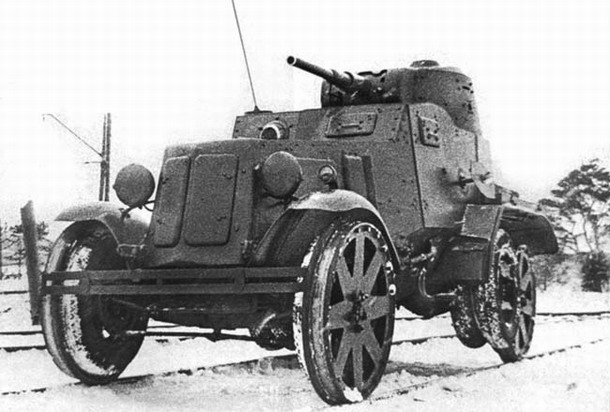
BA-10ZhD railway armoured car, source: Aviarmor.net with permission of the operator, edited
Beyond the Red Army, the BA-10 was also used by the armed forces of other nations. The Soviets sold a number voluntarily to Mongolia. Romania, Finland and Germany all obtained examples as war booty. The Finns made particularly intensive use of their captured BA-10s, modernising them extensively, and only officially retired them in 1959. One Finnish BA-10 is especially worth mentioning — it was converted into a mobile crane and remained in service in that role until 1978! The Germans put their captured vehicles to use under the designation Panzerspähwagen BA203(r), employing them mainly for policing duties, anti-partisan operations and other second-line tasks.
Technical Specifications
Weight |
5.14 / 5.36 t |
Length |
4.65 m |
Width |
2.07 m |
Height |
2.19 m |
Ground clearance |
0.24 m |
Engine |
GAZ-M1 |
Maximum power |
50 hp |
Maximum speed |
53 km/h |
Fuel capacity |
118 / 109 l |
Range – road |
300 km |
Range – off-road |
220 km |
Armour |
front 10–15 mm sides and rear 10 mm roof 6 mm floor 4 mm |
Armament |
1 × 45 mm cannon 2 × DT machine gun, 7.62 mm |
Crew |
4 men |

ARTICLE
CONTENTS:
Reproducing text from the Tankist website without the written consent of the operator is prohibited.