BA-9
a rejected prototype
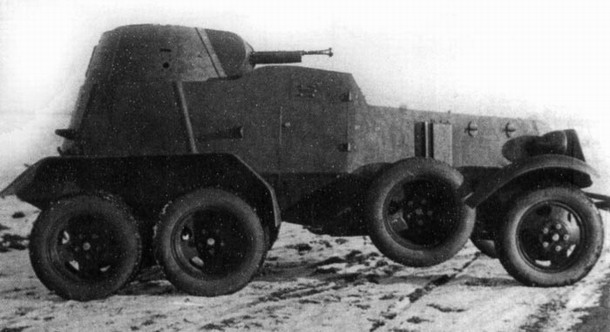
BA-9 armoured car prototype, source: Wikimedia, Public domain, edited
Origins of the Vehicle
In 1936 the Izhora Factory in Leningrad produced a modernised version of the BA-6 armoured car, designated BA-6M. Running alongside the development of the BA-6M, however, was work on a lightened variant of the same vehicle, which received the military designation BA-9 (BA standing for "Bronevoy avtomobil"). All modifications were limited to a change of armament. The chassis, hull, turret, engine and all other components remained identical to those of the BA-6M.
Description of the Design
The BA-9 was again built on the GAZ-AAA truck chassis, consisting of three axles: a front steerable axle and two rear driven axles fitted with dual wheels. At the front was the engine compartment, protected by a bonnet that widened towards the rear from the narrow front plate. Large mudguards over the front wheels ran along the sides of the engine compartment, with headlights mounted on them. The front plate carried two longitudinal, vertically positioned air intake openings for the engine. Additional ventilation and service openings were provided in the side walls of the engine bonnet.
Behind the engine compartment was the crew cabin. In its forward section sat the driver and the machine gunner side by side. The driver occupied the left-hand seat and looked out through a conventionally arranged vision port that closed with a cover fitted with a slit. The weapon operated by the machine gunner was a DT of 7.62 mm calibre. These two crew members entered and exited through doors in the side walls of the hull. The hull roof was at its highest directly above the driver and machine gunner. Behind them it stepped down to form a platform for the turret. The turret was conical in shape, with sloped walls that offered better resistance to enemy fire.
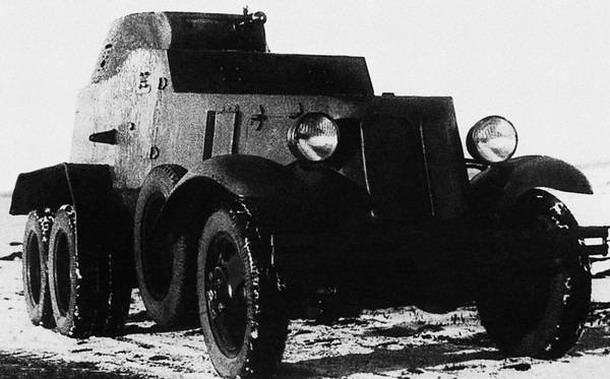
BA-9 armoured car prototype, source: Aviarmor.net with permission of the operator, edited
Mounted in the front wall of the turret was the new armament: a DShK heavy machine gun of 12.7 mm calibre. Observation from the turret was provided by slit vision ports in the side walls, while a periscope in the roof served for aiming. The vehicle carried 1,000 rounds of 12.7 mm ammunition and 1,512 rounds of 7.62 mm ammunition. The turret housed the remaining two crew members — the loader and the commander, who also served as the turret gunner. These men entered and exited through hatches in the turret roof.
The armour on the front of the hull and the turret was 10 mm thick. The hull sides were 8 mm, the roof 6 mm and the floor a mere 4 mm. The BA-9 had a combat weight of 4.5 tonnes and, powered by the GAZ-M1 engine developing 50 hp, could reach a top speed of 55 km/h. It was fitted with a type 71-TK-1 radio. After trials of the prototype the vehicle was rejected, and only the single example ever built remained. The principal reason for rejection was that apart from its higher speed, the BA-9 offered no advantage over the BA-6M — and even that one benefit came at the cost of significantly weaker armament.
Technical Specifications
Weight |
4.50 t |
Length |
4.90 m |
Width |
2.07 m |
Height |
2.30 m |
Engine |
GAZ-M1 |
Maximum power |
50 hp |
Maximum speed |
55 km/h |
Fuel capacity |
118 l |
Range – road |
230 km |
Range – off-road |
180 km |
Turret armour |
8–10 mm |
Hull armour |
4–10 mm |
Armament |
1 × DShK machine gun, 12.7 mm 1 × DT machine gun, 7.62 mm |
Crew |
4 men |

ARTICLE
CONTENTS:
Reproducing text from the Tankist website without the written consent of the operator is prohibited.