BA-6
another member of the Leningrad family
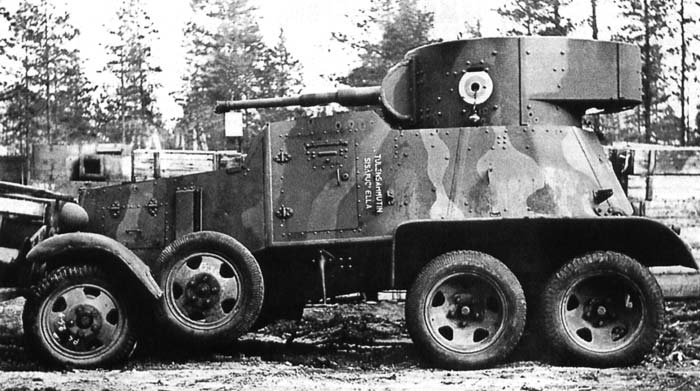
captured BA-6 armoured car in Finnish Army service, source: Aviarmor.net with permission of the operator, edited
Origins of the Vehicle
In 1935, designers at the Izhora Factory in Leningrad proposed a modernised version of the BA-3 armoured car produced there. The new vehicle, designated BA-6 (BA standing for "Bronevoy avtomobil"), looked very similar to its predecessor at first glance. However, a whole range of improvements and refinements had been applied. The BA-6 used exclusively the GAZ-AAA chassis. The vehicle also received a new GAZ-M engine developing 40 hp, and electric interior lighting for the fighting compartment was introduced for the first time. New GK-type tyres were also fitted — these were bullet-resistant, being filled with soft rubber rather than air. Their service life was shorter than conventional tyres, but in practice they proved quite effective.
The connections between the hull and the chassis were also strengthened to reduce the hull vibration during hard driving that crews had so frequently complained about. In photographs the BA-6 can be distinguished from its predecessor mainly by two details. The BA-6 had no entry door in the rear wall of the hull — its removal simplified manufacture of that section and also freed up space on the rear wall to hang the auxiliary tracks when they were not fitted to the wheels. The second distinguishing detail is the ventilation covers on the sides of the engine compartment. On the older BA-3 these covers were two-piece and folded in half when opened, whereas on the BA-6 they were single-piece.
Description of the Design
The BA-6 prototype was built at the end of 1935. As already noted, the chassis was taken from the GAZ-AAA truck and consisted of a front steerable axle and two rear driven axles with dual wheels. One spare wheel was mounted on each side of the hull behind the front mudguards. These wheels were attached so that they could rotate freely, helping the vehicle negotiate significant obstacles without damaging the chassis or becoming stuck.
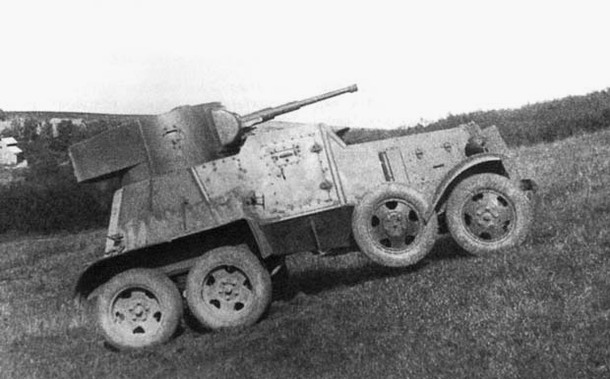
BA-6 armoured car, source: Aviarmor.net with permission of the operator, edited
The hull layout was identical to that of the older BA-3, though welding was used to a greater extent in place of riveting. At the front was the engine compartment, protected by a bonnet that widened towards the rear from the narrow front plate. Large mudguards over the front wheels ran along the sides of the engine compartment, with headlights mounted on them. The front plate carried two longitudinal, vertically positioned air intake openings for the engine. Additional ventilation and service openings were provided in the side walls of the engine bonnet.
Behind the engine compartment was the crew cabin. In its forward section sat the driver and the machine gunner side by side. The driver occupied the left-hand seat and looked out through a conventionally arranged vision port that closed with a cover fitted with a slit. The weapon operated by the machine gunner was a DT of 7.62 mm calibre. These two crew members entered and exited through doors in the side walls of the hull. The hull roof was at its highest directly above the driver and machine gunner. Behind them it stepped down to form a platform for the turret.
The side walls of the hull were only very slightly angled. The rear wall was angled considerably more and had a bend at mid-width. The turret mounted at the rear of the hull was taken from the T-26 tank. In the front wall of the turret was a 20K model 1932 cannon of 45 mm calibre with a coaxially mounted DT machine gun. Observation from the turret was provided by slit vision ports in the side walls, while a periscope in the roof served for aiming. The vehicle carried 60 rounds for the cannon and 3,339 rounds for the machine guns (other figures are sometimes cited).
The turret housed the remaining two crew members — the loader and the commander, who also served as the cannon gunner. These men entered and exited through hatches in the turret roof. Compared to the T-26 tank, the turret had thinner armour at just 8 mm — the same thickness as the hull side walls. The hull roof was 6 mm and the floor a mere 4 mm. The BA-6 had a combat weight of 5.12 tonnes and a top speed of 43 km/h.
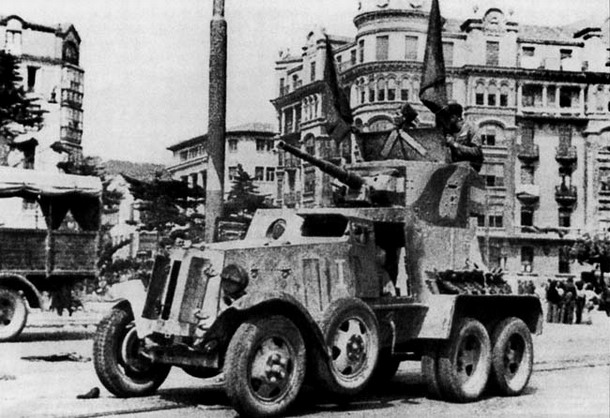
BA-6 armoured car during the Spanish Civil War, source: Flickr.com with permission of the publishing user, edited
Just as with the BA-3, the BA-6 used improvised tracks that slipped over the wheels of the two rear axles to improve cross-country performance. The tracks did not work perfectly and occasionally slipped off, but even so they allowed the vehicle to tackle terrain it would otherwise have been unable to cross.
The BA-6 prototype was tested during the summer of 1935 and performed satisfactorily overall. The shortcomings uncovered were similar to those of the older BA-3. The most persistent problem was the intense heating of the crew cabin by engine heat — a benefit in winter but a source of serious discomfort and even danger in summer. During tests with hatches and vision ports closed, crew members inside the vehicle began sweating heavily after just 10 to 15 minutes of driving. After approximately two hours in the cabin, feelings of suffocation set in. With hatches open, the same effect was delayed to around four hours.
It is rather striking how much attention was paid during testing to crew comfort. Among the other deficiencies noted were the hard seats of the driver and machine gunner, which caused back pain during longer journeys, and complaints about the lack of footholds for the commander and loader — climbing safely down into the turret through the roof hatches was no easy task. The original BA-6 was not fitted with a radio. This changed in the summer of 1936 when a type 71-TK-1 set was installed, though this required a reduction in the ammunition load for both the cannon and machine guns. Vehicles equipped with a radio are easily identifiable in photographs by the frame antenna mounted on several supports around the turret.
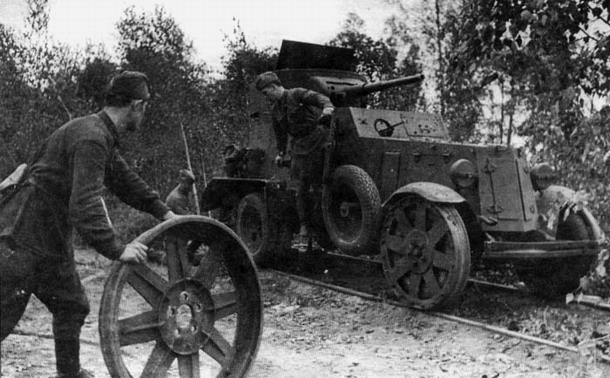
BA-6ZhD railway armoured car, source: Aviarmor.net with permission of the operator, edited
The BA-6M Modernisation
In the winter of 1936 a modernised version of the vehicle was produced, designated BA-6M. It received a new and more powerful GAZ-M1 engine developing 50 hp at 2,200 rpm. Thanks to the uprated powerplant the top speed increased to 50 km/h. But that was not the only change. The fuel tank capacity was enlarged to 118 litres, the original 8 mm hull armour was increased to 10 mm, and a type 71-TK-1 radio was installed. The most distinctive feature of the BA-6M, however, was its new conical turret with sloped walls which, at the same armour thickness, offered better resistance to fire. The originally angled rear wall of the hull was also redesigned with a rounded profile. Alongside the BA-6M, one further modified version of this armoured car was produced. It received the designation BA-9 and was intended as a lighter variant of the vehicle. BA-9 is covered separately.
Railway Version
Also in 1935, a railway version of the BA-6 was developed, designated BA-6ZhD. The vehicle was fitted with special steel rims that were placed over the standard rubber tyres — but only on the front wheels and the rearmost wheels. On the rear axles the outer wheels also had to be removed, with the rims fitted to the inner wheels only. The middle wheels remained in their standard road-going configuration. The removed outer rear wheels were hung on the sides of the hull in the same positions where conventional BA-6s carried their spare wheels. When travelling on ordinary roads, two of the steel rims were carried on the sides of the hull and the remaining two were placed on the turret roof. The BA-6ZhD could reach 55 km/h on the rails. To prevent accidental derailment, the front steerable wheels were locked in the straight-ahead position.
Combat Deployment
BA-6s were assigned to the reconnaissance units of tank, infantry and cavalry formations of the Red Army. During the Spanish Civil War the Soviets supplied them to Republican forces, where they took part in numerous engagements. At the time they carried a very powerful weapon for their class and were capable of destroying enemy tanks. After the end of the civil war, the remaining serviceable vehicles stayed in Spain and continued in use there into the 1950s. The BA-6 also saw mass deployment in the fighting against Japanese forces at the Khalkhin Gol river.
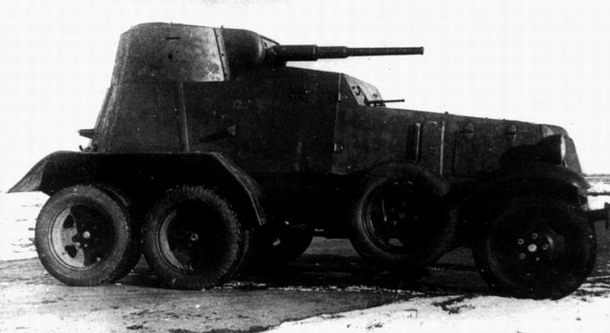
modernised BA-6M armoured car, source: Flickr.com with permission of the publishing user, edited
Smaller numbers of BA-6s were also deployed during the invasion of Poland in September 1939 and in the Winter War against Finland. The Finns managed to capture several of these vehicles and subsequently used them themselves — in fact until as late as 1956. The next major theatre for the BA-6 was of course the Great Patriotic War against Nazi Germany, in which BA-6s fought until roughly mid-1942, by which point they had either been destroyed or withdrawn from service as obsolete.
The BA-6 was at the time among the most heavily armed armoured cars in the world, and its 45 mm gun allowed it to take on tanks effectively. Its weakness, however, was its thin armour, which could be penetrated even by a heavy-calibre machine gun. Production of the BA-6 ran from 1935 to early 1938, with a total of 386 vehicles built. How many of these were the BA-6M variant is unfortunately not known.
Technical Specifications
|
BA-6 |
BA-6M |
Weight |
5.12 t |
4.80 t |
Length |
4.90 m |
4.90 m |
Width |
2.07 m |
2.07 m |
Height |
2.36 m |
2.30 m |
Engine |
GAZ-M |
GAZ-M1 |
Maximum power |
40 hp |
50 hp |
Maximum speed |
43 km/h |
50 km/h |
Fuel capacity |
65 l |
118 l |
Armour |
4–9 mm |
4–10 mm |
Armament |
1 × 45 mm cannon 2 × DT machine gun, 7.62 mm |
1 × 45 mm cannon 2 × DT machine gun, 7.62 mm |
Crew |
4 men |
4 men |

ARTICLE
CONTENTS:
Reproducing text from the Tankist website without the written consent of the operator is prohibited.