PANZER 38(t)
the Czechoslovak that made a career with the neighbours
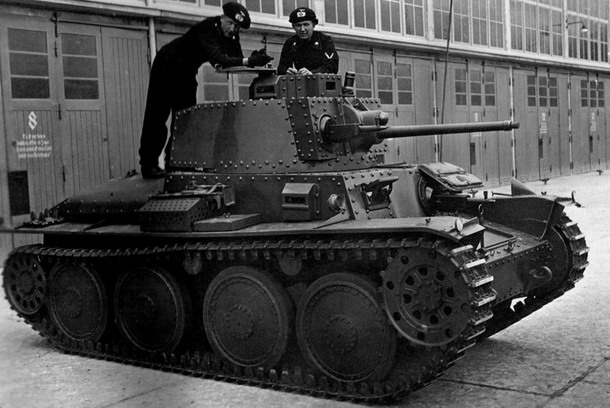
the light tank Panzerkampfwagen 38(t), source: flickr.com with permission of the publishing user, edited
Even the casual reader will notice that the designation PzKpfw 38(t) does not quite fit the standard German tank naming convention, which otherwise used Roman numerals from one to six. The truth is that the Germans needed some time to find a suitable name for this tank. The reason was simple: it was not a vehicle of their own design but a prize seized from occupied Czechoslovakia — a prize valuable enough that the Germans decided to make it truly their own, not merely using it but continuing to produce it and developing it intensively. At its heart, however, this tank was the work of the designers at Praga, a subsidiary of the ČKD engineering concern.
A Tank for Export
Since its founding in 1871, ČKD had remained something of a second-tier player in the field of armoured fighting vehicles — both at home and abroad. Everything changed at the turn of 1934 and 1935, however, when the company — along with the Škoda works in Pilsen — was approached by an Iranian procurement commission seeking to buy approximately one hundred light tanks for the Iranian army. This was an enormous order that could finally open doors to further major military contracts, and ČKD therefore threw itself into the project with full energy. A key role was played by engineer Alexej Surin of the design office in the special vehicles department. He designed two highly modern fighting vehicles: the light tank TNH armed with a 37 mm gun and the even lighter tankette AH IV with machine gun armament.
At the beginning of 1935, however, both of these vehicles existed only on paper, so all ČKD could show the Iranians were drawings. Even the drawings alone impressed the customer enough to continue negotiations, and on 14 May 1935 a preliminary contract was signed with ČKD for the delivery of 30 AH IV tankettes and 26 TNH tanks. Škoda Plzeň, which had also been approached, therefore did not win the Iranian contract. It did not go away empty-handed, however, as ČKD placed a sub-supply order with it for the 37 mm tank guns for its TNH. Machine gun armament was to be supplied by Zbrojovka Brno.
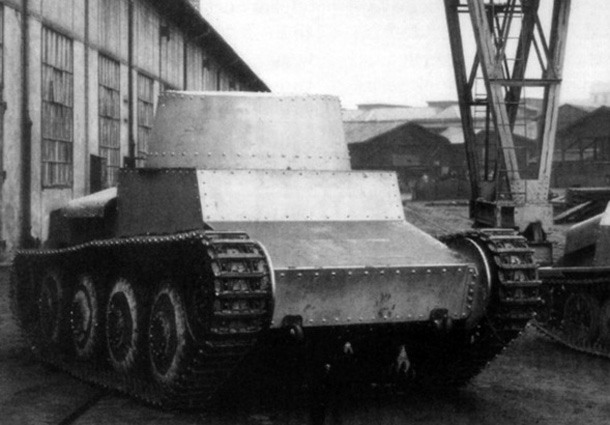
the first TNH tank prototype from 1935, still without any armament and with only mock turrets, source: flickr.com with permission of the publishing user, edited
The first prototypes of both ordered vehicles were built in September 1935, still without armament and fitted only with dummy turrets. When the members of the Iranian commission inspected them they were delighted and promptly doubled their order to 50 of each vehicle. All one hundred vehicles were to be delivered by October 1936. The purchase price was 1,629 British pounds for the AH IV tankette and 3,570 pounds for the TNH tank. Series production was immediately launched at the ČKD plant in Slaný. The entire order was ultimately delivered with only a minor delay — a delay caused not so much by ČKD as by the Iranian army officials themselves, who apparently tried to prolong their stay in Europe and were deliberately slow in accepting the completed vehicles. ČKD wasted no time and, as any good salesman would, immediately began offering its new tanks to other foreign armies. With considerable success: between 1936 and 1939 it fulfilled orders for variously modified tanks for Romania, Switzerland and Peru (not to mention an order for Lithuania that was ultimately never delivered). And the first success on the domestic market was about to follow.
A Tank for the Czechoslovak Army
In October 1937, the Czechoslovak army command decided to hold a competition for the supply of new light tanks to supplement the existing LT vz. 35 fleet and bring the army up to its required mobilisation strength. ČKD drew on all its experience gained from producing export tanks and set about building a prototype of a new tank for the Czechoslovak army. An unarmed evaluation example was ready at the end of 1937, designated TNH-S. In appearance the prototype was essentially identical to the TNH tanks built for Iran, but it received a new Praga TNHPS engine and a new Praga Wilson gearbox. During factory trials the prototype covered 550 km, after which it was handed over on 18 January 1938 to Milovice for troop trials.
Army trials continued until the end of March 1938, during which the prototype covered around 5,000 kilometres. Throughout this period it performed very well, showing reasonable reliability and low maintenance demands. After the trials concluded, the army returned the prototype to the factory in Prague-Libeň along with a list of required modifications. These included, for example, enlarging the fuel tanks from 180 to 210 litres, adding a transmission oil cooler, changing the spacing of the road wheels and many other minor changes. One significant modification that would define the tank's appearance for years to come was the angling of the front wall of the crew compartment. On the original TNH-S prototype (and on the Iranian TNH tanks) this wall was flat. Army representatives, however, requested that the left portion be moved 100 mm forward, creating more interior space for the comfortable operation of the hull machine gun positioned there. The right portion of the front wall in front of the driver was to remain in its original position, creating a stepped kink in the middle of the front wall.
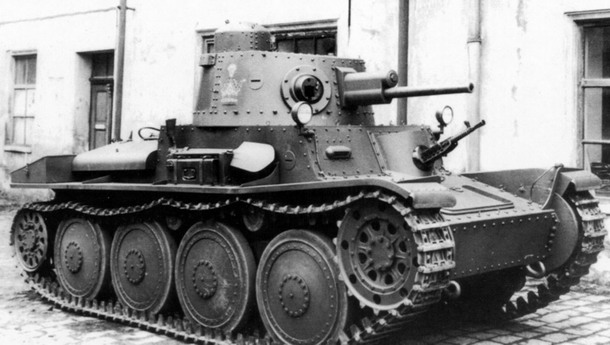
one development stage of the TNH prototype for the Iranian army (note the interesting hull machine gun mount), source: flickr.com with permission of the publishing user, edited
The modified prototype was fitted with a turret from the LT vz. 35 and sent back to Milovice for continued trials. After barely a week, however, it returned to Prague for the installation of the definitive fighting turret and the fitting of the Škoda A 7 gun in 37 mm calibre. The tank then travelled to Slovakia for firing trials, and in mid-May 1938 it went on to Pilsen where intensive ballistic trials continued. In total the tank reportedly fired 470 rounds there. The efforts of both the manufacturer and the testing soldiers were rewarded on 1 June 1938, when the prototype was presented at Prague-Kyje to an armament commission of thirty senior officers. The commission members heard a report summarising the results of the trials so far, observed the tank during a demonstration drive, and then unanimously approved its adoption into Czechoslovak army service under the designation light tank model 38, or LT vz. 38. At that moment the prototype's total mileage stood at an impressive 7,740 kilometres.
Because the international political situation was developing very badly for Czechoslovakia, negotiations between the Ministry of National Defence and ČKD over the accelerated start of series production, the delivery of the first 150 tanks and of course prices had already been running since April 1938 — in parallel with the prototype trials. The negotiations were dragged out, however, by ČKD's high price demands, and the final order was not placed until 22 July 1938. It called for 100 tanks with armour plate from Poldi Kladno (at 620,146 Czech Crowns per vehicle without armament) and 50 tanks with armour from the Vítkovice steelworks (at 619,570 Crowns per vehicle without armament). Gun and machine gun armament was ordered separately and represented an additional cost of approximately 250,000 Crowns per tank. The first 20 complete tanks were to be delivered by the end of 1938 according to the order.
Preparations for series production of the new tank immediately got under way at the ČKD plant in Prague-Libeň. Deliveries of the crucial armour plate from Kladno and Vítkovice were delayed, however, as were deliveries of guns from Pilsen and machine guns from Brno. On the day the Munich Agreement was signed, 30 September 1938, not a single LT vz. 38 tank had been completed. Under the Munich diktat, Czechoslovakia was forced to cede extensive border territories to Germany, and with them its entire system of frontier fortifications. Without these defences the army was objectively incapable of defending the truncated republic against a potential invasion. It is therefore no surprise that in February 1939 the Ministry of National Defence agreed to release a full third of the ordered LT vz. 38 tanks for sale to another customer. That customer was Sweden, which had been in discussion with ČKD about a purchase for some time. The price offer was dispatched to Sweden on 14 March 1939 — at the very moment the first German units were crossing our borders and advancing into the interior of the country. The German occupation arrived, Slovakia was detached as a separate state and the Protectorate of Bohemia and Moravia was declared. Negotiations with Sweden continued (under German supervision), but the delivery ultimately came to nothing — though we will return to this story later.
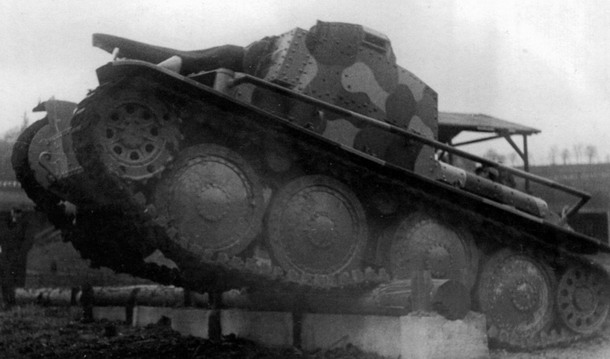
the LT vz. 38 during a demonstration for the German army in May 1939, source: flickr.com with permission of the publishing user, edited
The German Confiscation
The German occupiers first seized tanks and other military equipment already in service with Czechoslovak military units. Vehicles in the factories came a little later. Representatives of the German Waffenamt did not arrive at ČKD until 2 May 1939. Among other things, they inspected the first 10 practically complete LT vz. 38 tanks. The Germans were enthusiastic and immediately decided to take over the original Czechoslovak army order and place the new tank into their own service. They drew up a new production schedule according to which ČKD was to deliver 25 tanks per month from June 1939, completing the entire 150-tank series by November of that year. This schedule was met, and the last of the ordered tanks was duly handed over to the German army on 27 November 1939.
The Germans had evidently not anticipated taking foreign-designed tanks into their own service and so finding a suitable official designation for the LT vz. 38 was clearly not entirely straightforward. For a time they therefore used a simple translation of the original Czech name — Leichte Tank Muster 38, abbreviated L.T.M. 38 (some authors give this as Leichte Tank Modell 38). They then decided to bring the designation closer to their own standard and so PzKpfw III (t) was created. The letter t in brackets referred to the word tschechisch (Czech), while the Roman numeral III placed the new vehicle on a par with the German PzKpfw III. Both types carried a 37 mm gun of similar characteristics, which predestined both for the same role — the destruction of enemy tanks. Only in 1940 was the definitive designation PzKpfw 38(t) introduced. The 150 tanks of the first production series were then designated Ausführung A, abbreviated Ausf. A.
Ausführung A
For the first production series, the Germans introduced only the bare minimum of changes to the Czechoslovak tank. Worth noting are, for example, the application of German armour grey paint in place of the Czechoslovak three-colour camouflage, and the installation of new Bosch-brand electrical equipment. The driver's rear-view mirror was also moved from the right track mudguard to the left (the original position reflected the former Czechoslovak rules of the road requiring driving on the left, while the new position corresponded to the German standard of driving on the right). In my modest view, the driver could not have seen anything at all in a mirror positioned so far from his vision port.
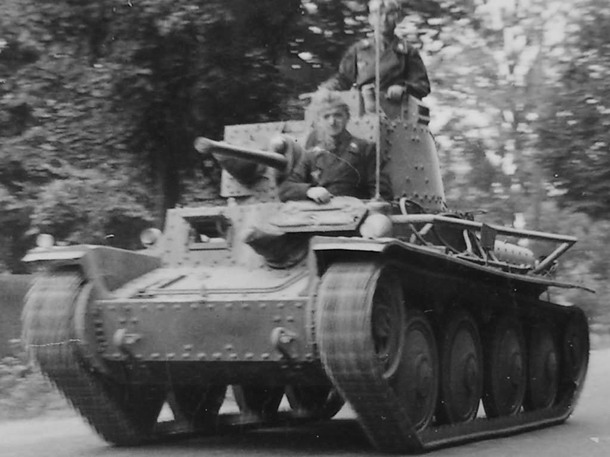
PzKpfw 38(t) Ausf. A; note the tubular antenna running along the left track mudguard, source: worldwarphotos.info with permission of the site owner, edited
The PzKpfw 38(t) had a suspension consisting of four road wheels on each side, 775 mm in diameter, fitted with rubber tyres around their circumference for a smoother ride. The wheel discs were made from 6 mm armour plate, which provided a not insignificant degree of additional protection for the hull sides. The two front and two rear road wheels on each side formed a pair, suspended on a shared arm and sprung by a shared semi-elliptical leaf spring. The track assembly also included a front toothed drive sprocket 637 mm in diameter, a rear idler wheel 535 mm in diameter and two return rollers 220 mm in diameter. The tracks themselves were 293 mm wide, each consisting of 94 links. The tracks were fitted with a double guide horn to prevent them from running off the road wheels. Along their full length the tracks were protected from above by mudguards made from shaped 2 mm sheet metal. The mudguards were sturdy enough to walk on.
The tank's hull was built from armour plates attached with rivets and bolts to a skeleton welded from steel strips and angle sections. Up to a height of one metre all joints were sealed against water using inserted strips of oiled parchment paper. The hull front consisted of an elongated nose with a frontal plate 25 mm thick. The nose roof plate had a large hatch for service access to the gearbox. Further back rose the front wall of the crew compartment, kinked in the middle with the left portion offset forward. Behind this wall sat the driver and the radio operator, who also operated the hull machine gun. Both men sat in comfortable padded seats with folding backs, with the gearbox between them.
At the time the LT vz. 38 was designed, Czechoslovakia drove on the left, and the driver's station was accordingly positioned on the right side of the crew compartment. Directly in front of the driver, in the front wall, was his main vision port, filled with 50 mm hardened glass and fitted with an external armoured cover. When the cover was closed, the driver could only see through a narrow slit in it. In a safe area he could open the cover for a better view. A further vision port was in the side wall to the driver's right. Immediately below it in the side wall was a ventilation slot. Both the vision port and the ventilation slot were protected from outside by a shared fixed armoured cover. The tank was operated by two horizontally mounted steering levers, three pedals and a gear selector.
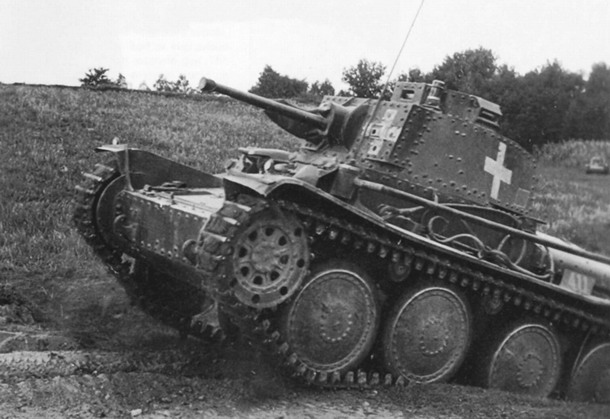
again the PzKpfw 38(t) Ausf. A with its tubular antenna above the left track mudguard, source: flickr.com with permission of the publishing user, edited
The radio operator sat on the left and also had his own armoured vision port in the front wall directly in front of him. In the side wall to the radio operator's left there was no vision port, but there was a ventilation slot covered from outside by an armoured cover. The hull machine gun was positioned to the radio operator's right, partially above the gearbox. The ball mount allowed horizontal movement of the machine gun through 14 degrees to either side and vertical movement from −10 to +10 degrees. The machine gun was aimed using a monocular sight ZDK 2105 (ZDK = záměrný dalekohled kulometný — machine gun telescopic sight) with 2.6× magnification and a 25-degree field of view, manufactured by Optikotechna of Přerov. The machine gun itself, in 7.92 mm calibre, was the product of the Brno arms factory and its original Czechoslovak designation was ZB vz. 37. The Germans assigned it their own designation MG 37(t).
As already mentioned, the radio operator was the primary gunner of the hull machine gun. If necessary (for example if the radio operator was killed in action), the driver could also fire the hull machine gun. For this purpose the gun was locked in zero elevation and zero traverse (pointing horizontally directly ahead of the tank) and the driver fired it with a button on one of his steering levers. This button was connected to the machine gun trigger by a Bowden cable (the cable is clearly visible in the photograph HERE, Flickr.com). Since the machine gun was locked in a fixed position, the driver had to aim by manoeuvring the whole vehicle. For this purpose he had a simple sight in the form of a ring on a short metal rod mounted in front of his vision port (see photo HERE, Flickr.com). Directly above his seat, the radio operator had a two-part crew hatch. This hatch also served the driver.
The Škoda A7 Gun
On the crew compartment roof sat a fully rotating fighting turret on a ring 1,265 mm in diameter. The turret extended rearward with rounded side and rear walls. The front wall, 25 mm thick and sloped at 10 degrees from the vertical, slightly projected forward from the turret — and this was where the tank's main armament was mounted, a 37 mm gun. The Czechoslovak army designated it the 37 mm kanon ÚV vz. 38 (ÚV = útočná vozba — tank arm), while the manufacturer (Škoda Plzeň) called it the Škoda A 7. The Germans gave it their own designation 3.7cm KwK 38(t) (KwK = Kampfwagen Kanone = tank gun). To the left of the gun was its sight, type ZDD 2109 (ZDD = záměrný dalekohled dělový — gun telescopic sight), a product of Optikotechna Přerov with 2.6× magnification and a 25-degree field of view. To the right of the gun was a turret machine gun of the same type as in the hull — ZB vz. 37 / MG 37(t).
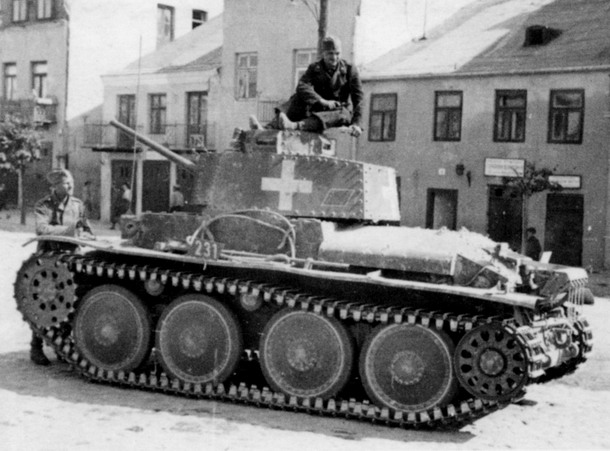
PzKpfw 38(t) Ausf. A without the tubular antenna, in Poland; note the set of smoke grenades installed above the exhaust silencer, source: flickr.com with permission of the publishing user, edited
Both the gun and the machine gun beside it were operated primarily by the commander/gunner. Since both weapons were normally coupled, the gunner aimed both simultaneously using the gun sight. Together they could be elevated from −10 to +25 degrees. The machine gun trigger was operated by the gunner via a Bowden cable. In an emergency the machine gun could be uncoupled from the gun and aimed independently — but this could only be done by the loader sitting on the right side of the turret. Once uncoupled, the machine gun could also be moved horizontally through a total range of 15 degrees. Horizontal movement of the gun was only possible by rotating the entire turret (and therefore had an unlimited range). Turret traverse was manual, via a handwheel with a grip positioned on the turret ring to the left of the commander/gunner. If necessary, the drive could be disengaged from the handwheel, leaving the turret to rest freely on its ball bearing, after which the gunner could rotate it as fast as he liked by bracing his feet on the floor and his shoulder against the gun rest (something that would have been unthinkable in a heavy tank, but the low weight of the LT vz. 38 turret made it possible).
Behind the gun breech was a sheet metal housing that defined the recoil space of the weapon (photo HERE, Flickr.com). It was decidedly unwise to put one's hands in there while the gun was firing. Below this housing hung a fabric bag to catch the empty cases ejected from the gun breech, holding 15 to 20 of them. The purpose of catching the cases was to prevent them rolling freely around the floor where they could obstruct the crew. Similar bags were hung at both machine gun positions. The maximum practical rate of fire of the gun was around 15 rounds per minute.
Two types of ammunition were prepared for the original Czechoslovak ÚV vz. 37 gun: armour-piercing and high-explosive. The Germans adopted the original armour-piercing shells under their own designation 3.7cm Pzgr.Patr. 37(t). The projectile of this round had a muzzle velocity of 741 m/s and weighed 850 grams, of which 8 grams were explosive charge. At 600 metres this round could penetrate 28 mm of sloped homogeneous armour. The Germans improved the original armour-piercing ammunition: they increased the explosive charge from 8 to 13 grams, added a ballistic cap to the nose for better flight and impact characteristics, and fitted a tracer to the base so the gunner could follow the path of the fired round. The improved ammunition received the designation 3.7cm Pzgr.Patr. 37(t) umg. (umg. = probably umgearbeitet, meaning reworked). Thanks to the modifications the projectile weight decreased to 815 grams while muzzle velocity rose to 750 m/s. Using this ammunition the tank could penetrate 33 mm of armour at 500 metres and 27 mm at one kilometre.
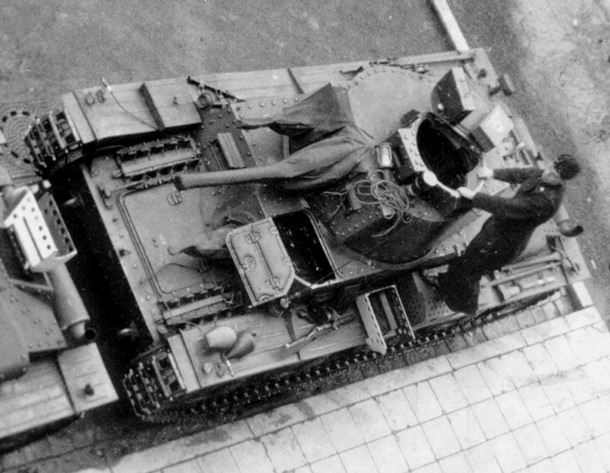
a fine overhead view of the PzKpfw 38(t) Ausf. D, source: Flickr.com with permission of the publishing user, edited
In March 1941 a new type of armour-piercing ammunition was introduced for the KwK 38(t) gun, designated Pzgr. 40/37(t). This was a subcalibre round with a tungsten core weighing only 368 grams, which left the muzzle at 1,020 m/s. At 400 metres this projectile could penetrate 37 mm of homogeneous armour. The vehicle's gun ammunition stowage totalled 90 rounds, carried six to a rack in 15 ammunition containers. Nine containers were in the extended rear section of the fighting turret, three were against the right side wall of the crew compartment and three against the left. Containers holding armour-piercing ammunition were marked with a white stripe.
Now let us look at the turret roof. On its left side was the commander's cupola, fitted with observation periscopes at the front, rear and on both sides. The cupola was the highest point on the vehicle and served as the tank commander's observation post. The rear and side periscopes were fixed, while the front periscope allowed limited lateral rotation — which is also why its external armoured cover was noticeably larger than the covers of the other periscopes. For the commander's comfort, the interior of the cupola, including the periscope eyepieces, was fitted with soft padding. The commander's cupola also served as the crew entry and exit hatch. The one-piece hatch cover forming its roof was also padded so the commander would not injure himself on it. The cupola hatch cover had a small circular opening used for signalling to other tanks by flag or lamp. Right next to the commander's cupola was a rotating periscope that also gave the commander all-round visibility.
In the rear section of the hull behind the fighting turret was the engine compartment, housing a water-cooled petrol six-cylinder engine, the Praga TNHPS/II. This was a modified version of the Swedish Scania Vabis 1664 engine, produced under licence. The 7.75-litre unit developed a maximum output of 125 hp at 2,200 rpm. Air for the powerplant was drawn in through intakes hidden beneath the overhanging side flanges of the engine deck and expelled again through a rectangular outlet on the ridge of the deck (photo HERE, Flickr.com). The side flanges of the engine deck could be lifted for service access to the engine. The engine was started primarily with an electric starter. It could, however, also be hand-cranked, both from outside and from inside the crew compartment. The engine section was separated from the crew compartment by a firewall consisting of two millimetres of steel, two millimetres of asbestos and one millimetre of aluminium. The firewall had two rectangular closeable openings for service access to the engine directly from the crew compartment. The tank carried 210 litres of petrol in two tanks. A driveshaft ran from the engine to the gearbox at the front of the crew compartment. The gearbox was a Praga Wilson type with five forward gears and one reverse.
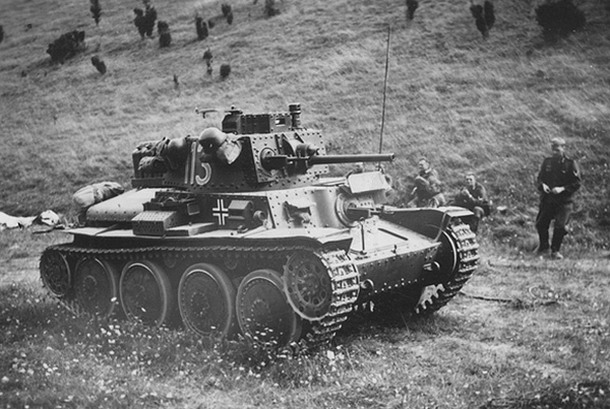
PzKpfw 38(t), apparently Ausf. B, source: Flickr.com with permission of the publishing user, edited
The crew consisted of four men. The already mentioned driver and radio operator/machine gunner sat side by side in the front of the hull, separated by the gearbox. Behind them were the other two crew members — the loader and the commander, who also operated the gun. These two soldiers sat on seats suspended from the turret ring and therefore rotated with the turret. For the original Czechoslovak LT vz. 38 no intercom — an internal radio for communication between crew members — was apparently planned. The driver and commander could, however, communicate via an interesting signalling device: a set of three coloured bulbs (green, red and blue) with corresponding buttons. The driver's panel was positioned to the right of his main vision port, and the commander had his assembly in the left corner of the turret front wall. Lighting the bulbs in different combinations carried different agreed meanings. The Germans replaced this impractical arrangement with an intercom to which headphones and microphones were connected for all crew members except the loader.
The Czechoslovak army intended to equip the new tanks with domestically produced radio sets. The LT vz. 38 had two radio antennas for this purpose. The main 3-metre rod antenna was attached to the left corner of the crew compartment front plate. The second, so-called combat antenna was concealed in a tube running along the left side of the hull. After taking over the order, the Germans immediately replaced the planned Czech sets with their own Telefunken equipment. Standard combat tanks received only the Fu 2 receiver. Vehicles intended for platoon commanders carried the Fu 5 set, which combined a receiver and transmitter. Finally, company commander tanks were equipped with a combination of Fu 2 and Fu 5, giving them two receivers and one transmitter and therefore the ability to receive on two different frequencies simultaneously. All of these tank variants had only a single rod antenna, however. To make room for the expanded radio equipment, the hull machine gun was removed from platoon and company commander vehicles and the opening was simply covered with a circular armour plate. The gun armament and turret machine gun were retained. Beyond these modified tanks, there were also considerably more specialised command versions for higher-echelon commanders (at battalion and regimental level), but we will come to those later.
As already mentioned, production of the 150 PzKpfw 38(t) Ausf. A tanks ran from June to November 1939. The vehicles received simple serial numbers from 001 to 150. During production a number of minor modifications were introduced. From July 1939 a bracket for smoke grenades was added to the rear above the exhaust silencer — standard equipment on German tanks. If threatened, the crew could discharge the grenades directly from the crew compartment and withdraw under the resulting smoke screen. Toward the end of the production run the combat antenna tube above the left mudguard was no longer fitted; in its place a Notek driving light appeared on the mudguard, along with a rear convoy light.
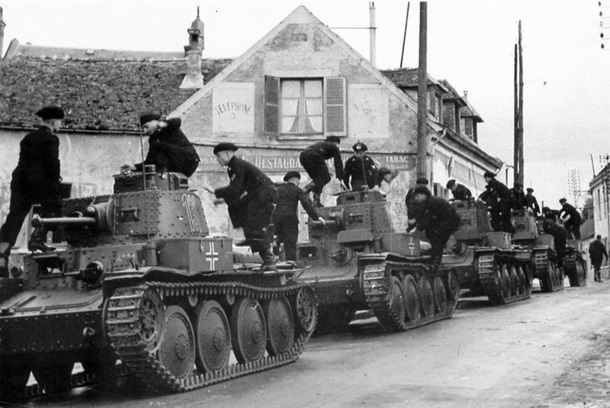
PzKpfw 38(t) of the 7th Panzer Division during the conquest of France in May and June 1940, source: flickr.com with permission of the publishing user, edited
Ausführung B
The modern Czechoslovak tank was undeniably a welcome prize for the Germans. But truly a godsend for the occupiers was the completely prepared series production capability that came with it. In the middle of 1939, the German armoured forces relied on light PzKpfw I and PzKpfw II tanks armed only with machine guns or a weak 20 mm gun respectively. The more substantial production of the medium PzKpfw III (37 mm gun) and PzKpfw IV (75 mm gun) was only just getting under way. Another tank with gun armament was therefore very welcome indeed. It is no surprise, then, that as early as June 1939 the German Waffenamt placed an order for a further 325 Panzer 38(t) tanks, to be delivered in three production batches (110 + 110 + 105 vehicles).
Tanks from the first of these batches were designated Ausf. B and were delivered between January and May 1940. The tank's design was essentially unchanged from the Ausf. A. The Notek driving light and convoy light were now standard equipment. The combat antenna tube was no longer fitted, but the rod antenna base remained the original cylindrical type for now. The top of the commander's rotating periscope on the turret roof received an armoured cover, and a small metal rain deflector was added above the gun sight aperture in the turret front wall. The stowage arrangement for tools on the track mudguards and various other details also changed. Ausf. B vehicles carried serial numbers 151 to 260.
Ausführung C
In May 1940, the third production batch entered production, designated Ausf. C. By August of the same year, 110 of these tanks had been built, with serial numbers 261 to 370. The first vehicles of this variant were essentially indistinguishable from the late vehicles of the preceding variant, as most of the design changes only came during the Ausf. C production run. The most significant modification was probably the strengthening of the hull front plate from the original 25 to 40 mm. Also worth noting is a turret ring guard in the form of three steel sections fastened to the crew compartment roof plate in front of the turret.
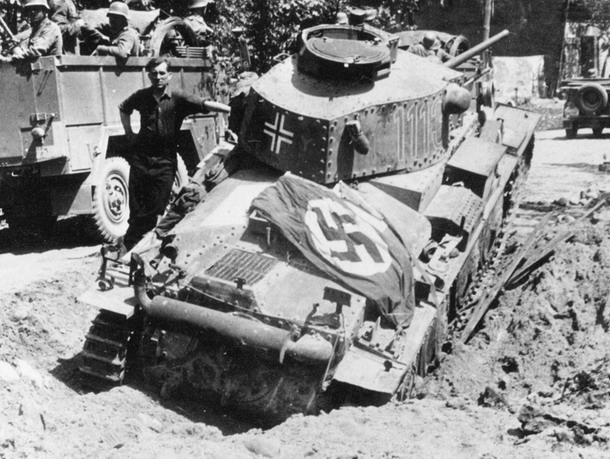
a fine view of the rear of the PzKpfw 38(t), source: flickr.com with permission of the publishing user, edited
Ausführung D
From September to November 1940, the fourth Panzer 38(t) production series was built, designated Ausf. D. A total of 105 vehicles were produced, with serial numbers 371 to 475. The Ausf. D brought only minimal changes, among which we can mention the replacement of the original cylindrical rod antenna bracket with the standard German type featuring a flexible rubber base.
The Ausf. A through D tanks were generally very similar to one another and can sometimes be virtually impossible to tell apart in photographs. This is compounded by the fact that when damaged tanks were withdrawn from the front for major repairs, they were often simultaneously updated to the latest design standard, bringing newer design features onto older vehicles. It was in exactly this way that some Ausf. C and Ausf. D tanks had their exhaust silencer moved higher to allow a smoke grenade bracket to be fitted beneath it.
Ausführung E
In response to the good performance demonstrated by the Panzer 38(t) during the Polish campaign in September 1939, the German Waffenamt placed an order for a further 275 vehicles before the end of that year. Based on the lessons learned in Poland, however, these tanks were to have heavier armour. The new production series received the designation Ausf. E and serial numbers 476 to 750. A larger number of design changes were made this time around. The front wall of the crew compartment was no longer stepped — it was now flat, which was simpler to manufacture. At the same time this wall was also reinforced from the original 25 mm to 50 mm. For some reason, however, the designers did not use a single homogeneous plate of the required thickness, but joined two plates each 25 mm thick. The hull frontal armour and the turret front wall were reinforced to 50 mm (25 + 25) in the same way. Additional 15 mm armour plates were also added to the sides of the crew compartment. The turret sides and rear, however, were reinforced using homogeneous armour — 30 mm on the sides and 25 mm on the rear. The mounting of the armour plates to the skeleton was also simplified, reducing the total number of rivets and bolts.
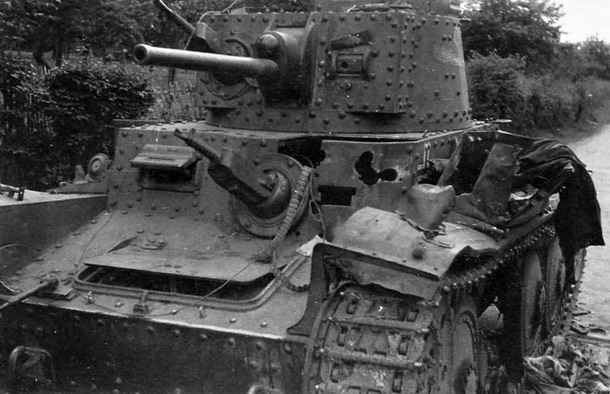
a shot-up PzKpfw 38(t); enemy fire has completely torn off the radio operator's vision port cover and his hatch cover, source: worldwarphotos.info with permission of the site owner, edited
Let us pause for a moment on the armour reinforcement mentioned above. Some reliable sources do not mention the use of double-layer armour on the hull, crew compartment and turret fronts at all. According to these sources, homogeneous rather than laminated armour was used on the Ausf. E. It does admittedly seem rather illogical that the designers would change the crew compartment front wall from a stepped to a flat design, yet make it only 25 mm thick rather than the required 50 mm and then laboriously attach a second plate of the same thickness on top. There are, however, photographs that rather clearly demonstrate that this was indeed the case. The photographs in question show a PzKpfw 38(t) Ausf. E captured by the Red Army from the German 20th Panzer Division on 23 July 1941. This vehicle was subsequently subjected to a range of tests, including firing trials from various weapons. The photographs showing the results of the firing trials clearly show the double-layer armour on the turret front wall (photos HERE and HERE, source: Flickr.com) and on the hull front plate (photos HERE and HERE, source: Flickr.com).
Returning now to the description of the Ausf. E: a new bracket was fitted to the hull front plate to carry 7 to 8 spare track links, which further increased the protection of this area against hits. A further ten spare track links were stored on the nose roof plate, five on each side. The original driver's and radio operator's vision port covers in the crew compartment front wall were replaced by new cast covers, which were more resistant and at the same time simpler to manufacture. The Ausf. E tanks received new tracks with lightened guide horns.
The main and fundamental innovation of the Ausf. E was in any case the increase in armour protection. This naturally meant an increase in the vehicle's weight — from the original 9,725 kg to 10,354 kg. The great majority of this increase was in the front half of the vehicle (due to the reinforced frontal armour). The front pair of road wheel springs therefore had to be strengthened: a fifteenth leaf was added to the front leaf spring, which had previously consisted of fourteen. Beyond the above, a further series of smaller modifications was carried out on the PzKpfw 38(t) Ausf. E that are not worth listing in full. It should be added, however, that the overall weight gain had no effect on the vehicle's driving characteristics. Production of the Ausf. E ran from November 1940 to May 1941.
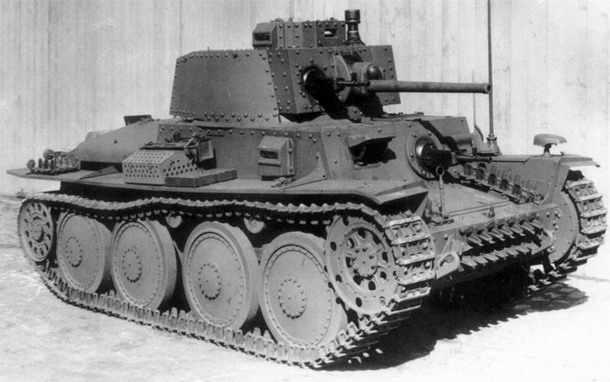
a brand-new PzKpfw 38(t) Ausf. F in the factory yard; note the spare track links on the hull front, source: Praga archive with permission of the company representative, edited
Ausführung F
As early as the beginning of 1940, ČKD (by then operating under the name Böhmisch-Mährische Maschinenfabrik AG, abbreviated BMM) received an order for a further 250 tanks. This was the sixth production series, designated Ausf. F. Production of this series partially overlapped with the preceding Ausf. E and subsequently continued until October 1941. These tanks differed from the previous variant only minimally (for example, the driver's rear-view mirror on the left track mudguard was deleted). PzKpfw 38(t) Ausf. F vehicles carried serial numbers 750 to 1000.
Ausführung G and H
In 1941 the Waffenamt placed orders for two further production series of 500 tanks each. Tanks from these series received the designations Ausf. G and Ausf. H. Compared to the two preceding variants, not a great deal changed. The main new feature was apparently the replacement of the laminated armour on the hull, crew compartment and turret fronts with homogeneous 50 mm plate. Some minor production simplifications were also made. The production plan called for delivery of one thousand tanks by April 1943. The course of the fighting on the Eastern Front, however, soon buried these plans. The Red Army was fielding ever-growing numbers of excellent medium T-34 tanks, which the light PzKpfw 38(t) simply could not compete with. The Germans understood that light tanks in general had no future in the front line. Further armour strengthening of the Panzer 38(t) was theoretically possible, but rearming it with a more powerful gun — ideally 75 mm calibre — was completely out of the question.
On the other hand, the tank's chassis was a very sound design with which both soldiers and mechanics had good experience. The Germans therefore decided to end production of the tank as such and use its chassis to build a self-propelled anti-tank gun — a tank destroyer. This was how the vehicle named Marder III came into being. From April 1942 the BMM factory was simultaneously producing both PzKpfw 38(t) tanks and the new Marder III tank destroyers. Production of both types continued in parallel in May 1942 as well, and only in June was light tank production definitively concluded. The last PzKpfw 38(t) Ausf. G left the factory on 20 June 1942. Of the 500 ordered Ausf. G tanks, only 306 were completed. Of the further 500 ordered Ausf. H tanks, not a single one was completed.
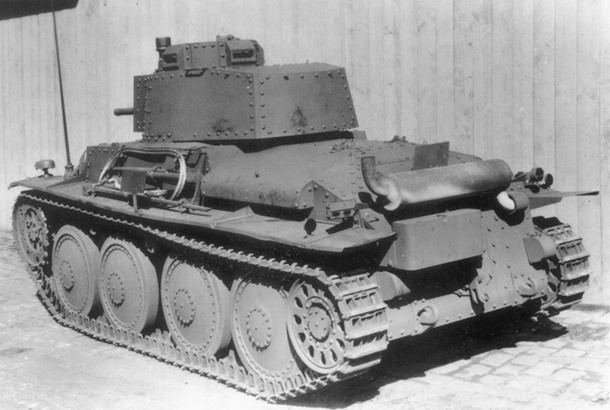
the same PzKpfw 38(t) Ausf. F from a different angle; note the covers for the idler wheel adjustment mechanism on the hull rear wall, source: Praga archive with permission of the company representative, edited
Ausführung S
Let us briefly return to the pre-war year of 1938. As mentioned above, ČKD was that year in negotiations to sell its new tanks to the Swedish army, and shortly before the proclamation of the Protectorate in March 1939 had even sent Sweden a price offer for fifty tanks, internally designated TNH-Sv. The Germans, after taking over the factory (and the entire country), continued negotiating with Sweden, with whom they generally had good commercial relations. The talks dragged on (apparently due to Swedish uncertainty about what would happen to ČKD and its product) but eventually, in December 1939, Sweden sent a military commission to Prague to inspect the subject of interest properly.
For this purpose, a prototype adapted to Swedish requirements was prepared at ČKD (by then BMM). The tank made an excellent impression on the foreign officers, and in January 1940 an order came from Sweden for 90 vehicles. The tanks were to be delivered without armament, as the Swedes planned to fit them with weapons of their own make. The contract was signed on 21 March 1940, setting out the details of the delivery. At that time ČKD already had Wehrmacht orders totalling 1,000 vehicles on the table (Ausf. A through Ausf. F), so the Swedish series was assigned serial numbers 1001 to 1090.
Assembly of the tanks for the Swedish army began in June 1940. On 18 July of that year, however, the German Army High Command decided to seize the entire series of part-built TNH-Sv tanks for its own use. The Swedes immediately opened negotiations about producing a replacement series, but these came to nothing. The Germans simply needed every available tank. An agreement was eventually reached to sell Sweden a production licence to manufacture the tank domestically.
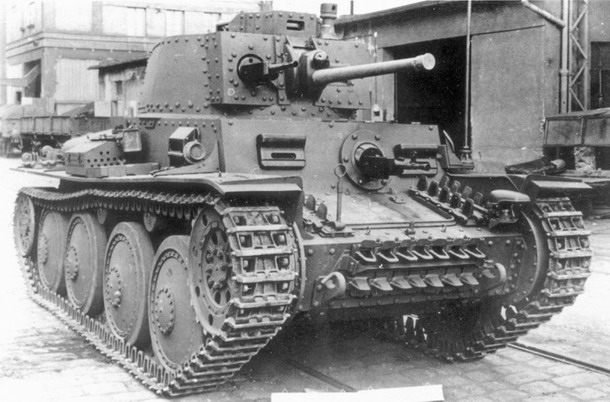
a fine factory photograph of a new PzKpfw 38(t) Ausf. G, source: Praga archive with permission of the company representative, edited
The ninety-vehicle series of confiscated tanks was assigned the designation PzKpfw 38(t) Ausf. S (S = Sweden). Since the tanks had originally been ordered without armament, the Germans now had to additionally order guns and machine guns for them. Moreover, these tanks had the lighter armour corresponding to the standard of the older variants. The Germans therefore had the armour plates on the frontal surfaces replaced with thicker ones to match the current Ausf. F standard. The side armour plates, however, remained unreinforced — creating a somewhat hybrid vehicle whose armour did not correspond to any standard production variant.
Production of the Panzer 38(t) ran from June 1939 to June 1942. A total of 1,396 were built in eight production series. The production cost of a single tank without armament, optics and radio equipment was around 56,000 Reichsmarks. In addition to BMM itself, a whole range of sub-suppliers of course participated in the tank's production. Guns were supplied by the already mentioned Škoda Plzeň, and machine guns by Zbrojovka Brno (specifically its factory in Vsetín). Gun and machine gun sights, as well as the optics for the observation periscopes, came from Optikotechna of Přerov.
After production at BMM switched from tanks to Marder III tank destroyers, workers completed a further 184 fighting turrets that were then used on various defensive lines in Norway, Denmark, Italy, France, the Balkans and also in Russia.
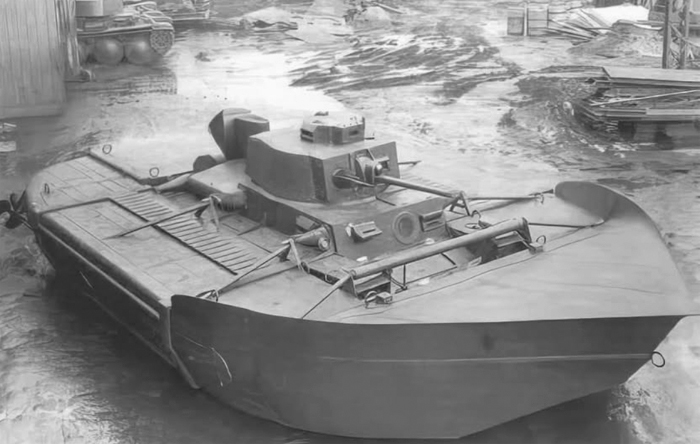
prototype of the amphibious PzKpfw 38(t), source: Flickr.com with permission of the publishing user, edited
The Amphibious Tank
From February 1941, work was carried out at ČKD (by then BMM) on the construction of a flotation device that would allow the Panzer 38(t) to travel on the water surface. The first prototype was completed in June 1941 and immediately tested on the Vltava river in Prague. At the rear of the float were two propellers connected to the tank's engine via a gearing arrangement. The engine compartment had to be hermetically sealed, and a kind of chimney newly installed above the engine section handled air intake and exhaust gas evacuation. The float was attached to the tank by locks that could be released from inside the fighting compartment, allowing the float to be jettisoned. This apparently had to happen only after the tank had fully driven ashore, however, as the front section of the float was too large for the tank to simply drive over it after jettisoning. The tank presumably had to jettison the float and then reverse out of it, which would not have been possible in the water. Although the prototype demonstrated its functionality on the Vltava, the float was not put into production and only the single built example was ever made.
PzKpfw 38(t) n.A.
During the first year of the war the Wehrmacht came to the conclusion that its armoured arsenal was badly lacking a fast tank capable of carrying out reconnaissance missions. At the time, reconnaissance was the domain of armoured cars and occasionally half-tracked vehicles. Armoured cars, however, were too vulnerable and also incapable of crossing difficult terrain. Half-tracks such as the Sd.Kfz. 250 could handle cross-country travel but were too slow and also rather lightly armoured. Nor did any tank then available to the Germans meet the requirements of reconnaissance work (there were the light PzKpfw II Ausf. D and Ausf. E, which were theoretically fast enough for reconnaissance missions, but in practice these vehicles proved rather unsatisfactory). The Waffenamt therefore approached MAN, BMM and Škoda-Werke (Škoda Plzeň) in July 1940 with a request to develop a new fast reconnaissance tank weighing 11 to 13 tonnes and capable of reaching 50 to 60 km/h. Each of the approached manufacturers was to build five evaluation prototypes — two in mild steel and three with full armour.
Škoda submitted its T-15 prototype for this competition. MAN's entry was the PzKpfw II Ausf. L, better known by its combat name Luchs. BMM bet on its proven TNH tank and prepared a modernised version designated Praga TNH n.A. The Germans apparently referred to this vehicle as PzKpfw 38(t) n.A. The letters n.A. in both names abbreviated either neue Ausführung (new variant) or neuer Art (new type).
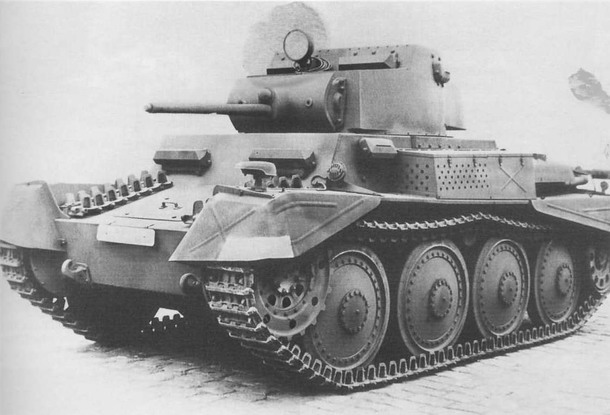
prototype of the reconnaissance tank TNH n.A., also known as PzKpfw 38(t) n.A., source: Praga archive with permission of the company representative, edited
Although the new BMM reconnaissance tank was derived from the classic PzKpfw 38(t), it was only marginally so — in essence it was a newly developed vehicle. What primarily linked the prototype and the series tank was the chassis, though even that had undergone many modifications. Despite appearances to the contrary, the prototype even received new road wheels that were larger than those on the production PzKpfw 38(t) and therefore better suited for high-speed travel (the road wheels on the production PzKpfw 38(t) had a diameter of 775 mm; on the TNH n.A. prototype they were 810 mm). This allowed one return roller to be removed, so the TNH n.A. had only one, positioned between the second and third road wheels.
BMM delivered the first prototype on schedule in December 1941, with the remaining four following between January and April 1942. The first one or possibly two examples had riveted hulls and turrets; the subsequent prototypes already had welded hulls and turrets. Hull front armour was 30 mm, sides and rear 20 mm, roof and floor 10 mm and 8 mm respectively. The fighting turret had a rounded gun mantlet 30 mm thick (some authors give 50 mm). The turret sides and rear were 20 mm armour. An interesting feature was the raised central section of the turret roof, which effectively replaced the traditional commander's cupola. This section was fitted with two periscopes at the front, two at the rear and one on each side. The new tank's main armament was the Škoda A 19 gun in 37 mm calibre — nothing other than the A 7 gun used on the production PzKpfw 38(t), modified for mounting in a rounded mantlet. To the right of the gun was a standard German MG 34 machine gun in 7.92 mm calibre. Gun stowage was 90 rounds and 2,100 machine gun rounds were carried.
The THN n.A. also received a new eight-cylinder Praga NR engine of 14.236 litres displacement. Maximum power figures quoted for this engine range from 225 to 265 hp depending on the source. The gearbox was a Praga Wilson. The vehicle's weight was around 11.8 tonnes. According to some authors the tank could achieve a maximum road speed of 64 km/h; others report that during trials the 70 km/h barrier was broken. The crew of four followed the traditional composition: driver, radio operator, loader and gunner/tank commander. It is worth noting that, unlike the production PzKpfw 38(t), the TNH n.A. had the driver's station on the left. Radio equipment consisted of Fu 2 and Fu 5 sets.
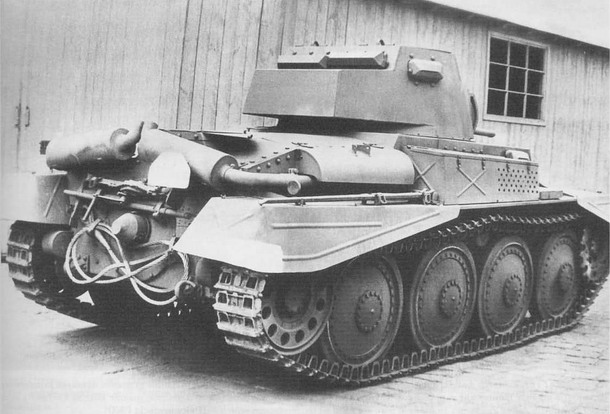
prototype of the reconnaissance tank TNH n.A., also known as PzKpfw 38(t) n.A., source: Praga archive with permission of the company representative, edited
Testing of prototypes from all three competing manufacturers apparently ran from March to June 1942 at Kummersdorf. According to a report dated 27 June 1942, the TNH n.A. prototype covered 3,866 kilometres during the trials while exhibiting only minimal mechanical failures. The vehicle was easy to handle and gave the crew an excellent field of view. The BMM prototype therefore passed its tests, as did the MAN vehicle. The Škoda T-15 prototype left a rather more negative impression. The overall competition winner was ultimately the MAN design. According to some historians, however, this was an undeserved victory driven more by political considerations (how could a Slavic design be better than a German one?) than by technical merit. The TNH n.A. therefore did not reach series production and remained at only five prototypes. Four were taken by the Germans; one remained the property of BMM, which continued to experiment with it (fitting it experimentally with a Tatra T-103 diesel engine, for example).
Aufklärungspanzerwagen 38(t)
BMM's efforts in the field of reconnaissance vehicles did not end there. Why? The competition winner, the PzKpfw II Ausf. L Luchs from MAN, did not enjoy its glory for long. It turned out to be relatively complex to manufacture and therefore expensive. In May 1943 its production was therefore halted on grounds of general cost-cutting. The Prague-based BMM naturally sensed an opportunity to re-enter the game for the light reconnaissance tank. The company's management thought very pragmatically. If the Germans had cancelled the Luchs in the search for savings, an alternative should be offered that would be very cheap. And that would be achieved by building the vehicle on the standard production PzKpfw 38(t) chassis, modifying only the "upper portion." This was how the reconnaissance tank proposal later known as the Aufklärungspanzerwagen 38 (2 cm) came into being.
The designers at the Prague plant therefore took the chassis and hull of a standard tank (incidentally, this was precisely the period when tank production was in any case being wound down and the production lines were transitioning to the Marder III tank destroyer), retained only the front wall of the original crew compartment, and behind it built a completely new crew compartment widened outward to the edges of the track mudguards. The walls of this new compartment were joined by rivets to a skeleton of steel angle sections. The new compartment was also somewhat taller than the original, and on its roof sat a low fighting turret. In a further effort to reduce production costs, the designers used the turret being developed at that very time for the forthcoming heavy armoured car Sd.Kfz. 234. It had a hexagonal footprint with sloped walls. Turret armour was 30 mm at the front and 14.5 mm on all other surfaces. The turret had no roof — only its front section was protected by a raised frame filled with heavy wire mesh. The wings of this mesh cover could be folded down to the sides. The mesh obviously could not withstand fire, but it was intended mainly to prevent hand grenades from being thrown into the vehicle. In bad weather the crew in the turret had to shelter under a waterproof tarpaulin.
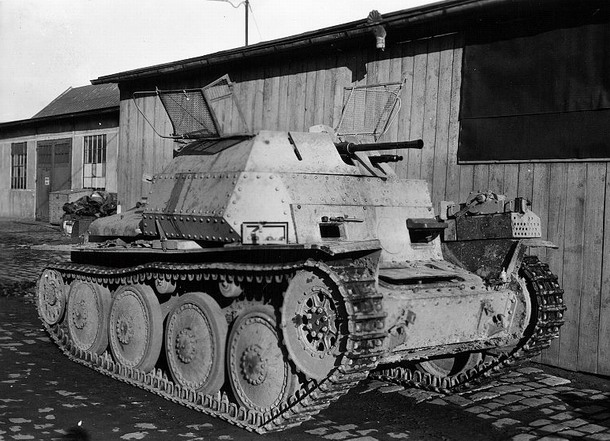
prototype of the reconnaissance tank Aufklärungspanzerwagen 38(t), source: Praga archive with permission of the company representative, edited
At the junction of the two front turret walls was a cutout through which the barrel of the KwK 38 L/55 gun in 20 mm calibre projected. To the left of the gun was a further cutout in the turret front wall for the barrel of an MG 34 machine gun. Both weapons were installed together in a Hängelafette 38 mounting. The hull machine gun was removed and the opening sealed with a circular armour plate, just as on the command tanks. Since one of the reconnaissance tank's priorities was speed, the Aufklärungspanzerwagen 38 received a more powerful Praga AE engine (the same one later used in the Hetzer tank destroyer) developing 150 hp. Maximum road speed was around 45 km/h.
BMM offered the army a balanced vehicle resting on an already established and proven chassis, supplemented by a simple crew compartment and a turret that was already being prepared for production for another vehicle anyway. This meant negligible development costs and the ability to launch series production almost immediately. The Waffenamt was evidently taken with this and ordered production of an initial series of 70 vehicles. Five were to be delivered in October 1943, a further 20 in November, 25 in December and the last 30 in January 1944. Due to various delays, however, BMM delivered the first 37 vehicles only in February 1944 and the remaining 33 a month later (and reportedly some of these were delivered without armament). The vehicles were to form reconnaissance platoons of 25 vehicles each, of which 9 would be equipped with powerful Fu 12 radio sets with star-shaped antennas and the remaining 16 would carry the weaker Fu.Spr.Ger. f set.
The first 25 vehicles were received in April 1944 by the first company of the Grossdeutschland division's reconnaissance battalion. A further 25 were sent to the reconnaissance battalion of the 3rd Panzer Division. Production was not continued further, and little information has survived about the combat fate of those sole 70 vehicles.
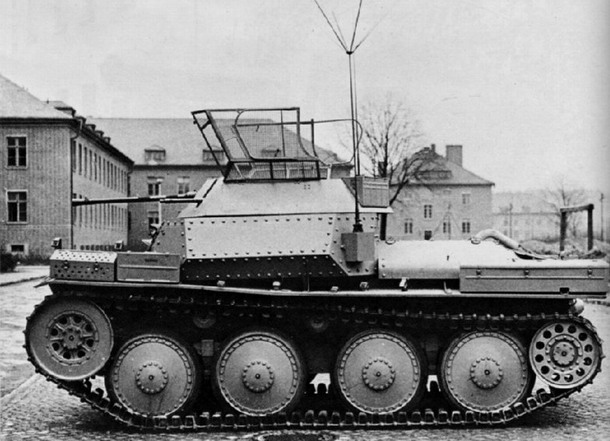
prototype of the reconnaissance tank Aufklärungspanzerwagen 38(t), source: Praga archive with permission of the company representative, edited
In addition to the reconnaissance tank described above, the BMM designers also proposed a vehicle intended to provide heavier fire support for reconnaissance units. The reason was simple: the Aufklärungspanzerwagen 38 carried only a 20 mm gun, which was not a particularly destructive weapon. It was therefore to operate in tandem with a similar vehicle armed with a short 7.5 cm Kanone L/24 in 75 mm calibre. Surviving photographs show that the designers produced two versions of this vehicle, differing in the form of crew compartment armour. In both cases, however, only non-functional demonstrators with dummy guns were built. The German army was evidently not interested, as no production order was placed and no functional prototype was apparently built.
Command Variants
As already described above, Panzer 38(t) tanks were supplied with different combinations of radio sets depending on whether they were standard tanks, platoon commander tanks or company commander tanks. Beyond these, however, there were also specially adapted command tanks (German: Panzerbefehlswagen) intended for commanders at battalion and regimental level. Even reliable literature is divided on the number of command tank variants of the Panzer 38(t). According to some authors, only two command variants were built, designated Sd.Kfz. 267 and Sd.Kfz. 268. Other sources hold that three variants existed: Sd.Kfz. 266, 267 and 268. Whichever is correct, we will describe all three cited variants.
The first command variant with ordnance code Sd.Kfz. 266 was intended for battalion headquarters and its radio equipment consisted of Fu 5 and Fu 2 sets. The second command variant, Sd.Kfz. 267, carried Fu 2 and Fu 8 sets and was intended to serve commanders at tank regimental headquarters. The powerful Fu 8 set allowed voice communication at ranges of up to around 20 km. The third command variant, designated Sd.Kfz. 268, carried Fu 2 and Fu 7 sets and was intended for communication with the Luftwaffe. The Fu 7 set had an impressive voice range of around 50 km.
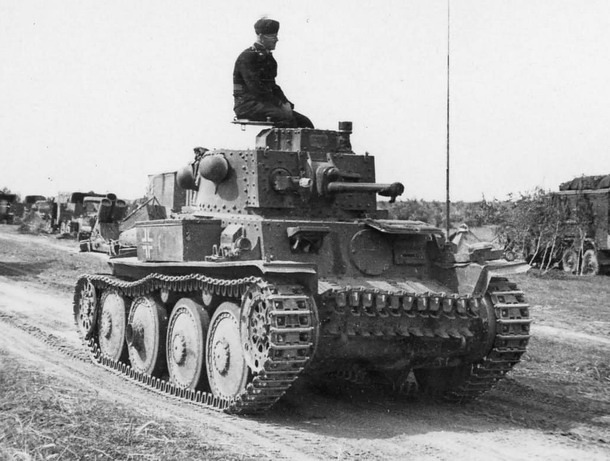
PzKpfw 38(t) intended for a platoon commander; the hull machine gun has been removed to make room for the expanded radio equipment; also of interest on this vehicle is the smoke grenade launcher at the rear of the mudguard, source: flickr.com with permission of the publishing user, edited
To find room inside the relatively small tank for radio sets, their accessories and other special equipment, most of the armament had to be sacrificed. After all, a command tank was not intended for fighting but for commanding. The Panzerbefehlswagen 38(t) therefore lost its gun and hull machine gun, retaining only the turret machine gun (according to some authors, command tanks built on the Panzer 38(t) Ausf. A had the gun retained, and it was only from the Panzer 38(t) Ausf. B onwards that it was removed). To "deceive the enemy," a wooden dummy gun barrel was installed in place of the removed gun. The opening in the turret front wall where the gun sight had been now served as a simple observation port, and the opening left by the hull machine gun was covered with a circular armour plate. The turret traverse mechanism was also removed and the turret locked rigidly in the zero position — pointing directly forward. For service access to the engine compartment, however, the turret could be unlocked and rotated to the required position so it did not obstruct access (rotating the turret presumably first required disconnecting the cables powering the radio sets).
Command tanks also had further special equipment such as a directional gyroscope. The crew composition was also altered, consisting of a driver, commander and two radio operators, one of whom also operated the turret machine gun if necessary. The various command tank sub-variants can be distinguished in photographs by their antennas. The Sd.Kfz. 266 carried a single rod antenna, the Sd.Kfz. 268 had two rod antennas, and the Sd.Kfz. 267 added a prominent frame antenna mounted above the engine compartment to one rod antenna.
Organisation and Combat Deployment
Like other German tank types, the PzKpfw 38(t) was organised into standard Panzer divisions — though not immediately. The very first unit to receive these tanks was the 3rd Light Division (3. leichte Division), specifically its 67th Tank Battalion (Panzer Abteilung 67). The battalion consisted of three companies, each with four platoons. Each platoon had four tanks. The PzKpfw 38(t) was mixed here with light PzKpfw II tanks.
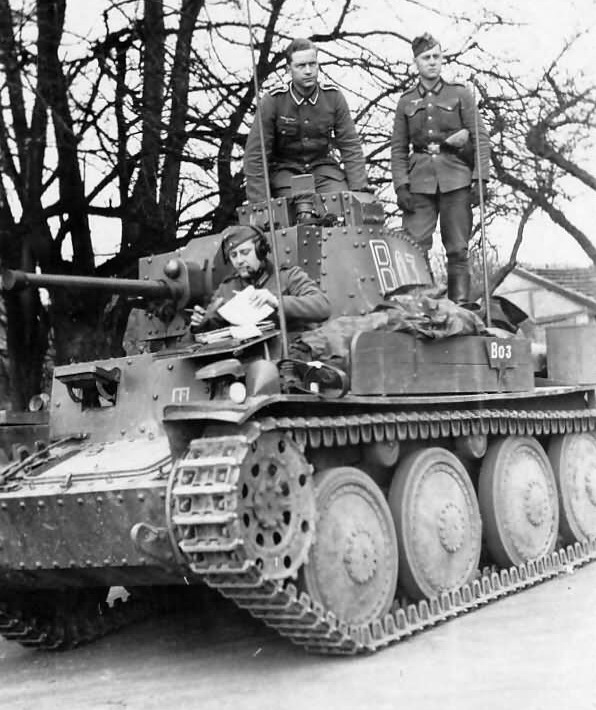
PzKpfw 38(t) command tank in the Sd.Kfz. 268 version; the gun mantlet is slightly different from that of a standard combat tank, which confirms that the barrel here is a wooden dummy, source: worldwarphotos.info with permission of the site owner, edited
On 1 September 1939 — the day the Second World War began — BMM had completed 78 Panzer 38(t) tanks. However, only 57 were committed to the attack on Poland (two of them in command configuration), in the already-mentioned Panzer Abteilung 67 of the 3rd Light Division. This division was subordinated to the 10th Army within Army Group South. The 3rd Light Division and its tanks crossed the Polish border in the direction of Częstochowa and continued eastward through Żarki and Koniecpol. In the fighting around Koniecpol the division lost its first PzKpfw 38(t) to a hit from a Polish 37 mm anti-tank gun. From there the unit pressed further east to the town of Ostrowiec, where it turned north and advanced toward the town of Iłża, which was soon taken. The division continued northward along the left bank of the Vistula. West of Warsaw it helped repel the Polish counter-attack at the Bzura river. From there it moved further north-east to take part in the siege and capture of the Modlin fortress at the confluence of the Vistula and Narew rivers. The rest of the Polish campaign was spent at Modlin, as the fortress did not surrender until 29 September.
Sources agree that the 3rd Light Division lost a total of seven Panzer 38(t) tanks during the Polish campaign. According to some authors all seven were repaired; according to others all seven were written off completely. In any case, seven destroyed tanks represents losses of approximately 12 percent of all committed PzKpfw 38(t). The fighting in Poland revealed both the strengths and weaknesses of these tanks. The main weakness proved to be their thin armour. The tank could withstand fire from infantry rifles, but 37 mm anti-tank guns penetrated even the frontal armour without difficulty — and at closer ranges even 20 mm guns were sufficient. The main strength of the tank, meanwhile, was its reliability. The Panzer 38(t) experienced only minimal mechanical failures throughout the entire campaign.
The 3rd Light Division was restructured after the end of the Polish campaign into the 8th Panzer Division, which continued to be built around PzKpfw 38(t) tanks. The second division to be equipped with these tanks was the 7th Panzer Division. Both divisions took part in the attack on the Benelux countries and France in May 1940. The 7th Panzer Division went into battle with 91 Panzer 38(t) tanks plus a further 8 in command configuration. The 8th Panzer Division had 116 tanks of this type plus a further 15 command vehicles. Operation Gelb therefore committed a total of 207 standard and 23 command PzKpfw 38(t) tanks. These vehicles thus represented around 8.5% of the German tank forces committed to the attack on France. Far more interesting, however, is to set aside the other types (especially the light Panzer I and Panzer II) and compare like with like — the PzKpfw 38(t) with the PzKpfw III. Seen this way, the Czechoslovak vehicles made up around 37% of the tanks in their category committed by the Germans to France. That is a truly significant proportion!
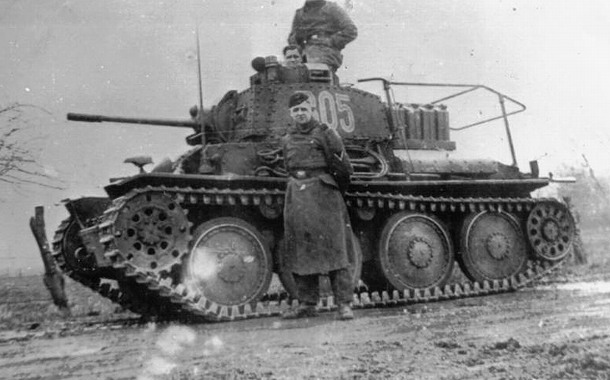
PzKpfw 38(t) command tank in the Sd.Kfz. 267 version with the frame antenna above the engine compartment; the gun barrel is a wooden dummy, source: worldwarphotos.info with permission of the site owner, edited
The 7th Panzer Division, commanded by Major General Rommel, came under the 15th Motorised Corps (XV Armeekorps (mot.), General of Infantry Hermann Hoth) in France, which was part of the 4th Army under Colonel General Günther von Kluge. The division swept rapidly across Belgium in the direction of St. Vith and Marche-en-Famenne. By 12 May 1940 — after only two days of marching — the division had covered nearly one hundred kilometres of Belgian territory and stood on the bank of the Meuse. The first of Rommel's men crossed the river at Houx during the night of 12 to 13 May. The tanks crossed to the other bank at Dinant the following day. By the evening of 16 May, after heavy fighting with the French 1st Armoured Division, the 7th Panzer Division crossed the Belgian-French border near Sivry-Rance and rolled on toward Cambrai. On 21 May the division repelled a British Expeditionary Force counter-attack near Arras and pressed irresistibly on toward Lille.
The German 8th Panzer Division took its PzKpfw 38(t) tanks into the French campaign somewhat further south, as part of XLI Motorised Corps (XLI Armeekorps (mot.), Lieutenant General Georg-Hans Reinhardt), which came under the 12th Army of General Ewald von Kleist. The division passed through Luxembourg, entered Belgian territory at Martelange, crossed the "impenetrable" Ardennes hills and forests and subsequently crossed the Belgian-French border north of Bouillon. It crossed the Meuse at Nouzonville and advanced westward past Cambrai, south of Arras to Mondicourt and then northward. On 28 May it stood at Hazebrouck near Saint-Omer (only 40 km from the port of Dunkirk).
At the turn of May and June, the objectives of Operation Fall Gelb (the first phase of the attack on France) had been achieved. German units regrouped and launched the second phase, codenamed Fall Rot, in which both the 7th and 8th Panzer Divisions headed south. The 7th Division advanced close to the Channel coast, first across the Somme at Abbeville, then through St. Valery-en-Caux, across the Seine, until on 18 June it reached Cherbourg, where its fighting essentially ended. The 8th Panzer Division moved south-east with Guderian's tank group to clear the area west of the Maginot Line. On 10 June the division was at Rethel and continued through Suippes, Saint-Dizier, Chaumont, Langres and finally to Épinal, where the division's combat actions ended with the French capitulation.
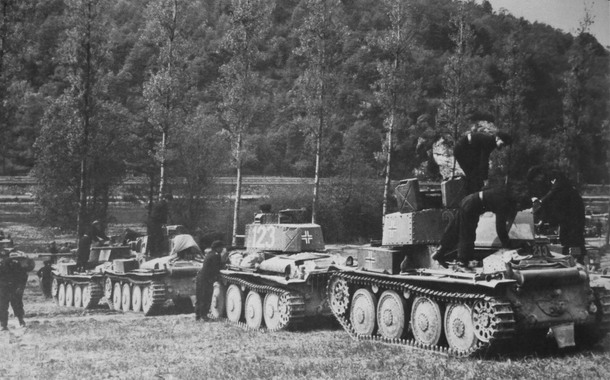
Rommel's PzKpfw 38(t) tanks arriving at the Meuse river, source: Flickr.com with permission of the publishing user, edited
When the Germans tallied their tank losses after the fighting ended, they arrived at a figure of 54 PzKpfw 38(t) destroyed. Here too the literature disagrees about how many were permanently lost. Most sources give this figure as the definitive total, but elsewhere one can read that 48 of the 54 were repaired and only 6 had to be completely written off (which seems rather hard to believe). Generally speaking, the Praga tanks again distinguished themselves in France primarily for their reliability. At the same time, however, it was becoming clear that the 37 mm gun was not adequate armament for destroying enemy armoured vehicles.
April 1941 brought the German invasion of Greece and Yugoslavia. The 8th Panzer Division with its 125 Panzer 38(t) tanks (7 of them command vehicles) took part in this operation codenamed Marita. The division came under the 46th Motorised Corps, part of the 2nd Army. The unit launched its attack on Yugoslavia from Hungarian territory and advanced through Belgrade, Valjevo and Nikšić to Kotor on the Adriatic coast. During the Yugoslav operation, which lasted only twelve days from 6 to 18 April, the Germans lost 7 Panzer 38(t) tanks. As usual, it is not clear whether these were complete write-offs or not — some authors hold that all seven vehicles were subsequently returned to service. The Yugoslav army was of course no match for the German one. A greater obstacle for the German fighting vehicles than the enemy itself was the difficult terrain and poor roads. Tanks that had covered five to six hundred kilometres under these conditions were ready for engine, gearbox, road wheel and track replacement.
The swan song of the PzKpfw 38(t) (and of front-line light tanks in general) was the attack on the Soviet Union. At the first light of dawn on 22 June 1941, exactly 660 Panzer 38(t) tanks stood on the German start line, distributed among five Panzer divisions. The 7th Panzer Division had 167 combat and 7 command vehicles, the 8th Panzer Division 118 combat and 7 command, the 12th Panzer Division committed 109 combat and 8 command, the 19th Panzer Division had 110 combat and 11 command, and finally the 20th Panzer Division had 121 combat and 2 command PzKpfw 38(t) tanks — a total of 625 combat and 35 command vehicles. For completeness, a further hundred or so of these vehicles were with training units away from the front at the same time.
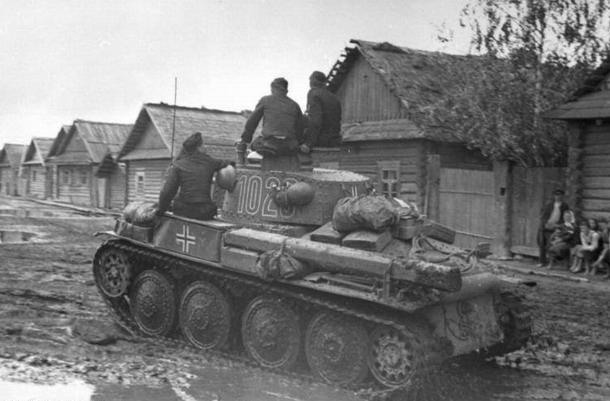
PzKpfw 38(t) passing through a typical Russian village main street, source: Bundesarchiv_Bild_101I-265-0037-10, Wikimedia, Creative Commons, edited
The 8th Panzer Division entered Operation Barbarossa as part of LVI Panzer Corps, which was subordinated to Panzergruppe 4 within Army Group North (Heeresgruppe Nord). The division set out from East Prussia and advanced through Lithuania, Latvia and Estonia toward Leningrad. The other four Panzer divisions (7th, 12th, 19th and 20th) were distributed between the 39th and 57th Panzer Corps, both of which came under the 3rd Panzer Group within Army Group Centre. The 3rd Panzer Group launched its attack from occupied Poland and participated in the enormous encirclement operations on the central sector of the front, advancing in the direction of Moscow. In early December 1941 the group came close to Moscow but subsequently had to fall back.
The Panzer 38(t) could cope with the light Soviet BT and T-26 tanks, but it was completely outclassed by the medium T-34 and the heavy KV. Losses of Panzer 38(t) tanks in the Russian campaign were on an entirely different scale from the preceding two years. From July to December 1941 the Germans were losing an average of 127 of these tanks every month (these figures represent permanent losses plus damage that could not be repaired in frontline workshops, though a smaller proportion of vehicles was repaired after being sent back to the home factory). For example, the 12th Panzer Division, which had entered the operation on 22 June with 109 PzKpfw 38(t), by 26 August had only 42 operational and 20 under repair. Production was running at full capacity but could not keep pace with the losses. By 1 January 1942 the total number of Panzer 38(t) tanks in the German army had fallen to only 373 vehicles.
By this time the Germans already understood that this vehicle had no future in the front line. Unfortunately there was nothing to replace it with yet, so production and equipping of units continued. In 1942 the 22nd Panzer Division received these tanks and fought with them on the Eastern Front until the division was destroyed at Stalingrad. During 1942 the Germans lost 429 PzKpfw 38(t) tanks; in 1943 the figure was "only" 222; and in 1944 no combat losses of this type were recorded at all. By 1 October 1944 the German army still counted 229 of these tanks, apparently distributed among various training, security or anti-partisan units. It should also be noted that from 1942 onwards these tanks were also incorporated into armoured train compositions. The complete tank simply drove onto a flatcar, rode with the train and fired from its rotating turret wherever needed.
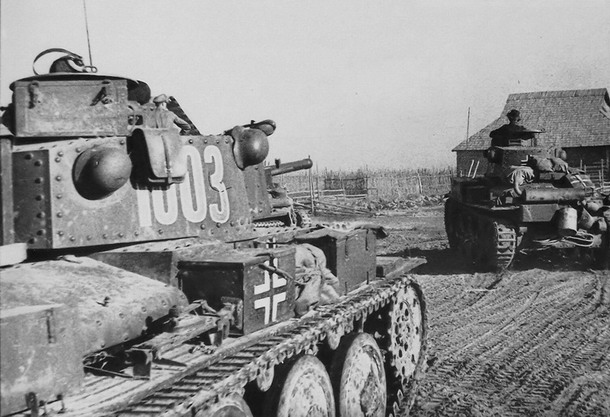
two PzKpfw 38(t) tanks in a Russian village, source: Flickr.com with permission of the publishing user, edited
In preparation for the invasion of the Soviet Union, some PzKpfw 38(t) tanks were modified in late May 1941 to tow a special trailer carrying additional fuel. The aim was naturally to extend the vehicle's range and reduce its supply demands — which made sense given the vast distances of the Soviet Union. The trailer itself was a fairly simple affair — essentially a 200-litre drum on a two-wheeled chassis. A rubber hose with a quick connector was attached to the drum. A similar hose was installed on the tank and led out through the rear hull wall. When the tank had consumed the petrol in its own tanks, a crew member dismounted, connected the hose at the rear of the tank to the hose running from the drum, and apparently using a hand pump transferred the fuel from the drum into the internal tanks. The tow hitch at the rear of the tank was fitted with a release mechanism operable from inside the tank. This meant that if the tank came under fire and there was a risk of the fuel trailer being hit, the crew could quickly and safely jettison it.
In May 1942, tests were conducted on a PzKpfw 38(t) Ausf. G specially adapted for conditions on the African battlefield. The engine air intake and exhaust ventilation openings were modified, and crew compartment ventilation was also improved. Hooks for securing a tarpaulin to be draped over the engine deck during sandstorms appeared on the hull. An improved oil filter was fitted, along with brackets for drinking water jerrycans. The modified tank was tested but never put into production, and the PzKpfw 38(t) never saw service in Africa.
Probably only unofficially, a service and recovery vehicle was also built on the Panzer 38(t) chassis. The vehicle had no fighting turret or armament, but was fitted with a rotating crane installed above the engine deck. The circular opening remaining in the crew compartment roof after the removal of the fighting turret was apparently covered with a sheet metal or wooden cover. Available photographs appear to show two different crane designs, suggesting at least two examples of this vehicle were built (though this is of course not certain). This was most likely the creation of mechanics at some field service workshop, who made use of a written-off tank and presumably used the vehicle themselves for handling heavy components in field conditions (photos HERE and HERE, Flickr.com).
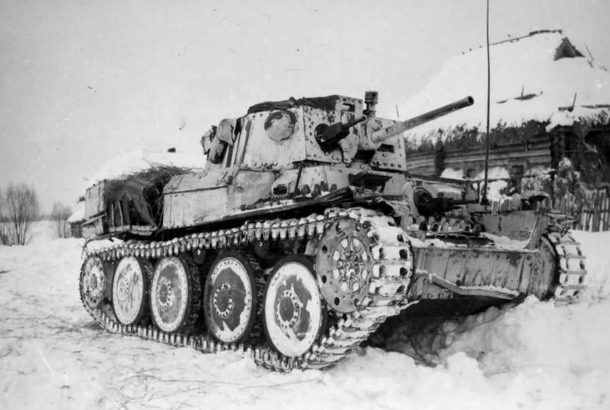
Panzerkampfwagen 38(t) in the Russian winter, source: worldwarphotos.info with permission of the site owner, edited
A conversion of the Panzer 38(t) into an ammunition carrier is also photographically documented. This was again probably a field conversion using the chassis of a written-off tank or tanks. The fighting turret was removed, the opening covered with a tarpaulin, and the crew compartment interior used for ammunition stowage. Such an ammunition carrier had two important advantages: its tracked chassis allowed it to cross difficult terrain and keep pace with the tanks it was supplying, and the vehicle was armoured so there was no risk of it being destroyed by a small-arms-wielding infantryman hitting the ammunition on board (or at least not as easily as with, say, a standard truck).
Other Users
When in 1938 the Czechoslovak Ministry of National Defence ordered the first 150 new LT vz. 38 tanks, it intended to assign some of them to the 3rd Tank Regiment in Turčianský Sv. Martin in Slovakia. As we already know, the German occupation and the outbreak of war buried all such plans. Slovakia became independent and joined Germany's side. Its interest in the promised light tanks persisted, however, and negotiations between the Slovak army and the Czech manufacturer (by then BMM) continued. These negotiations concluded in April 1940 with the signing of a contract for the delivery of ten tanks. BMM tracked these vehicles internally as TNH-S1, while the Slovak side designated them LT-38 (or TNH LT-38). The tanks were completed during October, November and December 1940 and handed over to the Slovak army in February 1941. Before that, in September, the Slovaks had expanded their order by a further twenty vehicles. These were not delivered until December 1941, as deliveries to the Wehrmacht naturally took priority. The last seven tanks were ordered by the Slovak army sometime in 1941 and received, apparently well into 1942. In total, our eastern neighbours purchased 37 tanks of this type from BMM. A further 37 PzKpfw 38(t) tanks were also received by the Slovaks from the Germans as "military aid" — 10 vehicles in August 1943, 12 in February 1944 and the last 5 in June 1944.
The Slovak LT-38 tanks fought on the Eastern Front alongside the German ones from June 1941 onwards. At first they were committed to the front line; as time went on they were used only in so-called security units, for guard, escort and similar duties. In August 1944 the soldiers from Turčianský Sv. Martin joined the Slovak National Uprising with their tanks. From August to October 1944, German units managed to destroy 27 of the rebel tanks and capture a further 20. A certain number of tanks did escape and reached the partisans. These vehicles were subsequently lost in clashes with the Germans or abandoned due to mechanical failure. With a degree of irony, one could say that when the Slovaks fought against the Germans in 1944, they suffered comparable losses in LT-38 tanks to those they had suffered in three years of fighting alongside them.
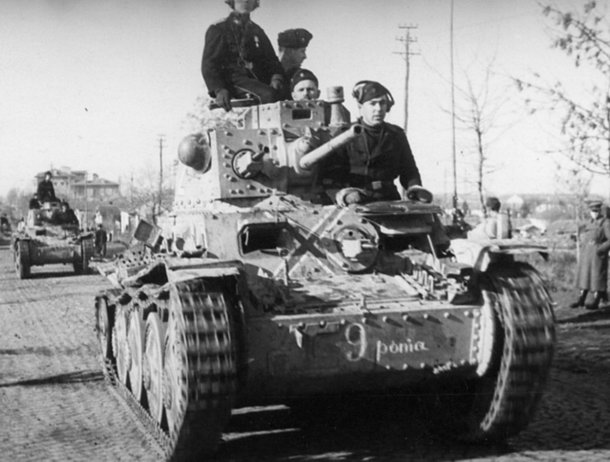
PzKpfw 38(t) in Bulgarian service, source: Flickr.com with permission of the publishing user, edited
A total of 108 PzKpfw 38(t) tanks were also received from the Germans by another ally, Hungary. The Hungarians had committed two armoured brigades to the attack on the Soviet Union in June 1941, equipped with light domestic and Italian-made vehicles. Between June and October these brigades lost around 80% of their equipment in hard fighting and were therefore withdrawn home in November. From November 1941 to February 1942 their soldiers took delivery of new PzKpfw 38(t) tanks supplied from Wehrmacht stocks. The Hungarian army designated these vehicles T-38. In the summer of 1942 the Hungarian tanks were back on the Eastern Front, helping the Germans advance on Stalingrad. While the German units were slowly and painfully fighting their way into the city, the Hungarians stood to the north with the task of protecting this flank from a Soviet counter-attack. That counter-attack, as we know, did eventually come. Numerically superior Soviet forces richly equipped with medium T-34 tanks broke through the Hungarian defensive positions in January 1943 as if they were not there. Not a single PzKpfw 38(t) committed to this battle returned from it. The Hungarian army was left with only 22 tanks of this type, which then served primarily as training vehicles until 1944. When the Eastern Front reached Hungarian territory in 1945, perhaps some of these tanks saw one last desperate combat deployment — though it was of virtually no consequence whatsoever.
Another German ally to receive PzKpfw 38(t) tanks was Romania. The Romanians had entered the attack on the Soviet Union with tanks they had previously purchased — the Škoda R-2 (the export version of the Czechoslovak LT vz. 35) and the Renault R-35. By that point these were already quite obsolete vehicles, though the Romanians made do with them until the end of 1942, when they lost most of their equipment in the fighting around Stalingrad. The Germans then had to help their ally rearm, and the choice fell on the PzKpfw 38(t) — which was by then also well past its prime, but still represented better equipment than what the Romanians were used to. The first fifty tanks were handed over from Wehrmacht stocks in March 1943. The Romanian army designated them T-38 and sent most of them with their crews to Crimea for conversion training on this "new" type. After a rapid training period the tanks moved about three hundred kilometres east to the Kuban region, where from the summer of 1943 they were committed to fighting the Red Army. They slowly but surely retreated from there back toward Crimea, and by April 1944 were fighting in defensive actions on the peninsula itself, falling back toward Sevastopol. Here the last of the committed Romanian T-38s were gradually lost. Only around twenty survived — those that had remained with a reserve unit in Bucharest. These vehicles took part in Romania's revolt against Germany in August 1944. The last operational Romanian T-38s made their final appearance supporting the Red Army's advance into Slovakia in February and March 1945, where the last serviceable examples were lost.
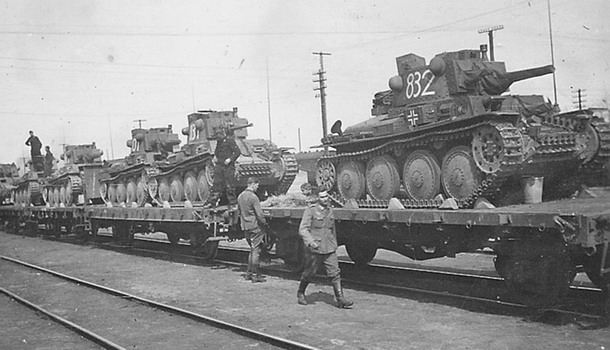
PzKpfw 38(t) tanks heading to the front, source: Flickr.com with permission of the publishing user, edited
The LT vz. 38 represented the cutting edge among light tanks at the time of its creation. Its armour was admittedly fairly thin, but it carried reasonably strong armament, was highly mobile and exceptionally reliable. It is a pity that the designers used riveted rather than welded construction, which was in many ways a step backward rather than forward. As German soldiers would later experience first-hand, riveted joints brought one significant disadvantage: if a bullet from an enemy rifle or machine gun happened to strike the outer head of a rivet directly, the inner head could sometimes be violently sheared off. It would then literally fly through the interior of the tank — which was of course extremely dangerous for the crew. The historical irony remains that quite possibly the best tank Czechoslovakia ever developed ultimately served its enemy so well.
Technical Data
|
|
Ausf. A – B |
Ausf. C – D |
Ausf. E – G & S |
|
weight: |
9,725 t |
9,725 t / 9,850 t |
10,354 t |
|
length: |
4.61 m |
4.61 m |
4.61 m |
|
width: |
2.135 m |
2.135 m |
2.135 m |
|
height: |
2.252 m |
2.252 m |
2.252 m |
|
engine: |
Praga TNHPS/II |
Praga TNHPS/II |
Praga TNHPS/II |
|
engine power: |
125 hp |
125 hp |
125 hp |
|
max. speed: |
42 km/h |
42 km/h |
42 km/h |
|
fuel capacity: |
220 l |
220 l |
220 l |
|
road / cross-country range: |
250 / 100 km |
250 / 100 km |
250 / 100 km |
|
frontal armour: |
|
|
|
|
- hull: |
25 mm |
25 / 40 mm |
50 mm |
|
- crew compartment: |
25 mm |
25 mm |
50 mm |
|
- turret: |
25 mm |
25 mm |
50 mm |
|
crew: |
4 men |
4 men |
4 men |
|
armament: |
3.7 cm KwK 38(t) gun 2× MG 37(t) |
3.7 cm KwK 38(t) gun 2× MG 37(t) |
3.7 cm KwK 38(t) gun 2× MG 37(t) |
ARTICLE
CONTENTS:
Reproducing text from the Panzernet website without the written consent of the operator is prohibited.