BAUKOMMANDO BECKER
Captain Alfred Becker's wartime "second hand" shop
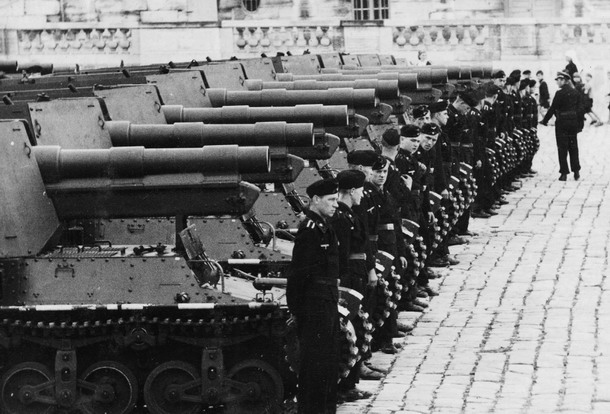
one of the products of Baukommando Becker, the heavy howitzer sFH 13 mounted on a Lorraine 37L tractor chassis, source: flickr.com with the permission of the publishing user, edited
Before the War
Alfred Becker was born on 20 August 1899 in the city of Krefeld in western Germany. In July 1914, the First World War broke out, and according to some sources, Becker enlisted as a volunteer at the age of just 15. If that is indeed the case, he most likely first attended some form of military preparatory training and did not enter active service until he turned 17 in 1916. This would also explain how he quickly rose to become an artillery officer. He was decorated with the Iron Cross for his service and was wounded shortly before the war's end when he was hit by poison gas. After the First World War, he studied mechanical engineering and began working as a design engineer in the textile industry. He later apparently also worked for Krefelder Stahlwerke and even established his own small engineering firm.
Becker and the 227th Infantry Division
Shortly before the outbreak of the Second World War, the now 40-year-old Becker was called up to serve in the German Wehrmacht. He was promoted to the rank of captain and assigned as commander of the 12th Battery of the artillery regiment of the 227th Infantry Division. At the time of the German invasion of Poland, the 227th Infantry Division was stationed in the Eifel highlands region on the border with Belgium, tasked with protecting the western frontier of the Reich against any potential retaliatory action by the French and their allies. No such action came, however, and so Becker's division did not see any combat.
The artillerymen of the 227th Infantry Division had to wait until May of the following year for their first real action, when the German campaign in the west began. The division was assigned to the 18th Army of Army Group B and was tasked with advancing on the right flank of the German offensive into the Netherlands. The division pushed through in the direction of Enschede and Deventer, reaching the so-called Grebbe Line on 13 May. An attempt to breach it near the town of Scherpenzeel failed. Through practically the entire night of 13–14 May, Dutch artillery kept up fire towards suspected German positions, though largely blind. In the morning, as the Germans were preparing to renew their attack, they discovered that under cover of the artillery barrage the Dutch had quietly abandoned their positions overnight and withdrawn further west. The reason was straightforward: somewhat to the south, the German 207th Infantry Division had managed the previous day to break through the Grebbe Line at the Grebbeberg hill, forcing the Dutch to begin pulling back regardless.
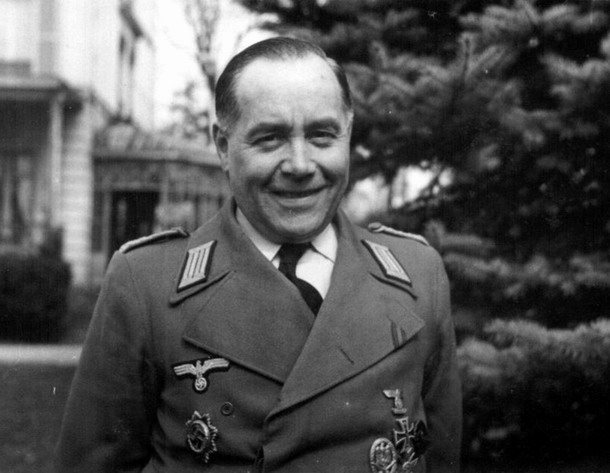
Dr. Ing. Alfred Becker, here most likely already holding the rank of major (the shoulder boards that would confirm this are unfortunately not clearly visible), source: flickr.com with the permission of the publishing user, edited
Dutch Spoils
The surprised soldiers of the 227th Infantry Division thus occupied the town of Amersfoort the following day without a fight – it had by then been nearly completely evacuated as well. The retreating Dutch army had left behind vast quantities of equipment and vehicles across the entire area, and it was this circumstance that was to change Alfred Becker's life forever. The Dutch Army officially capitulated on 15 May 1940, and Becker's unit remained in the Amersfoort area for some time afterwards. During his stay, Becker had the abandoned enemy vehicles constantly before his eyes, and it troubled him that perfectly serviceable equipment should go to waste – especially since his own artillery battery was still essentially dependent on horse-drawn transport. He therefore decided to requisition the abandoned trucks and wheeled tractors (such as the Brossel TAL) and, after making the necessary modifications, use them to tow German guns. As a result, Becker's battery gained incomparably greater mobility and speed than it had ever had before.
Service in Le Havre
After the defeat of France, the 227th Infantry Division was left in Normandy for garrison duty along the Channel coast in the Le Havre area. Between 10 and 13 June 1940, approximately 11,000 troops – not only British – were evacuated from Le Havre, and they too were forced to leave all their equipment behind. This time it was not just wheeled vehicles, but also tracked tractors and tanks. Captain Becker sensed an opportunity once again. When his battery had switched from horse-drawn to motorised traction, it had meant a fundamental increase in combat effectiveness – so what might be possible if the guns could be mounted directly onto tracked chassis? His enthusiasm for this idea was certainly also fuelled by his personal background. Becker was a trained engineer, and mechanical machines of every kind were clearly his passion. Moreover, his battery included a number of men who had worked in technical trades in civilian life and were skilled with metalwork. And since garrison duty in Normandy during the second half of 1940 was probably not the most adrenaline-charged of occupations, Becker decided to make use of the temporary lull, his expertise, and his connections to try to obtain self-propelled guns for his unit through his own initiative.
The First Self-Propelled Gun
Of all the equipment left behind by the British troops in the Le Havre area, the chassis of the light tank Mk. VI seemed the most suitable. The engine and transmission on this type were located at the front of the hull, which was ideal for the planned conversion, as it left plenty of room in the rear for a new fighting compartment. The intention was to mount a 10.5 cm leFH 16 light howitzer on this captured chassis. Becker planned to enclose the fighting compartment on all sides with light armour plating. He not only designed the exact layout, but also drew it up in full detail down to the level of individual steel plates. The drawings were then sent to Krefelder Stahlwerke (by then part of the Deutsche Edelstahlwerke conglomerate) in his home city of Krefeld. It is possible that in addition to the armour plates, Becker also asked Krefelder Stahlwerke to manufacture additional components, such as the howitzer mount, ammunition storage, and similar parts.
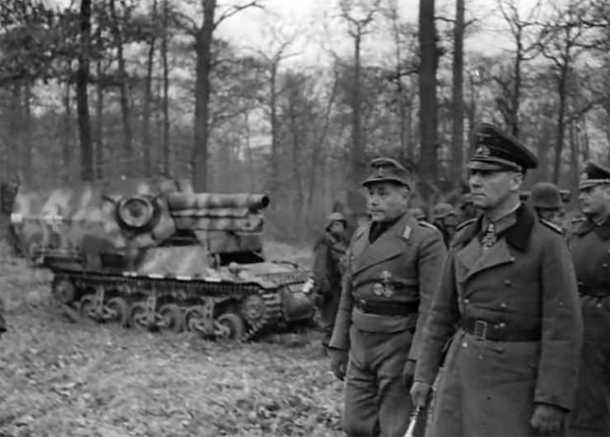
Field Marshal Rommel during one of his inspections of Becker's unit, with a 150 mm self-propelled gun on a Lorraine tractor chassis visible in the background, source: flickr.com with the permission of the publishing user, edited
As we know, Alfred Becker had previously worked for Krefelder Stahlwerke, so he had considerable connections there. Without them, he would scarcely have had a chance of ordering armour plate in the middle of a war for a vehicle being developed in what might be called an unofficial capacity. Although how unofficial it actually was is open to question. It certainly was not purely Becker's private venture, not least because the end result concerned not just his own battery but the entire battalion – perhaps even two battalions. Moreover, no matter how good one's connections, it is difficult to imagine Krefelder Stahlwerke simply donating steel plates free of charge, and it is equally hard to picture Captain Becker paying for their production and transport from Germany to France out of his own pocket. Becker's project also employed a large number of soldiers and mechanics and made use of divisional workshop facilities. It is therefore highly unlikely that Becker undertook the whole venture without the blessing of his superiors.
Whatever the case, within six months Becker's men had slowly but surely managed to build 12 self-propelled 105 mm howitzers on the Mk. VI tank chassis. In addition, they converted another 12 Mk. VI tanks into ammunition carriers, turned four more into command vehicles, and built several additional ammunition carriers on British Bren Carrier chassis. Virtually all sources indicate that Becker's workshop also built a further 6 self-propelled guns armed with the heavy 150 mm sFH 13 howitzer, mounted on some unspecified "heavier chassis". What that chassis was, however, the sources do not say. It certainly cannot have been the Mk. VI tank chassis, as it would not have been able to bear such heavy armament. Were these then the chassis of French Lorraine 37L tractors? And is this information even accurate? Twelve light 105 mm self-propelled howitzers is exactly the right number to equip one artillery battalion, but six heavy ones? That is too many for a single battery yet too few for a battalion – so why exactly six?
In any case, Becker's technical education and engineering experience, combined with professionally manufactured armour plates and other components, translated very positively into the finished fighting vehicles. They were admittedly an improvisation making use of available chassis and weapons, but the overall quality of execution was genuinely very high. This was confirmed by the results of firing trials, which the vehicles underwent first near Le Havre and subsequently at the military base at Beverloo in Belgium.
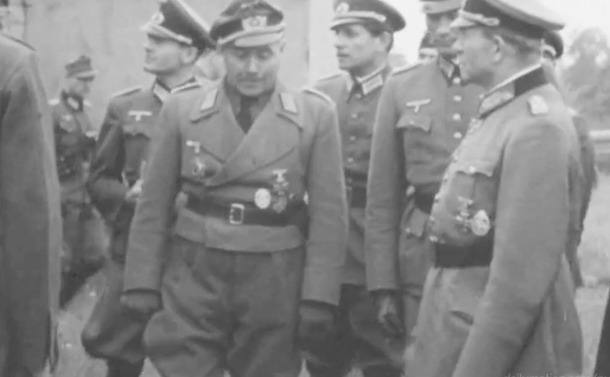
Becker's armoured vehicles were also inspected in person by the Inspector General of Panzer Troops, Heinz Guderian (Becker facing the camera, Guderian first from the right), source: flickr.com with the permission of the publishing user, edited
Thanks to Ing. Becker's efforts, the 227th Infantry Division became the only German formation of its kind to be equipped with self-propelled artillery. At the time, even armoured divisions could only dream of something like that. And how were the new fighting vehicles incorporated organisationally? A standard infantry division artillery regiment (Artillerie-Regiment) consisted of four battalions (Abteilung), three of them light (105 mm guns) and one heavy (150 mm guns). Each battalion had three batteries of four guns each, giving twelve guns per battalion in total. If we accept that Becker built a total of 18 self-propelled guns (12 light 105 mm and 6 heavy 150 mm), this was enough to equip more than one complete artillery battalion. Around the turn of 1940–1941 (roughly when all 18 vehicles were completed), a fifth battalion was added to the organisational structure of the 227th Artillery Regiment (the regiment subordinate to the 227th Infantry Division). Becker's 12th Battery (which had until then been part of the fourth battalion) was transferred into it, and a new 13th Battery was simultaneously created. The literature does not say so explicitly, but based on the context it seems reasonable to assume that Becker's self-propelled guns were concentrated into the new 5th Battalion, divided between the transferred 12th Battery and the new 13th Battery. If that was indeed the case, it meant that the two batteries together fielded a total of 18 self-propelled guns – considerably more than regulations prescribed. How the light and heavy vehicles were distributed between the two batteries, no source explains.
In September 1941, the 227th Infantry Division, including its artillery regiment, was transferred to northern Russia near Leningrad. From December onwards, the division became actively engaged in fighting against the Red Army. Combat use of the self-propelled guns confirmed that they were a successful design, and Becker's battery, thanks to its high mobility, soon became a kind of "fire brigade" dispatched to wherever the front was under threat.
Collaboration with Alkett
News of the success of Becker's self-propelled guns soon reached the representatives of the German Waffenamt (Army Weapons Office), who decided to make use of the obviously talented engineer. Their interest, however, was not in building more self-propelled howitzers, but in getting anti-tank guns moving.
There had been growing anxiety within the German high command for some time, driven on one hand by the sheer numbers of Soviet tanks, and on the other by two specific types against which German anti-tank guns were wholly inadequate – namely the T-34 and the KV. In early 1942, Rheinmetall was preparing to begin series production of the new and powerful 75 mm Pak 40 anti-tank gun, and based on the positive experience with the first tank destroyers, military planners were already thinking about how to make this gun self-propelled. One option was to mount it on a captured tracked chassis – a French one, for instance. And it was at precisely this moment that Alfred Becker came to mind at the Waffenamt, and it was decided to bring him together with the engineers at Alkett, who had experience building the first German tank destroyer, the Panzerjäger I.
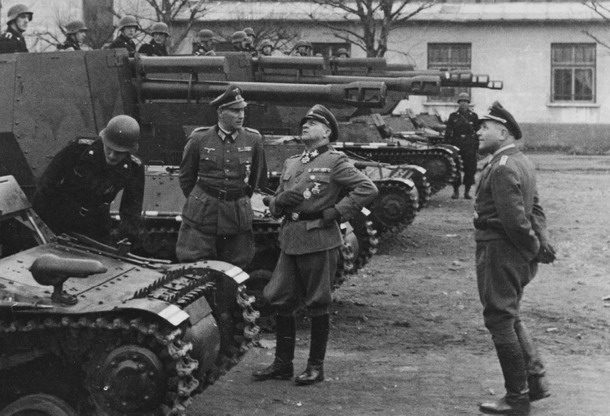
Becker's fighting vehicles attracted frequent visits from all manner of senior military figures – if for no other reason than to check that Becker and his men were not simply using France as a way of avoiding front-line service, source: flickr.com with the permission of the publishing user, edited
In early 1942, Becker was therefore withdrawn from the Eastern Front and sent to Alkett's factory in Berlin. Together with the engineers there, he examined the possibility of mounting the Pak 40 gun on the chassis of the French Lorraine 37L tractor (known to the Germans as the Lorraine Schlepper (f)). This tractor had its engine located in the middle of the hull, with the rear reserved for the cargo area – meaning that the open rear section was well suited to creating a new fighting compartment. The load-bearing capacity of the chassis also appeared sufficient for mounting both the gun and light armour to protect its crew. And being the old artilleryman that he was, Becker naturally included calculations for mounting a light or heavy howitzer in his considerations from the outset. When the proposal for self-propelled weapons on the Lorraine Schlepper chassis was presented in May 1942, no fewer than three variants were on the table: a tank destroyer with the 75 mm Pak 40, a light self-propelled howitzer with the 105 mm leFH 16, and a heavy self-propelled howitzer with the 150 mm sFH 13.
Hitler was satisfied with the proposals and asked how many captured French chassis the German army actually had available. The answer was that around 160 serviceable examples were held in the army vehicle depots (the so-called Heeres-Kraftfahrpark, or H.K.P.) in Paris and Bielitz in Poland (German: Bielitz). The Führer therefore decided that 60 of them should be converted into tank destroyers, another 60 should carry the 105 mm howitzer, and the remaining 40 the 150 mm howitzer. These numbers were later revised, but the highest priority was given to the production of 30 units of the heavy 150 mm self-propelled howitzer for Rommel's forces in North Africa. Alkett was tasked with their urgent production, and Alfred Becker was temporarily assigned to the company to oversee the work.
The first 30 urgently needed heavy self-propelled guns for the Afrika Korps were completed as early as June 1942 and were already in action near El Alamein by August of the same year. According to the established priorities, the next step was the conversion of Lorraine tractors into tank destroyers armed with the 75 mm Pak 40. Since shipping all the French tractors from the depots in Paris and Bielitz to Berlin would have been too slow and costly, the opposite approach was taken: Alkett's factory in Berlin prepared the conversion components and shipped them to France and Poland, where the tractors were converted on-site at the local Heeres-Kraftfahrpark depots. It was most likely at this point that Alfred Becker was dispatched to Paris to oversee the construction of the tank destroyers.
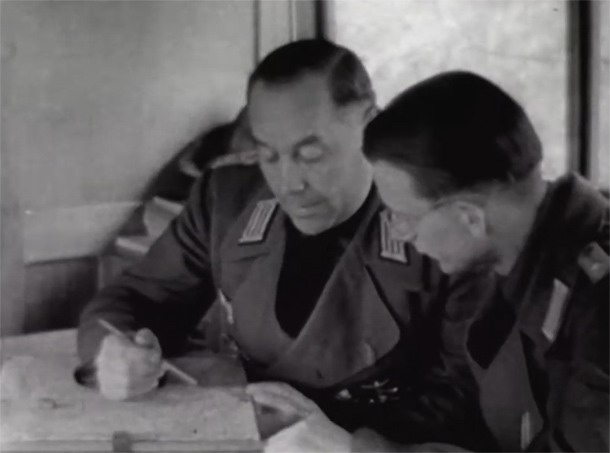
Alfred Becker during manoeuvres of his assault gun battalion Sturmgeschütz Abteilung 200, source: flickr.com with the permission of the publishing user, edited
Enter Baukommando Becker
The conversions of French tractors appeared likely to offer genuine combat value at relatively low cost, and Hitler therefore ordered Becker to remain in France and organise the conversion of further usable captured equipment into self-propelled weapons. A special unit was established under the German Ministry of Armaments for this purpose, known as either Baukommando Becker or Baustab Becker, with Alfred Becker appointed (unsurprisingly) as its commander. As for the correct designation, the longer and more striking Baukommando is generally used, but the shorter Baustab also appears in various documents and film footage. We shall use both names interchangeably. The Baukommando was allocated three originally French factories: the Matford plant in Poissy, the Talbot factory in Suresnes, and finally the Hotchkiss factory in Paris itself.
Becker accepted this assignment with undoubted enthusiasm, but he asked his superiors for permission to have the men from his 12th Battery of the 227th Artillery Regiment – the same men with whom he had carried out the first conversions of British Mk. VI tanks back in 1940 – assigned to him. With this move he intended to kill two birds with one stone. There was no doubt that his skilled, technically experienced men would be valuable for the new assignment, but his deeper motivation was almost certainly to save them from the horrors of the Eastern Front. By September 1942, his former unit had already endured nearly a year of continuous action near Leningrad. All twelve of the original self-propelled guns had been either destroyed or put out of action by mechanical failure, and many of Becker's comrades were now serving as ordinary infantry, risking their lives directly in the front line. Withdrawing soldiers from the front for deployment in production back home was of course not officially possible. Becker, however, managed to come to an arrangement with the commander of the 227th Infantry Division, and through informal channels he had all his old comrades out of northern Russia and with him in Paris by Christmas 1942 – for which they were surely not the least bit ungrateful.
15 cm sFH 13 auf Lorraine Schlepper
Becker established his Baukommando headquarters at the Matford factory in Poissy and set to work. The first thing he tackled was a further series of heavy 150 mm sFH 13 self-propelled howitzers on the Lorraine 37L tractor chassis. To recap: the first 30 examples of this vehicle had been built by Alkett in June 1942 for Rommel's Afrika Korps. Baukommando Becker now followed up this first production run with additional vehicles delivered during July and August 1942. Exactly how many is not clear from the available literature. Some sources cite 64 examples, others 72. However, there is contemporary film footage documenting the work of the Baukommando in which the figure given is 94 heavy self-propelled guns built by Baustab Becker in total. It is possible that this figure includes the 30 vehicles built at Alkett in Berlin plus 64 produced in France. In any case, work on these vehicles was made somewhat easier by the fact that Becker received serviceable tractors from army depots. Subsequent conversions, however, were not so straightforward, as he had to source suitable chassis himself.
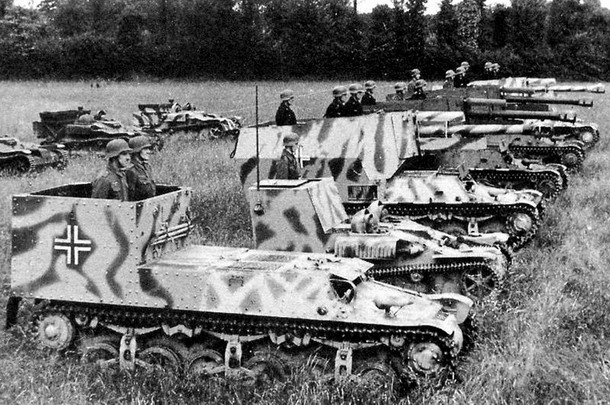
Baukommando Becker built not only self-propelled guns but also a wide range of support vehicles for artillery observation, ammunition supply, and command (as seen in this photograph), source: flickr.com with the permission of the publishing user, edited
Scavenging for Scrap Metal
By this point, more than two years had passed since the French capitulation, and all the serviceable vehicles captured by the German army at the time had long since been put to use with various security and anti-partisan units, or with training formations teaching new tank crews. Becker therefore had to set his sights on vehicles that had been written off as unusable after the fall of France and were awaiting scrapping. He assembled several teams from his men and sent them out across the entire occupied territory to find whatever could be had. Becker's soldiers and mechanics drove through depots, scrapyards, and the yards of various ironworks and foundries, but also across the battlefields and retreat routes of the Allied forces from 1940. Rusty wrecks of tracked and half-tracked vehicles were pulled out of fields and roadside ditches – and even from streams, rivers, and ponds.
The vehicles that were gathered were subsequently divided into three categories: those requiring minor repairs and replacements, those requiring substantial repairs and replacements, and those beyond repair that would serve only as a source of spare parts. In terms of specific vehicle types, the three factories accumulated French tanks such as the FCM 36, Hotchkiss H35, and Hotchkiss H39, the already-mentioned Lorraine 37L tractors, Renault UE carriers, and also half-tracks including the Unic P107, Somua MCG, and Somua MCL.
The conversion process worked as follows: one example of each vehicle type was first used to work out all the necessary modifications – the design of the fighting compartment, the precise method of mounting the weapon and ammunition, the positioning of the crew seats, and other details. The armour plates and any other required new components were then drawn up or in some cases modelled in wood, and these templates were sent to Alkett, which arranged production of the parts in the required quantities. Becker's own factories in France therefore served "merely" as assembly workshops. Even so, there was no shortage of work: every vehicle had to be stripped down, cleaned, have worn or damaged parts replaced, repainted, modified to allow the conversion, and then have all the new components fitted – most importantly the weapon and the armoured fighting compartment. Becker also thought ahead to ensuring an adequate supply of spare parts for future operational use. For most components, between 10 and 30 percent of the total production run was set aside as spares.
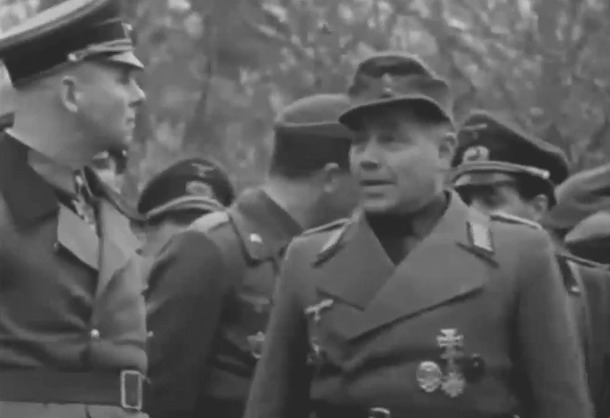
Alfred Becker and Erwin Rommel during a parade of self-propelled guns "made by Baukommando Becker", source: flickr.com with the permission of the publishing user, edited
FCM 36 Chassis
The first self-propelled gun produced entirely under the auspices of Baukommando Becker was probably the 105 mm leFH 16 light howitzer on the chassis of the French FCM 36 tank. Only 8 examples were built in September and October 1942, with a further 4 added in March 1943. One does, however, also encounter the claim that 48 of these vehicles were built in total, which is most likely not accurate. This type was followed still in 1942 by production of a tank destroyer based on the same chassis (the FCM 36 tank). The tank destroyer was armed with the 75 mm Pak 40 anti-tank gun, and its fighting compartment was almost a twin of its sister vehicle's – judge for yourself from the photograph HERE. Only around 10 examples of this variant appear to have been built.
10.5 cm leFH 18 auf Lorraine Schlepper
Next in line was apparently the 105 mm leFH 18 self-propelled howitzer on the chassis of the already-mentioned Lorraine 37L tractor. Here, however, Becker once again collaborated with Alkett in Berlin. Based on their joint design, Alkett built the first 12 examples of this type, either in September or November 1942 (sources disagree). A further batch of 12 was then produced in Baukommando Becker's own workshops, sometime between December 1942 and August 1943. According to the aforementioned film made by Becker's men, a third batch of 12 was apparently also produced, as the total given there is 36 examples. The vehicles built by Alkett and those built by Becker were not, however, entirely identical. The horizontal fold in the side armour of the fighting compartment was positioned much lower on the Alkett vehicles than on Becker's own, as is clearly visible in the comparison photograph HERE, and there were other minor differences as well.
Hotchkiss H39 Chassis
At some point during 1942, members of Becker's Baukommando built 24 tank destroyers armed with the Pak 40 on the Hotchkiss H39 tank chassis. The same chassis was also used for the 105 mm leFH 18 self-propelled howitzers. The first batch of twelve was completed in September 1943 and a second equally-sized batch in February 1944. According to some sources, a further 24 vehicles of this type were to be built later, bringing the total to 48 examples. Becker's documentary film gives a figure of 36 completed vehicles for this type, but since the film was made on 7 September 1943 according to its opening credits, it may not include the February 1944 batch of 12 – in which case the overall total of 48 completed vehicles could well be correct.
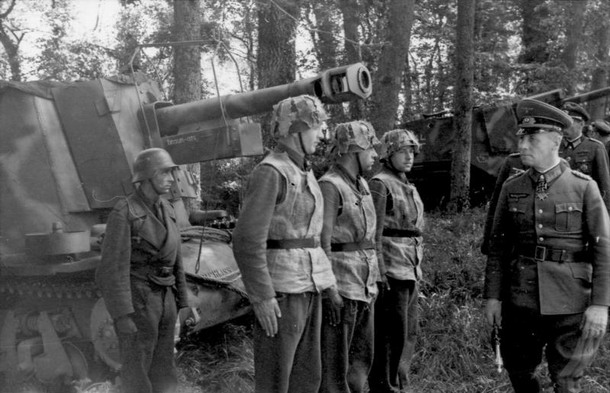
Another moment from Field Marshal Rommel's visit to the 21st Panzer Division, showing a 105 mm howitzer on the Hotchkiss H39 tank chassis, source: Bundesarchiv Bild 101I-300-1865-06, Wikimedia, Creative Commons, edited
Other Conversions
Beyond the self-propelled guns and tank destroyers on fully tracked chassis described above, the Baukommando workshops also produced a wide range of other equipment based on half-tracked tractor chassis. This category includes the already repeatedly mentioned anti-tank Pak 40 gun on the Somua MCG half-track, a battery of captured French 81.4 mm mortars on the same chassis, the Vielfachwerfer multiple rocket launcher on the Somua MCL chassis, an automatic 20 mm cannon on the UNIC P107 half-track, and an armoured infantry carrier on the same vehicle. Becker's men also designed and produced several types of ammunition, command, and observation (i.e. forward artillery spotting) armoured vehicles on the chassis of the aforementioned Hotchkiss tanks, Lorraine tractors, and light Renault UE carriers, as well as additional armoured carriers on wheeled transport chassis. In May or June 1943, Reich Minister of Armaments and War Production Albert Speer visited the Matford factory in Poissy in order to report to Hitler on the progress of Becker's mission. He toured the production hall, inspected the finished vehicles, and even rode in some of them.
Organisational Assignment of Becker's Vehicles
The equipment being produced by the Baukommando was naturally not simply left standing idle in factory yards. The first recipient of Becker's vehicles was the gepanzerte Artillerie-Brigade (Sfl.) – literally the armoured self-propelled artillery brigade – established in October 1942. As the number of available fighting vehicles grew, this unit was reorganised in February 1943 into a formation designated the verstärkte Schnelle Brigade West – the reinforced rapid brigade West. At the time, the Germans were apparently planning to form several so-called schnelle Divisionen (rapid divisions), which were to perform a garrison role on French territory. These divisions were to be fully motorised and therefore capable of rapid movement over relatively large distances, meaning that relatively few of them would be needed to cover a large area. It was part of the German preparation for an Allied landing in France: the Germans knew it was coming, but since they did not know precisely when or where, they needed fast-reaction units capable of responding quickly and moving to the landing zone within a short time. However, the German war industry did not have the capacity to equip such divisions with standard material, making the use of captured equipment and its conversions an almost ideal solution.
In July 1943, the German Army High Command issued an order for the verstärkte Schnelle Brigade West to be reorganised, expanded, and used as the foundation for re-forming the 21st Panzer Division (the original 21st Panzer Division had been destroyed in North Africa in May 1943). Due to a shortage of fighting equipment, the newly formed division was equipped primarily with old captured French tanks (whose combat value was already negligible by mid-1943) and Becker's converted tank destroyers, self-propelled guns, and other vehicles. Among others, approximately 2,000 veterans of the original 21st Panzer Division who had been on leave, in hospital, or otherwise absent at the time of its capitulation were also incorporated into the division. Generalleutnant Edgar Feuchtinger was appointed divisional commander, and Becker was given command of the Sturmgeschütz Abteilung 200 assault gun battalion.
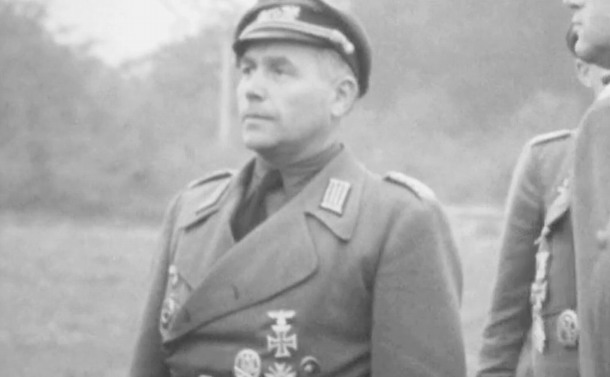
As photographs show, Becker wore the grey-green uniform of the self-propelled artillery almost without exception, source: flickr.com with the permission of the publishing user, edited
The name of this battalion was somewhat misleading, since a Sturmgeschütz (assault gun) was a specific type of fighting vehicle intended for direct infantry fire support. Becker's battalion, however, was a combined-arms unit that included self-propelled guns (German: Selbstfahrlafette) and tank destroyers (German: Panzerjäger). You would have looked in vain for any actual assault guns. In the summer of 1943, Becker conducted the first manoeuvres with his battalion, from which, incidentally, a very fine piece of film footage has also survived.
Becker Goes into Action
In December 1943, Becker received orders to move his battalion to the area around the small town of Mauron, further west and closer to the coast. That same month, loading-onto-rail exercises were carried out, as this was apparently something the drivers had not yet had the opportunity to practise. Film footage from this exercise has also survived. The actual move to Mauron itself most likely took place in January 1944.
Another event captured on film and preserved to this day was an inspection by Field Marshal Erwin Rommel, commander of Army Group B, which took place in the spring of 1944. By that time, Becker's battalion had five batteries in total, each consisting of four 75 mm tank destroyers and six 105 mm self-propelled howitzers (by June 1944 these were in all likelihood all vehicles on the Hotchkiss chassis). On 6 June 1944, as we know, the Allied landing in Normandy took place. Due to the initial confusion, Becker's battalion did not enter the fighting until 9 June, when it provided fire support for the 125th Panzergrenadier Regiment of its parent 21st Panzer Division.
The battalion's greatest moment of glory came more than a month later and some 200 kilometres to the north-east, as part of the Allied Operation Goodwood. Becker's unit was by then part of the so-called Kampfgruppe Luck, alongside the 125th Panzergrenadier Regiment, a battalion of Panzer IV tanks, and several Tiger tanks from the 503rd Heavy Panzer Battalion. The five batteries of Becker's battalion were deployed across an area roughly 3x3 kilometres in the villages and hamlets east of Caen, positioned to control from both sides the road running north-east from Caen. On the morning of 18 July 1944, Allied bombers began saturating the entire area. Their raids lasted nearly two hours. Barely had the last bombs fallen when artillery shells from warships offshore began landing around them, continuing for a further approximately 30 minutes.
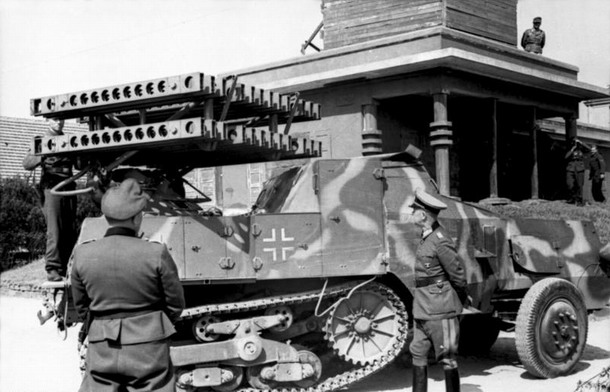
a rocket launcher on a Somua MCL half-track chassis from Baukommando Becker's workshops during a demonstration for army officers on the coast of northern France, source: Bundesarchiv Bild 101I-300-1863-30, Wikipedia.org, Creative Commons, edited
When Becker finally managed to re-establish radio contact with his battery commanders, he received the following reports. All ten self-propelled weapons of the 1st Battery, positioned in the village of Démouville, had been destroyed. The 2nd Battery had suffered some losses but remained essentially fully combat-capable. The remaining three batteries had not been hit by the Allied bombardment at all. After this thorough preparatory barrage, tanks of the British 11th Armoured Division advanced, moving from the north towards the village of Hubert-Folie. As soon as they came within range, the British found themselves under fire from Becker's 3rd, 4th, and 5th Batteries. Becker's men, firing from well-camouflaged positions, managed to knock out several British tanks and halt their advance. The 2nd, 4th, and 5th Batteries then repositioned to engage further approaching British units, again with success. Together with the Luftwaffe's 88 mm guns positioned in the village of Cagny, Sturmgeschütz Abteilung 200 succeeded in containing the British advance for the remainder of the morning, until German reinforcements arrived. During the afternoon, the British attack finally exhausted itself. In total, the British lost more than 200 tanks during Operation Goodwood!
The battalion's next significant engagement came at the turn of July and August 1944, during the British Operation Bluecoat. Sturmgeschütz Abteilung 200 was to take part in repelling the British south-east of Saint-Lô. However, on 1 August 1944, Major Becker was wounded in the thigh by a shell splinter near the village of Le Tourneur. This wound ultimately spared him, if not from death, then almost certainly from capture: the remnants of his battalion were encircled in the Falaise Pocket approximately two weeks later. Becker withdrew with the remaining elements of the 21st Panzer Division into Belgium. On 22 August he established a formal command post at the Château de Taravisée near the village of Fosses-la-Ville. By early September, however, he was forced to flee, and by some means eventually made his way to Alsace in eastern France, where he was captured by the Allies in December 1944. Dr. Ing. Alfred Becker survived the war and returned to Germany. He died on 26 December 1981 at the age of 82. In total, Baukommando Becker is said to have built or modified around 1,800 vehicles of various types over the course of its existence – it is little wonder that Alfred Becker received the German Cross in Gold (1942), the War Merit Cross First Class with Swords (1942), and quite possibly even the Knight's Cross of the War Merit Cross with Swords (1945), rising ultimately to the rank of major.
ARTICLE
CONTENTS:
Reproducing text from the Panzernet website without the written consent of the operator is prohibited.