SPW UNIC P 107
armoured personnel carrier on a French chassis
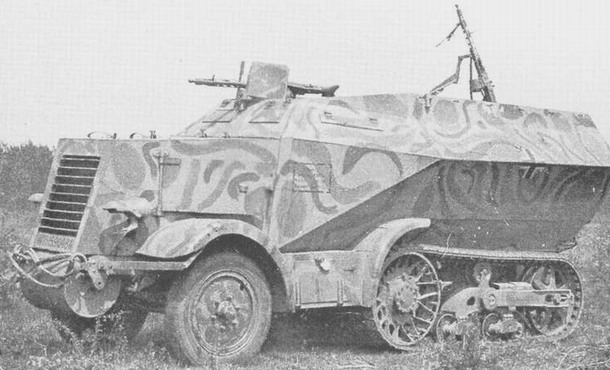
armoured personnel carrier leichter Schützenpanzerwagen U304(f) on the Unic P 107 chassis, source: super-hobby.cz, modified
The Unic P 107 half-track trucks were manufactured by the French company Unic in cooperation with Citroën. The vehicle rested on a chassis consisting of a steerable front axle and a rear track assembly. The design of the track section followed the standards of the French engineering school of the period and was arranged similarly to other half-tracks of the time.
At the front the track assembly was bounded by a large drive sprocket and at the rear by a slightly smaller idler wheel, both of the spoked type. Between them sat four small and rather intricately mounted road wheels. The front and rear pairs of wheels were each combined into a bogie, and both bogies were then attached to a single larger bogie. A bracket for the single return roller, which supported the track from above, connected to the top of this main bogie. The main bogie was sprung by a substantial leaf spring and linked to the rear idler wheel by a metal beam.
The vehicle was powered by a four-cylinder engine producing 60 horsepower, capable of propelling it to a road speed of up to 45 km/h at a fuel consumption of around 40 litres of petrol per 100 km.
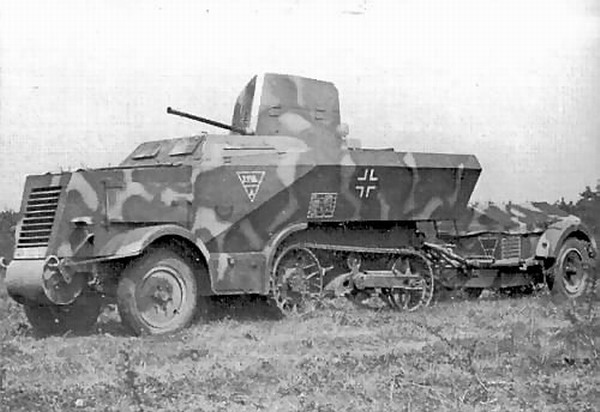
2 cm Flak 38 Selbstfahrlafette auf leSPW U304(f), source: topwar.ru, modified
After the French capitulation, several hundred of these vehicles fell into German hands in fully operational condition. The German army dealt with them in its own way — some were put to use in their original form and for their original purpose as cargo vehicles and tractors, while a number of conversions were also carried out to adapt the vehicle for entirely different roles.
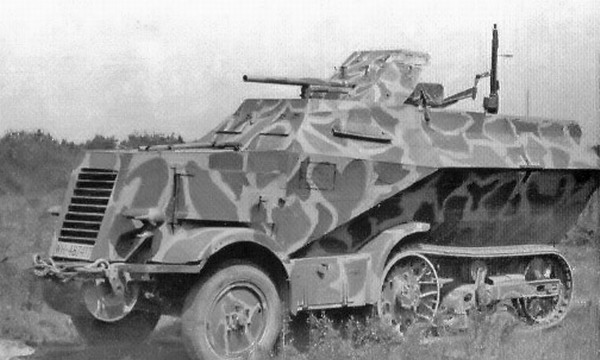
The first conversion was an infantry armoured personnel carrier designated Mannschaftstransportwagen U 304 (f). U 304 (f) was the general designation the Germans assigned to the Unic P 107 upon its incorporation into their own army. A sizeable superstructure welded from steel plate was built up on the chassis. In the rear section of the vehicle, where space was provided for an infantry section, the upper and lower panels of the hull met at a sharp angle. This sloping of the walls increased their resistance to fire. The armour offered protection only against small arms fire and light splinters, however, as it was a mere 8 mm thick.
The armament of the personnel carrier consisted of two 7.92 mm MG 34 machine guns, arranged identically to the German standard for their own armoured personnel carriers such as the Sd.Kfz. 250 and Sd.Kfz. 251. The first machine gun was mounted on the front edge of the open-topped troop compartment and protected by a steel shield. The second was suspended on a swinging arm at the rear edge of the troop compartment.
A total of 60 Unic P 107 vehicles were converted to this configuration, and all subsequently served with Schnelle Brigade West.
3.7 cm PaK 35/36 auf Zugkraftwagen P-107 U-304(f), source: topwar.ru, modified
The second conversion of the French tractor produced a self-propelled anti-aircraft gun, mounting the 20 mm Flak 38. The gun was installed on its mount in the centre of the troop compartment, complete with its fairly large frontal shield. The side walls around the weapon's fighting space had to be lowered to increase the clearance for the gun to traverse freely. From photographs it is clear that a cargo trailer carrying an additional ammunition supply was towed behind the vehicle. A total of 72 vehicles were converted to this configuration.
The final variant produced by the Germans was a tank destroyer armed with the 37 mm PaK 36. The hull construction was identical to that of the Mannschaftstransportwagen U 304 (f) described above — the only difference being that instead of the front machine gun, a light anti-tank gun was installed in the fighting compartment, complete with its shield. The rear machine gun on its swinging arm was retained. The exact number of vehicles converted to this configuration is not known.
All three conversions of the French vehicle were carried out in the workshops of Baukommando Becker. The cost of their production was minimal — as was the practical combat value of the resulting machines.
Reproducing text from the Panzernet website without the written consent of the operator is prohibited.