SIG 33 AUF PANZER III
improvised 150 mm self-propelled gun
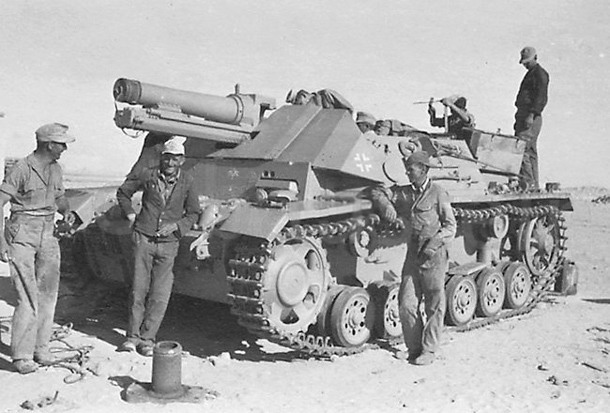
the improvised sIG 33 self-propelled gun on a Panzer III chassis, built in the field workshop of the 90th Light Africa Division, source: Flickr.com with permission of the publishing user, edited
Origins
At the turn of 1941 and 1942, the German army ordered twelve sIG 33 self-propelled guns on modified Panzer II chassis from the firm Alkett. All twelve completed vehicles were subsequently shipped to Africa to serve with the 90th Light Africa Division (90. leichte Afrika-Division). Combat use of this type — which for some reason acquired the wholly invented nickname Bison — proved deeply disappointing. Its chassis and engine were simply too weak to carry such a heavy weapon, and the vehicle struggled badly with the African climate due to inadequate cooling.
On the other hand, Rommel's forces needed every available self-propelled gun and could not afford simply to write these vehicles off. On the contrary, they had to work hard to get the best they possibly could out of them. And the best thing about the Bison was its weapon: the heavy infantry gun sIG 33 in 150 mm calibre (sIG = schwere Infanterie Geschütz). At some point during 1942, one of the field workshops therefore carried out a "transplant" of this weapon from an original Bison self-propelled gun onto the chassis of a Panzer III Ausf. H. Very little information about this conversion has survived, so it is not clear, for example, whether the gun was removed from a destroyed Bison (a salvage operation) or whether the troops' patience with the slow and unreliable Bison had simply run out and they stripped an otherwise functional vehicle. What has survived to this day, however, is a reasonably rich set of photographs that give us a clear picture of what the resulting improvised self-propelled gun on the Panzer III chassis looked like.
The 15 cm sIG 33 Gun
Let us pause for a moment on the gun itself. As its name suggests, the sIG 33 was a weapon intended to provide close fire support for infantry. The requirement for such a gun grew out of the lessons of the First World War, when infantry had lacked an artillery weapon capable of moving across the battlefield right behind them and delivering immediate, close-range fire support. For this role an infantry gun needed only a relatively short range, since it was not meant to remain far behind the front but to stay close to "its" infantry. The schwere Infanterie Geschütz 33 was developed in the late 1920s by Rheinmetall and introduced into the German army in 1933 in two versions that differed only in the design of the wheeled carriage — one intended for horse traction, the other for motor traction.
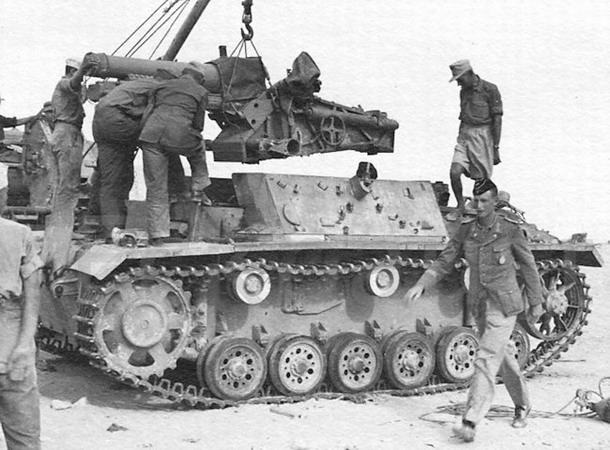
the heavy infantry gun sIG 33 being mounted on the Panzer III Ausf. H chassis, source: Flickr.com with permission of the publishing user, edited
The gun barrel measured barely 170 cm in length (roughly 11 calibres) and its maximum range was only around 4.7 km. By September 1939 the Wehrmacht had 410 of these guns available. They performed very well in the Polish campaign but at the same time revealed that they were not mobile enough for modern fast-moving warfare. The pace of the German advance in Poland was tremendous, and guns with such a short range had to change position very frequently to keep pace with the rapidly shifting front. Each time this meant hitching the gun to a prime mover (a half-track or a six-horse team), driving to the new position, unhitching it and readying it for action again — a laborious and above all time-consuming process.
This otherwise excellent and effective weapon was practically crying out for improved mobility through installation on a self-propelled mount. The army heeded the call, and over the following months and years the sIG 33 became the armament of no fewer than five types of German self-propelled guns (Sturmpanzer I, the already-mentioned Bison, the Grille, the sIG 33 and, in a heavily modified form, the Brummbär).
Design Description
Let us return to North Africa in 1942. Which unit actually carried out the conversion? The original Bison self-propelled guns had been issued to only two companies: s.I.G.Kp (mot. S) 707 and s.I.G.Kp. (mot. S) 708 (schwere Infanterie Geschütz Kompanie, motorisiert — motorised heavy infantry gun company). Both companies were part of the already-mentioned 90th Light Africa Division. It was evidently in the field workshop of one of these two companies that a damaged Panzer III Ausf. H arrived — one whose chassis and hull were still fully functional but whose fighting turret and/or gun were not. The mechanics took up their cutting torches and welding equipment, removed the fighting turret and the crew compartment roof beneath it, and prepared a large open space for the installation of the heavy gun.
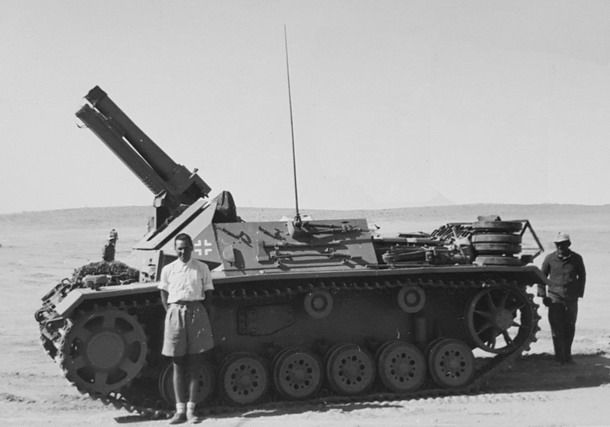
the mounting gave the weapon a generous range of vertical elevation, source: Flickr.com with permission of the publishing user, edited
Side panels — apparently taken from an original Bison II self-propelled gun (judging from a comparison of photographs of both vehicles) — were welded on either side of the new fighting compartment. The left side panel carried a range of tools, hooks for tow ropes and a radio antenna bracket. The right side panel had a large sheet metal box, probably used to stow gun cleaning equipment. The original tank crew compartment front wall was retained and supplemented from above and the sides by a custom-made frontal shield with a cutout for the gun barrel. The gun was positioned inside the fighting compartment slightly to the right of the vehicle's centreline, apparently to leave sufficient room on the left for the driver to crawl through to his seat. The gun was transferred to the vehicle complete with its mounting, so it most likely retained its original traversing and elevating capability — meaning the weapon could be elevated from −1.5 to +70 degrees and traversed 14 degrees in total, 7 degrees left and 7 degrees right.
The gun used separate-loading ammunition — the shell and the propellant cartridge were loaded individually. Six different propellant charges were available: with the smallest, charge No. 1, the shell left the barrel at 122 m/s and could reach a range of up to 1,475 metres. Charge No. 2 gave a projectile velocity of 152 m/s and a range of 2,125 metres. Charge No. 3 drove the shell out at 186 m/s to a maximum range of 3,000 metres; charge No. 4 gave 210 m/s and 3,750 metres; charge No. 5 gave the shell a velocity of 220 m/s and a range of 4,375 metres; and finally with the largest charge, No. 6, the gun could fire a shell at 240 m/s to a distance of 4,700 metres.
The powerplant, gearbox and other internal components were in all likelihood simply carried over with the chassis, meaning the improvised self-propelled gun was powered by the Maybach HL 120 TRM twelve-cylinder petrol engine of 11.9 litres displacement and 300 hp, coupled to the Zahnradfabrik SSG 77 gearbox with six forward gears and one reverse. The crew size, the ammunition load carried and the overall weight of the finished vehicle are details that will most likely never be known with certainty.
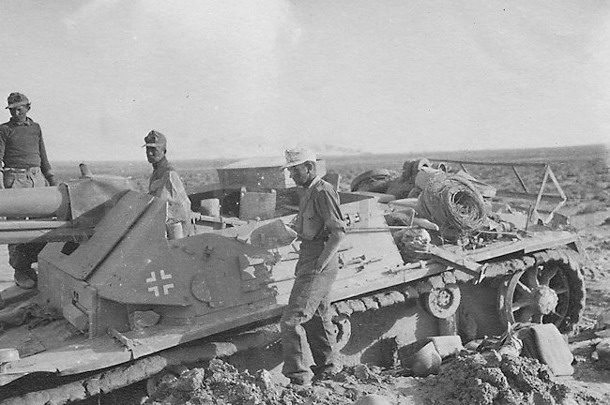
the sIG 33 self-propelled gun on Panzer III chassis in Africa, source: Flickr.com with permission of the publishing user, edited
Equally, no details of its combat use are known — if indeed it ever saw action at all. It seems reasonable to assume, however, that this improvised self-propelled gun was a more capable fighting vehicle than the original Bison II. The Panzer III chassis was considerably more robust than the light Panzer II chassis and its engine twice as powerful. The sIG 33 self-propelled gun on the Panzer III chassis was apparently built as a single example only, and that example clearly did not survive the war. Its wreck presumably remained somewhere in Africa and was most likely scrapped after the war.
ARTICLE
CONTENTS:
Reproducing text from the Panzernet website without the written consent of the operator is prohibited.