GRILLE
self-propelled gun from the Protectorate
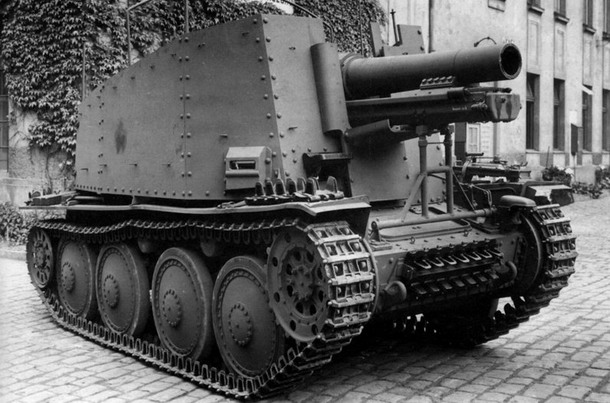
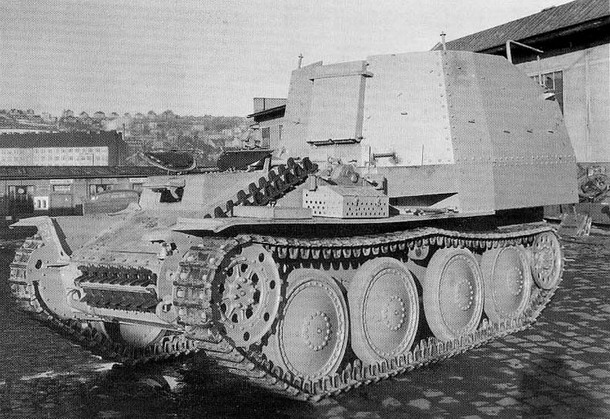
Grille Ausf. H in the factory yard, source: Praga archive with the permission of a company representative, modified
Origins of the Self-Propelled Gun
Even before the outbreak of war in the East it was clear that the light tanks Panzer I and Panzer II — armed respectively with only machine guns and a 20 mm cannon — were no longer fit for use as front-line tanks. Fighting on the Eastern Front very quickly demonstrated that even more heavily armed light vehicles simply had no future in the first line. The same applied to the originally Czechoslovak tank PzKpfw 38(t), which the Germans had taken into service and continued to manufacture on Protectorate territory.
The design of the PzKpfw 38(t) was, however, reliable, and German crews and mechanics had accumulated extensive experience with it. Scrapping a proven vehicle type and shutting down an established production line was something the Germans could not afford in the face of their problems on the Eastern Front. They therefore began looking for new uses for the chassis. As early as the turn of 1941–42, the firm Alkett was working on the development of a self-propelled anti-tank gun based on exactly this chassis. The prototype of what would later become known as the Marder III was tested and accepted into service in February 1942.
As early as March of that same year, the logical idea arose of using the same chassis to build another vehicle — this time a self-propelled gun of 150 mm calibre. Development of such a vehicle was again entrusted to Alkett, which had extensive experience with conversions of this kind, having previously developed self-propelled guns of the same category on the chassis of the obsolete light tanks PzKpfw I and PzKpfw II.
The prototype of the new self-propelled gun was completed in October 1942. The basis was the chassis of the latest variant, the Ausf. H. This chassis variant had been introduced in June 1942 and was intended exclusively for the production of Marder III tank destroyers, since production of the Panzer 38(t) tank itself had ended with this version — the last Panzer 38(t) tanks built were the Ausf. G.
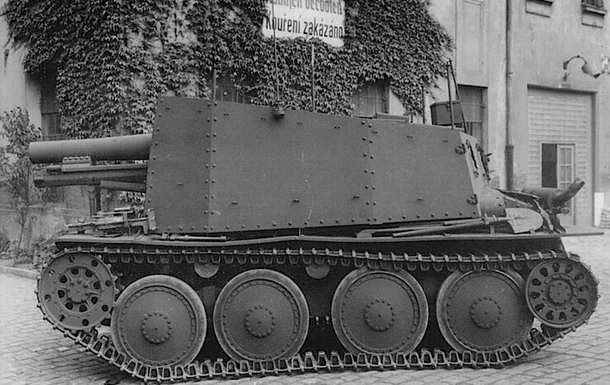
Grille Ausf. H in the factory yard, source: Praga archive with the permission of a company representative, modified
Ausführung H
The running gear on each side consisted of four road wheels 775 mm in diameter, fitted with rubber tyres around their circumference. At the front was a toothed drive sprocket with circular lightening holes, and at the very rear was the idler wheel. Two return rollers mounted in the forward half above the road wheels completed the arrangement. The road wheels were sprung in pairs — the front pair and the rear pair each shared a common leaf spring. Track width was 29.3 cm. The Ausf. H chassis received a new Praga AC powerplant producing 160 horsepower at 2,600 rpm, compared to the older Ausf. G, and the engine was located at the rear of the hull.
The self-propelled gun inherited not only the running gear and mechanical components from the tank chassis but virtually the entire hull as well, except for the fighting compartment. The original turret was removed completely and replaced by a tall open-topped enclosure of flat armour plates joined by a combination of riveting and welding. The front wall of the new fighting compartment was positioned in line with the front wall of the original tank turret. Towards the rear, however, the enclosure extended well beyond the limits of the original turret and covered the front half of the engine deck. The new fighting compartment was also wider than the original turret, extending at its widest point almost to the outer edge of the track mudguards.
The fighting compartment was left open at the top in the interests of keeping the vehicle's overall height and weight within reasonable bounds. There were no observation ports in the armour, as the crew were expected to look out over the upper edges. In bad weather a waterproof tarpaulin could be pulled over the open top for protection. It was supported by two rod-shaped struts at the front, three more at the rear, and one arched strut that spanned the full width of the compartment roughly at its midpoint. To prevent the tarpaulin from being torn away by wind, its edges were clipped to small wire rings on the outer face of the armour. For visibility, the tarpaulin was fitted with several transparent plastic inserts. When erected, the tarpaulin significantly increased the vehicle's silhouette.
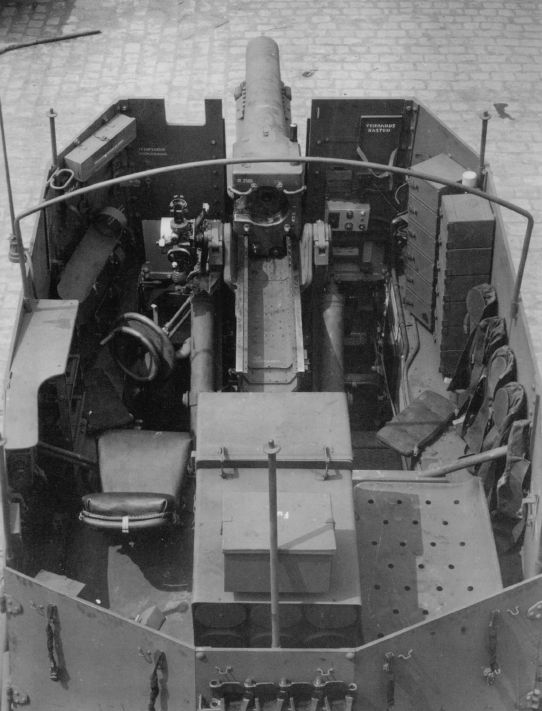
view into the interior of the Grille Ausf. H, source: Praga archive with the permission of a company representative, modified
The thickness of the plates forming the fighting compartment enclosure was 25 mm on the front wall and 14.5 mm on all other walls. Given the vehicle's intended role — providing indirect fire support — this level of protection was theoretically adequate. The centre of the front wall was cut away to allow the gun barrel to pass through. Below the barrel a movable armour plate was fitted, which tilted downward together with the gun during depression and swung upward when the gun was elevated to maximum, thereby keeping the front armour continuous. To the left of the howitzer, a smaller notch was cut in the upper edge of the front wall to accommodate the aiming periscope. To the right of the barrel, a vision port for the driver was fitted in the lower section of the front plate. This port could be swung open to give a better view in safe areas; in dangerous territory the driver kept it shut and observed only through the narrow slit in its cover. A second vision port was available to the driver in the right side wall — this one was fixed rather than hinged.
The front plate was the tallest of all the armour panels, and the height of the plates decreased towards the rear of the fighting compartment. When seated, the gunner and loader were fully concealed behind the armour; when standing, they rose above its edges. The commander/radio operator — on the dual role, more below — protruded above the side armour even when seated. The rear wall of the fighting compartment was made up of three panels, of which the two outer ones could be opened. Hinged each on two pintles, they swung rearward and to the side, creating openings for the crew to enter and exit more comfortably — though given the modest height of the rear armour, it was equally easy to simply climb or step over it.
The driver's position followed the layout of the standard PzKpfw 38(t) tank. However, unlike in the original tank, the driver had no roof above his head; he sat in effect alongside the rest of the crew in the main fighting compartment, but considerably lower — partly even beneath the gun itself. Getting in and out of the driver's seat was evidently no easy matter. The hull machine gunner's position, which in the standard Panzer 38(t) tank sat to the left of the driver, was completely eliminated on the self-propelled gun.
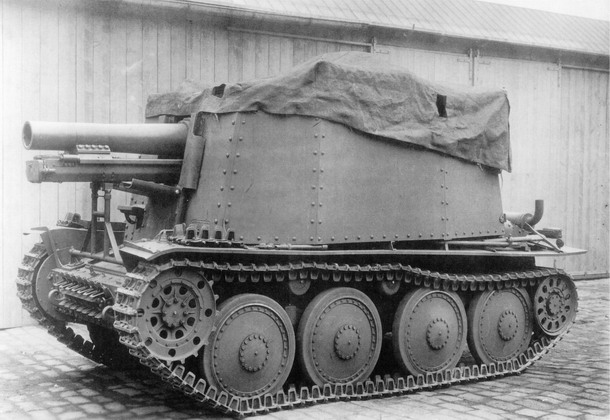
Grille Ausf. H with the waterproof tarpaulin over the fighting compartment, source: Praga archive with the permission of a company representative, modified
Behind the driver's seat lay the main and widest part of the fighting compartment, its floor raised significantly above the driver's lower-level workspace. In the centre of this area was mounted the vehicle's main armament: the heavy infantry gun sIG 33 (schweres Infanterie Geschütz) of 150 mm calibre. In its standard towed configuration — complete with wheels, shield and massive trail — this weapon weighed somewhere between 1.7 and 1.8 tonnes. For installation on the self-propelled chassis, only the bare essentials were retained. To the left of the gun sat the gunner, to the right the loader, each with a small padded seat mounted at an angle to the vehicle's centreline, facing the gun's breech.
The gun's vertical elevation ranged from 3 to 72 degrees. Lateral traverse appears to have been unavailable — the gun was fixed in the hull — and aiming sideways was achieved by turning the entire vehicle. Given the vehicle's role and the devastating effect of its shells, precise lateral aiming was not essential. On the right-hand side wall (the loader's side) were the ammunition lockers, with the shells and propellant cartridges stored separately. Additional ammunition was carried on the side wall on the gunner's side, and a few rounds could also be stowed in the space previously occupied by the hull machine gunner in the original tank. On longer road marches, the gun barrel was lowered onto a folding travel support mounted on the hull nose ahead of the fighting compartment, fabricated from tube welded into an H-shape.
The rearmost third or so of the fighting compartment sat above the engine compartment, and the engine deck therefore formed its floor — raised noticeably higher than the rest. In the centre of this elevated section was a large box holding six rounds of ammunition. To the left of it was a padded seat for the radio operator (who doubled as commander — see the following paragraphs), with a folding backrest to allow the crew to pass through towards the openings in the rear armour. The space to the right of the ammunition box was left clear, its floor formed by a hinged perforated plate. In cold weather with the tarpaulin in place, the holes in this plate allowed warm air from the engine to circulate into the interior.
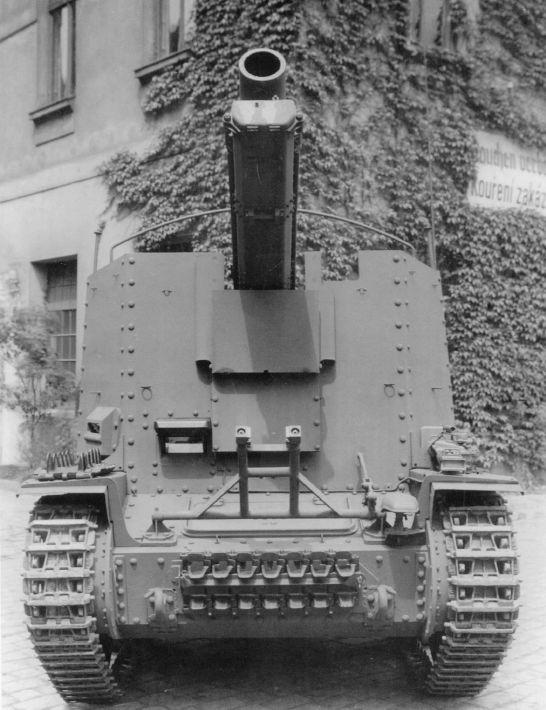
Grille Ausf. H with the gun at maximum elevation — note how the hinged cover has risen to fill the aperture in the front armour beneath the barrel, source: Praga archive with the permission of a company representative, modified
As for the total number of crew members, two different figures appear in the sources. The overwhelming majority state five men, while a small number of authors give only four. The driver, gunner, loader and commander are beyond dispute. Those who argue for a five-man crew add a separate radio operator; those who favour four men instead hold that the vehicle commander served as radio operator as well.
The existence of high-quality factory photographs of the interior allows both versions to be examined. The positions of the first four crew members have already been described. It is quite apparent that no additional seat for a fifth man was provided in the fighting compartment. The only vacant space where such a man might theoretically have sat was in the rear section to the right of the ammunition box. If present at all, this man could only have served as commander, since the roles of all the others were clearly defined — the man on the folding seat to the left had to be the radio operator, as the radio set was mounted on the side wall immediately to his left.
A fifth man in the role of commander would have been the only crew member without a padded seat, sitting instead on an uncomfortable bare metal plate. It seems far more probable that the crew numbered just four, one of whom combined the roles of commander and radio operator. The space in the rear of the compartment to the right of the ammunition box was deliberately left clear as a passageway to the openings in the rear armour. The perforated plate forming the floor of this section also makes sense in this context — the holes allowing warm engine air to heat the interior in cold weather when the tarpaulin was fitted.
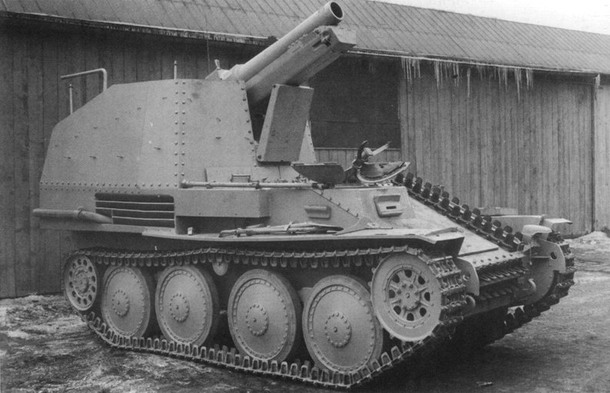
Grille Ausf. M, source: Praga archive with the permission of a company representative, modified
A number of rare photographs additionally prove that a version existed with the radio set mounted on the right-hand side wall instead, in which case the loader operated the radio. The rarity of these photographs presumably reflects the rarity of vehicles in this configuration. Experience probably showed that the commander could fulfil both roles more effectively than the loader. However, if vehicles existed where the loader operated the radio, what role would a fifth man have served? This too points towards a four-man crew.
As already noted, the prototype of the new self-propelled gun was completed by Alkett in October 1942. The vehicle underwent trials and was accepted into service with the German army. Its official designation, as so often, exists in multiple versions: some sources refer to it as "15cm sIG 33 (Sfl.) auf PzKpwf 38(t) Ausf. H", while others use "15cm sIG 33 auf Geschützwagen 38(t)". Its code designation of Sd.Kfz. 138/1 is unambiguous, however. The vehicle is best known under its combat name Grille — meaning cricket — and this first variant carries the suffix Grille Ausf. H.
Series production began in February 1943 at the BMM plant in Prague (the former ČKD works). The first 25 examples were delivered in February, and production continued until June, by which point a total of 200 vehicles had been built.
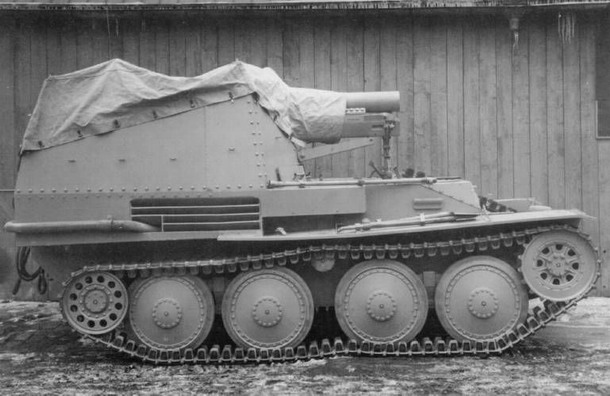
Grille Ausf. M with the tarpaulin over the fighting compartment, source: Praga archive with the permission of a company representative, modified
The Grille Ausf. H weighed 10.8 tonnes and achieved a respectable top speed of 47 km/h. Its weaknesses included a relatively large overall height, the lack of any organic anti-infantry armament, and limited on-board ammunition capacity. The first two drawbacks could be considered fairly minor, since a self-propelled gun of this type was not expected to engage enemy fire or infantry attacks at close quarters. The eliminated hull machine gun was compensated for by crews carrying two submachine guns.
The most significant shortcoming was therefore the small ammunition supply. Depending on the source this was 16 rounds, with some accounts suggesting even fewer. Photographs of the interior show four shells stored vertically on the right inner wall, two or three horizontally on the left wall, and six rounds in a box in the centre of the rear part of the fighting compartment. Any remaining rounds could be stowed in the space vacated by the eliminated hull machine gunner's position.
Ausführung M
The development of a second-generation Grille was driven by circumstances arising from an entirely different fighting vehicle. The Marder III Ausf. H tank destroyer was built on the same chassis as the Grille Ausf. H. Unlike the self-propelled howitzer, it was designed for direct combat, making the inadequacies of its crew protection far more significant. The army's pressure to improve this aspect of the Marder led the designers to develop a new chassis variant, designated Ausf. M. The key innovation was moving the engine from the rear to the centre of the hull — which is also the origin of the M in the variant's name, standing for Mitte, meaning centre. Ending production of the Ausf. H chassis and introducing a new one naturally required the self-propelled gun built on the same basis to be redesigned as well, giving rise to the Grille Ausf. M.
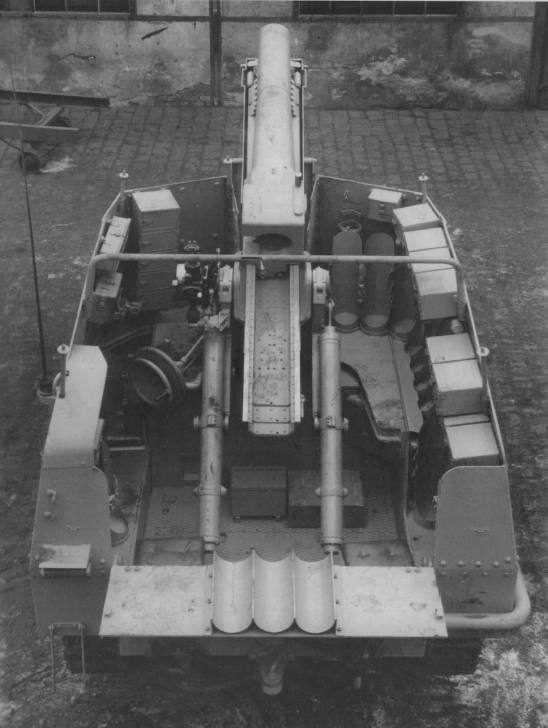
view into the fighting compartment of the Grille Ausf. M, source: Praga archive with the permission of a company representative, modified
The running gear itself changed barely at all from the earlier version — the only visible difference was the removal of one of the two return rollers. The Marder III Ausf. M and the Grille Ausf. M shared more than just their chassis, however: the hull layout was identical between the two. The vehicles differed essentially only in the design of their fighting compartments. On the Ausf. M the fighting compartment was now located at the rear of the vehicle, in the space freed up by relocating the engine. The front section of the hull on the M variant was covered by a sharply sloped plate, from the right side of which projected a boxy cab housing the driver's position. The driver's field of view was provided by two vision ports, one directly ahead and one in the right side wall. A circular hatch with a two-part cover was fitted in the roof of the driver's cab.
The fighting compartment was enclosed by armour plates joined partly by riveting and partly by welding. These plates were only 10 mm thick. The floor of the fighting compartment was lower than in the previous version, giving the gun crew better cover. At the rear of the compartment the armour was reduced in height, and the upper section of the rear wall could be folded down to make entry and exit easier. The aperture for the gun barrel again passed through the centre of the front wall, with the same type of movable armour plate below it that tilted in unison with the gun to maintain the integrity of the front armour at maximum elevation.
The armament again consisted of the heavy 150 mm sIG 33 infantry howitzer. The vehicle carried no built-in secondary armament, so crews once again had to carry submachine guns for close-range defence against infantry. The compartment remained open-topped and could be covered with an impregnated tarpaulin in bad weather. It was supported at the front by three rod struts, at the rear by two rod struts and one large arched strut running across the centre. A later modification replaced the central arched strut with two rod struts running rearward along the sides. The tarpaulin's edges were clipped to rings on the outer face of the armour, as on the previous version.
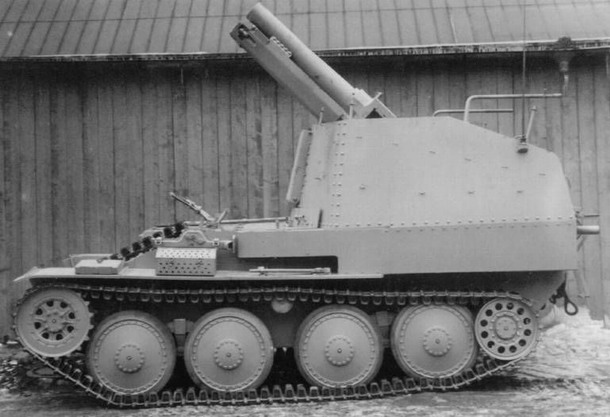
Grille Ausf. M, source: Praga archive with the permission of a company representative, modified
The crew of the Grille Ausf. M most likely numbered four men — though here too some authors cite five, while a look at the interior reveals only three seats in the fighting compartment. The driver sat in the left front section of the hull, separated from the rest of the crew by the engine section, and used his own dedicated hatch to enter and exit. Inside the fighting compartment, the loader, gunner and commander — who also served as radio operator — each had their station. Every man had his own padded seat. The gunner sat to the left of the gun, where the elevation control and periscopic sight were also located. The loader sat in the right rear corner of the compartment. The entire right half of the interior was densely packed with ammunition lockers. The commander and radio operator in one person had his seat in the left rear corner of the compartment, with the radio set mounted on the side wall immediately to his left.
The on-board ammunition supply increased on the Ausf. M to 18 rounds. The vehicle's weight also grew, to approximately 12 tonnes (11.5 tonnes is also sometimes cited), and as a consequence top speed dropped to 35 km/h. Production of the Grille Ausf. M began in all probability in October 1943 and continued until November 1944. The total number of vehicles built is unfortunately given inconsistently across sources — figures of 172 or 282 are cited.
Ammunition Carrier Version
The small on-board ammunition supply was a significant weakness of both Grille variants, making continuous resupply of vehicles in action a constant logistical challenge. To address this, an ammunition carrier version of the Grille Ausf. M was developed early in 1944. It was essentially a standard vehicle from which the weapon had not been installed. The movable cover in the front armour was fixed in the raised position to blank off the empty gun aperture, and the space freed up inside was filled by a large rack for carrying rounds. The interior of the ammunition carrier could accommodate up to 40 rounds in total. In addition to the driver, the crew consisted of two further men responsible for handling the ammunition. A total of 102 ammunition carriers were built, though 93 is also given as a figure. If required, the ammunition carrier could be fairly easily fitted with the howitzer and pressed into service as a standard self-propelled gun.
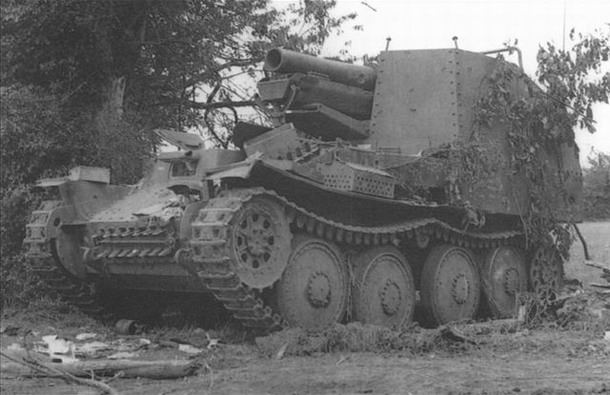
Grille Ausf. M knocked out on the Western Front, source: internet, Public domain, modified
The MK 108 Cannon
Photographs from the Prague uprising of May 1945 show an interesting modification of the Grille Ausf. M. Instead of the howitzer, a rapid-fire MK 108 cannon of 30 mm calibre — originally designed for installation in fighter aircraft — had been mounted in the fighting compartment. It is unclear to what extent the mounting allowed the weapon to be traversed; in all five photographs of this vehicle that I have seen, the barrel points forward and upward.
Little information is available about the history of this unusual machine, and what can be found is highly ambiguous. Some authors claim the conversion was carried out at German request before the outbreak of the Prague uprising, and that several examples were produced — two, or even a small series. All surviving photographs, however, clearly show one and the same vehicle, judging by its distinctive camouflage scheme, and all were evidently taken in Prague. The crude quality of the installation also points more towards a field modification than a factory conversion.
I will venture a speculation here: this vehicle could theoretically have been the work of the insurgents. It may have been either an ammunition carrier or an incomplete standard self-propelled gun. An unfinished vehicle could easily have fallen into rebel hands — Grilles were manufactured in Prague, after all. Local workers might have hastily fitted the gun and sent the vehicle into the streets. Had the builders been less pressed for time, they would surely have taken more care over the execution, and would likely also have chosen the Flakpanzer 38(t) as their base vehicle — its design being far better suited to mounting a weapon of this type, with its folding armour panels and fully rotating gun mount.
ammunition carrier based on the Grille Ausf. M, source: Praga archive with the permission of a company representative, modified
One of the limiting factors for the Grille's deployment in action was the effective range of its main armament: 4.7 km. This relatively short range was more than compensated for by the gun's enormous destructive power — its high-explosive shell contained more than 8 kilograms of Amatol explosive. Overall, the Grille was a considerably more mature design than the earlier sIG 33 installations on the Panzer I and Panzer II chassis.
ARTICLE
CONTENTS:
Reproducing text from the Panzernet website without the written consent of the operator is prohibited.