Sd.Kfz. 253
observation and fire direction vehicle for assault guns
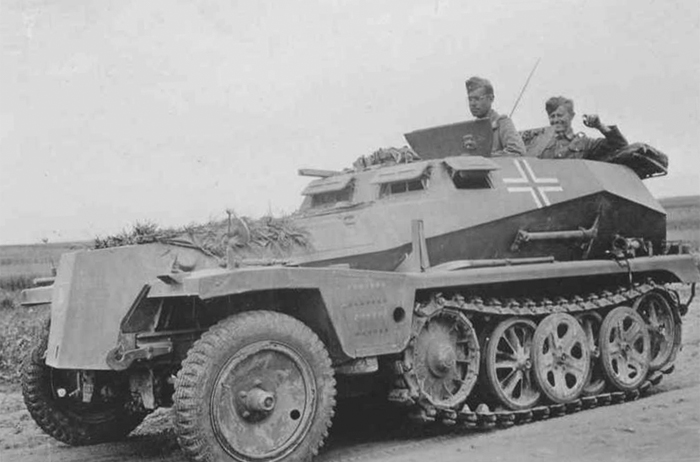
Leichter gepanzerter Beobachtungskraftwagen (Sd.Kfz. 253); source: worldwarphotos.info, used with permission of the operator, edited
Origins of the Vehicle
In 1936 Germany began development of an assault gun for infantry support, which later entered history as the highly successful Sturmgeschütz III (or StuG III for short). For these vehicles the Army required two types of support vehicle. The first was to be an ammunition carrier — a Munitionswagen — capable of delivering shells directly to the fighting StuGs at the front line. The second (which is the subject of this article) was generally known as the Beobachtungswagen (beobachten = to observe) and was intended for target acquisition and fire direction for the assault guns. The Munitionswagen was eventually realised as the Sd.Kfz. 252 half-track (described elsewhere), while the second support type became the Sd.Kfz. 253.
According to the Army specification, the Beobachtungswagen had to be capable of handling terrain just as difficult as the Sturmgeschütz itself, which meant it needed at least a partially tracked chassis. At the same time it had to be a reasonably agile vehicle capable of reaching 40 km/h on roads. The vehicle was to have a fully enclosed armoured cab resistant to armour-piercing small-arms fire. Since it was not intended for combat, no integral weapon was required. Its "weapons" were to be a retractable rotating periscope and radio equipment capable of voice communication over a range of at least 3 to 4 km.
The Army specification was probably drawn up as early as December 1936, with the first prototype required for testing by May 1937. The deadline was extremely tight, but the Army openly indicated that the prototype did not need to be a fully finalised production-ready vehicle. The principal aim of the trials was simply to validate the concept of such a vehicle.
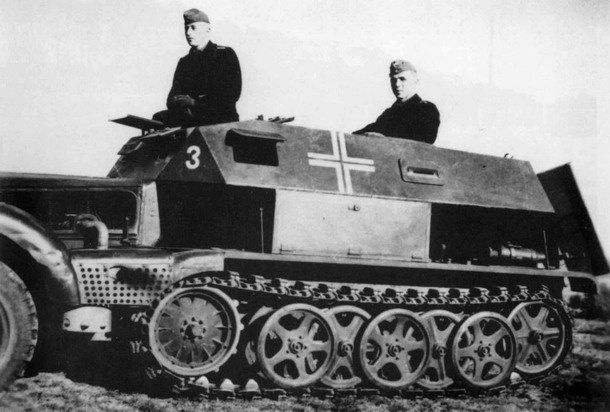
the 1937 observation half-track prototype, still built on the D ll 3 chassis version; source: Flickr.com, used with permission of the publishing user, edited
The First Prototype
Developing an entirely new chassis for the observation vehicle would have been too costly and time-consuming, so the Army decided to make use of the ongoing development of the light artillery tractor Sd.Kfz. 10, on which Demag (Deutsche Maschinenbau Aktiengesellschaft) was already working. By 1936 Demag had reached the third generation of prototype for its tractor, designated D ll 3, and it was this chassis that was used to build the first Beobachtungswagen prototype. A fully enclosed armoured superstructure was constructed on the half-track tractor chassis, with the original cargo area at the rear now serving as the main crew compartment. The front grille and engine bonnet remained the same as on the standard tractor — that is, unarmoured.
Testing of the observation vehicle prototype confirmed the validity of the concept, and development was to continue with a view to refining the vehicle for series production. However, the trials also revealed one significant problem: the fully enclosed armoured cab placed too great a load on the chassis and engine, as a result of which the vehicle apparently did not achieve the expected driving performance. The designers found themselves in an awkward position — they could not reduce weight by removing the roof or thinning the armour without violating the Army specification. Eventually, however, they found a way out: they simply made the whole vehicle smaller by shortening the chassis.
The D7p Chassis
By this point, in 1939, the designers were no longer working with the D ll 3 chassis but with the definitive chassis version bearing the factory designation D7, on which the series-production Sd.Kfz. 10 tractors were built. For the Beobachtungswagen, however, the production chassis required modification. In addition to the shortening already mentioned — which involved removing one road wheel from the track unit — the radiator, fuel tank, exhaust and even the steering wheel all had to be changed. The steering wheel had to be tilted downward to fit beneath the front armour of the cab.
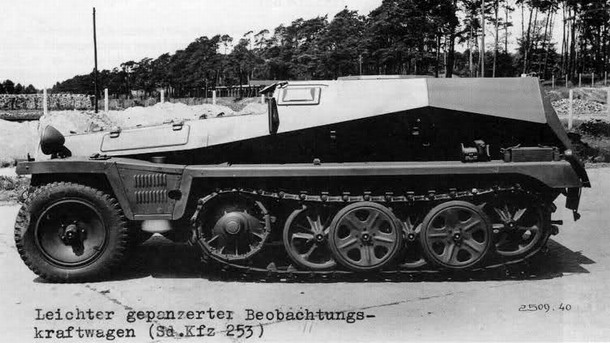
the series-production Sd.Kfz. 253 was built on the D7 chassis; source: Flickr.com, used with permission of the publishing user, edited
The modified chassis received the designation D7p. It consisted of a front steered wheel axle and a rear track unit. The front wheels were sprung by a transversely mounted leaf spring. The track unit comprised a front drive sprocket, a rear idler wheel, and four road wheels. The road wheels were sprung by torsion bars and fitted with rubber tyres to improve ride characteristics. Each wheel was a double unit made up of two steel discs — so the half-track effectively had eight road wheel discs arranged on four axles. The wheels were arranged in an interleaved pattern, each pair partially overlapping the adjacent pair — a configuration typical of German half-tracks and, later, tanks as well. The discs of the even-numbered wheels were mounted further apart on their axles, with the odd-numbered wheels — whose discs sat close together — fitting into the gap between them. Viewed from the side, only the even-numbered wheels were fully visible, specifically their outer discs. The tracks were fitted with rubber pads for smoother running on hard roads.
Shortening the chassis did achieve the desired reduction in overall weight, but it also shifted the vehicle's centre of gravity. The shorter track unit meant a greater load on the front wheel axle, and as a result the Sd.Kfz. 253 — and indeed all vehicles built on the D7p chassis — was reportedly more prone to front axle problems than the standard Sd.Kfz. 10 tractor on its unshortened D7 chassis.
Technical Description
The engine compartment occupied the front of the vehicle. Power was provided by a Maybach HL 42 TKRM petrol six-cylinder engine with a displacement of 4.198 litres and a maximum output of 100 hp at 2,800 rpm. The gearbox was of the Maybach Variorex VG 102 128 H type, with seven forward speeds and three reverse. Both the engine and gearbox were carried over together with the chassis from the Sd.Kfz. 10. Fuel capacity was 140 litres, sufficient for approximately 320 km on roads and around 210 km cross-country.
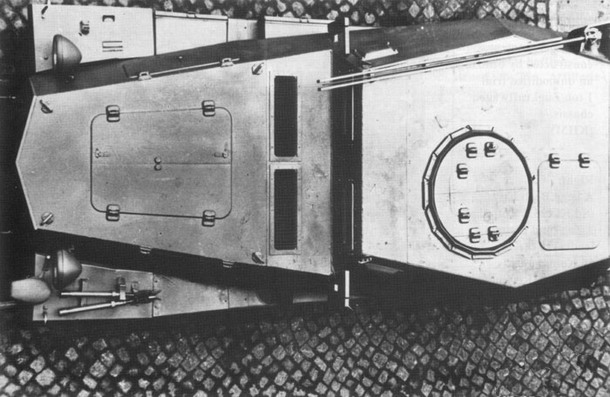
this photograph of the Sd.Kfz. 253 gives an excellent view of the closed cab roof with its two hatches and the aerial stowed in its protective trough; source: Flickr.com, used with permission of the publishing user, edited
Exactly as the Army specification required, the Beobachtungswagen received full armour protection extending even to the engine compartment. The front grille was formed by a single armour plate that could be removed for service access to the radiator (the vehicle without this plate can be seen, for example, in the photograph HERE, Flickr.com, used with permission of the publishing user). The engine bonnet had three further service access openings: two smaller oblong ones in the sides and one large one in the main bonnet panel, closed by a two-piece hatch. Behind this last opening were two ventilation cutouts in the main bonnet plate to allow airflow to (or rather from) the engine, protected by heavy wire mesh grilles.
Behind these ventilation openings, the front wall of the cab rose from the engine bonnet. Behind it sat the first two crew members: the driver on the left and a second observer on the right. Each had his own front and side vision port. All the vision ports, except the one in the right side wall, had openable armoured covers fitted with narrow observation slits. In safer areas the crew could open the covers and get a better view; even then they were still protected by a block of bulletproof glass fixed inside the port. In combat they closed the covers and observed only through the narrow slits. The driver steered with a conventional steering wheel: gentle turns moved only the front wheels, while larger steering inputs engaged braking on the inside track to assist cornering.
Behind the driver and second observer was the main crew compartment, where the remaining two crew members were stationed — the radio operator and the first observer, who also apparently served as vehicle commander. This section of the cab also housed the vehicle's most important equipment. Chief among it was the SF 14 Z binocular artillery observation periscope. This was mounted on a retractable bracket, so in normal use it was kept safely inside the armoured cab; when needed it extended through a circular hatch in the roof. The bracket also allowed the periscope to rotate fully through 360 degrees. The vehicle's other key "weapon" was its radio equipment, consisting of Fu 2 and Fu 6 sets and apparently also a portable Tornister Funkgerät. A two-metre whip aerial was fixed to the upper right side of the cab. When not in use, it could be folded forward and stowed in a protective wooden trough on the cab roof.
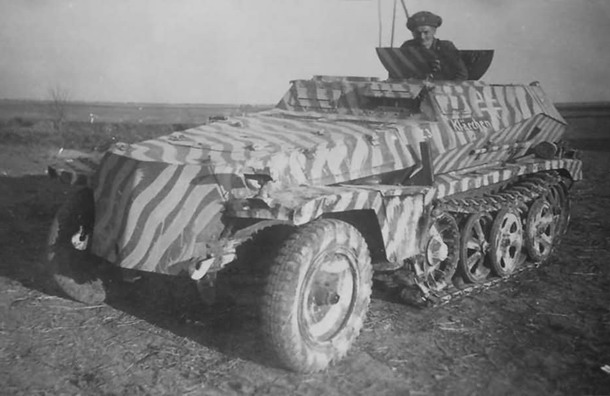
Sd.Kfz. 253 in an interesting winter camouflage scheme; source: worldwarphotos.info, used with permission of the operator, edited
The side walls of the cab followed the design typical of most German armoured half-tracks and vehicles — not flat, but angled so that there was no face onto which an enemy round could strike perpendicularly, always at least somewhat obliquely. This approach improved the effectiveness of the armour even with relatively thin plates. In the left half of the rear wall were large entry and exit doors for the crew, fitted with a vision port.
The cab roof was fully enclosed by a horizontal armour plate. Cut into its right section were two hatches. Further forward was a large circular hatch with a two-piece lid — this was the opening through which the observation periscope extended. For greater safety it was not necessary to open the entire lid to use the periscope: only a small independently opening section, provided specifically for this purpose, needed to be opened. To allow the periscope to rotate, both sections of the lid were mounted on a rotating ring, so whether open or closed they turned together with the periscope. Behind this circular hatch was a second, rectangular one. This had no special function and served simply as an entry and exit hatch for the crew. The armoured cabs were supplied by the firm Wegmann.
The official designation of the new half-track was Leichter gepanzerter Beobachtungskraftwagen (Sd.Kfz. 253) — literally "light armoured observation vehicle." Its armour thickness ranged from 5.5 mm to 14.5 mm. The vehicle measured 4.7 metres in length, 1.8 metres in height and 1.95 metres in width, and weighed 5.7 tonnes. Top speed was an impressive 65 km/h, though in practice the half-track generally operated at speeds up to around 45 km/h.
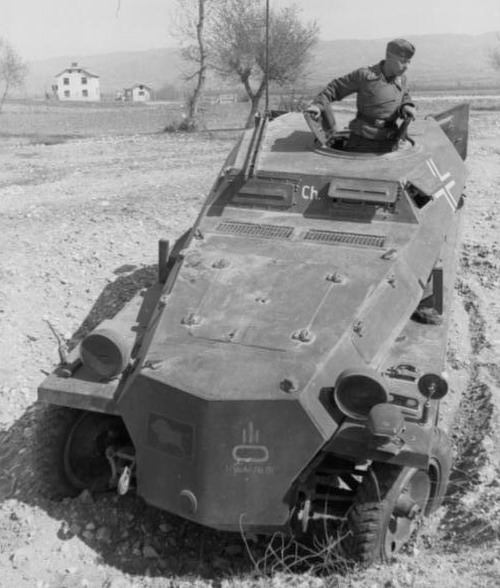
another fine overall view of the Sd.Kfz. 253; source: Bundesarchiv_Bild_101I-162-0283-14A, Wikimedia, Creative Commons, edited
The purpose of the Sd.Kfz. 253 was not combat but fire direction for the StuG III assault guns. Accordingly, the half-track carried no integral weapon. The crews did apparently carry one or two MP 38 (or MP 40) submachine guns and possibly also an MG 34 machine gun. Photographs do exist, however, showing that some crews modified their vehicles to improve their ability to defend themselves in the event of an unexpected encounter with the enemy. The image HERE, Flickr.com, used with permission of the publishing user, for example, shows a machine gun mounted on some kind of arm in front of the circular roof hatch. The crew of the vehicle shown HERE, worldwarphotos.info, used with permission of the operator went to even greater lengths, mounting their machine gun complete with a small gun shield — much as was done on the Sd.Kfz. 250 and Sd.Kfz. 251 armoured personnel carriers.
Although the first evaluation prototype — built on the D ll 3 chassis — was completed as early as 1937, series production of the Sd.Kfz. 253 as we know it did not begin until March 1940. Only 85 vehicles were built by the end of that year. Production continued into 1941, with a further 200 examples built between January and June. The total production run of the Sd.Kfz. 253 therefore amounted to 285 vehicles.
Combat Deployment
Sd.Kfz. 253 vehicles were allocated to assault gun batteries — the so-called Sturmbatterie. The assault battery, 1939 pattern, consisted of 6 StuG III assault guns (divided into 3 platoons of two guns each), 4 Sd.Kfz. 253 half-tracks (one per platoon plus one for the battery commander) and 3 Sd.Kfz. 252 ammunition carriers (one per platoon). As early as 1941, however, this establishment was revised and newly formed assault gun batteries no longer included Sd.Kfz. 253 half-tracks at all. Production of the type was accordingly brought to an end in June 1941. In future, where needed, Sd.Kfz. 250 half-tracks — specifically the Sd.Kfz. 250/5 variant — were to be used in their place.
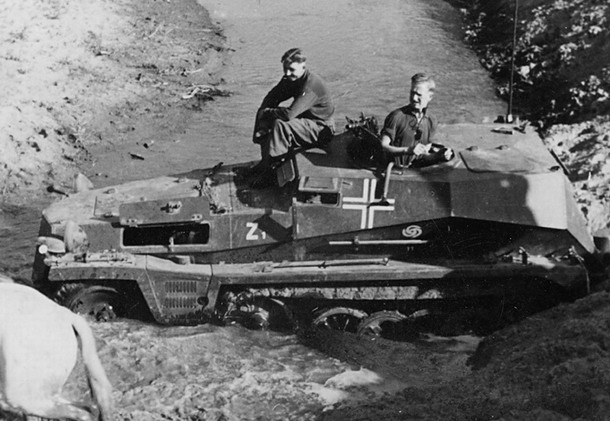
Sd.Kfz. 253; source: Flickr.com, used with permission of the publishing user, edited
Field Modifications
Like many other vehicles, the Sd.Kfz. 253 was the subject of various field modifications and conversions. Of those documented photographically, two are worth mentioning. Soldiers of Rommel's Afrika Korps converted at least one of these half-tracks into a command vehicle. A new radio set was apparently installed, and to extend its range a large frame aerial of the type commonly carried by other radio vehicles was fitted to the cab roof. At the rear of the cab beside the entry doors, a box-shaped extension to the rear armour appeared, enlarging the interior space — whether to accommodate the additional radio equipment or to increase fuel capacity (certainly a useful option in Africa) is not clear.
Another highly interesting modification was the conversion of a half-track into a self-propelled crane. This conversion scarcely needs describing, as a photograph says far more — see the image HERE, Flickr.com, used with permission of the publishing user. No further details about this particular vehicle have come to light. In any case it represented a most unusual conversion of an armoured vehicle.
Technical Specifications
|
weight: |
5.7 t |
|
length: |
4.7 m |
|
width: |
1.95 m |
|
height: |
1.8 m |
|
engine: |
Maybach HL 42 TKRM |
|
engine output: |
100 hp |
|
max. speed: |
65 km/h |
|
range – road: |
320 km |
|
range – cross-country: |
210 km |
|
crew: |
4 men |
|
armament: |
crew personal weapons only |

ARTICLE
CONTENTS:
Reproducing text from the Panzernet website without the written consent of the operator is prohibited.