Sd.Kfz. 252
ammunition carrier for assault guns
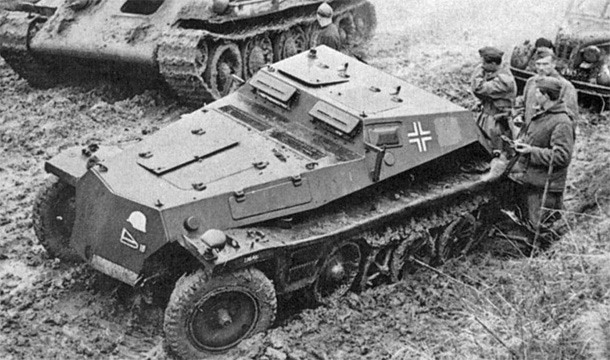
Sd.Kfz. 252 ammunition carrier on the Eastern Front; source: Flickr.com, used with permission of the publishing user, edited
Origins of the Vehicle
In 1936 Germany began development of an assault gun for infantry support, which later entered history as the highly successful Sturmgeschütz III (or StuG III for short). For these vehicles the Army required two types of support vehicle. The first, known as the Beobachtungswagen, was to serve for target acquisition and fire direction for the assault guns. This vehicle later materialised as the Sd.Kfz. 253 half-track (described elsewhere). The second support vehicle was to be an ammunition carrier — a Munitionswagen — capable of delivering shells directly to the fighting StuGs at the front line. It was for this role that the Sd.Kfz. 252 was developed, and that vehicle is the subject of this article.
According to the Army specification, the Munitionswagen had to be capable of handling terrain just as difficult as the Sturmgeschütz itself, which meant it needed at least a partially tracked chassis. At the same time it had to be highly agile, capable of reaching 60 km/h on roads. The vehicle was to have a fully enclosed armoured cab resistant to armour-piercing small-arms fire. Since it was not intended for combat, no integral weapon was required. However, it had to be able to carry at least 1,000 kg of cargo on board and a further 1,000 kg in a towed trailer.
The Army specification was probably drawn up as early as December 1936. Developing an entirely new chassis for the ammunition carrier would have been too costly and time-consuming, so the Army decided to take advantage of the ongoing development of the light artillery tractor Sd.Kfz. 10, on which Demag (Deutsche Maschinenbau Aktiengesellschaft) was already working. The same basis was also to underpin the second support vehicle mentioned above — the observation car Sd.Kfz. 253. It is interesting that the sources make no mention of any prototype for the Sd.Kfz. 252 ammunition carrier. It is therefore quite possible that none was ever built and that the engineers and the Army simply worked from the experience gained with the Sd.Kfz. 253 prototype — after all, both types were intended to be very similar in construction.
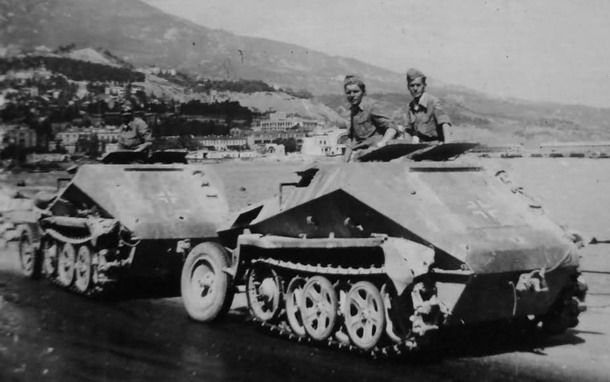
a pair of Sd.Kfz. 252 ammunition carriers; source: worldwarphotos.info, used with permission of the operator, edited
Tests of the Sd.Kfz. 253 observation car prototype revealed one significant problem: the fully enclosed armoured cab placed too great a load on the chassis and engine, as a result of which the vehicle apparently did not achieve the expected driving performance. The designers found themselves in an awkward position — they could not reduce weight by removing the roof or thinning the armour without violating the Army specification. Eventually, however, they found a way out of the problem: they simply made the whole vehicle smaller by shortening the chassis.
The D7p Chassis
The modified chassis version was prepared in 1939. In addition to the shortening already mentioned — and the removal of one road wheel from the track unit — the radiator, fuel tank, exhaust and even the steering wheel all had to be modified. The steering wheel had to be tilted downward to fit beneath the front armour of the cab. The modified chassis received the designation D7p. It consisted of a front steered wheel axle and a rear track unit. The front wheels were sprung by a transversely mounted leaf spring.
Technical Description
The track unit comprised a front drive sprocket, a rear idler wheel, and four road wheels. The road wheels were sprung by torsion bars and fitted with rubber tyres to improve ride characteristics. Each wheel was a double unit made up of two steel discs — so the half-track effectively had eight road wheel discs arranged on four axles. The wheels were arranged in an interleaved pattern, each pair partially overlapping the adjacent pair — a configuration typical of German half-tracks and, later, tanks as well. The discs of the even-numbered wheels were mounted further apart on their axles, with the odd-numbered wheels — whose discs sat close together — fitting into the gap between them. Viewed from the side, only the even-numbered wheels were fully visible, specifically their outer discs. The tracks were fitted with rubber pads for smoother running on hard roads.
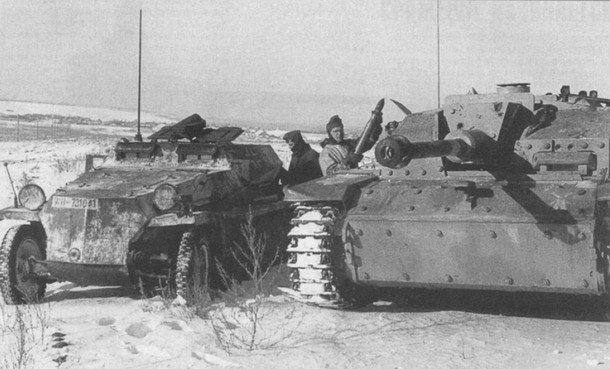
Sd.Kfz. 252 replenishing the ammunition of a StuG III Ausf. F assault gun; source: Flickr.com, used with permission of the publishing user, edited
Shortening the chassis did achieve the desired reduction in overall weight, but it also shifted the vehicle's centre of gravity. The shorter track unit meant a greater load on the front wheel axle, and as a result the Sd.Kfz. 252 — and indeed all vehicles built on the D7p chassis — was reportedly more prone to front axle problems than the standard Sd.Kfz. 10 tractor on its unshortened D7 chassis.
The engine compartment occupied the front of the vehicle. Power was provided by a Maybach HL 42 TKRM petrol six-cylinder engine with a displacement of 4.198 litres and a maximum output of 100 hp at 2,800 rpm. The gearbox was of the Maybach Variorex VG 102 128 H type, with seven forward speeds and three reverse. Both the engine and gearbox were carried over from the Sd.Kfz. 10. Fuel capacity was 140 litres.
Exactly as the Army specification required, the ammunition carrier received full armour protection extending even to the engine compartment. The front grille was formed by a single armour plate that could be removed for service access to the radiator. The engine bonnet had three further service access openings: two smaller oblong ones in the sides and one large one in the main bonnet panel, closed by a two-piece hatch. Behind this last opening were two cutouts in the main bonnet plate for engine ventilation, protected by heavy wire mesh grilles.
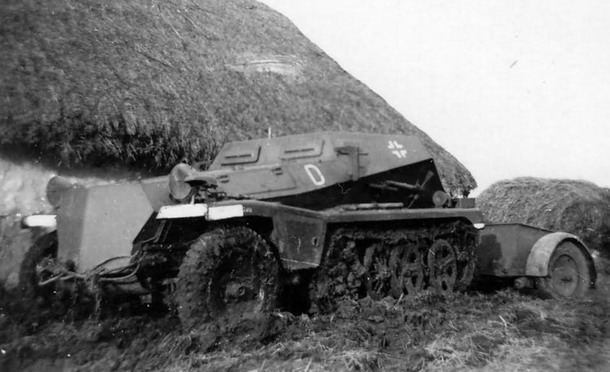
Sd.Kfz. 252 with its towed ammunition trailer; source: worldwarphotos.info, used with permission of the operator, edited
Behind these ventilation openings, the front wall of the cab rose from the engine bonnet. Behind it sat the vehicle's only two crew members. On the left sat the driver, who would certainly also have helped with loading and unloading ammunition when required. On the right sat the second crew member, who apparently served as vehicle commander, primary ammunition handler, and — where the vehicle was fitted with a radio — radio operator as well. Each man had his own front and side vision port. All the vision ports, except the one in the right side wall, had openable armoured covers fitted with narrow observation slits. In safer areas the crew could open the covers and get a better view; even then they were still protected by a block of bulletproof glass fixed inside the port. In combat they closed the covers and observed only through the narrow slits. Below both side vision ports were small circular cutouts that could serve as firing ports for the crew's personal weapons. The driver steered with a conventional steering wheel: gentle turns moved only the front wheels, while larger steering inputs engaged braking on the inside track to assist cornering.
Behind the driver and co-driver's backs was the cargo compartment, filled by an ammunition box for 75 mm rounds. The individual shells were stored vertically in a metal container. The side walls of the cab followed the design typical of most German armoured half-tracks and vehicles — not flat, but angled so that there was no face onto which an enemy round could strike at a perpendicular angle, always at least somewhat obliquely. This approach improved the effectiveness of the armour even with relatively thin plates. The horizontal roof ended at approximately the midpoint of the cab length and transitioned into a steeply sloped rear wall. In this rear wall were large double doors providing easy access to the ammunition in the cargo compartment. Additional 75 mm rounds were towed behind the half-track in the Sonderanhänger 32 trailer.
In the forward section of the cab roof, rectangular entry hatches were cut above the seats of both crew members. Each was fitted with a single-piece lid that opened rearward. The inside of the lids was padded with soft material. Hull and cab armour thickness ranged from 14.5 mm on the front faces down to just 5.5 mm on the roof panels. The armoured cabs were supplied by the firm Wegmann.
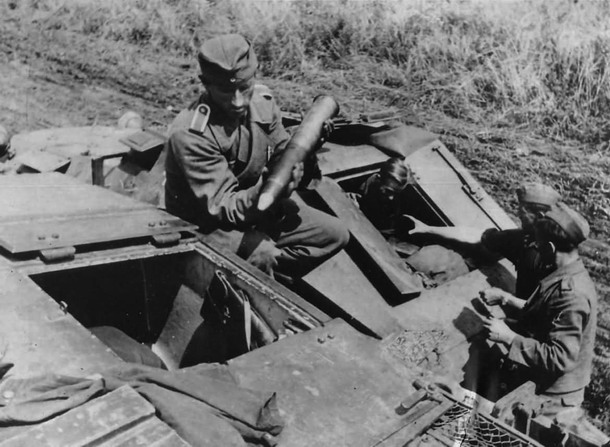
again the Sd.Kfz. 252 resupplying a StuG III assault gun; source: worldwarphotos.info, used with permission of the operator, edited
The official designation of the new half-track was Leichter gepanzerter Munitionstransportwagen (Sd.Kfz. 252) — literally "light armoured ammunition transport vehicle." The vehicle measured 4.7 metres in length, 1.8 metres in height and 1.95 metres in width, and weighed 5.73 tonnes. Top speed was an impressive 65 km/h, though in practice the half-track generally operated at speeds up to around 45 km/h. The Sd.Kfz. 252 was apparently fitted with a Fu15 radio receiver with a whip aerial fixed to the right side of the roof, though photographs of vehicles without aerials suggest that not all half-tracks were equipped with a radio set. As noted repeatedly, the purpose of the Sd.Kfz. 252 was not combat but the delivery of ammunition to the StuG III assault guns. Accordingly, the vehicle carried no integral weapon. The crews did, however, apparently carry one or two MP 38 (or MP 40) submachine guns and possibly also an MG 34 machine gun.
Although the Army specification for this vehicle was formulated as early as the turn of 1936–37, series production of the Sd.Kfz. 252 did not begin until much later — specifically in June 1940. Production then continued until September 1941, with a total of 423 vehicles of this type built. Production was not discontinued because ammunition carriers were no longer needed, but as part of a rationalisation: the role of ammunition carrier was henceforth to be taken over by the Sd.Kfz. 250 half-track (specifically its sub-variant the Sd.Kfz. 250/6). The Sd.Kfz. 252 did not disappear from combat units immediately, however — the vehicles remained in service for several more years, carrying ammunition for the new generations of StuGs fitted with longer-barrelled guns.
Field Modifications
One photographically documented modification converted an Sd.Kfz. 252 into a command radio vehicle. The cargo compartment was apparently used to house a more powerful radio set and additional crew members, and a new star-branched whip aerial appeared on the right side of the cab. This vehicle is shown in the photograph HERE. This appears to have been an informal field conversion, motivated by a shortage of regular command radio vehicles.
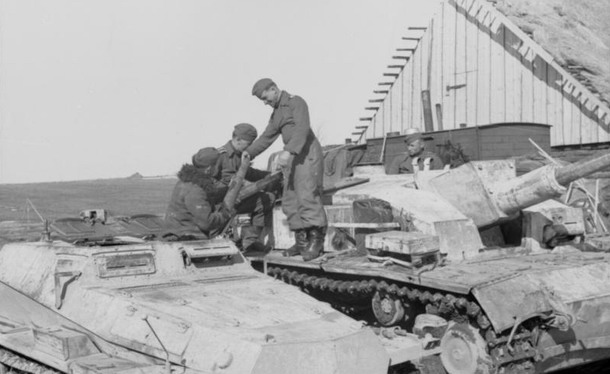
again the Sd.Kfz. 252 resupplying a StuG III assault gun; source: Bundesarchiv_Bild_101I-152-1811-09, Wikimedia, Creative Commons, edited
Finally, let us address a common misconception. Many authors state that the Sd.Kfz. 252 and Sd.Kfz. 253 were derived from the Sd.Kfz. 250 half-track infantry carrier. In fact, however, the Sd.Kfz. 252 and Sd.Kfz. 253 were developed earlier than the Sd.Kfz. 250. It was therefore the Sd.Kfz. 250 that adopted the modified chassis from both of the aforementioned types, not the other way around.
Technical Specifications
|
weight: |
5.73 t |
|
length: |
4.70 m |
|
width: |
1.95 m |
|
height: |
1.80 m |
|
engine: |
Maybach HL 42 TRKM |
|
engine output: |
100 hp |
|
max. speed: |
65 km/h |
|
fuel capacity: |
140 l |
|
consumption – road: |
40 l / 100 km |
|
consumption – cross-country: |
80 l / 100 km |
|
armour – front: |
14.5 mm |
|
armour – sides: |
8 mm |
|
armour – rear: |
8 mm |
|
crew: |
2 men |
|
armament: |
crew personal weapons only |

ARTICLE
CONTENTS:
Reproducing text from the Panzernet website without the written consent of the operator is prohibited.