TANK T-26
the indomitable light tank
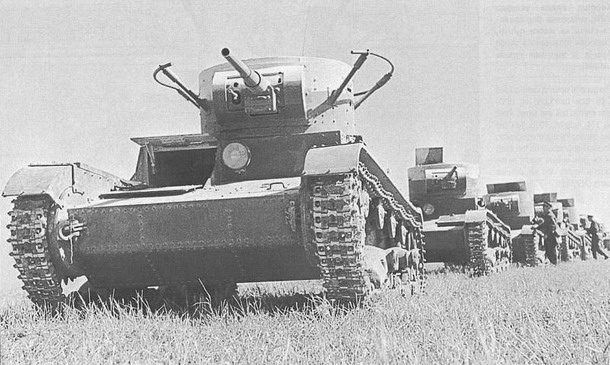
T-26 tanks, specifically the Model 1933, the first vehicle is a command tank, source: Flickr.com, Public domain, edited
Origins
In 1929 the Soviet Army was looking for tanks that could be produced in large numbers to fulfil the Red Army's rearmament programme. Development of domestic designs — such as the T-12 and T-24 — was proving extremely difficult, and so Soviet officials made the sensible decision to look abroad for new armoured vehicles. Their attention focused primarily on England, where tanks had originally been invented and where their development remained at a high level.
On 30 December 1929 a specialist commission headed by the chief of the Red Army's Mechanisation and Motorisation Directorate, I. A. Khalepsky, departed for England. Among other types, the commission examined the Vickers Mark E light tank (also known as the Vickers 6-ton), which was significantly more modern, faster, and cheaper than contemporary Soviet designs. On 28 May 1930 a contract was signed with Vickers for the purchase of 15 of these tanks in the Version A configuration — the twin-turret variant armed with two water-cooled Vickers machine guns of 7.7 mm calibre.
The tanks were purchased along with complete manufacturing documentation and the equipment needed for series production in the Soviet Union. To gain as much practical knowledge as possible, Soviet technicians even participated in the assembly of the purchased tanks at Vickers' factories. This vindicated Vickers' strategy, as the company had developed the tank not for the British Army but primarily for the armies of less industrially advanced nations, particularly in Eastern Europe, Asia, and South America.
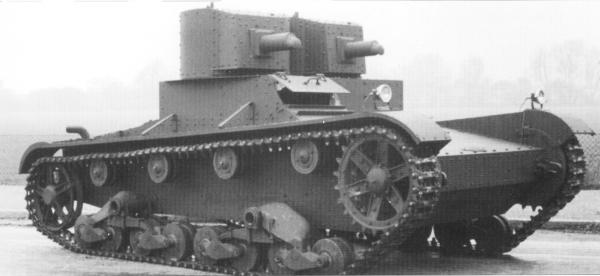
the basis for the Soviet vehicle – the British Vickers 6-ton Mark A tank, source: Flickr.com, Public domain, edited
TMM Prototypes
The purchased tanks were delivered gradually during 1930 and 1931, and were most likely designated V-26 in Soviet service, with the "V" standing for Vickers. Upon arrival they were immediately stripped down and work began on adapting the design for series production. The original Soviet plan called not for a simple copy of the British vehicle, but for the development of a domestically modified version. Two proposed variants were therefore drawn up, designated TMM-1 and TMM-2 (tank maloy moshchnosti — tank of low power).
In place of the original Armstrong Siddeley engine, both the TMM-1 and TMM-2 used a Hercules six-cylinder engine taken from a lorry. A further change was the relocation of the driver's position to the right side of the hull and a redesign of the crew compartment beneath the turrets. The TMM-1 retained the same armament as the original British Vickers, with the addition of a DT machine gun mounted in the left side of the hull, served by a fourth crew member added specifically for that purpose. The TMM-2 omitted the hull machine gun, but instead had a 37 mm cannon installed — or planned to be installed — in the right turret, with the original machine gun remaining in the left.
Neither prototype offered any improvement over the original, and in many respects their characteristics were actually worse. It was therefore decided that the original Vickers design, with only minor modifications, would enter series production. On 13 February 1931 the tank was officially accepted into Red Army service under the designation T-26. According to the plan, production of the new tank was to take place in a newly constructed factory in Stalingrad and was to be carried out on a truly mass scale. Construction of the factory was delayed, however, and it was eventually decided that the tanks would instead be built at the Bolshevik plant in Leningrad.
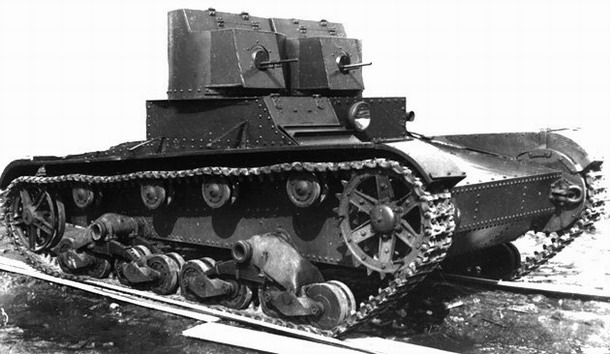
and here already the Soviet T-26 Model 1931, source: Flickr.com, Public domain, edited
To prepare for series production, an experimental design bureau called OKMO (opytny konstruktorsko-mekhanicheskiy otdel) was established at the Bolshevik plant, headed by N. Barykov and S. A. Ginzburg. The tank production department was subsequently separated from the Bolshevik plant and constituted as an independent facility named after K. E. Voroshilov and designated Factory No. 174.
T-26 Model 1931
The first series-produced T-26 tanks, designated Model 1931, were ultimately almost identical copies of the British Vickers Version A. The only — or at least the only significant — modification was the substitution of Soviet-made DT machine guns for the original Vickers weapons. The running gear consisted of eight small-diameter twin road wheels with rubber tyres on each side. The wheels were paired into bogies, which were in turn grouped into pairs sharing a common leaf spring and a large swinging arm. At the front was a spoked drive sprocket, and at the rear a spoked idler wheel. The upper run of the track was supported by four small return rollers. Track width was 260 mm.
The hull was riveted together from flat steel plates. Armour on the front and rear was 13 mm, on the sides 10 mm, with only 6 mm on the roof and floor. Behind the steeply angled upper glacis plate rose the vertical walls of the crew compartment. The driver sat in the right front of the compartment, with his entry hatch directly ahead of him, projecting slightly from the front face. The hatch was closed by a two-part cover — the smaller upper section opened upwards, while the larger lower section opened forward toward the bow. In the upper part was a narrow vision slit through which the driver could observe the road when the hatch was closed.
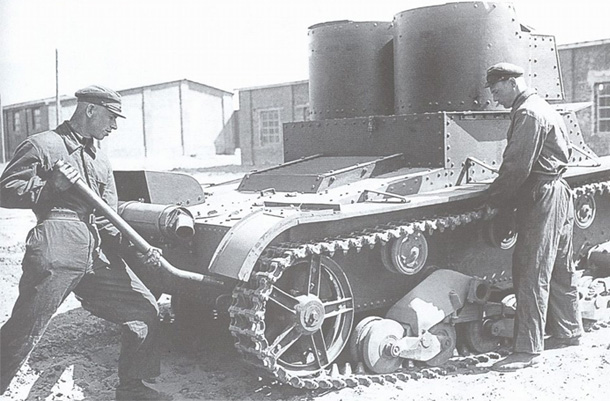
rear of a T-26 Model 1931, note the later raised cover for the cooling air outlet, source: Wikimedia, Public domain, edited
On the flat roof of the crew compartment sat two identical turrets. From the otherwise circular turret body, a rectangular projection extended forward and to the right, with a ball mount for the machine gun at its centre. The machine guns were of the DT (Degtyaryova Tankovy) type, calibre 7.62 mm. The turret roof was stepped, with the front portion sitting lower than the rear. In the raised rear section was a single-piece entry and exit hatch opening toward the bow. In the step between the two roof sections was a vision port with a hinged cover. The internal space inside the relatively small turrets was quite cramped and uncomfortable. The turrets were positioned very close together, meaning the forward gun projections on each prevented full rotation — each turret could traverse only somewhere between 265 and 270 degrees. A large portion of the firing arcs of both turrets overlapped. Ammunition supply for the machine guns was 6,615 rounds.
The engine compartment occupied the rear of the tank, its roof sloping gently toward the stern. Immediately behind the crew compartment, a large grille in the centre of the engine deck served as the cooling air intake, while the outlet was in the left rear corner — the intake protected by metal vanes, the outlet by a mesh grille. A raised cover was later added over the exhaust outlet, probably to prevent snow from blocking it. The exhaust pipe was mounted along the rear edge of the engine compartment, with an emergency starting crank hole in the rear plate below it.
The powerplant was a Soviet-built copy of the original air-cooled Armstrong Siddeley four-cylinder engine, displacing 6.6 litres and producing 90 horsepower at 2,100 rpm. Fuel capacity was 182 litres. The gearbox, located at the front of the hull, provided five forward gears and one reverse. The tank weighed approximately 8 tonnes and could reach a maximum speed of around 30 km/h.
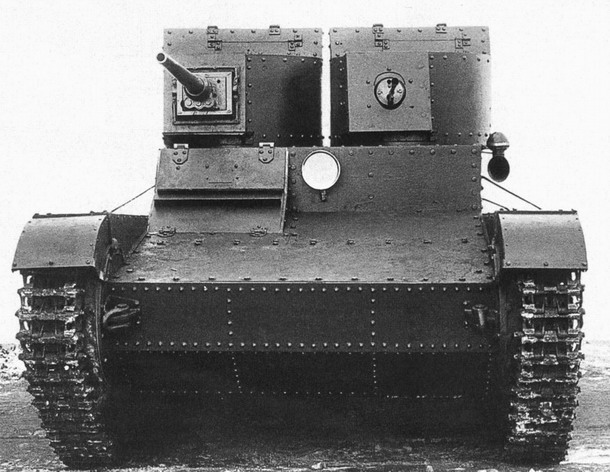
prototype of the T-26 Model 1931 with a B-3 cannon in the right turret, source: Flickr.com, Public domain, edited
The crew consisted of three men. The driver was the only one in the hull; the other two each manned one of the turrets. The tank was equipped with no communications equipment whatsoever — contact with the outside world was maintained solely by signal flags, while communication between the crew inside the vehicle was conducted directly, which in practice was extremely difficult. The men in the turrets were effectively isolated from one another, and coordinating their actions in combat was nearly impossible. Radios were fitted only to command versions of the tank, though the sources are unclear as to whether command vehicles were produced in the Model 1931 variant or only in later ones.
The first seventeen series-production Model 1931 tanks were completed in November 1931 (some sources say October). By the end of the year a total of approximately 120 vehicles had been built, though again differing figures are quoted. The early tanks suffered from numerous problems despite being essentially copies of a working design. Of those 120 vehicles, it is said that the army accepted only 88, with 35 of those accepted conditionally. Initial production costs were also considerably higher than anticipated.
Gun Armament
As early as the end of 1931, Soviet designers raised the question of upgrading the T-26's firepower. The tank had been conceived to support infantry, but even in that role a cannon would have been useful for destroying fortified positions, machine gun nests, and enemy armoured vehicles. The first prototype with a cannon was most likely completed before the end of the year, apparently armed with a French Hotchkiss 37 mm gun. Tests showed the concept to be viable and preparations for series production began.
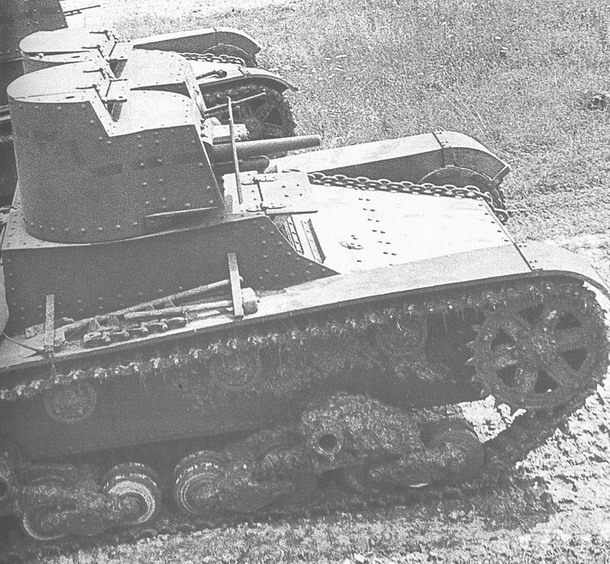
series-production gun-armed T-26 Model 1931 with a PS-1 cannon, source: Flickr.com, Public domain, edited
Sources contain many different and sometimes contradictory accounts regarding the selection of the new main weapon. It appears that experiments were conducted with two guns: the PS-1, a Soviet licence-built version of the French Hotchkiss, and the domestic PS-2, both in 37 mm calibre. The PS-2 had superior ballistic performance but could not be fitted into the standard T-26 turret. Prototypes armed with these guns therefore used turrets borrowed from the then-under-development multi-turret heavy tank T-35, which was a significant complication that put the PS-2 at a considerable disadvantage.
The preferred solution was therefore the new B-3 cannon (factory designation 5-K), developed by the artillery department of the Bolshevik plant. This weapon was derived from a German Rheinmetall design and met the designers' requirements — it was smaller than the PS-2 and had a shorter recoil stroke, allowing it to fit into the existing machine gun turret of the T-26. However, production of the B-3 did not ramp up as smoothly as hoped, with numerous quality problems emerging. Furthermore, it was decided that the B-3 guns produced would be allocated primarily to the BT-2 tanks. As a result, the PS-1 was ultimately adopted for the modernised T-26 production variant, despite its lower performance.
The new version of the tank (designated T-26 Model 1932, though probably only retrospectively and unofficially) retained its two small turrets, but with the PS-1 37 mm cannon replacing the machine gun in the right one. The installation of the cannon further reduced the already cramped interior space of that turret. The left turret retained its original machine gun. On-board ammunition was 222 cannon rounds and 3,528 machine gun rounds. The weight of the Model 1932 increased by 500 kg, which apparently had no effect on driving performance. A total of 450 tanks of this version were built in 1932 and 1933, of which approximately 50 were command variants fitted with a radio, easily identifiable by the frame antenna mounted on several brackets above the mudguards and front hull.
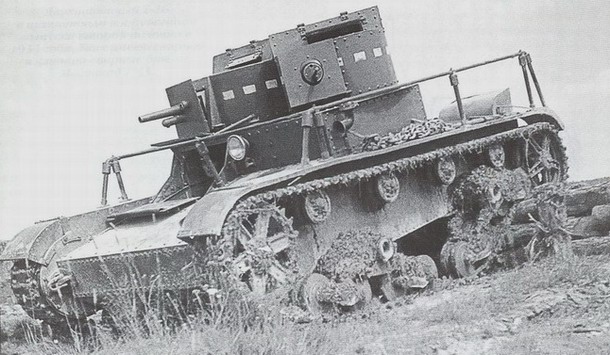
command version of the gun-armed T-26 Model 1931, note the frame antenna, source: Wikimedia, Public domain, edited
T-26 Model 1933
A cannon crammed into a small turret originally designed for a machine gun was far from an ideal solution. As already noted, internal space was extremely limited and uncomfortable, and it was clear that any further increase in firepower — meaning the installation of a more powerful gun — would not be possible without a fundamental redesign. That change came in 1933, with the introduction of the single-turret T-26 Model 1933. The development and production history of the new turret is surrounded by many conflicting accounts and is not easy to describe clearly. Two factories were involved in developing and manufacturing it: the Izhora plant (at Kolpino, near Leningrad) and the Mariupol plant (in Mariupol, Ukraine).
The origins of the new T-26 variant are closely linked to the development of another light tank, the BT — specifically the BT-2 and BT-5 variants. The new turret being developed by both the Izhora and Mariupol plants was originally intended for the BT-2, which was armed with a 37 mm cannon in a cylindrical turret. When designers tried to fit a more powerful 45 mm gun into that turret, it proved impossible, and so from 1932 both factories began work on a new, larger turret. This turret was ultimately used not on the BT-2 but on the newer BT-5, and after trials it was decided it was also suitable for the T-26.
The Mariupol turret was riveted, and its most distinctive feature was a small, sharply angular counterweight riveted to its rear wall — a boxy appendage that had no smooth visual connection to the rest of the cylindrical turret. There was a single rectangular hatch in the roof with a one-piece cover. The turret ventilator also opened through the left side of the roof — an addition necessitated by the more powerful gun, which produced more propellant fumes. Turret armour ranged from 8 to 13 mm. Only a relatively small number of these turrets were built (230 is the commonly cited figure), and photographs of both BT and T-26 tanks fitted with them are rare.
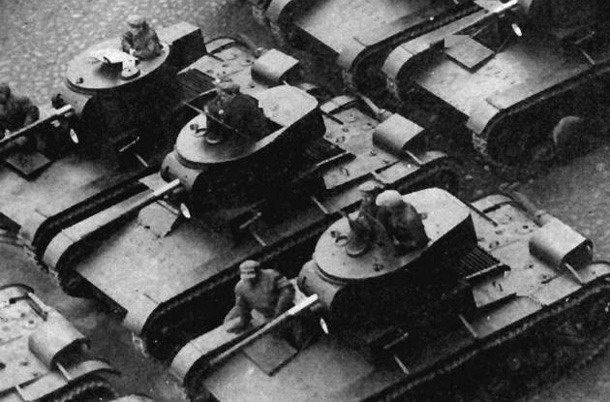
T-26 Model 1933 tanks; the first tank on the left is the rare version with the original turret featuring the small angular counterweight and single entry hatch, source: Flickr.com, Public domain, edited
The Izhora plant's turret was a more modern design. It was welded, with a larger, rounded rear bustle that blended smoothly into the side walls. In the rear wall of the bustle was a small door, probably used for loading ammunition. The roof had a large hatch closed by two independently opening covers. The turret ventilator was centrally positioned, with the commander's periscope aperture to its right. Both side walls featured elongated vision ports and, below them, circular ball mounts for firing personal weapons. At its thickest points the turret armour was 15 mm. The hull of the Model 1933 remained riveted, with armour ranging from 15 mm at the front and rear down to just 5 mm on the engine deck roof.
Two weapons were considered for the new variant: the 37 mm B-3 cannon that had been passed over during the twin-turret modernisation, and the 20K Model 1932 45 mm cannon with a barrel 46 calibres long. The designers naturally preferred the 45 mm weapon, which was more capable not only in the anti-armour role but could also fire heavier and more effective anti-personnel fragmentation shells. Factory No. 174 in Leningrad prepared an installation pairing this cannon coaxially with a DT machine gun, which underwent testing in March 1933. Those tests revealed significant problems with the semi-automatic breech, which was supposed to automatically eject spent cases after each shot — saving the loader's effort and increasing the rate of fire — but at normal temperatures failed to eject the case in approximately 30% of firings, with failures occurring even more frequently in cold weather.
Correcting these faults would take considerable time, and in the interim the gun simply had to be manually unloaded after each shot, reducing the rate of fire. Even so, it was judged more suitable than the competing 37 mm B-3. The 20K was therefore approved as the armament of the single-turret T-26 Model 1933 in the spring of 1933. The work to eliminate the breech problems eventually led to a modernised version designated 20K Model 1934, which began replacing the earlier gun in production tanks as soon as it became available — the same change applying simultaneously to the BT-5.
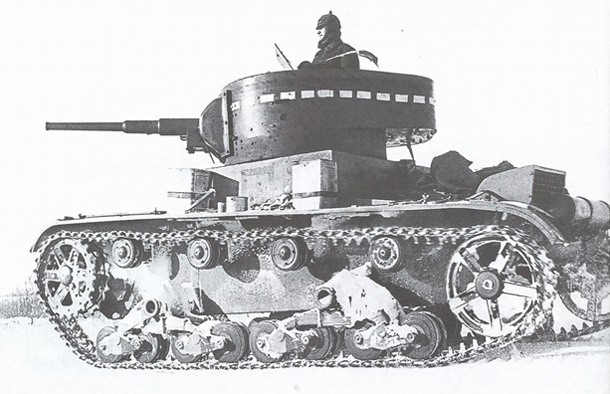
T-26 Model 1933, source: Flickr.com, Public domain, edited
The gun's elevation range ran from -6° to +22° (some sources quote -8° to +25°). Both armour-piercing and high-explosive fragmentation ammunition was used. The armour-piercing round weighed 1.425 kg (sometimes given as 1.435 kg) and left the muzzle at 760 m/s (some sources quote higher). Its maximum range was 3.6 km (again, some sources give higher figures), and at 500 metres it could penetrate up to 43 mm of vertical homogeneous armour. The on-board cannon ammunition supply varies widely depending on the source, with figures ranging from 122 to 138 rounds. The same is true of the machine gun ammunition count, for which 2,898 or 2,961 rounds are quoted — a difference of one magazine (46 or 47 magazines).
The crew of the single-turret T-26 remained three men. The driver continued to sit in the hull, while the other two shared the turret. The gunner sat to the left of the cannon and the commander to the right — though the commander simultaneously served as loader. The gunner aimed using the TOP-1 optical sight, which protruded from the gun mantlet to the left of the barrel. To the right of the cannon was a coaxially mounted 7.62 mm DT machine gun. The combined gun mantlet was originally welded, but was later replaced by a pressed version with rounded edges.
Production of the Model 1933 was intended to begin immediately after its design was approved in spring 1933, but slow cannon deliveries reportedly delayed the first series-production vehicles until summer. Production of the new single-turret and the older twin-turret variants ran in parallel. By the end of 1933 approximately 713 single-turret tanks had been completed (though other figures are also cited). The following year saw the last twin-turret tank built and production of that variant ended, with capacity concentrated on the newer model. That year the Leningrad factory turned out approximately 946 single-turret T-26 tanks including command variants (exact figures differ, as always). A negligible number were also produced at the newly completed — and overdue — Stalingrad factory.
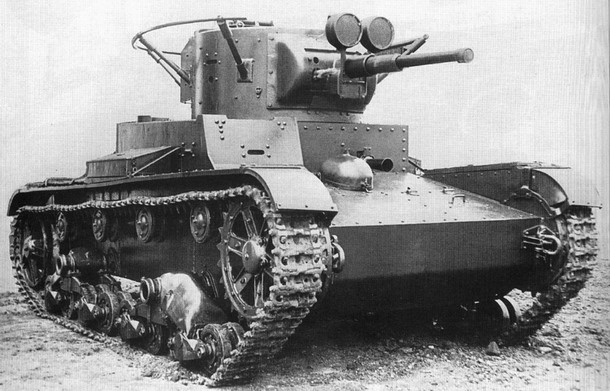
progressively modernised command T-26 Model 1933, note the new pressed gun mantlet, headlights above the barrel and the headlight cover on the hull nose, source: Flickr.com, Public domain, edited
As with the Model 1931, command vehicles were also produced in the single-turret variant. These carried a 71-TK-1 radio set mounted in the rear bustle of the turret. Operating the radio became an additional duty of the commander, who now effectively held three roles simultaneously — commanding the vehicle, loading the cannon, and operating the radio. In combat this must have kept him extremely busy. Command vehicles were easily identified by the large frame antenna encircling the turret (except for the front), mounted on six brackets around its circumference. The installation of the radio required a reduction in the cannon ammunition supply to 96 rounds.
In the years that followed, a series of incremental improvements and modifications were introduced to the Model 1933. As mentioned, the welded gun mantlet was replaced by a pressed one. A hinged armoured cover was added to the headlight on the front of the crew compartment, and two additional headlights for night fighting were fitted above the barrel. A PT-1 periscopic sight was installed, the engine air intake received a new cover, and riveted joints across much of the hull were progressively replaced by welding. A second DT machine gun was added to the rear of the turret bustle (where the small door had originally been), covering the space behind the tank. A third DT machine gun was probably added from 1937, this one mounted on the turret roof for anti-aircraft defence.
All these modifications brought a slow but steady increase in weight, reaching 9.75 tonnes by 1937, with an inevitable negative impact on mobility. The Soviets had been looking for a more powerful engine to address this problem long before 1937 — as early as 1932, the British apparently offered a modernised version of the Armstrong Siddeley engine with output raised to 100 horsepower. The Soviets studied it and decided they could achieve a similar improvement on their own. They declined the British offer and instead developed their own engine during 1933, simply designated T-26, with output raised to 95 horsepower. The new engine began to be fitted in tanks during 1934.
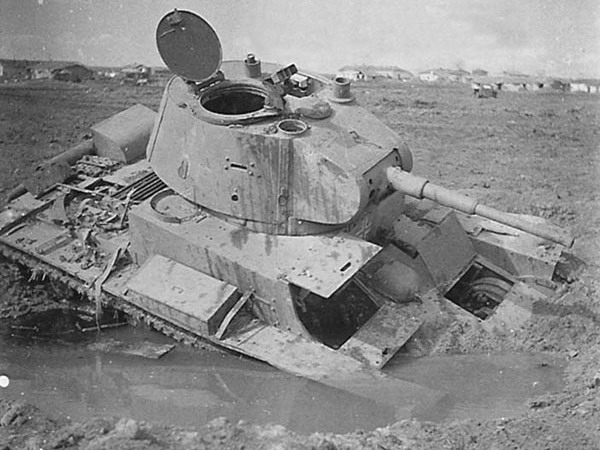
wrecked T-26 Model 1938, conical turret and gun mantlet with sharp side edges, source: Flickr.com, Public domain, edited
T-26 Model 1938
A more significant change came in 1938 in the form of a new conical turret — one that tapered toward the top. The turret walls remained 15 mm thick, but the sloping was intended to increase their resistance to hits. Combat experience with T-26 tanks in the Spanish Civil War had highlighted the weakness of its armour. Thickening the armour outright would have meant further weight increases and consequently a further decline in mobility, which was already unimpressive. Since no more powerful engine was available for installation, improving protection through sloped armour was the ideal solution.
The rear wall of the turret again featured a DT machine gun, and the roof had two hatches — one circular, one (nearly) rectangular. The tank also received the latest version of the 20K cannon, the Model 1938, fitted with a stabilised TOS periscopic sight. The fuel tank capacity was also enlarged, from 182 to 285 litres (some sources suggest this increase had already been made earlier as part of the ongoing modernisation). The cumulative result of these changes pushed the weight above 10 tonnes. In 1938 a total of 716 tanks of this variant were produced.
T-26 Model 1939
The year 1939 brought another round of modifications. In the same way that the turret had been given sloped walls the previous year, the sides of the crew compartment beneath the turret were now sloped as well — both the front and side walls. Any remaining riveted joints on the hull were eliminated entirely in favour of welding. The turret received a new-style gun mantlet with rounded edges. An attempt to further improve the engine led to it being modified to run on a higher-octane special fuel, which raised output to 97 horsepower. This did, however, create new logistical demands, since vehicles with the modified engines could not run on standard petrol. That year the Leningrad factory completed a total of 1,295 tanks (plus a smaller number built in Stalingrad).
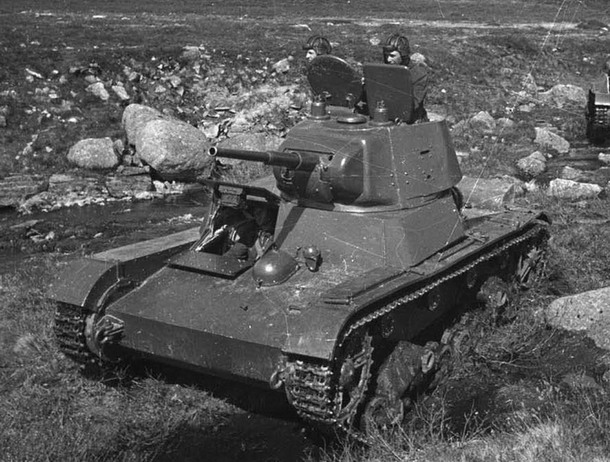
T-26 Model 1939, sloped hull sides, conical turret and rounded gun mantlet, source: Flickr.com, Public domain, edited
Up-Armoured T-26E
The Winter War with Finland once again exposed the inadequacy of the T-26's armour. As an improvised remedy, around a hundred tanks of various models were fitted with additional armour plates bolted or riveted directly onto the existing hull surfaces. The thickness of the supplementary plates is not entirely clear from the sources, but 25 mm is commonly cited. The add-on armour was applied to the hull front and all walls of the crew compartment and turret, with the work carried out at the Leningrad factory. Tanks modified in this way were designated T-26E, where the "E" abbreviated the Russian word ekranirovany — meaning screened or up-armoured. Tests, and probably combat as well, showed a dramatic improvement in the tank's resistance to enemy fire. The trade-off was a significant increase in weight, which pushed the vehicle's speed down to the bare minimum of acceptability. Later, during the fighting against the Germans, further tanks received improvised additional armour in the field — most commonly in the form of welded plates applied to the front or sides of the turret.
T-26 Model 1940
The final round of modifications came in 1940. Turret and crew compartment armour was increased to 20 mm — not through bolt-on plates this time, but by thickening the walls themselves. This pushed the tank's weight past 12 tonnes. What effect this had on maximum speed is not clear from the sources, though it could hardly have been a positive one. The frame antenna of earlier variants was replaced on this final version with a less conspicuous whip antenna. In 1940 a total of 1,336 tanks were built (plus a smaller number at Stalingrad). Production of the T-26 came to an end in 1941 with a final run of just 47 vehicles.
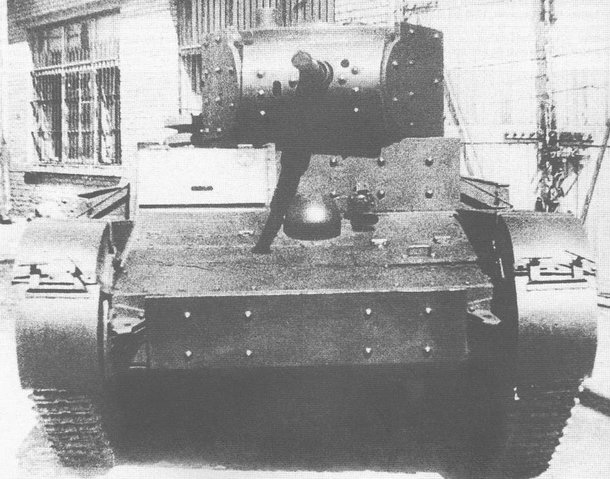
T-26E fitted with additional armour, source: Flickr.com, Public domain, edited
The total number of T-26 tanks produced is not easy to determine — cited figures vary quite considerably. The number 11,218 is often encountered, though it is unclear whether this includes only tanks or also all the other vehicle types derived from the T-26 chassis. In any case, the figure gives a clear enough sense of how massively this fighting vehicle was produced — on a scale that had no parallel anywhere in the world at the time.
T-26 with 76.2 mm Cannon
The T-26 chassis served as the basis for a wide variety of specialised vehicles, several of which grew out of attempts to mount a more powerful weapon than those used in the standard production tanks. The twin-turret Model 1931 with its two small turrets presented a particular challenge in this regard, yet in 1934 a prototype was built in which a 76.2 mm cannon was squeezed into one of the small machine gun turrets. The weapon was the recoilless DRP gun designed by Leonid Vasilyevich Kurchevsky — chosen for its relatively low weight, which did not overload the tank's suspension. It could fire both anti-personnel and armour-piercing rounds at a muzzle velocity of up to 470 m/s. The cannon was installed in the right turret, with the original machine gun retained in the left.
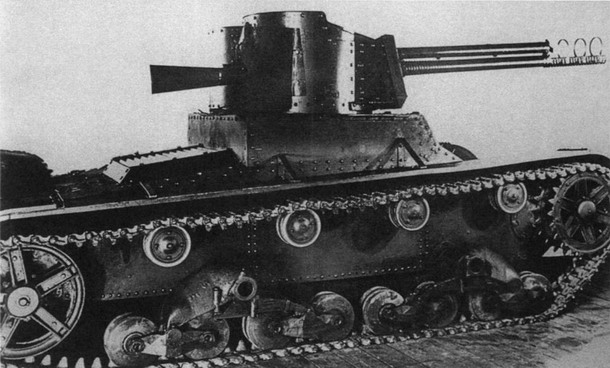
prototype T-26 with a 76.2 mm recoilless cannon, source: Wikimedia, Public domain, edited
Thanks to the recoilless principle, the turret did not need to absorb the firing energy of such a powerful weapon — which would in any case have been impossible. Instead, a portion of the propellant gases was vented in the opposite direction, out through the rear of the turret, counteracting the force of the projectile. Even so, the installation was far from problem-free. Loading was extremely awkward, presumably requiring the loader to work from below inside the crew compartment since there was no room to stand beside the gun in the turret itself. More seriously, the rearward gas venting posed a direct safety hazard — the jet of flame that erupted from the port in the turret rear wall endangered any troops moving behind the tank. These and other faults were uncovered during testing in March 1934 and led to the project's rejection. The T-26 BPK, as the prototype was designated, was therefore built in a single example only.
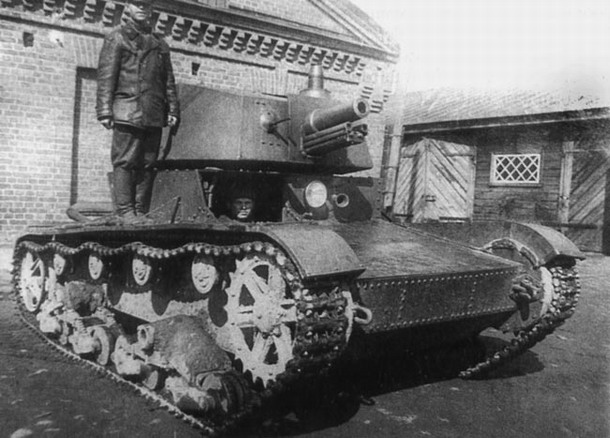
prototype T-26 with A-43 turret, source: Wikimedia, Public domain, edited
T-26 with A-43 Turret
Another attempt to fit more powerful armament produced the prototype tank with the A-43 turret, sometimes referred to as the T-26A. The new turret was developed by N. Dyrenkov's team at the Bolshevik plant as a universal gun turret that could be fitted to both T-26 and BT chassis. It was octagonal and welded, with a roof that sloped downward from the midpoint toward the front plate, and large double rear doors in the rear wall. The turret carried a short-barrelled 76.2 mm Model 1927/32 cannon with a coaxial DT machine gun. The T-26 prototype with this turret was built and tested, most likely in late 1932, but was not accepted for service. The turret was only marginally larger than the later series production turrets of the T-26 Model 1933, making it evident that the large-calibre cannon must have occupied most of the available internal space, leaving its crew in a very uncomfortable working position — which was probably one of the main reasons the project was rejected.
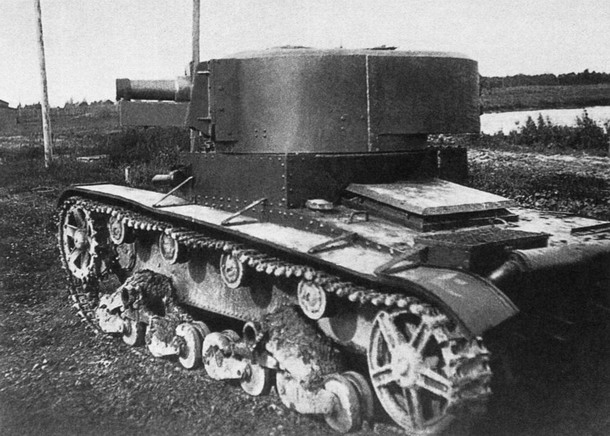
T-26-4 prototype, source: Flickr.com, Public domain, edited
T-26-4 Prototype
A further design effort produced the T-26-4 prototype in 1933. This vehicle carried a modified turret taken from the new T-28 heavy tank — a circular turret with a rounded rear bustle. The main gun came with the turret: the KT-28, a 76.2 mm cannon with a barrel 16.2 calibres long (some sources say 16.5). This weapon had a shorter recoil stroke than the Model 1927/32 cannon and therefore took up proportionally less internal space. A 7.62 mm DT machine gun was installed to the right of the cannon. The turret naturally had to be modified and lightened for the new application, but even so its installation increased the vehicle's weight and reduced speed and mobility. Some sources suggest only a handful of examples were built, while others claim that dozens were produced during 1934 and 1935.
Flamethrower Tanks
The flamethrower variants of the T-26 form a substantial chapter in their own right. The Soviets classified these vehicles as chemical tanks (ChT — chimicheskiy tank, literally chemical tank) because, in addition to projecting flames, they could also lay smoke screens or contaminate the battlefield with chemical agents. Work on the first chemical T-26 began in 1932, when the first prototype was built, designated ChT-26 and based on the Model 1931. The very earliest version — never accepted into production — retained both original small turrets, with the tanks of the TChP-3 chemical equipment mounted externally on the track mudguards. The chemical equipment was developed and manufactured by the Kompresor factory. However, it is the series-produced variant that became better known under the ChT-26 designation — this version had the left turret removed and the space in the crew compartment below it used to house a fuel tank and a compressed air reservoir. The remaining right turret was fitted with both a machine gun and the KS-24 flamethrower.
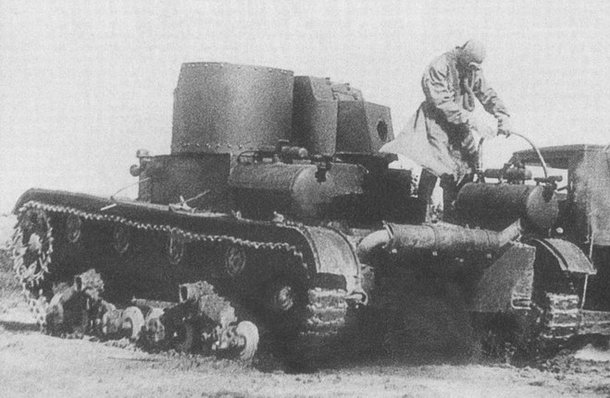
first variant of the chemical T-26 with external tanks, source: Flickr.com, Public domain, edited
Figures for the on-board fuel supply vary between 360 and 400 litres, sufficient for approximately 40 five-second bursts. The flamethrower's effective range is variously given as 35 or 45 metres. The fuel was carried from the tanks to the projector nozzle through flexible hoses. Turret traverse was artificially limited to 270° to prevent the turret from rotating fully around, which would have twisted, and possibly burst, the hoses — causing a fire inside the crew compartment. The flamethrower tank's crew most likely numbered two men, though three is sometimes cited. The ChT-26 is also referred to as the BCHM-3 or, more commonly, as the OT-26. The prototype was tested during June and July 1932 and approved for series production. Between 1932 and 1935 a total of 552 were built.
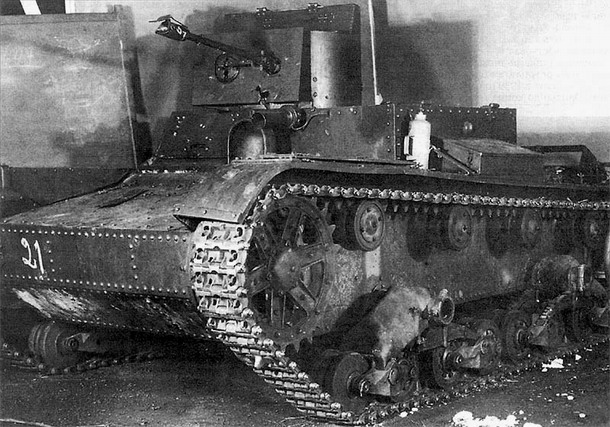
chemical (flamethrower) tank ChT-26, also sometimes designated OT-26, source: Flickr.com, Public domain, edited
In 1936 a pre-production batch of ten vehicles was built for a new flamethrower tank based on the single-turret T-26 Model 1933. Designated ChT-130, it carried the KS-25 flamethrower. The fuel supply — stored in two tanks inside the left side of the crew compartment — was 360 litres, and the effective range of the flame was approximately 55 metres. The turret also retained a machine gun alongside the flamethrower. A redesigned connection between the tanks and the projector nozzle now allowed full 360° turret traverse. The pre-production vehicles passed their trials successfully, and between 1936 and 1939 a total of 401 ChT-130 tanks were built.
In 1939 designers at Leningrad Factory No. 174 attempted to create a tank combining both flamethrower and gun armament. Two prototypes were built, designated ChT-131 and ChT-132, but they were not accepted for production — primarily due to problems with the internal arrangement of the fuel tanks and cannon ammunition, which left the fighting compartment extremely cramped and made the crew's work very difficult.
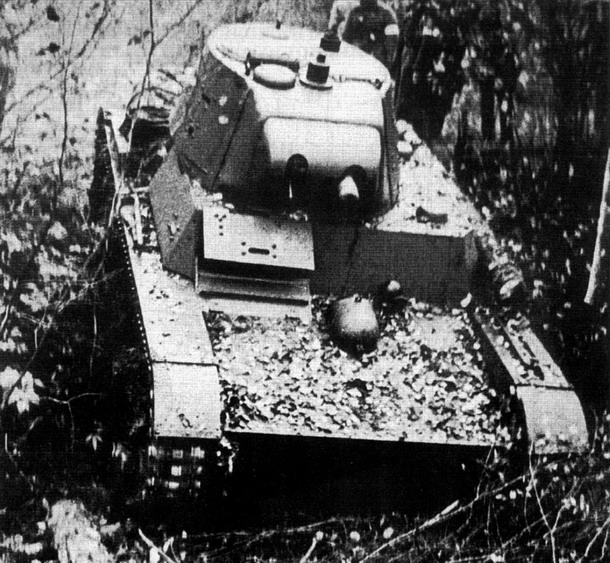
chemical (flamethrower) tank ChT-133, also sometimes designated OT-133, source: Flickr.com, Public domain, edited
In the autumn of 1939 the new ChT-133 flamethrower tank, based on the T-26 Model 1939, was successfully tested. It therefore featured the conical turret and sloped hull sides of that variant. The flamethrower was the same KS-25 unit as on the older ChT-130, as was the secondary machine gun armament. Between 1939 and 1940 a total of 269 were produced.
The last chemical tanks based on the T-26 were the two ChT-134 prototypes, built in January 1940. In these, the designers finally succeeded in combining flamethrower and gun armament in a single vehicle. The Model 1939 turret retained its 45 mm cannon (and probably its machine gun as well), while the flamethrower barrel was unconventionally mounted on the upper nose plate of the hull. The fuel supply was reduced to make room for cannon ammunition inside the vehicle. The ChT-134 also featured supplementary armour riveted to the turret walls, intended to improve crew protection when the vehicle had to close to the relatively short effective range of the flamethrower. Both prototypes were sent to Finland for trials against the fortifications there, but were ultimately not accepted for production — most likely because the flamethrower's effective range was reduced by its unorthodox mounting position.
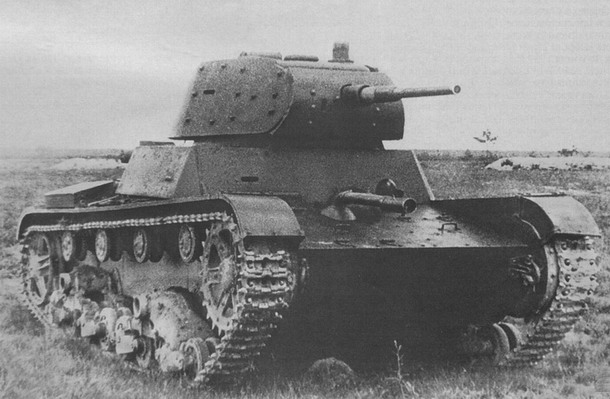
chemical (flamethrower) tank ChT-134, source: Flickr.com, Public domain, edited
Artillery Tractors
Another category of vehicles built on the T-26 chassis was artillery tractors. The first of these appeared in 1932 or 1933 (sources disagree) under the designation T-26T (T = tyagach = tractor). In place of the original crew compartment and turrets, a light framework was erected to support a canvas canopy forming a new cab. Each canvas side had two small windows filled with transparent celluloid film, and the right half of the front face could be lifted to give the driver a better view. Any notion of crew protection behind canvas walls is of course out of the question — but then the vehicle was not intended for combat, only for towing guns and loads.
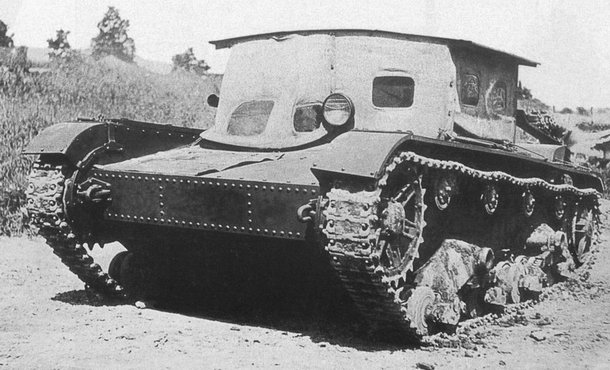
T-26T artillery tractor in the canvas-cab version, source: Flickr.com, Public domain, edited
An armoured cab version was also produced. The original crew compartment was extended upward using a riveted superstructure with a rounded front and rear edge. The driver's entry hatch with its two-part cover was retained in the front wall. Each side wall had a single rectangular opening with a one-piece cover, and the rear wall had two such openings. In the roof there was at least one square entry hatch with a single-piece cover.
The T-26T was most commonly used to tow 76.2 mm cannon, 122 mm and 152 mm howitzers, or loads of up to 5 tonnes. The tractor itself was naturally lighter than the standard T-26 tank, weighing 7.7 tonnes (or 8.1 tonnes in the armoured cab version). With a 5-tonne load in tow it could reach 15 km/h on a road. Cross-country the engine was put under considerable strain and speed was of course lower — the engine's inadequate power output was the tractor's main weakness.
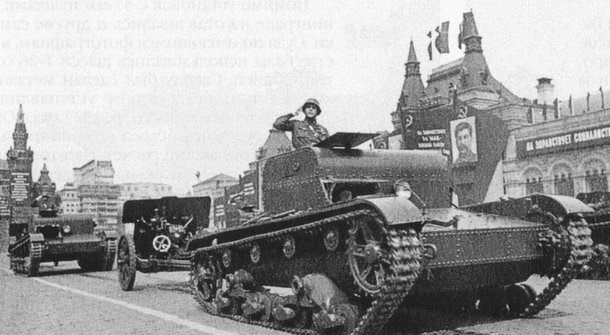
T-26T artillery tractor in the armoured cab version, source: Wikimedia, Public domain, edited
The only permanent crew member was the driver. The remaining men on board — four or five in number — belonged to the towed gun's detachment. Production took place at Factory No. 174 (the same facility that built the T-26 tanks themselves) from 1933 to 1936. Total production figures of 201 or 211 are given. The vast majority were in the canvas-cab version; only 10 armoured-cab tractors are cited by some sources.
Probably in 1936 a limited production run of modernised tractors designated T-26T2 was built. These received an updated towing coupling and apparently a more powerful engine. The T-26T2 was most likely produced only in the canvas-cab version. Some sources suggest the tractors served throughout the entire Second World War; others maintain that all were lost in fighting against the Germans, with the only surviving examples being those converted during the war from older — and presumably damaged — T-26 tanks.
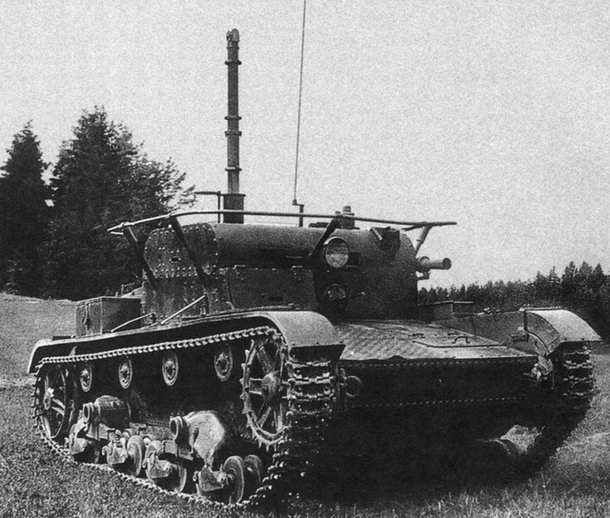
modernised prototype of the BSNP observation tank, note the extended periscope, source: Flickr.com, Public domain, edited
Observation Tank
In September 1934, a prototype observation tank designated T-26TN (TN = tank nablyudeniya, observation tank) was built on the basis of the armoured-cab T-26T tractor. The vehicle was intended for reconnaissance and to assist in directing artillery fire. A DT machine gun was newly installed in the front wall of the armoured cab, along with closeable observation ports. Inside the cab a 71-TK-1 radio was fitted, with a large frame antenna running around the outside of the cab. Additional equipment included an optical rangefinder, compass, and signal searchlight.
The T-26TN was tested in 1935. The overall concept was considered sound, but the specific execution of the prototype was not, and the vehicle ended up in storage with its development suspended for several years. It was revived in 1939, when the original prototype was modernised and a new vehicle designated BSNP (bronirovany samokhodny nablyudatelny punkt — armoured self-propelled observation post) appeared. The BSNP was equipped with a ten-power observation periscope that could be extended high above the roof to provide a truly excellent field of view. It was tested in the summer of 1939 with much the same outcome as its predecessor: the committee agreed that an observation tank was certainly a useful vehicle, but the specific prototype submitted did not satisfy them, and development came to a permanent end.
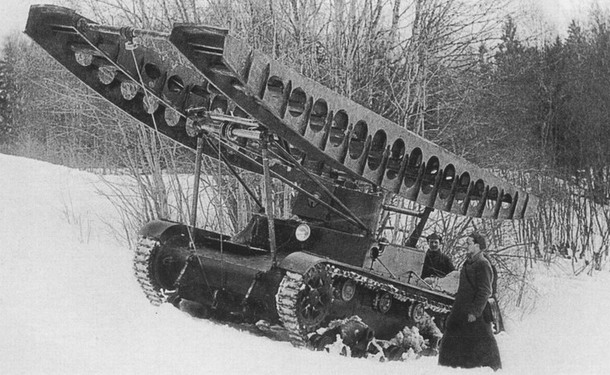
engineering tank ST-26 with bridge, source: Flickr.com, Public domain, edited
Engineering Tank
In 1932 an engineering variant of the T-26 was developed, designated ST-26 (ST = saperny tank — sapper's tank). Engineering tanks were intended to fulfil two primary functions: bridge-laying and mine-clearing. The ST-26 was based on the Model 1931. One of the two original machine gun turrets was removed and the other was moved to the centre of the crew compartment roof, with its raised step removed to lower it slightly. The remaining turret retained its DT machine gun, with 1,008 rounds on board. Turret traverse was limited to 211 degrees.
A special frame was fitted to the tank, carrying a 7.35-metre bridge weighing 1,100 kg. The bridge was designed to span depressions or small rivers up to 6 metres wide, or to overcome obstacles up to 2 metres high, with a load capacity of around 14 tonnes — suitable for lighter tanks or lorries. Laying the bridge took just 40 seconds and could be accomplished without either crew member leaving the safety of the vehicle. Retrieving the bridge was a more involved operation, taking 2 to 3 minutes and requiring the commander to dismount and assist from outside. The winch used to handle the bridge was powered by the tank's engine.
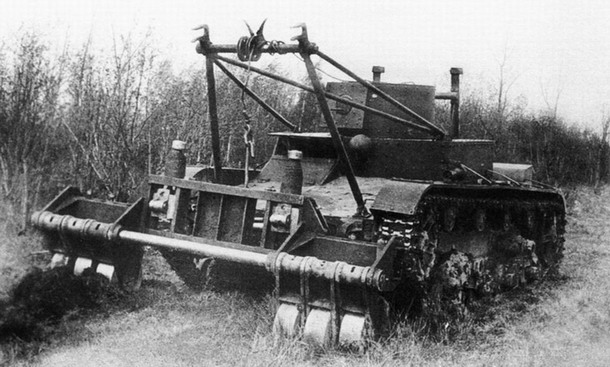
engineering tank ST-26 with roller mine-clearing equipment, source: Flickr.com, Public domain, edited
The ST-26 could also be employed as a mine-clearer. In this role, the bridge-carrying frame was fitted instead with mine-clearing equipment. Two types were used: roller-based and knife-based. The rollers ran along the ground ahead of the tracks, detonating any mines they rolled over. The roller equipment existed in at least two versions — one with three small rollers placed side by side in front of each track, another with a single large roller for each track.
The knife-based equipment had blades that dug into the ground ahead of the tracks to "plough out" buried mines — rather than detonating them, the intention was to expose them and push them out of the tank's path. Three versions of the knife equipment were developed, at least one of which featured a useful additional function: wire mesh baskets mounted behind the blades, into which the ploughed-up mines would fall. In theory the mine-clearer could thus also assist in recovering enemy materiel. The knife equipment reportedly proved less practical than the roller type in field use. The frame could also be fitted with a dozer blade, allowing the ST-26 to clear snow or rubble.
In 1933 the army ordered 100 engineering tanks. In the end only 64 were delivered — 44 during 1934 and 20 the following year. The shortfall was not the fault of Factory No. 174, which built the ST-26, but of the subcontractor supplying the bridge sections. The tank's crew consisted of a driver and a commander.
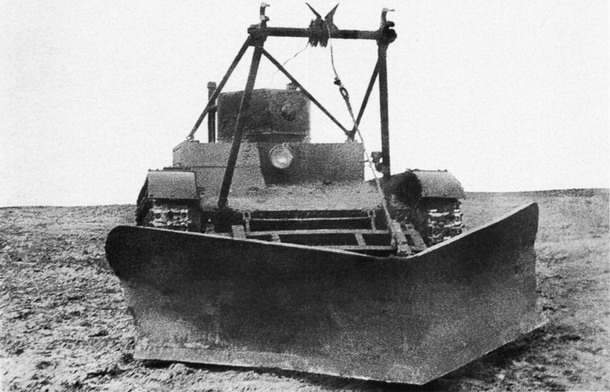
engineering tank ST-26 with dozer blade, source: Flickr.com, Public domain, edited
Between 1934 and 1936 several further bridgelayer projects were developed in an attempt to modernise the original design. Worth mentioning is a vehicle designated UST-26, which replaced the winch with a hydraulic system and allowed the bridge to be laid and retrieved without anyone leaving the cab. Only two examples were built, in 1936.
Armoured Personnel Carrier TR-1
In 1933 designers used the T-26 as the basis for a prototype armoured personnel carrier, designated TR-1 and built on the Model 1931 hull. The vehicle received a different engine from the series tanks — the Hercules, which had also been used in the earlier TMM-1 and TMM-2 prototypes. Significantly, the engine was relocated from the rear to the front of the hull, alongside the gearbox, freeing up the rear of the vehicle for the troop compartment. The driver remained in his usual position at the right front of the hull, now surrounded by the engine and gearbox. Along with the engine, a ventilation grille appeared on the front deck roof and the exhaust was routed out on the left side.
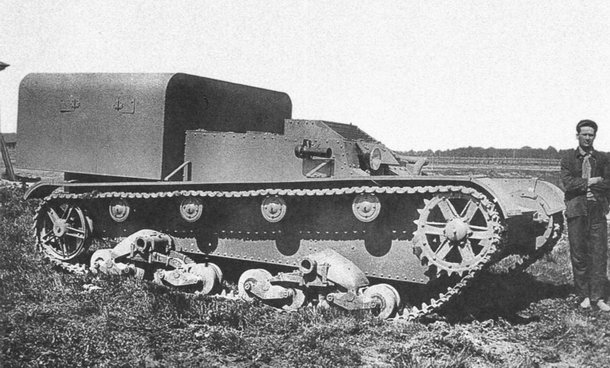
prototype of the TR-1 armoured personnel carrier, source: Wikimedia, Public domain, edited
The troop compartment at the rear was completely enclosed by armoured walls 6 to 7 mm thick. Almost the entire rear wall was taken up by large double doors for boarding and dismounting. All walls featured closeable openings for observation and for firing personal weapons. How many soldiers could fit inside the compartment is not entirely clear — 14 men is the figure sometimes given, which seems hardly imaginable given the vehicle's dimensions. One surviving photograph shows eight soldiers disembarking from a TR-1, though it cannot be confirmed whether this represents the full complement; the number does at least seem plausible given the size of the compartment.
Prototype trials were conducted in August 1933. Despite a number of identified shortcomings, the overall evaluation was positive. The vehicle was not placed into production nonetheless, as a newer carrier based on the same T-26 chassis was already under development.
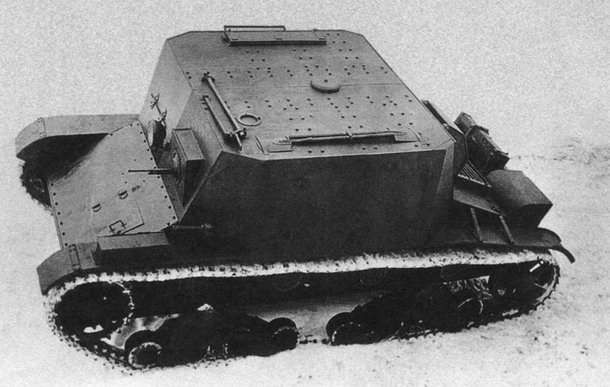
prototype of the TR-4 armoured personnel carrier, source: Flickr.com, Public domain, edited
Armoured Personnel Carrier TR-4
Further development took place at the Bolshevik plant (renamed in 1935 as the S. M. Kirov Plant No. 185) and resulted in several specialised vehicles, including a new personnel carrier designated TR-4. Unlike its predecessor the TR-1, the TR-4 kept the engine at the rear of the hull, with the troop compartment in the middle, enclosed by an angular, fully armoured box. The front wall of this box had the driver's vision port on the right and a DT machine gun on the left. Both side walls featured large double doors for boarding and dismounting. Sources say up to 10 soldiers could be carried inside. The prototype was probably tested in 1935 together with the other specialised vehicles built on the same chassis. Due to problems identified during those trials, the TR-4 was also not accepted for production, and no further development in this direction took place after 1935.
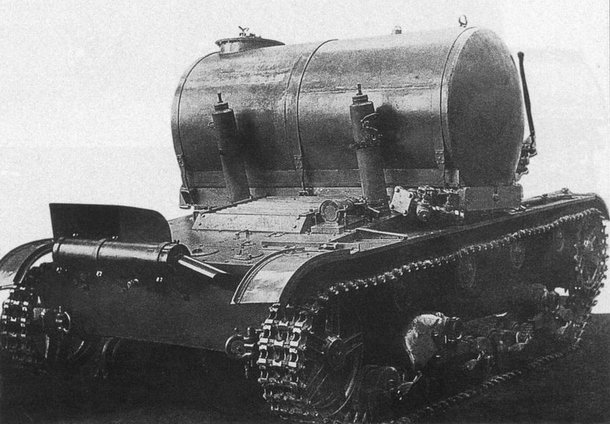
prototype of the TC-26 fuel tanker, source: Flickr.com, Public domain, edited
TC-26 Fuel Tanker
As part of the same specialised vehicle development programme at the Bolshevik plant, a self-propelled fuel tanker designated TC-26 was also produced. A large cylindrical tank was mounted in the centre of the hull, with a hand pump beside it on the hull surface for transferring the tank's contents. The TC-26 was intended to deliver fuel directly to fighting tanks and other vehicles in the field. Its tracked chassis meant it could handle rough terrain that wheeled tankers could not manage. The vehicle was produced in at least two versions — one with the cylindrical tank described, and another with a rectangular riveted superstructure housing a tank of different shape. The designation T-26C is sometimes encountered as well, though whether this refers specifically to the second version or is simply a naming inconsistency is unclear. Another vehicle from this same series of specialised types was an ammunition carrier designated TR-4-1.
Remote-Controlled Tanks
A further distinctive chapter in the T-26's story is that of the so-called teletanks — remote-controlled vehicles based on its chassis. Soviet designers had been working on remote-controlled tanks since 1927, but it was not until 1932 that this effort extended to the T-26. At the end of that year the first examples of remote-controlled vehicles designated TT-26 were tested, equipped with several different control systems for evaluation: the Pirit-1 and Pirit-2 sets developed by the Central Laboratory of Wire Communications, and the Reka-1 and Reka-2 sets from the Scientific Research Institute of Communications and Electromechanics in Moscow. Pirit-1 could process ten different commands, Pirit-2 fifteen. Both Reka sets handled 16 commands. The tests, which ran until October 1933, concluded decisively in favour of the Reka systems.
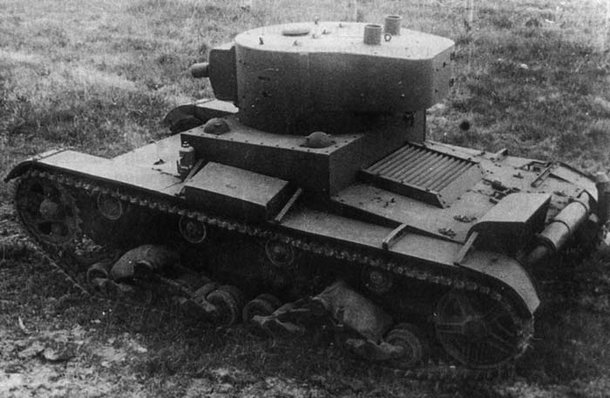
teletank TT-26, note the two receiver antenna housings on the turret roof, source: Flickr.com, Public domain, edited
The very first experiments with remote-controlled tanks had already demonstrated that the concept was impractical for gun-armed vehicles — and not only because of the challenge of loading the cannon without a human operator, but also because of the impossibility of aiming accurately at a target. The principle proved far better suited to flamethrower (or chemical) tanks, where precise aiming was less critical. Remote-controlled tanks were therefore envisaged primarily for destroying bunkers and fortifications with fire or chemical contamination, clearing paths through minefields, laying demolition charges, and decontaminating the battlefield.
For series production of the TT-26, the TOZ-IV control system was developed in 1935. In 1936 the first 37 teletanks were built — or more precisely, the first 37 so-called telemechanical groups, each consisting of a controlled tank and a controlling tank working as a pair. The controlled vehicle was designated TT-26, the controlling vehicle TU-26 (tank upravleniya — command tank). Both were produced by Factory No. 174, with the control electronics supplied by subcontractor Factory No. 192. The controlled tanks were based on the OT-130 (or ChT-130) flamethrower variants; the controlling tanks on the standard T-26 Model 1933. A second production batch of 28 pairs was built in 1937, these vehicles equipped with the newer TOZ-VI control system.
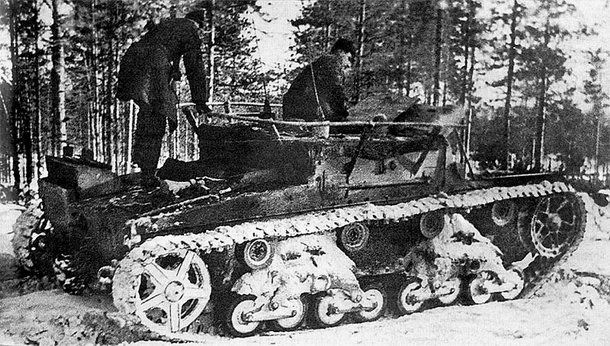
controlling tank from the Podrivnik group — the turretless version, source: Flickr.com, Public domain, edited
The physical operation of the controls inside the teletank was handled by a system of pneumatic pistons and linkages. Received radio commands were converted into electrical signals that opened and closed the valves of a compressed air system, which then drove pistons connected to the standard manual controls of the tank. The advantage was that the entire apparatus could be removed, after which the tank could be operated in the conventional way with a human crew. While reasonably reliable, the remote control system was imprecise, and movement across difficult terrain was risky, as errors leading to the tank becoming stuck were easy to make.
The controlling tank retained its standard armament — a 45 mm cannon and a machine gun — with a three-man crew, the commander being responsible for directing the teletank. The controlling tank's role was to cover the teletank with its own fire when necessary, and if the teletank was in danger of being captured by the enemy, to destroy the rear section of the controlled vehicle's turret, where the signal receivers were housed — preventing the Soviets' latest technology from falling into enemy hands. For added certainty, a demolition charge was reportedly later installed in the teletank's turret rear to complete the destruction.
Around the turn of 1939–1940, during the Winter War, a further variant of both the controlling and controlled tank was developed. The standard turret was removed and replaced in the cab below with a control console. A frame antenna was fitted to brackets around the outside of the cab, with two additional whip antennas projecting from the cab roof. The controlled vehicle was also turretless and unarmed, but carried a demolition charge weighing several hundred kilograms. The teletank was to place this charge near an enemy fortification and then reverse to safety. The resulting explosion was powerful enough to destroy underground corridors. These vehicles were organised into a combat unit designated "Podrivnik" — roughly translating as "demolisher" or "blaster". Remote-controlled tanks were deployed primarily against Finnish fortifications during the Winter War.
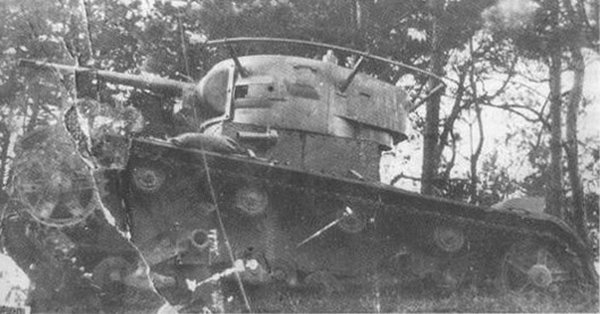
T-26FT photo tank prototype, note the camera and film opening in the side wall, source: Flickr.com, Public domain, edited
T-26FT Photo Tank
One particularly unusual T-26 modification is worth noting — the so-called photo tank. A prototype was built in 1937 on the basis of the Model 1933. The vehicle, designated T-26FT (foto tank), was intended for photographing and filming enemy positions. At first glance it appeared virtually identical to the standard T-26, but the cannon barrel was a dummy — the gun had been removed to free up internal space for its unique "armament": a film camera, a still camera, and an associated observation periscope. The only real weapon remaining on board was the DT machine gun in the turret front.
In the left side wall of the turret was an opening with a sliding cover through which photographs and film footage were taken. The tank could operate in this role both stationary and on the move. According to sources, equipment for developing photographs was also installed inside the turret. The crew consisted of three men — a driver and a two-person camera team. The prototype was tested in early 1938, but the project was not developed further.
T-26PCh Submersible Tank
The last T-26 variant we will cover is its amphibious underwater-driving adaptation. Work on modifications to allow the T-26 to move along the bottom of a body of water began in the summer of 1933, and in September of that year the first adapted version of the Model 1931 was ready. Large hollow prisms appeared on both mudguards, connected at the rear of the tank to the engine compartment. Rising from their rear sections were two "chimneys" that were intended to supply air to the engine and vent exhaust gases while the tank was submerged. The tubes were 4.5 metres long and 70 cm in diameter, positioned not vertically but angled slightly toward the front of the tank, with their upper ends bent backward — to prevent water from splashing in too easily while driving.
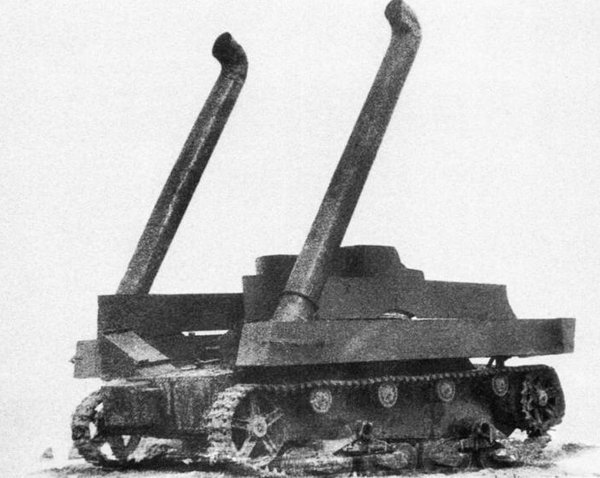
twin-turret variant of the T-26PCh submersible tank, source: Flickr.com, Public domain, edited
Before submerging, the crew naturally had to seal the tank thoroughly. Rubber gaskets, impregnated leather, and even grease and resin were used for this purpose. The machine gun barrels also had to be plugged with rubber stoppers. Underwater, the tank was driven mostly in first gear for safety. Steering could only be done by dead reckoning or by compass. Submersible tanks were designated T-26PCh (Podvodnogo khoda — underwater-driving). During trials in 1934 the submersible tanks reportedly crossed a river 2.5 to 3 metres deep without difficulty. Despite this, they never entered series production — for a simple reason: it was no longer worth developing a modified version of the old twin-turret T-26 when the more modern single-turret Model 1933 was already available.
The underwater adaptation of the single-turret tank was considerably simpler. A single tube was attached to the roof of the turret — though it was in fact composed of two sections each 1.4 metres long, joined together. Exhaust gas venting was handled by a valve on the exhaust pipe, and engine cooling was achieved by flooding the oil cooler. The entire tank, including the cannon barrel, still had to be carefully sealed. This version of the T-26PCh also passed its tests successfully, but similarly never entered wider production.

PT-26 floating tank, source: Flickr.com, Public domain, edited
PT-26 Floating Tank
Alongside the submersible variants there was also a floating version — one that moved across the surface of the water rather than along the bottom. It was designated PT-26. The tank was buoyed up by large pontoons attached to its sides alongside the tracks, most likely constructed from rubber-coated canvas stretched over a wire framework. Propulsion while afloat was provided by the running tracks themselves. Steering was handled by a rudder fitted to the rear of the vehicle, and the exhaust had to be angled more steeply upward to prevent water from entering during swimming. The PT-26 never entered production and apparently never saw any combat use.
Photographs also reveal other modifications that were probably produced in single examples only, as field workshop conversions. The number of different rebuilds and specialised variants built on the T-26 chassis is considerable, reflecting the enormous quantity of tanks produced — and for that reason, any list of them can probably never be entirely complete.
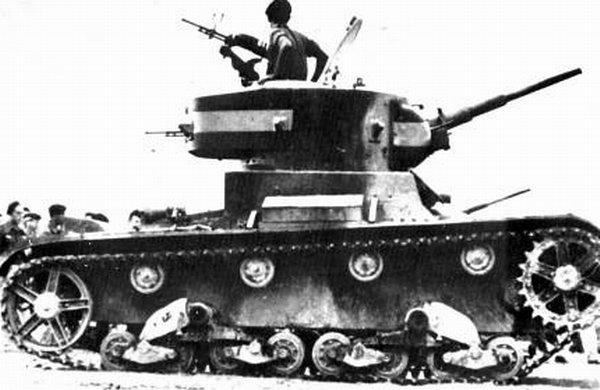
T-26 in the Spanish Civil War, source: Flickr.com, Public domain, edited
Combat History
The T-26 made its combat debut in the Spanish Civil War. The Soviets negotiated the sale of these tanks to the Spanish Republicans along with spare parts, ammunition, and other supplies. Beyond the equipment itself, the Soviet Union also provided the services of "military advisers," among whom were of course tank crews intended to participate directly in the fighting. The first 50 T-26 tanks arrived at the port of Cartagena aboard the Soviet freighter Komsomol on 13 October 1936 (though some sources place the first delivery of 15 tanks as early as 26 September of that year).
These first vehicles were originally intended to be used for training Spanish tank crews and maintenance personnel. However, given the course of the fighting, a portion of the tanks had to be committed to action on 29 October, near Madrid. Further deliveries followed, and the Spanish Republicans eventually received 281 tanks in total (though the figure of 297 is also frequently encountered). All the delivered tanks were of the Model 1933 variant. During the first year of T-26 operations, most crews were mixed — Soviet and Spanish. It was only from the autumn of 1937, after many Soviet volunteers returned home, that purely Spanish crews became predominant.
In terms of firepower, the T-26 and its 45 mm cannon had no equivalent on the Spanish battlefield. The great majority of the Nationalist armoured forces consisted of German Panzer I light tanks and Italian CV33 tankettes, both armed only with machine guns. It is no surprise then that an intact T-26 became a prized capture, with a reward reportedly offered for acquiring a functioning example. In terms of armour protection, however, the Soviet tanks were far less impressive — their armour was very thin and could be penetrated by even light anti-tank guns. The T-26 also inspired the Spanish to develop their own armoured vehicle, the Verdeja. The T-26 became the most widely used tank of the Spanish Civil War and one of its defining symbols.
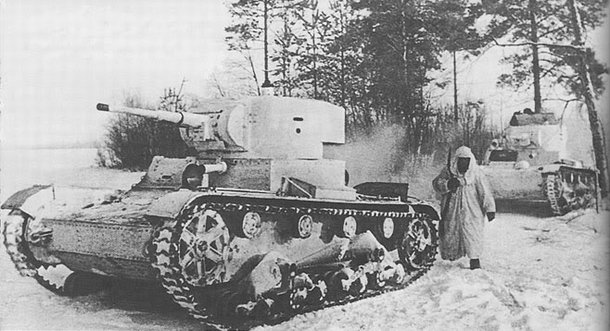
T-26 during the fighting near Moscow in the winter of 1941, source: Wikimedia, Public domain, edited
The Red Army itself first used T-26 tanks in combat during the fighting with the Japanese at Lake Khasan in the summer of 1938 and, a year later, at the Khalkhin Gol river. At Lake Khasan the 2nd Mechanised Brigade and two independent tank battalions were deployed, fielding a combined total of 257 T-26 tanks (including flamethrower variants). Japanese anti-tank defences were well organised enough to destroy or seriously damage 85 of them. At Khalkhin Gol significantly fewer T-26s were involved, but they were committed to the fighting far more intensively.
The Soviets next joined a campaign alongside the Germans in 1939. On 17 September of that year, 878 T-26 tanks of the Belorussian Front and a further 797 belonging to the Ukrainian Front crossed into Poland. The Polish campaign proceeded without complications — in combat the Russians lost only 15 T-26 tanks, though a further 302 were knocked out by mechanical breakdowns.
The T-26 saw extremely intensive deployment during the Winter War against Finland. In the space of just three and a half months, more than a thousand T-26 tanks were destroyed, damaged, or broke down. Nearly half were eventually repaired and returned to service, but even so the scale of the losses speaks for itself. The Finns, for their part, captured around 70 of these tanks during the war — effectively doubling their armoured strength at a stroke.
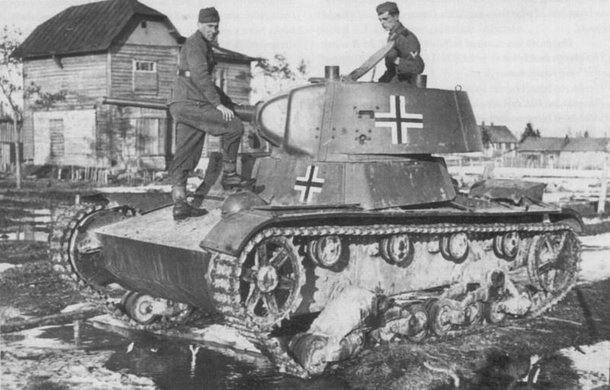
T-26 Model 1939 captured and pressed into German service, source: Flickr.com with permission of the publishing user, edited
When the Great Patriotic War — the war against Nazi Germany — began on 22 June 1941, T-26 tanks numbered more than ten thousand and formed the backbone of the Red Army's armoured units. This time, however, the opponents were not the weak Panzer I tanks, but the more powerful and modern Panzer III and Panzer IV, supported by strong artillery and air power — all of it highly coordinated and backed by formidable fighting spirit. Within just two months the vast majority of Soviet T-26s had been lost. They did not disappear from the battlefield entirely, however — T-26s were still being committed against the Germans as late as early 1944, and as recently as the summer of 1945 they were fighting the Japanese in the Far East.
The Finns also participated in Operation Barbarossa, bringing with them the T-26s they had captured earlier. During 1941 they managed to capture approximately a hundred more. Far from all of these were in usable condition, but the Finns demonstrated their resourcefulness by salvaging at least the turrets — or even just the cannons — from captured tanks and fitting them into their own Vickers tanks purchased from Britain. In 1945 the Finns still had 94 T-26 tanks on strength. The last of them were officially retired from Finnish service in 1961.
The Germans also deployed captured T-26 tanks, though not on the mass scale that would theoretically have been possible. Particularly in the early stages of the eastern campaign, they did not bother expending much effort repairing badly damaged captured vehicles. In 1943 they used around ten T-26 chassis as the basis for an improvised self-propelled anti-tank gun, mounting an originally French 75 mm cannon on the hull. Other operators of the T-26 included Turkey and China, which purchased them officially from the Soviet Union, and Hungary and Romania, which acquired them as war booty.

ARTICLE
CONTENTS:
Reproducing text from the Tankist website without the written consent of the operator is prohibited.