TANK T-24
the failed successor to the failed T-12
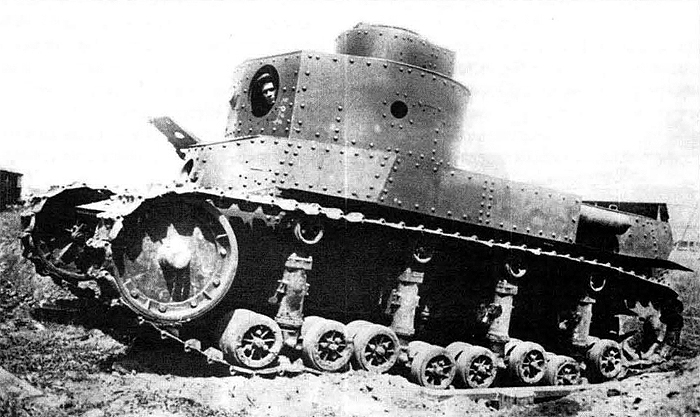
T-24 without armament, source: Flickr.com, Public domain, edited
Origins of the Tank
The medium tank prototype T-12 of 1929 did not fully meet the army's expectations, and approval for series production was made conditional on resolving the deficiencies identified during trials. The improvement work that followed was, however, so thorough that it effectively produced an entirely new tank — which accordingly received a new designation: T-24.
Technical Description
The running gear, hull shape, and turret were all redesigned from scratch. New designs were developed for the road wheels, drive sprocket, idler wheel, and return rollers. Eight road wheels were fitted on each side of the hull, suspended and sprung in pairs as on the T-12 prototype. The idler wheel was of solid construction and was positioned at the front; the drive sprocket was at the rear, and the upper run of the track rested on four return rollers. The overall height of the track assembly was significantly reduced compared to the T-12, and the upper run of the track no longer reached as high as the hull sides. This allowed the tracks to be shortened, resolving the problem of track shedding during movement.
The lower track assembly height allowed the hull to be widened above the track level. The shape of the hull front was also changed. Its left section was extended noticeably forward, and a DT hull machine gun was installed at this point. To the right, as on the T-12, was the driver's position, with a fairly large square window in the front plate ahead of him. This window was fitted with a single-piece cover that opened upward. When operating outside a combat zone, the driver could open the window fully for a better view; in a dangerous area, he closed the cover and observed only through its vision slit. In front of the driver's window, on the steeply sloped upper nose plate, was another fairly large opening fitted with a two-piece cover. This opening connected to the driver's window, and when both covers were opened together they formed a hatch large enough for the driver — and probably the hull machine gunner — to enter and exit the vehicle.
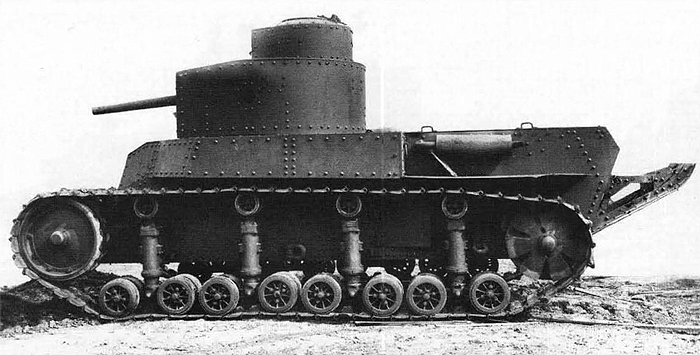
T-24, source: Topwar.ru with permission, edited
The hull roof plate remained flat, and in its forward half sat the tank's fully rotating main turret. Unlike the nine-sided turret of the T-12 prototype, the production turret had a rounded rear section. A small supplementary machine-gun cupola projected from the roof of the main turret. The main turret's front face housed the 45 mm Sokolov gun — though development of the cannon was still not complete when production began, so the guns were only fitted to the completed T-24s retrospectively. The machine gun arrangement was unchanged from the prototype. One machine gun was installed in the front plate to the right of the cannon, a second in the left side wall, and the third in the supplementary cupola. The only difference from the prototype was that the T-24 used single machine guns throughout rather than twin paired mountings. All were of the DT type, 7.62 mm calibre.
Ammunition stowage consisted of 89 rounds for the cannon and 8,000 rounds for the machine guns. The engine remained unchanged from the prototype — a petrol-powered eight-cylinder M6 producing 180 horsepower. The fuel tank capacity was almost doubled to 460 litres. The modifications brought a significant increase in weight, which the designers could only partially offset by reducing the thickness of most of the armour. Despite this, the T-24's final weight reached 18 tonnes, which pushed its maximum speed down to 22 km/h — compared to 26 km/h for the T-12.
"Series" Production
The first three examples of the new tank were completed in July 1930 and immediately put through trials, which the tank passed satisfactorily. An unusually large order was then placed for 200 vehicles, later increased still further to 300. Before the end of 1930, however, the order was cancelled and the entire programme was quietly brought to a close.
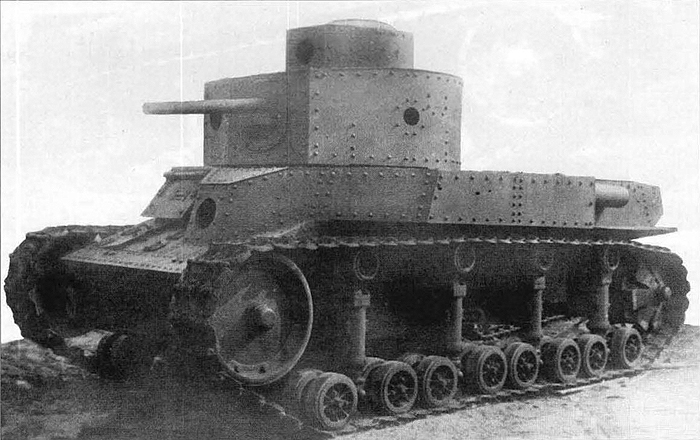
T-24 with a dummy gun, source: Flickr.com, Public domain, edited
By that point, only 24 tanks had been built. The completed vehicles were distributed in small numbers to various military units. It was not until 1932 that the tanks could be retrofitted with their guns; until then they operated with machine-gun armament only. Most sources agree that none of these tanks survived to see the Second World War, let alone take any active part in it. They most likely ended their days as training vehicles at instructional units.
Technical Specifications
Weight |
18 t |
Length |
6.5 m |
Width |
2.89 m |
Height |
3.04 m |
Engine |
M6 |
Maximum output |
180 hp |
Maximum speed |
22 km/h |
Fuel capacity |
460 l |
Operational range |
140 km |
Turret armour |
20 mm |
Hull armour |
20 mm |
Armament |
1 x 45 mm cannon 4 x 7.62 mm DT machine gun |
Crew |
5 men |

ARTICLE
CONTENTS:
Reproducing text from the Tankist website without the written consent of the operator is prohibited.