SU-100
the next-generation successor to the SU-85
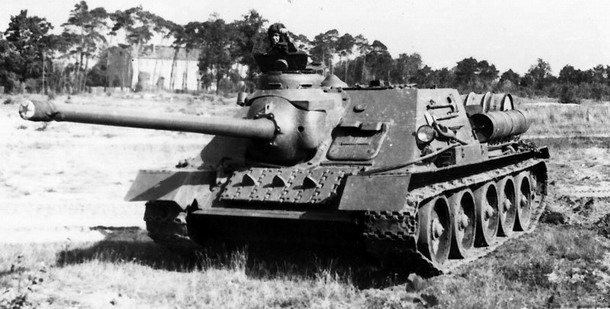
SU-100 self-propelled gun, source: Topwar.ru with permission of the operator, edited
Origins
The Battle of Kursk and the appearance of the new German Panther tank significantly accelerated efforts to rearm the Soviet T-34 medium tank with a more powerful 85 mm gun. It was already clear, however, that once the new version of the T-34 was ready and deployed, the SU-85 self-propelled anti-tank gun would lose its reason for existence — there was simply no point in manufacturing a self-propelled gun alongside a tank with identical firepower. From mid-1943, therefore, work was underway at the Uralmash plant (Uralsky Mashinostroitelny Zavod) to prepare the next generation of this self-propelled gun with heavier armament.
The work was led by designer L. I. Gorlitsky. The new self-propelled anti-tank gun was planned around a 100 mm calibre weapon. In December 1943 the design team submitted its proposals to the People's Commissariat of Tank Industry and to the self-propelled artillery command. On 28 December the Uralmash plant was officially tasked with building a prototype of the new vehicle, to be completed by the demanding deadline of 25 February 1944. The official order specified the S-34 gun as the vehicle's primary weapon — but when the designers examined the gun's drawings, they quickly realised that installation would not be straightforward.
The S-34 gun was simply too large for the self-propelled gun's fighting compartment. Its size would restrict the weapon's traverse during aiming, but more critically it would take up so much of the front wall that there would be no room for the driver's hatch alongside it. Installing this gun would therefore require a complete redesign of the fighting compartment — and given the tight deadline for the prototype, the designers could not afford such extensive rework. The Uralmash engineers therefore turned to the design bureau of Artillery Factory No. 9, headed by F. F. Petrov, requesting the development of a 100 mm weapon that could be fitted into the SU-85 fighting compartment with minimal modification.
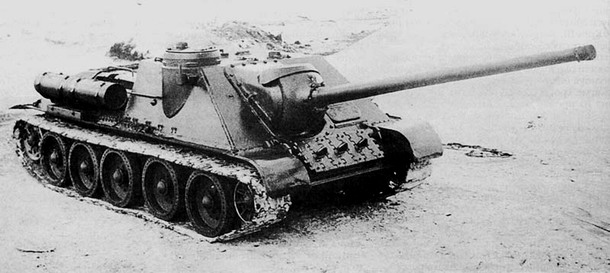
SU-100 self-propelled gun, source: Aviarmor.net with permission of the operator, edited
Petrov's answer was the D-10 gun, developed by adapting the naval B-34 gun. Its variant for the self-propelled gun role was subsequently designated D-10S, where the letter S indicated the word samokhodnaya (self-propelled). By the end of February the first prototype, coded Objekt 138, was ready. It underwent factory trials consisting of 150 kilometres of driving and 30 gun rounds. On 3 March the vehicle was handed over for military trials, which ran from 9 to 27 March and required the prototype to cover a full 864 kilometres and fire 1,040 rounds.
The army acknowledged that the prototype, despite its unplanned armament, met their requirements — but the Central Artillery Design Bureau (TsAKB) insisted on building a comparison vehicle armed with the originally specified S-34 gun. One example of the S-34 was modified for easier installation in the self-propelled gun hull, though even so the fitting required a series of minor modifications. The prototype with the S-34 gun was completed and tested in June 1944, receiving the provisional designation SU-100-2. This variant underwent trials of the same scope as its rival but performed worse and was rejected. The Objekt 138 armed with the D-10S gun was formally accepted into Red Army service on 3 July under the designation SU-100.
Design Description
The SU-100 was derived from the earlier SU-85 and was also very similar to it at first glance. The vehicle was again built on the T-34 tank chassis, from which it also took the engine, gearbox and other components. The running gear comprised on each side the traditional five large rubber-rimmed road wheels, with a smaller drive sprocket at the rear and the smallest idler wheel at the front. The entire rear section with its engine compartment corresponded to the T-34. The forward half of the hull was occupied by a fixed superstructure welded from flat armoured plates, with a sharply sloped front wall to improve ballistic protection. It is noted that the SU-100 shared 84% of its components with existing T-34, SU-85 and SU-122 vehicles — only 16% of the self-propelled gun's parts were newly developed.
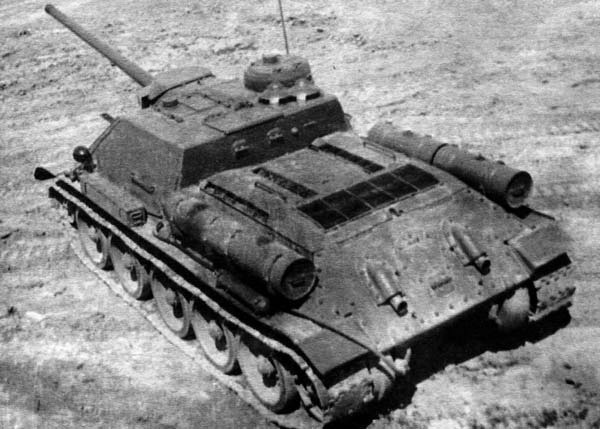
SU-100 self-propelled gun, source: Aviarmor.net with permission of the operator, edited
The most visible change from the earlier SU-85 was the commander's cupola, which appeared on the right side of the fighting compartment. The cupola body intruded noticeably into the right side wall. Around its circumference were narrow vision slots providing the commander with a full 360-degree field of view. In the cupola roof was a hatch for the commander's entry and exit, closed by a two-part cover, one section of which contained an observation periscope. Behind the cupola were two ventilation fans for the fighting compartment. A further entry/exit hatch with a two-part cover was in the front left section of the compartment roof, also fitted with an observation periscope in the cover. Finally, at the junction of the roof and the rear wall was the largest hatch of all, also used for loading ammunition and other supplies.
Another improvement over the SU-85 was the thicker front armour of the fighting compartment, which reached a full 75 mm (compared to 45 mm on the SU-85). The heavier armour and the larger gun naturally increased the weight at the front of the vehicle, putting greater stress on the front road wheels — which consequently required strengthened springs.
The main armament was of course also new: the already-mentioned 100 mm D-10S gun, with a barrel length of 53.5 calibres — that is, 535 cm. The gun was mounted in a massive 110 mm thick collar, with the sight aperture located to the left of the barrel within the collar. In armour penetration the D-10S outperformed both the German 75 mm KwK 42 (as fitted to the Panther) and the 88 mm KwK 36 (as fitted to the Tiger). It could not match the 88 mm KwK 43 of the Königstiger, however. Even against that weapon the Soviet gun held one advantage: thanks to its larger calibre, it could fire more powerful high-explosive fragmentation rounds than the Königstiger.
The SU-100's onboard ammunition stowage comprised 33 rounds in total: 18 armour-piercing BR-412B rounds (muzzle velocity 895 m/s) and 15 high-explosive OF-412 rounds. It is notable that almost half the ammunition carried was intended for use against enemy infantry, which suggests the SU-100 was viewed not as a pure tank destroyer but as a genuinely multi-purpose self-propelled gun. Information occasionally appears regarding the number of HEAT rounds carried, but as these were developed for the D-10S only after the war ended, this detail is most likely applicable only to the post-war period. In combat conditions the SU-100 could sustain a rate of fire of 5 to 6 rounds per minute.

SU-100 self-propelled guns in a barracks yard, source: Aviarmor.net with permission of the operator, edited
At a range of one kilometre, the armour-piercing round fired from the D-10S could penetrate an impressive 185 mm of vertical armour. At 1,500 metres the gun could punch through 100 mm of armour angled at 60 degrees. The SU-100 could therefore comfortably defeat the frontal armour of the German Panther and Tiger at ranges well beyond one kilometre. The German Ferdinand self-propelled gun was a harder proposition, though these operated on the battlefield in negligible numbers.
The D-10S gun had been developed under considerable time pressure, and refinement work continued until mid-summer 1944. As a consequence, series production of ammunition for the weapon could not be prepared in time, leading to an awkward situation. In July 1944 SU-85 production at Uralmash was halted, but SU-100 production could not be started due to the ammunition shortage. Designers had to improvise: old D-5S guns from SU-85 vehicles began to be installed in new SU-100 hulls. From July to December, these hybrid vehicles — designated SU-85M — rolled off the production lines, with a total of 315 built. From December 1944 production switched to the standard SU-100 with the D-10S gun.
The SU-100's total combat weight was 31.6 tonnes. Overall length including the gun barrel was 9.45 metres, width was exactly three metres and height somewhere between 2.2 and 2.45 metres. Powered by the V-2 34 diesel engine developing 500 hp, the vehicle could achieve a very respectable maximum speed of 48 to 50 km/h (though other figures are also cited). Road range was approximately 320 km. The crew of four consisted of the driver, who sat on the left in the front of the hull and used his own entry hatch in the front wall; the gunner, seated behind the driver; the loader, further back still; and the commander, positioned to the right of the gun.
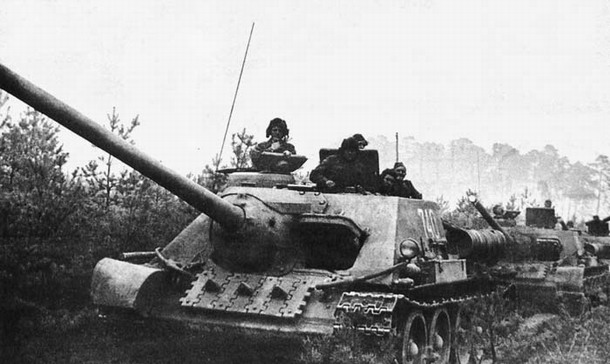
SU-100 self-propelled guns, source: Aviarmor.net with permission of the operator, edited
From December 1944 the completed SU-100s began to be organised into regiments and brigades. Each regiment consisted of four batteries of five vehicles plus one command vehicle. A self-propelled gun brigade comprised 65 vehicles in total. The SU-100 saw its combat debut in January 1945 and fought through to the very end of the war. Its most intensive employment was probably during the repulse of the German offensive codenamed Operation Frühlingserwachen at Lake Balaton in March 1945.
By the end of World War II, 3,037 SU-100s had been produced. Production continued after the war, according to some sources until March 1946, with reports of a brief resumption in 1947 as well. Production was certainly revived in the 1950s in Czechoslovakia. After the war the SU-100 served with the armies of many Soviet allies — not only Warsaw Pact members but also Algeria, North Korea, Yemen, Angola, Albania, Cuba, Syria, Egypt and Vietnam, undergoing various modernisations over the post-war decades. SU-100s were still being used in combat as late as 1973, when they were deployed against Israeli forces in the Yom Kippur War.
The SU-100 was a highly successful vehicle. In terms of its ability to destroy enemy armoured vehicles, it was the most powerful Soviet self-propelled gun of World War II. Its potent armament combined with strong armour protection, a low silhouette and relatively high speed made the SU-100 a dangerous and effective fighting machine. Its main weakness was the absence of an integral machine gun, which meant that crews had to be especially wary of close-range encounters with enemy infantry.
Technical Specifications
Weight |
31.6 t |
Length with gun |
9.45 m |
Width |
3.00 m |
Height |
2.2 – 2.45 m |
Engine |
V-2 34 |
Maximum power |
500 hp |
Maximum speed |
48 – 50 km/h |
Range |
320 km |
Superstructure armour |
|
– front |
75 mm |
– sides |
45 mm |
– roof |
20 mm |
Armament |
1 × D-10S gun, 100 mm |
Crew |
4 men |

ARTICLE
CONTENTS:
Reproducing text from the Tankist website without the written consent of the operator is prohibited.