LÖWE
how a mouse defeated a lion
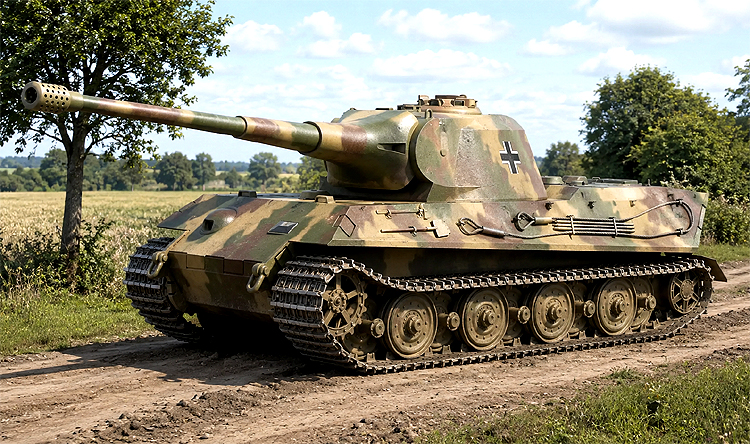
a possible appearance of the Löwe in its "conventional" configuration with the turret mounted centrally on the hull; source: generated by AI
With a degree of simplification, one could say that the entire history of German armoured forces — from the First World War right through to 1945 — was marked by a persistent drive to develop some form of heavy or super-heavy tank (K-Wagen, VK 65.01, Maus, E-100, or even the P.1000). The PzKpfw VII, better known as the Löwe, fits squarely into this tradition. The basic requirements for the vehicle were drawn up on 1 November 1941, suggesting that the Germans were responding to their first encounters with Soviet heavy tanks.
Army Requirements
When drafting the specification for the new tank, the military set their sights remarkably high. The hull was to have 140 mm of frontal armour and 100 mm on the sides — steel was clearly not going to be spared — and the expected weight of the vehicle reflected this, coming in at 70 tonnes. The main armament was left unspecified in the initial requirements, which was rather unusual, since the choice of gun has a significant bearing on a number of other parameters — particularly the size of the turret and the diameter of its ring, which in turn affects hull width and ultimately the vehicle's total weight. In the case of the Löwe, the armament simply was not finalised at the outset, and several options were under consideration... but more on that shortly.
The required top speed was set at an ambitious 43 km/h. Just how unrealistic this was becomes clear when you compare it to the heaviest German tank in series production at the time — the Panzer IV Ausf. F, which weighed a "mere" 22.3 tonnes and had a top speed of 42 km/h. It is difficult to imagine a vehicle more than three times heavier moving any faster. The German Army, however, appeared convinced it was achievable — all you needed was a sufficiently powerful engine. The proposed powerplant was the Daimler-Benz MB 507 C diesel marine engine, which delivered 1,000 horsepower at 2,400 rpm. Weighing 790 kg and displacing an extraordinary 44.52 litres, this engine was originally designed for fast torpedo boats, but also found its way into the heavy self-propelled mortar Karl Gerät.
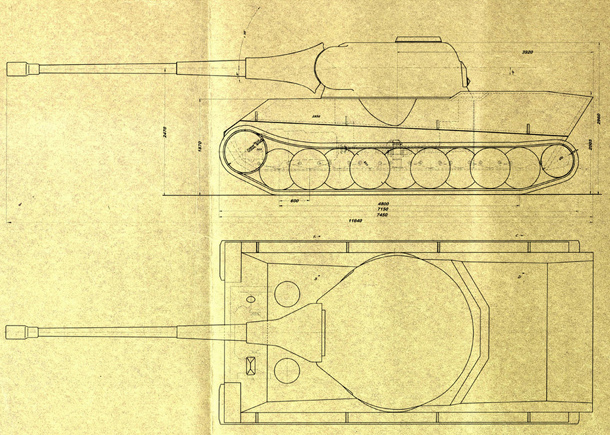
technical drawing of the VK 70.01, also known as the Löwe, by Krupp; source: internet, public domain, edited
Development of the new tank was entrusted to Krupp in December 1941. In historical context, this was a logical choice. Krupp had not participated in the concurrent design competitions for the medium tank Panther or the heavy tank Tiger (for the latter it had only submitted a turret design), so compared to its rivals it had considerable spare capacity, and its design office was able to begin work on the new contract immediately. The project was designated VK 70.01, reflecting the expected weight of 70 tonnes. However, the specification given to Krupp apparently set the maximum permissible weight at as much as 90 tonnes — most likely dictated by the load capacity of railway flatcars.
The Question of Armament
The question of the new tank's armament remained open for some time. Early deliberations centred on a 150 mm gun with a barrel length of 40 calibres (L/40). This idea apparently had a short life, however, as a surviving memorandum No. 41/56004 exchanged between the Waffenamt and Krupp representatives on 17 December 1941 refers to a 15 cm K L/52 — that is, a gun with a barrel 52 calibres long. The practical usefulness of such a monstrous weapon in a tank was highly questionable. Given that a single shell would have weighed around 43 kg, the gun would almost certainly have required two-piece (separated) ammunition, which would have significantly reduced the rate of fire and therefore the tank's combat effectiveness. By the end of 1941, thinking had shifted towards a 128 mm gun, and by early 1942 further still — to a 105 mm weapon.
When Krupp presented its conceptual design to the army on 21 January 1942, it therefore featured a 105 mm gun with a barrel 70 calibres long — approximately 7.35 metres. With this armament, the tank was expected to penetrate 160 mm of sloped homogeneous armour at a range of one kilometre. The Waffenamt reviewed the proposal and asked Krupp to replace the diesel Daimler-Benz MB 507 C with the petrol-powered Maybach HL 230. Although the Maybach was considerably less powerful at 700 horsepower, it was already planned for use in other tanks, making it a potential future standard, whereas the marine diesel would have been a true oddity among German armoured vehicles and would have complicated both fuel logistics and spare parts supply. The Waffenamt appears to have been broadly satisfied with the design as presented, declaring that series production of the heavy tank could begin as early as January of the following year — that is, 1943.
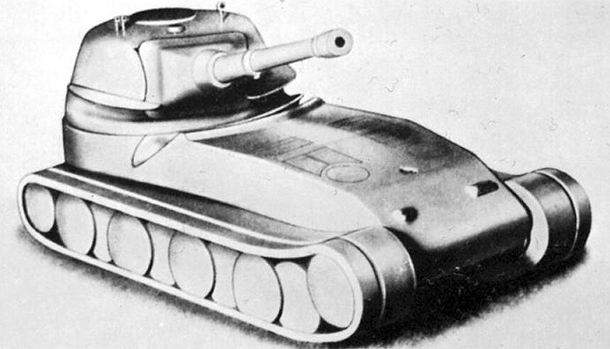
a reduced-scale model of the Löwe in the May 1942 configuration, which envisaged two Porsche diesel engines with a combined output of 840 horsepower and a rear-mounted turret; source: internet, public domain, edited
More and More Variants
In February 1942, the design was refined further, which apparently brought one very unwelcome surprise: the newly calculated total weight was approaching the stipulated ceiling of 90 tonnes. Combined with the decision to use the less powerful engine, this threatened a significant deterioration in the tank's mobility. The Waffenamt therefore ordered a reduction in armour thickness. The hull front was reduced from 140 mm to 100 mm, and the sides dropped from 100 mm to 80 mm. The hull rear was to be 100 mm, the roof 40 mm, and the floor 30 mm. Turret armour was set at 100 mm on the front and rear faces and 80 mm on the sides. Even after this slimming exercise, the expected weight still hovered around 72 tonnes.
The parameters described above are neatly summarised in a Waffenamt technical data sheet dated 5 March 1942. This document also reveals that the planned top speed had been reduced to 30–35 km/h. In line with the revised weight estimate, the project designation was changed to VK 72.01, and the name Pz.Kpfw. VII Löwe — "lion" in German — appeared for the first time. By the time this technical sheet was produced, Krupp had already signed a contract for the construction of two pre-production prototypes: one with a ballast weight in place of the turret, and one fully complete.
The signing of this contract did not, however, put an end to the debate over armour thickness. On 9 April 1942, two new drawings appeared showing two distinct variants of the tank. The first retained 100 mm of frontal armour and 80 mm on the sides, while the second featured 120 mm of frontal armour and side armour varying between 80 and 100 mm. The expected weight of the first variant was now 76 tonnes; the second came in at 90 tonnes. The top speed naturally differed as well: 26.8 km/h for the lighter version and 23 km/h for the heavier one. For some reason the hull of the heavier variant was to be 40 cm longer than that of the lighter one (7,050 vs. 7,450 mm, not counting the gun overhang). Both variants were to share the same 105 mm gun with a 70-calibre barrel, 800 mm wide tracks, and torsion bar suspension.
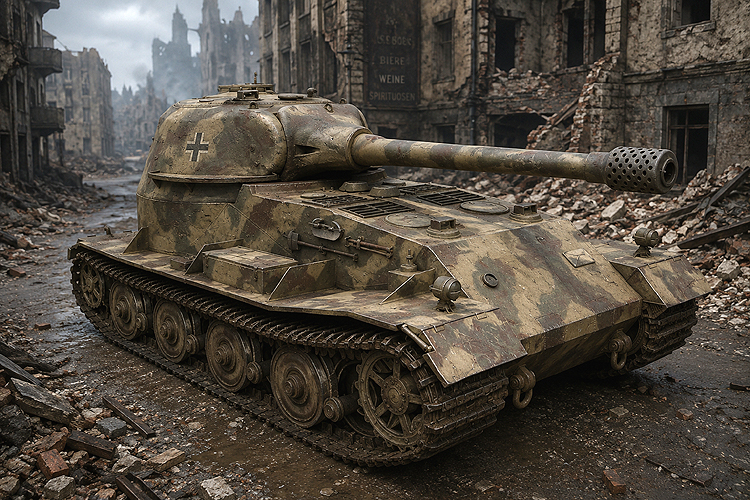
a possible appearance of the Löwe had it entered production in the rear-turret configuration; source: generated by AI
Less than a month later, two further drawings emerged, again showing one lighter and one heavier variant of the Löwe. These were slightly wider and taller than the previous designs, featured tracks 900 or even 1,000 mm wide, and reintroduced two alternative armament options. Alongside the 105 mm gun, the 150 mm L/40 weapon made a comeback. The engine remained the petrol-powered Maybach HL 230, yet somehow the projected top speed miraculously climbed back to 35 km/h for both variants — a reminder that paper tolerates anything.
The Führer Wants More Steel
In Hitler's view, however, the tank was still not robust or heavy enough, and as early as March 1942 he initiated the development of yet another super-heavy tank — one that would later become known as the Maus. While designer Ferdinand Porsche played the leading role in that project, Krupp was also involved. This collaboration between the two firms appears to have spilled over into the Löwe development as well. Evidence of this is the final proposed Löwe design, submitted on 11 May 1942, which envisaged two Porsche diesel engines with a combined output of 840 horsepower. In this last variant, the Löwe was to weigh 90 tonnes, carry a 150 mm gun, and have its turret mounted not in the centre but at the rear of the hull.
Although Porsche and Krupp collaborated to some extent, their Löwe and Maus projects were ultimately in competition with each other. Which do you think appealed more to Hitler — the smaller, lighter, more conventional design, or the larger, heavier one packed with untested innovations? Naturally, the Führer chose the megalomaniacal Maus, and the Löwe project was consigned to the dustbin of history. Work on the hull and running gear was terminated on 18 May 1942, and development of the turret and armament followed two months later. The Löwe never made it off the drawing board. In a somewhat ironic twist, you could say that a mouse — the Maus — managed to kill a lion — the Löwe.
ARTICLE
CONTENTS:
Reproducing text from the Panzernet website without the written consent of the operator is prohibited.