15 cm sFH 13 auf LORRAINE
self-propelled gun for Rommel's Afrikakorps
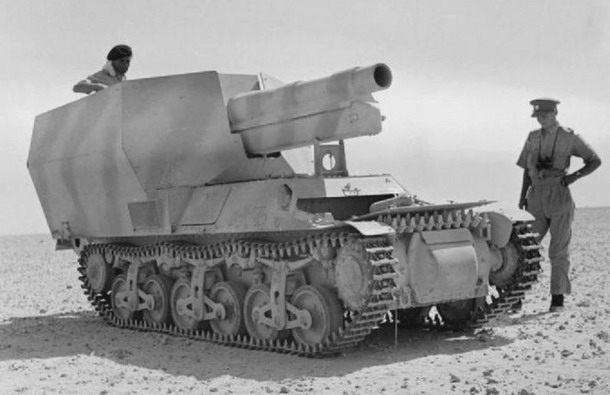
The 150 mm self-propelled gun on the chassis of the French Lorraine 37L tractor, captured by the British in North Africa, source: internet, Public domain, edited
Origins of the Vehicle
In the second half of 1940, soldiers and mechanics of the 227th Artillery Regiment of the Wehrmacht's 227th Infantry Division, working under the direction of Captain Alfred Becker, built largely on their own initiative 12 improvised 105 mm self-propelled guns, using as their basis the otherwise redundant chassis of captured British Vickers Mk. VI tanks. At very little cost, they produced fighting vehicles that proved reliable and effective weapons during their subsequent deployment on the Eastern Front. The success of these self-propelled guns did not go unnoticed among the officials of the German Ordnance Office (Waffenamt), who decided to make greater use of engineer Becker's obvious talent.
It was by then the end of 1941, and the German army was facing enormous numbers of Soviet tanks on the battlefield, among which the particularly dangerous T-34 and KV-2 types stood out. The Germans urgently needed to get into their soldiers' hands the largest possible number of weapons capable of dealing with these Russian armoured vehicles. The leading role was to be played by the new 75 mm Pak 40 anti-tank gun, whose development had just been completed and Rheinmetall was already preparing for its mass production. Buoyed by the good experience with the first tank destroyers, army representatives were already planning how to make this gun self-propelled. One option was to mount it on the chassis of one of the available captured tracked vehicles — for instance French ones. And it was at that point that the Ordnance Office remembered Alfred Becker and decided to bring him together with engineers from the firm Alkett, who had experience building Germany's first tank destroyer, the Panzerjäger I.
Early in 1942, Becker was therefore withdrawn from the Eastern Front (where he was serving with his 227th Artillery Regiment) and sent to Alkett's factory in Berlin. Together with the firm's engineers, Becker investigated the possibility of mounting the Pak 40 gun on the chassis of the French Lorraine 37L cargo tractor (referred to by the Germans as the Lorraine Schlepper (f)). Given its construction and load capacity, this chassis appeared suitable for both the gun and a light armour shield to protect its crew. But Becker, being the old artilleryman that he was, also immediately explored the possibility of mounting a light or heavy howitzer of 105 mm or 150 mm calibre respectively on the same chassis — and it turned out that both were feasible. When the presentation of the proposed self-propelled weapons on the Lorraine Schlepper chassis took place in May 1942, three variants were therefore on the table: a tank destroyer with the 75 mm Pak 40 gun, a light self-propelled howitzer with the 105 mm leFH 16, and a heavy self-propelled howitzer with the 150 mm sFH 13.
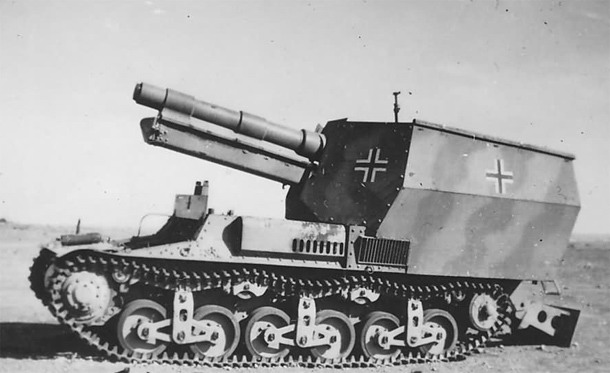
15 cm sFH 13/1 (Sf.) auf Geschützwagen Lorraine Schlepper (f) — note the folded rear travel support, source: internet, Public domain, edited
Hitler was satisfied with the proposals and asked how many of these captured French chassis the German army actually had available. The answer was that roughly 160 serviceable examples were held in army vehicle depots (the so-called Heeres-Kraftfahrpark, or H.K.P.) in Paris and in Bielitz in Poland (German: Bielitz). The Führer therefore decided that 60 of them were to be converted into tank destroyers, a further 60 were to carry the 105 mm howitzer, and the remaining 40 the 150 mm howitzer. These figures were later revised, but the highest priority was unambiguously given to the production of 30 heavy 150 mm self-propelled howitzers for Rommel's forces in North Africa. The firm Alkett was entrusted with their urgent production, and Alfred Becker was temporarily attached to the company to oversee the work.
Design Description
The French Lorraine tractor had its engine located in the middle of the hull, with the rear reserved for the cargo compartment. For conversion into a self-propelled gun this was an ideal arrangement, since the rear cargo area could be converted into a fighting compartment with relative ease — and that is exactly what happened. The front section of the hull was left essentially unchanged, with only the hot-air exhaust outlets from the engine being moved from the roof to the side walls, just forward of the fighting compartment's armour. (It is hard to imagine the designers leaving hot air flowing through the original vents into the fighting compartment — particularly as this was a vehicle intended for the African theatre, where it would have been hot enough inside without any additional help.)
The running gear, taken over from the French tractor, consisted on each side of six road wheels fitted with solid rubber tyres and suspended in pairs by leaf springs. At the front was the drive sprocket and at the rear the idler wheel. The tracks were only 22 cm wide. Hull armour was thickest at the front at 12 mm, with 9 mm on the sides and only 6 mm on the floor and roof. The original French Delahaye 135 engine was of course also retained — a six-cylinder petrol unit with a displacement of 3.556 litres and an output of 70 horsepower. The original five-speed gearbox was likewise carried over. The fighting compartment, formed in the rear of the vehicle, was enclosed by a tall protective shield welded and riveted from flat plates. At first glance the fighting compartment may appear enormous, but this is largely a function of its proportions relative to the quite slender chassis (the original Lorraine tractor was only 157 cm wide). In reality the fighting compartment was not particularly spacious, and at the rear it had to be extended significantly out over the tracks just to accommodate the gun and its crew.
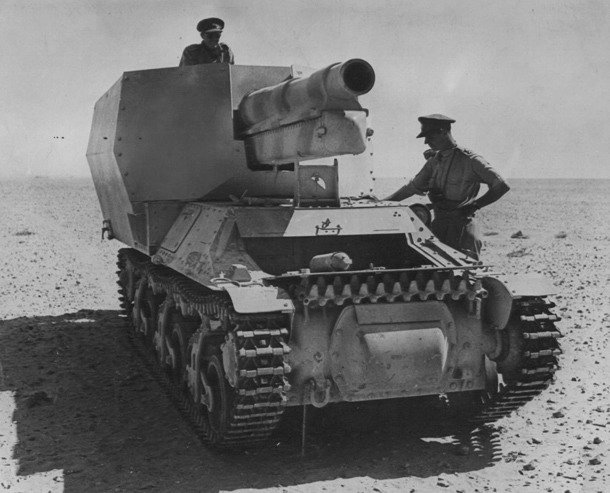
Another 15 cm sFH 13/1 (Sf.) auf Geschützwagen Lorraine Schlepper (f) captured by the British in Africa, source: internet, Public domain, edited
The armour of the fighting compartment was 10 mm thick at the front and 8 mm on the sides, which was insufficient even against armour-piercing rifle or machine gun rounds, offering protection only against ball ammunition and light shell splinters. Heavier armour was simply not an option, as any further increase in weight would have exceeded what the vehicle could bear. The original French Lorraine 37L tractor weighed 6.05 tonnes and could carry 810 kg of cargo in the load compartment plus a further 690 kg in a trailer. Its chassis was therefore rated for approximately 6.86 tonnes of direct load, with the drivetrain designed to handle a total towing mass of 7.55 tonnes. The self-propelled gun that the Germans built on this chassis weighed 8.5 tonnes — an increase the chassis handled without serious difficulty, which speaks well of the soundness of the original French design. The theoretical maximum speed of the self-propelled gun also remained the same as the original tractor's: 35 km/h. In practice, however, the vehicle could only sustain a road speed of around 20 km/h, and just 8 km/h cross-country. A fuel load of 110 litres of petrol was sufficient for roughly 135 km on road.
The 15 cm sFH 13/1 Howitzer
As already mentioned, the vehicle's main armament was the 15 cm sFH 13 heavy field howitzer (sFH = schwere Feldhaubitze). This was a weapon produced between 1913 and 1918 by Krupp. As more modern sFH 18 howitzers entered service, the older sFH 13s were progressively placed in army reserve, or transferred to training units and coastal artillery formations. Following the conquest of Belgium and the Netherlands in 1940, the Germans recovered a considerable number of these weapons that they had been required to hand over to those countries after the First World War. The Germans thus found themselves with more of these howitzers than they could reasonably put to use — troops generally preferred newer equipment over these "old ladies".
The sFH 13 howitzer had a barrel approximately 17 calibres long, with the recoil mechanism located beneath the barrel. The gun used separate-loading ammunition, meaning the shell (which incidentally weighed around 40 kg) was loaded first, followed by the cartridge case with the appropriate propellant charge. The propellant was inserted into the cartridge case in the form of individual bags, of which between one and seven could be used. With the maximum charge of seven bags, the howitzer could send a shell to a range of 8,600 to 8,900 metres. However, when installed on the self-propelled chassis, firing with the two heaviest charges — numbers 6 and 7 — had to be prohibited, as they placed excessive stress on the running gear. In its self-propelled form, the maximum effective range of the howitzer was therefore artificially limited to "only" 6,200 metres.
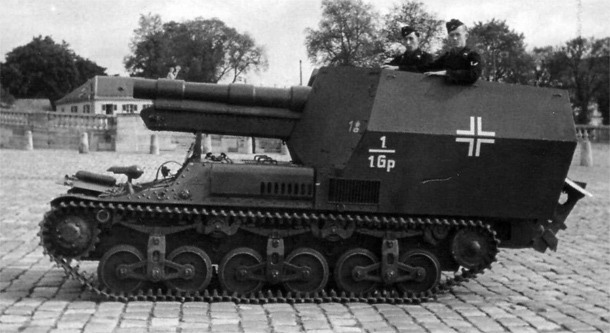
15 cm sFH 13/1 (Sf.) auf Geschützwagen Lorraine Schlepper (f) in France, source: Flickr.com, with permission of the publishing user, edited
What the howitzer's traverse and elevation figures were after installation on the French chassis is unfortunately not certain from the available sources. According to the Panzer Tracts series, vertical elevation was possible in a range from 0° to +14°, which is clearly nonsensical and is disproved by a whole range of photographs showing the gun elevated at a far greater angle. The actual maximum elevation was therefore probably around 40 to 45 degrees. As for horizontal traverse, the Panzer Tracts series gives a range of 7 degrees to each side, or 14 degrees in total — but this would be more than the howitzer was capable of in its original towed version, which is equally implausible. The actual traverse was therefore most likely just 7 degrees in total, or 3.5 degrees to each side.
The howitzer was positioned essentially in the rear third of the chassis. When combined with the already-mentioned considerable rearward extension of the fighting compartment over the tracks, this meant the vehicle's centre of gravity was heavily biased toward the rear. A large folding spade was therefore fitted at the rear to improve stability during firing. On early vehicles this spade was shorter; a small number of later vehicles apparently received a considerably longer spade, also positioned somewhat higher (the difference can be seen in photographs HERE). During travel the spade was raised; before firing it was lowered to the ground. Raising and lowering it appears to have been manageable without leaving the fighting compartment, using a chain and pulley arrangement. During travel the howitzer barrel was secured in a barrel rest to prevent it from bouncing and vibrating. This rest was mounted on the edge of the hull's front wall. On early vehicles it was probably fixed, or folded directly — meaning a crew member had to climb out to it. There are, however, photographs showing a long rod linkage running from the fighting compartment to the barrel rest, which was evidently another improvement introduced during production, allowing the crew to fold the rest remotely without leaving the compartment (photo HERE).
The crew of the self-propelled howitzer consisted of four men: commander, gunner, loader and driver. The driver sat in the front of the hull and the others most likely in the fighting compartment (in theory a second man could have sat in the hull beside the driver, but in practice this was probably not the case as the narrow hull was quite cramped for two). The driver entered and exited via a hinged front panel in front of his station, while the crew in the fighting compartment accessed the vehicle somewhat awkwardly through an openable upper section of the rear armour plate (which was apparently usable even with the rear spade raised). Loading the 40 kg shells over the high fighting compartment walls was clearly no easy task. Moreover, given the limited internal space, only 8 rounds could be stowed aboard; additional ammunition had to be carried in an accompanying ammunition vehicle. The self-propelled howitzer had no built-in close-defence weapon against enemy infantry. The crew did, however, carry an MG 34 machine gun and two MP 38 submachine guns. The machine gun could be fitted to a bracket in the right front corner of the compartment and fired over the top of the armour (photo HERE).
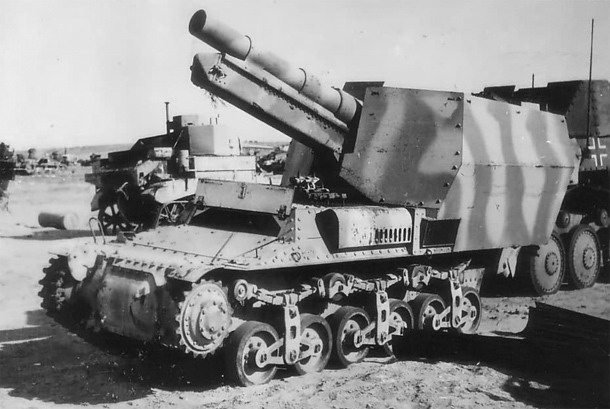
Wreck of an sFH 13/1 self-propelled gun on the Lorraine tractor chassis, somewhere in Africa, source: internet, Public domain, edited
The fighting compartment had no roof — which was effectively standard practice for German self-propelled guns of all types at that time. An open-topped design gave the crew better observation and made aiming easier. It also provided better ventilation and allowed freer movement and easier ammunition handling. The absence of a fixed roof also represented a considerable saving in weight and production cost. On the other hand, the crew was exposed to the elements, a problem addressed by stretching a waterproof tarpaulin over the opening. From a safety perspective the open top was not a critical weakness, since a self-propelled gun was not intended to engage the enemy in direct combat. Its role was to provide fire support to front-line units from a relatively safe distance.
The heavy self-propelled howitzer received the official designation 15 cm sFH 13/1 (Sf.) auf Geschützwagen Lorraine Schlepper (f). The first batch of 30 urgently needed vehicles for the Afrika Korps was completed in June 1942 and by the end of August they were already in action around El Alamein in Egypt.
Production
At that point it seemed the Germans had acquired, at very low cost, a vehicle of solid combat value, and it would have been a shame not to continue production while further chassis and howitzers remained available. Hitler therefore ordered Captain Becker to move to France in person and organise the conversion of further usable captured equipment into self-propelled weapons. A special unit was established under the German Ministry of Armaments for this purpose, known as either Baukommando Becker or Baustab Becker, with Alfred Becker appointed — naturally — as its commander. The Baukommando was allocated three originally French factories located in Paris or its immediate surroundings: the Matford factory in Poissy, the Talbot factory in Suresnes, and the Hotchkiss factory in Paris itself.
Becker requested that his old comrades from the 12th Battery of the 227th Artillery Regiment — the same men with whom he had carried out the first Vickers Mk. VI conversions in 1940 — be recalled from the front to assist him. He established the headquarters of his Baukommando at the Matford factory in Poissy and immediately set about producing the next series of heavy sFH 13 self-propelled howitzers on the Lorraine 37L tractor chassis. Baukommando Becker probably completed 64 of these vehicles during July and August 1942, which together with the first batch of thirty brings the total production to 94 units. Some authors, however, put Becker's output at 72 rather than 64 vehicles, raising the overall figure to 102, and there are even theories that Alkett ultimately built a further 64 vehicles, pushing the total to 166. The last figure in particular seems highly improbable. The majority of surviving photographs of this vehicle come from the African theatre, where only 30 (or more precisely 23) were demonstrably deployed. It would be very difficult to explain why 4.5 times as many of these vehicles (30 vs. 136) would have been deployed on other fronts yet left behind so few photographs.

15 cm sFH 13/1 (Sf.) auf Geschützwagen Lorraine Schlepper (f) in France, source: Flickr.com, with permission of the publishing user, edited, edited
Organisation and Deployment
As already mentioned, the first 30 new self-propelled howitzers were completed in June 1942. These vehicles were to be divided up with 12 going to the 15th Panzer Division and 12 to the 21st Panzer Division, with the remaining 6 assigned to the 90th Light Africa Division (all units of Rommel's Afrika Korps). In the event, only 23 vehicles actually reached the African continent, as 7 were sunk in transit across the Mediterranean. As a result, all surviving vehicles were divided between just the two panzer divisions: the 15th Panzer Division received 12 (enough to equip three platoons of four self-propelled guns each) and the 21st Panzer Division received 11. The vehicles' baptism of fire came at the turn of August and September 1942 in the area of El Alamein in Egypt. During five days of action between 30 August and 3 September 1942, the 15th Panzer Division lost three of these self-propelled guns. By 23 October 1942 the 15th and 21st Panzer Divisions together still had 19 sFH 13 self-propelled howitzers on the Lorraine chassis available — but by 2 December 1942 not a single one appeared in the returns. All had been lost within just six weeks.
The 64 self-propelled howitzers of the second production batch were used to equip two independent artillery regiments designated Gepanzerte Artillerie-Regiment 1 (Sfl.) and Gepanzerte Artillerie-Regiment 2 (Sfl.). Each received 30 vehicles, divided within the regiment into five batteries of six self-propelled guns. In December 1942, however, Gepanzerte Artillerie-Regiment 1 (Sfl.) was disbanded and its vehicles distributed among three infantry divisions stationed in France. Gepanzerte Artillerie-Regiment 2 (Sfl.) was later redesignated Panzer Artillerie-Regiment 155 and incorporated into the newly reformed 21st Panzer Division (the original 21st Panzer Division had been destroyed in Africa and subsequently rebuilt in France). When the Allies landed in Normandy in June 1944, the 21st Panzer Division had 24 sFH 13 self-propelled howitzers on Lorraine chassis at its disposal. Three were lost in June, a further nine in July, and most of the remainder in August of that year. By 1 November 1944 the 21st Panzer Division reported just a single vehicle of this type remaining.
Technical Data
|
weight: |
8.5 t |
|
length: |
4.4 m |
|
width: |
1.85 m |
|
height: |
2.2 m |
|
engine: |
Delahaye 135 |
|
engine power: |
70 hp |
|
max. speed: |
35 km/h |
|
crew: |
4 men |
|
armament: |
15 cm sFH 13 |
ARTICLE
CONTENTS:
Reproducing text from the Panzernet website without the written consent of the operator is prohibited.