TYPES AND DESIGNATION OF GUNS
not all guns are alike
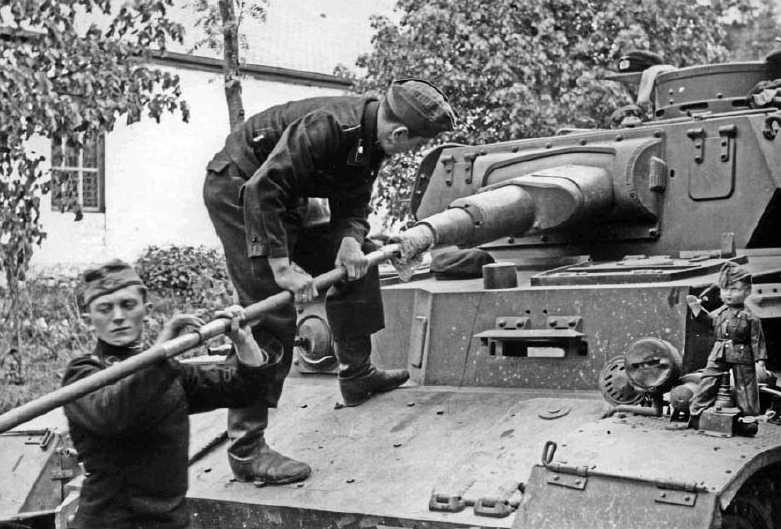
cleaning the 75 mm gun of a Panzer IV Ausf. A, source: Flickr.com, courtesy of the publishing user, edited
The division of armoured fighting vehicles into three basic categories — tanks, tank destroyers, and self-propelled guns — reflected the threefold distinction between artillery weapons themselves. Tank guns were versatile weapons capable of engaging armoured vehicles, infantry, and light fortifications alike. Large-calibre field guns and howitzers, by contrast, were intended primarily for breaking up massed enemy infantry, demolishing buildings, bunkers, and obstacles. The third category was the anti-tank gun, designed above all to defeat enemy armour.
This classification of gun types took shape — in Germany as elsewhere — largely during the interwar period. The corresponding division of armoured vehicles into the three categories mentioned above took somewhat longer to be formally adopted in the German army, as it was not strictly necessary at the outset. When the Second World War broke out, the Germans had only a single fully tracked vehicle other than tanks — the assault gun Sturmgeschütz III.
The reason for this apparent lack of variety in German armoured equipment was that the Wehrmacht's two key tanks of the period effectively covered the roles of the other vehicle types. The PzKpfw III carried an anti-tank gun, while the heavier PzKpfw IV was armed with an anti-infantry gun. In practice, the former functioned as a tank destroyer and the latter as a self-propelled gun. The two were intended to complement and support each other on the battlefield. Supporting the tanks as the primary combat arm was also later the role of the formally distinguished self-propelled guns and tank destroyers.
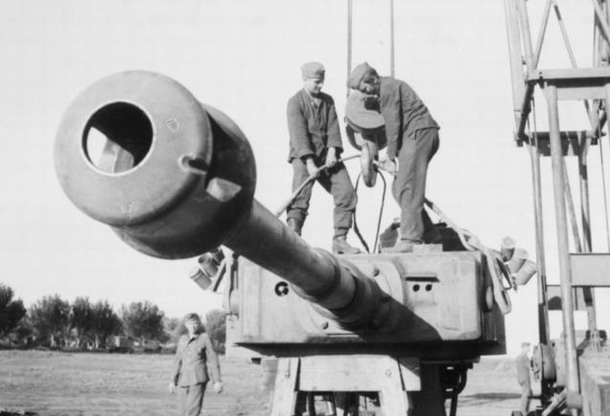
the barrel of a Tiger tank — note the damage to the muzzle brake, apparently caused by an enemy anti-tank rifle, source: Bundesarchiv_Bild_101I-022-2923-07A, Wikimedia, Creative commons, edited
The different types of guns varied in both their construction and the ammunition they fired. Anti-tank guns were characterised by a long barrel of relatively small calibre, which allowed them to achieve high muzzle velocity. As development progressed, however, calibres grew, and by the end of the war anti-tank guns of 128 mm calibre were being produced. Tank guns evolved over the course of the war to closely resemble anti-tank guns, as destroying enemy armour had become their primary function since the opening of the Eastern Front. Field howitzers, on the other hand, were characterised from the outset by large calibre and long range.
The design and characteristics of the projectiles themselves also differed. An armour-piercing round, whose primary function was to penetrate armour, contained a hard core and had to achieve the highest possible velocity. A high-explosive anti-personnel round, by contrast, carried a large bursting charge and was designed to produce as many lethal fragments as possible on detonation. Tanks, given their broadly universal combat role, carried an adequate supply of both types of ammunition. Vehicles with a more specialised purpose typically also carried a smaller stock of the secondary type. Tank destroyers thus kept a number of high-explosive rounds on board alongside their armour-piercing ammunition, in case the need arose — and the same applied in reverse to self-propelled guns.
The different types of guns were also designated in different ways, though the full official code identifying a specific artillery weapon followed a broadly consistent structure. The calibre of the gun came first, followed by a letter abbreviation indicating the type of gun, then a two-digit number denoting the year the weapon entered service, and finally the barrel length. The barrel length was not always included, however — it was commonly omitted, for example, in the designations of field howitzers used on various self-propelled platforms.
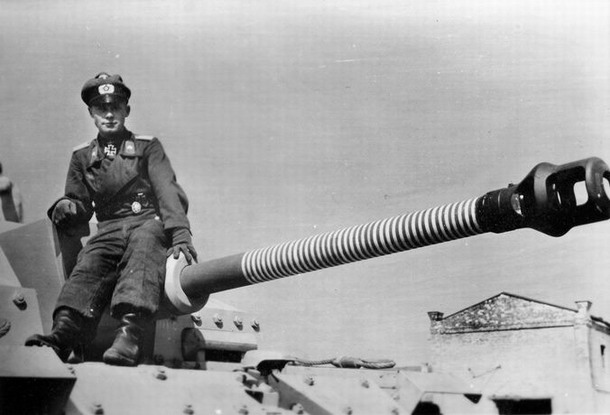
Lieutenant Walther Oberloskamp sitting on the 75 mm gun of his StuG III assault gun, with 40 kill rings painted on the barrel, source: Flickr.com, courtesy of the publishing user, edited
As noted, the first element of a gun's designation was its calibre. For artillery weapons in general, the Germans expressed calibre in centimetres, so guns are encountered with calibres such as 7.5 cm, 8.8 cm, and so on. The term "calibre" here refers to the diameter of the barrel's bore.
Next came the letter code indicating the type of gun. Tank guns carried the abbreviation KwK, standing for Kampfwagenkanone. Anti-tank guns used the code PaK, short for Panzerabwehrkanone. Field guns used the codes FH or lFH, standing for Feldhaubitze and leichte Feldhaubitze respectively. Other codes encountered include K for Kanone, StuK for Sturmkanone, StuH for Sturmhaubitze, and sIG for schwere Infanterie Geschütz. Anti-aircraft guns carried the abbreviation FlaK, short for Flugzeugabwehrkanone.
The year of introduction into service was expressed as a two-digit number. The number 40, for instance, indicated the year 1940. In some cases, the two-digit year was extended by a further number following a dash or slash, indicating that the weapon was a modified version of the original design.
German gun designations also included an expression of barrel length, measured from the muzzle to the breech face, excluding both the chamber and any muzzle brake. Barrel length was not given in absolute units, but as a multiple of the weapon's nominal calibre. A gun with a barrel length designation of L/56, for example, had a barrel measuring 56 times the diameter of its bore.
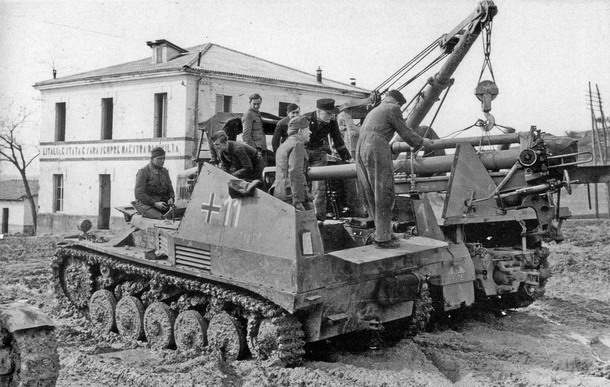
removing the 105 mm howitzer from a Wespe self-propelled gun, source: Flickr.com, courtesy of the publishing user, edited
A complete gun designation might therefore look like this: 8,8cm KwK 36 L/56. As this shows, it identified a tank gun of 8.8 cm calibre, originally introduced into service in 1936, with a barrel length of 56 calibres — that is, 56 times 8.8 cm, equalling 4.93 metres.
The designations of captured artillery weapons taken into German service were further extended by a letter in brackets indicating the country of origin. A captured Soviet 76.2 mm anti-tank gun, for example, was designated 7,62cm PaK (r), where the r stood for russisch — Russian.

Reproducing text from the Panzernet website without the written consent of the operator is prohibited.