HALF-TRACKS – INTRODUCTION
their origins, development, and evolution into self-propelled weapons
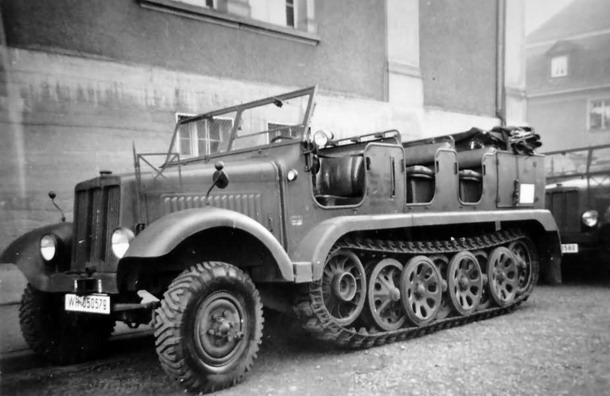
the Sd.Kfz. 6 half-tracked artillery tractor, source: worldwarphotos.info with permission of the operator, edited
A Little History
The concept of a vehicle combining a wheeled front section with a tracked rear appears to have originated around the turn of the 19th and 20th centuries. The engineers of the time were looking for a vehicle capable of moving across difficult terrain where a purely wheeled vehicle would become stuck, while at the same time requiring no special driving skills. The half-track proved to be the ideal solution, satisfying both requirements reasonably well. Unlike fully tracked vehicles, a half-track could be steered with a conventional steering wheel by turning the front wheels — sometimes in combination with braking one of the tracks — meaning that in theory, anyone who could drive an ordinary car could handle one.
Half-track development proceeded along two parallel lines. One involved converting standard passenger cars and trucks by replacing their rear axles with a tracked unit — often not as a permanent modification but as a seasonal adaptation, for winter conditions for example. The Russian Tsar, for instance, had his personal cars converted in this way to cope with deep Russian snow. Alongside this, agricultural machinery manufacturers — particularly in the United States — also began exploring half-track designs. The first commercially successful half-track is generally considered to be the steam-powered log hauler designed by Alvin Lombard in 1901, which found wide use in the American logging industry. A major step forward came with the agricultural tractors produced by Holt, which were powered by an internal combustion engine and featured a relatively large tracked section combined with a single large front steering wheel.
The First World War
Armies of many nations had apparently been interested in half-tracks even before the First World War, but when fighting broke out in 1914 that interest intensified considerably. Enormous quantities of men, supplies, weapons, and ammunition had to be moved across often very demanding terrain, and the armies involved needed suitable transport. This is how the Holt tractors came into military service. The company's representatives succeeded in convincing the British army of the merits of their Holt 75 model to such a degree that it was selected as the primary cargo and artillery tractor. Although it managed only 3 to 4 km/h when hauling a load — little more than walking pace — it rendered invaluable service to both the British and French on the Western Front.
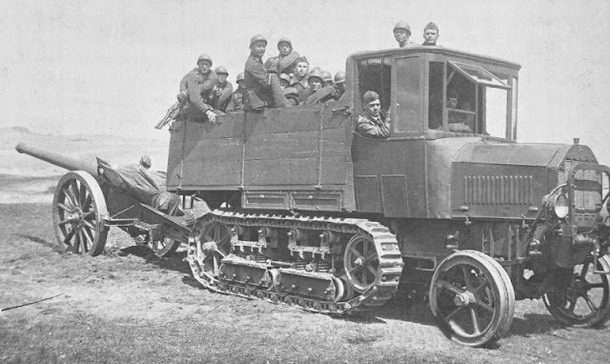
during the First World War the Germans deployed the Marienwagen half-tracked tractor (the one shown here appears to be in service with another army), source: landships.activeboard.com, public domain, edited
The German army, of course, also needed to supply its forces, and it too turned its attention to half-tracked vehicles. From 1915, engineer Hugo Bremer worked with army backing on converting a standard four-tonne Daimler truck into a half-track. Several prototype variants were tested in 1916, and the resulting vehicle was introduced into service as the Marienwagen — named after the Marienfelde district of Berlin where it was manufactured. It was used to transport troops and supplies and to tow artillery pieces.
The rear of the chassis was tracked while the front retained two spoked wheels. The driver's cab and cargo body were carried over from the original truck, giving the vehicle a distinctly civilian appearance. The Marienwagen apparently never saw widespread use and remained a fairly marginal type. In 1917 an armoured variant was even produced, making it in effect Germany's first armoured personnel carrier. In 1918, Benz — at that time still an independent company, separate from Daimler — also built a half-track prototype of their own, again based on a converted standard truck. The vehicle, designated Kraftprotze, was not particularly successful and appears to have been built in only a handful of examples.
Half-track development did not stop with the end of the war. The French in particular pursued it with considerable energy, with the firm Citroën standing out above all others through its collaboration with designer Adolphe Kégresse. Kégresse had accumulated extensive experience with converting passenger cars to partial tracked propulsion even before the war, and had developed his own solution for the tracked running gear, which was named after him. Notably, Kégresse did not use tracks made of metal links but rubber ones instead. During the 1920s, Citroën built several types of civilian and military half-tracks on Kégresse's foundations, and the vehicles gained fame through their participation in various overland expeditions.
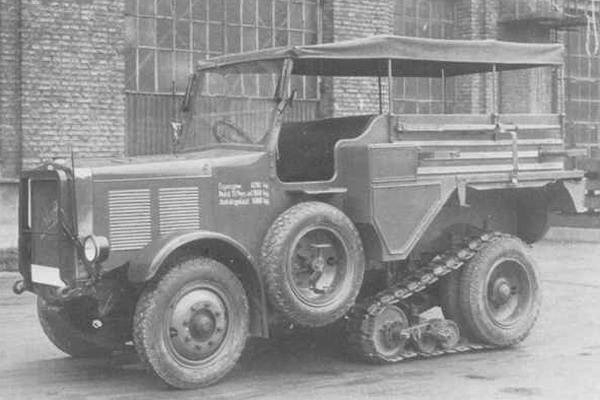
the MSZ 201 half-tracked tractor by Krauss-Maffei, source: Flickr.com with permission of the publishing user, edited
Post-war Germany
The Treaty of Versailles probably did not explicitly prohibit Germany from developing half-tracked cargo tractors for military purposes. However, given the sweeping reductions imposed on the German army, demand for this type of vehicle was very limited. Development of military half-tracks continued nonetheless, led primarily by the firm Krauss-Maffei. Around the turn of the 1920s and 1930s, it produced several types of half-tracked tractors for the Reichswehr. One example was the smaller MSZ 201, which looked much like a conventional wheeled vehicle but featured road wheels ahead of the rear axle that allowed the fitting of rubber tracks (a photograph without the tracks fitted can be found HERE). The army apparently purchased 24 of these vehicles, and there were even experiments with building an armoured and armed version.
Also worth mentioning is the KM-RK truck (KM = Krauss-Maffei, RK = Räder-Ketten = wheel-track). This was not a conventional half-track either, but a hybrid that could raise its tracked section clear of the ground and run on wheels alone. The entire project ended after only three prototypes were built, and they proved unsatisfactory.
The Half-Track in Full Bloom
In the early 1930s, the Germans decided to take a more systematic approach to half-track tractor development and launched a programme to develop and build six vehicle types, categorised by towing capacity from 1 to 18 tonnes. Development of the individual vehicles was contracted out to various firms — alongside the already mentioned Krauss-Maffei, these included Büssing NAG, Daimler-Benz, FAMO, Demag, and Hansa-Lloyd. Having learned from the shortcomings of previous types, the German Ordnance Office this time left nothing to chance and drew up the design specifications itself. There was to be no hybrid arrangement allowing travel on wheels alone; instead the emphasis was on maximising the use of the tracks, with the tracked section made as long as possible. The running gear of the tracked section was designed using a very modern arrangement of large, overlapping road wheels — a solution that proved highly effective and was the work of engineer Ernst Kniepkamp.
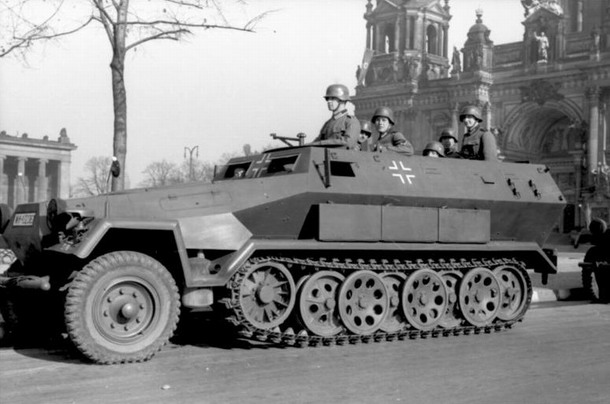
the Sd.Kfz. 251 served as an armoured infantry carrier and as a mount for a wide variety of weapons, source: Bundesarchiv_Bild_101I-801-0664-37, Wikimedia, Creative Commons, edited
The programme produced six types of half-tracked tractors that entered history under the ordnance designations Sd.Kfz. 6, Sd.Kfz. 7, Sd.Kfz. 8, Sd.Kfz. 9, Sd.Kfz. 10, and Sd.Kfz. 11. Since their design had largely been determined by the Ordnance Office's specifications, all six were closely related in appearance. In addition to their primary role of towing loads and recovering other vehicles, all of them also served as the basis for a variety of self-propelled weapons, most commonly anti-aircraft guns.
Beyond these, the German army also operated several other types of half-tracked vehicle. The most famous by far was the armoured infantry carrier Sd.Kfz. 251. Somewhat less celebrated was its smaller cousin, the Sd.Kfz. 250. There was also the ammunition carrier Sd.Kfz. 252 and the artillery observation vehicle Sd.Kfz. 253, both intended for assault artillery units. Over the years a whole range of additional prototypes appeared that never reached production. The Germans also made use of captured half-tracks, particularly those of French manufacture. The most modern half-track type that Germany put into production — not until late 1943 — was the so-called Schwerer Wehrmachtschlepper.
In June 1941, German forces invaded the Soviet Union. That very first autumn on the Eastern Front introduced the Germans to the phenomenon known as rasputitsa — the season when rain turned every unpaved road into a sea of mud. Tracked and half-tracked vehicles could generally cope with such conditions, but wheeled supply trucks were utterly useless. The Wehrmacht urgently demanded more half-tracked vehicles to keep its supply lines running, and so in 1942 a number of standard trucks were converted. As had been done many times before, their rear axles were replaced with a tracked section. These conversions, applied to vehicles by Opel, Mercedes-Benz, and Ford, are collectively referred to as Maultier — the German word for mule.
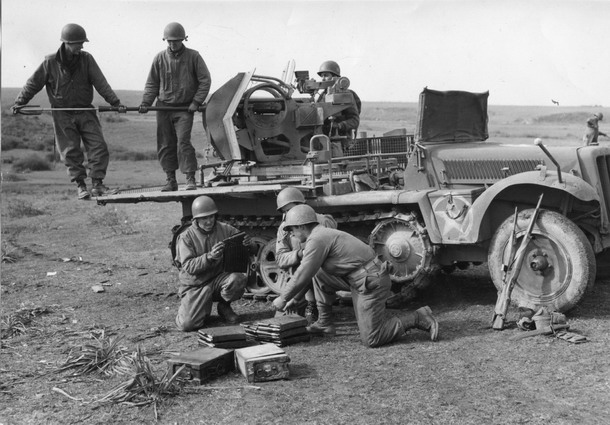
even standard half-tracked artillery tractors were converted into self-propelled weapons — shown here is an Sd.Kfz. 10 fitted with the Flak 38 anti-aircraft gun, source: internet, public domain, edited
Virtually all German half-tracks were originally built as non-combat vehicles intended for hauling cargo or carrying troops. As the war progressed, however, they were increasingly pressed into combat roles and converted to carry all manner of weapons. This was driven less by any coherent doctrine than by the desperate need to offset the enemy's numerical superiority in fighting vehicles. The frantic effort to fit the most powerful weapons possible onto half-track chassis reached its logical extreme in a prototype of the Sd.Kfz. 251 armoured personnel carrier chassis fitted with the 75 mm PaK 42 anti-tank gun with a 70-calibre barrel — the desperation of that particular design, one suspects, is apparent even to the casual observer (photograph HERE).
German half-tracks were renowned for their quality, durability, and outstanding cross-country performance. They were, however, relatively complex and expensive to manufacture. Germany managed to produce them in fairly large numbers, and although the Americans ultimately built more half-tracks in total, the half-tracked armoured personnel carrier became a symbol of no other army the way it did of the German one.
ARTICLE
CONTENTS:
Reproducing text from the Panzernet website without the written consent of the operator is prohibited.