Sd.Kfz. 10
self-propelled weapons on the half-track tractor chassis
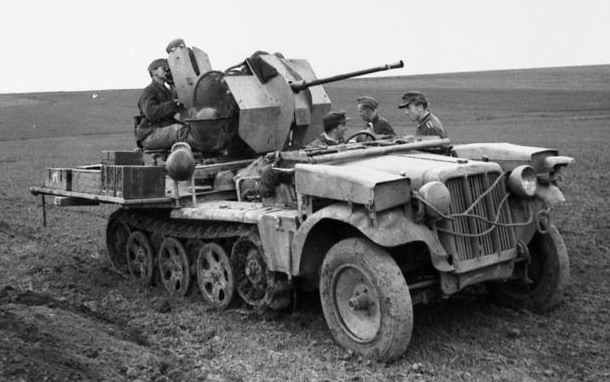
Sd.Kfz. 10/5 with Flak 38 gun, source: Bundesarchiv_Bild_101I-711-0406-07A, Wikimedia, Creative commons, edited
Origins of the Half-Track
The Sd.Kfz. 10 (Sd.Kfz. = Sonderkraftfahrzeug = special-purpose vehicle) was the lightest of six half-track tractor types whose development the German army commissioned from various manufacturers in the early 1930s. This light vehicle was designed to tow weapons and loads of up to one tonne. The contract for its construction was awarded to Demag (Deutsche Maschinenbau Aktiengesellschaft), most likely as early as 1932 (though 1933 or even 1934 are also cited in some sources). The project was given the rather unwieldy designation kleinster geländegängiger Kettenschlepper — literally, the smallest cross-country tracked tractor.
The first prototype appeared in 1934 under the factory designation D ll 1. There is, however, a curious "spelling dispute" in the literature surrounding this code. The first letter, D, is entirely uncontested and clearly stood for the manufacturer's name — Demag. The last character is equally certain: the numeral one, indicating it was the first prototype. The debate centres on the two middle characters. Some authors write them as lowercase letters "L", while others use two ones. The letter version seems more credible, since the two "L"s are said to have stood for "Liliput" — a nickname given to the vehicle by Demag itself. I will therefore stick with the letter version throughout.
The D ll 1 was a purely experimental prototype and had virtually nothing in common with the Sd.Kfz. 10 as we know it. It was a very small machine powered by a BMW 315 engine producing just 28 horsepower, with the engine mounted in the rear. In 1935 it was followed by a new version designated D ll 2 — again a purely experimental vehicle. The engine remained unchanged from its predecessor, but the track assembly was lengthened, extending the overall length of the vehicle.
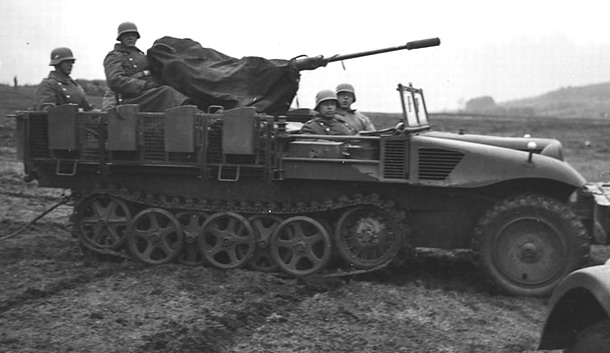
Mounting of the Flak 30 gun was also tested on the pre-production D6 half-track, source: worldwarphotos.info, used with permission of the site operator, edited
In 1936 the project reached its third prototype generation, designated D ll 3. This version represented a significant leap in design, bringing the vehicle much closer to its future production form. A BMW 319 six-cylinder engine producing 42 horsepower was used as the powerplant. The engine compartment was moved to the front of the hull and received a bonnet and front grille almost identical in appearance to those of the later production vehicles. The track assembly was considerably longer than on the first two variants. Although the road wheels still featured the atypical large circular lightening holes, their arrangement already closely matched the future standard layout. A total of 38 examples of the D ll 3 were built. Photographs confirm that this version was already being used to test the possibility of fitting the vehicle with a Flak 30 anti-aircraft gun.
The next step in the development of the Demag tractor was a vehicle designated D4 — one that existed only on the drawing board and was never built as a prototype. This version was planned around a Maybach HL25 engine producing 65 horsepower. Interestingly, from this point the "ll" letters disappeared from the designation. One might wonder whether the Demag engineers decided the vehicle had grown large enough that the Liliput nickname no longer suited it. The logical next step would have been a D5 prototype, but no record of its existence has been found. Instead, 1937 brought the D6 version, powered by a new Maybach NL38 TRK engine producing 83 horsepower. The most obvious external changes compared to the D ll 3 were revised front wheel mudguards, a slightly wider engine bonnet and a new type of road wheels for the track assembly. In 1937, eight vehicles were produced under the designation D6 Versuchserie (literally "test series"), followed the next year by a further 60 slightly modified vehicles designated D6 0-serie — the pre-production or "zero" series.
As photographs confirm, the D6 half-tracks were used to trial most of the later specialised sub-variants of the Sd.Kfz. 10, including the decontamination vehicle (later introduced as the leichte Entgiftungskraftwagen (Sd.Kfz. 10/2)), the contamination-laying vehicle (later introduced as the leichte Sprühkraftwagen (Sd.Kfz. 10/3)), and the mounting of the Flak 30 anti-aircraft gun (which would become the Sd.Kfz. 10/4).
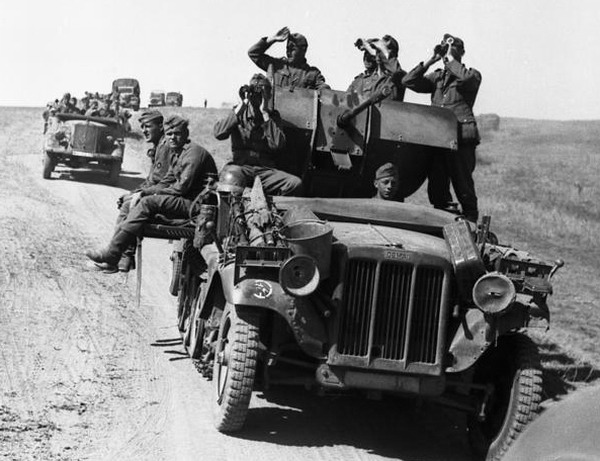
Sd.Kfz. 10/4 accompanying a column, source: Bundesarchiv_Bild_101I-218-0507-10, Wikimedia, Creative commons, edited
In 1938 the final version of the vehicle appeared, carrying the factory designation D7. The main change was the adoption of a Maybach NL38 TRKM engine producing 90 horsepower. Among the external changes, the most notable were the redesigned front wheel mudguards. Series production of the half-track most likely began in October 1938. In the meantime, in March 1937, the army had assigned the new half-track the official designation leichter Zugkraftwagen 1t (Sd.Kfz. 10). The first production vehicles used the aforementioned Maybach NL38 TRKM engine, but from 1939 this was replaced in production by the Maybach HL42 TRKM — a 4.192-litre unit producing a maximum of 100 horsepower (some authors suggest that the D7 designation was only applied from this engine change onwards). The gearbox was the Maybach Variorex VG 102 128 H type, offering seven forward and three reverse gears.
Vehicle Description
In its final form, the Sd.Kfz. 10 (and consequently the D7) rode on a chassis combining a steerable front axle with a rear track assembly. The front wheels were sprung by a transversely mounted leaf spring. The track system consisted of a front drive sprocket, a rear idler wheel, and five road wheels. The road wheels were sprung by torsion bars and fitted with rubber tyres to improve ride quality. Each wheel was in fact a double wheel — made up of two steel discs — so while the half-track technically had ten road wheels, they were arranged on just five axles. The wheels were staggered and overlapped one another, a solution typical of German half-tracks (and later tanks). The discs of the odd-numbered wheels were set further apart on their axles, with the even-numbered wheels — whose discs sat close together — nestling in the space between them. Viewed from the side, only the odd wheels were fully visible, specifically their outer discs. Early production vehicles had road wheels with large lightening holes; later, wheels with smaller holes and new pressed reinforcements were introduced.
The front of the vehicle housed the engine compartment, followed by the driver and commander's cab, with the main utility space at the rear — its use varying depending on the specific sub-variant. The driver and commander's cab was fully open, with only a folding windscreen at the front. The driver steered using a conventional steering wheel: gentle turns steered only the front wheels, while larger inputs additionally applied braking to the inner track. The fuel tank held 115 litres of petrol, giving a range of around 300 km on road and approximately 150 km cross-country. The theoretical top speed was 75 km/h, though drivers were instructed not to exceed 65 km/h in order to preserve track life.
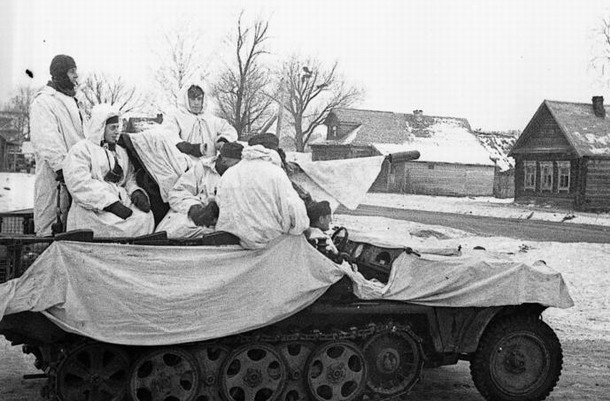
Sd.Kfz. 10 in winter camouflage, source: Bundesarchiv_Bild_101I-268-0180-03, Wikimedia, Creative commons, edited
In its basic configuration, the Sd.Kfz. 10 served as a cargo tractor for towing light artillery pieces and transporting their crews. For this purpose, the rear utility space was fitted with seating for up to six soldiers. The vehicle's own weight without load was 3.4 tonnes. According to specification, the Sd.Kfz. 10 could carry a payload of up to 1,500 kg while simultaneously towing a trailer of up to one tonne. The half-track was primarily used to tow the 37 mm PaK 36 anti-tank gun, the 20 mm Flak 30 anti-aircraft gun, or the 75 mm leIG 18 light infantry gun. From around mid-1940 a stronger towing coupling was introduced, enabling the vehicle to haul heavier weapons such as the 150 mm sIG 33 heavy infantry gun or the 50 mm PaK 38 and 75 mm PaK 40 anti-tank guns.
In addition to the basic tractor, several further sub-variants of the half-track were produced. The Sd.Kfz. 10/1 was equipped for chemical contamination detection. The Sd.Kfz. 10/2 was a decontamination vehicle designed to cleanse contaminated areas, while the Sd.Kfz. 10/3 was its opposite — intended to lay chemical agents. Given the sporadic use of chemical weapons in the Second World War, these sub-variants were neither produced nor deployed in any significant numbers.
Sd.Kfz. 10/4
For enthusiasts of military hardware, the most interesting sub-variants are the Sd.Kfz. 10/4 and Sd.Kfz. 10/5. Both involved the installation of an anti-aircraft gun, transforming a simple cargo tractor into a self-propelled weapon. The Sd.Kfz. 10/4 was armed with the 20 mm Flak 30 gun. Production began as early as 1939, with 195 units built for the army (Heer) and a further 175 for the Luftwaffe. The first experiments with fitting this weapon to the light half-track had, however, taken place earlier — initially on the prototype D3 and later on the pre-production D6.
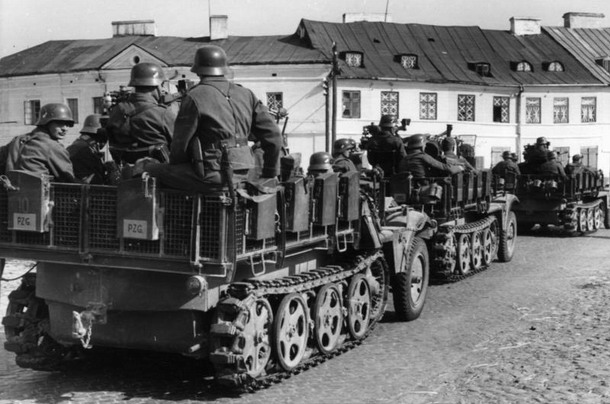
Rear view of Sd.Kfz. 10/4, source: Bundesarchiv_Bild_101I-380-0086-27, Wikimedia, Creative commons, edited
On the Sd.Kfz. 10/4, the rear utility space was converted into a single wide platform fitted with several clamps to secure the gun's mounting base. It was separated from the driver and commander's cab at the front by a simple tubular frame. Along the sides and rear, the fighting platform was enclosed by a low fence of steel mesh. The sections of this fence could be folded outward to the sides or rearward so as not to obstruct the gun's traverse. When folded flat, they lay horizontally, flush with the platform floor, and could bear a considerable amount of weight — effectively acting as an extension of the fighting space, giving the gun crew more room to work. Crews sometimes made use of the folded-down sides for travelling as well.
On the outside of the fence hung boxes for ammunition magazines — two at the rear and four on each side. Each box held one magazine of twenty rounds, giving a ready supply of 200 rounds in total. Additional ammunition was carried in a towed trailer (Sonderanhänger 51), which reportedly held 640 rounds and also carried a portable coincidence rangefinder for more precise fire control.
The gun was installed together with its mounting base, which kept it fully traversable through 360 degrees. In elevation it could be moved from -10 to +90 degrees. The weapon was fitted either with or without its original gun shield. When retained, the shield offered the open-platform crew at least some sense of protection, though it was rather large and uncomfortably increased the vehicle's profile, making it easier to spot. It also likely complicated the gun crew's work by taking up the already limited fighting space.
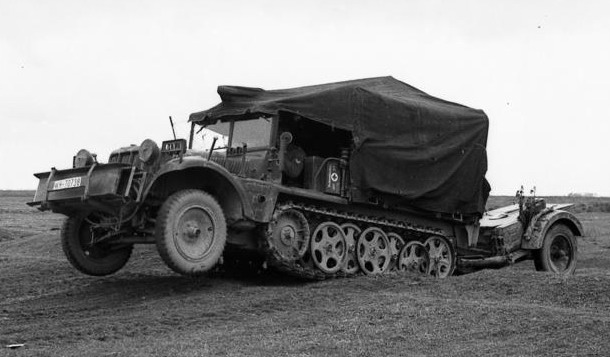
Sd.Kfz. 10/4 with canvas cover erected and Sonderanhänger 51 trailer, source: Bundesarchiv_Bild_101I-163-0323-13A, Wikimedia, Creative commons, edited
The Flak 30 was a widely used and reliable weapon — and crucially, it was small and light (weighing around 450 kg), meaning it presented no difficulty to the chassis of Germany's smallest half-track. Its effective ceiling of 2,200 metres was nothing spectacular, but it was more than adequate for the task at hand: defending moving columns of military vehicles from low-level enemy air attacks. The gun's main weakness was its low rate of fire. While the theoretical rate was around 280 rounds per minute, in practice it was closer to half that.
During 1940, two notable improvements were introduced into Sd.Kfz. 10/4 production. The first was the fitting of rifle racks on the front wheel mudguards on both sides of the vehicle — each side holding three standard K98 rifles. The second was the addition of a loading ramp, made up of two rails each consisting of two sections. When not in use, the folded sections were stowed in a rack on the vehicle's nose. Together with the Sonderanhänger 51 trailer, this ramp allowed the crew to carry out a complete removal or replacement of the gun in the field without any need for a workshop visit.
The procedure involved removing the wooden crate from the trailer, loading the gun together with its mounting base onto the empty trailer frame, and then pulling the trailer up the ramp onto the fighting platform, where the gun was unloaded and secured to the floor. Despite the gun weighing roughly half a tonne, a crew of six could manage this operation in the field. The hardest and most dangerous part was pushing the loaded trailer up the ramp onto the platform. To ease this, two pulleys were mounted on either side of the tubular frame separating the platform from the driver and commander's cab, allowing one man on each side to haul the gun upward with a rope while others pushed from behind.
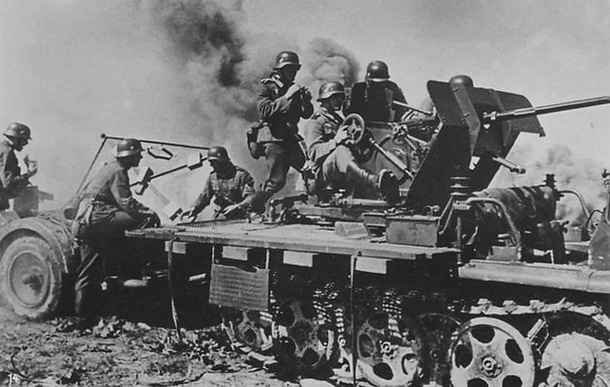
Sd.Kfz. 10/4 in action — note the loaders passing ammunition from the trailer, source: Flickr.com, used with permission of the publishing user, edited
This degree of self-sufficiency was highly practical. A proportion of Sd.Kfz. 10/4 vehicles were in fact delivered without a gun and served as support and ammunition carriers accompanying the armed vehicles. If an armed half-track suffered engine or running-gear damage, the crew could quickly transfer its gun to an unarmed carrier vehicle, preventing any reduction in the unit's firepower. Such unarmed carriers were not uncommon — according to regulations, an anti-aircraft platoon (Kompanie) was equipped with 18 Sd.Kfz. 10/4 vehicles, of which 12 were armed and 6 were not (a full third of the total).
It is somewhat surprising that the loading ramp was only introduced into production from 1940 rather than from the very beginning. Photographs clearly show that a ramp of this type — including the pulleys — had already been tested on the aforementioned experimental vehicles based on the D3 and D6 prototypes.
As noted above, 370 Sd.Kfz. 10/4 vehicles (175 + 195) were produced in 1939. According to some sources, a further 1,000 were to be built in 1940, after which the production rate dropped to around 20 to 25 vehicles per month.
Sd.Kfz. 10/5
In 1941 (1942 according to some sources), a new version of the half-track entered production under the designation Sd.Kfz. 10/5. It received a new main armament — the Flak 38 gun. This was again a 20 mm automatic anti-aircraft cannon, but of a more modern design, lighter in weight and with a higher rate of fire (theoretically up to 480 rounds per minute). The fighting platform had to be modified to accommodate the new gun type, which meant the two weapons were most likely not interchangeable — the Sd.Kfz. 10/4 could not carry the Flak 38, and the Sd.Kfz. 10/5 could not carry the Flak 30.
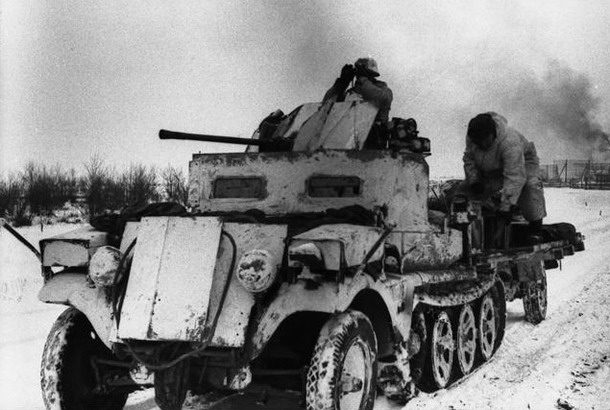
Sd.Kfz. 10/5 with armoured engine cover and driver/commander cab armour, source: Bundesarchiv_Bild_101I-665-6823-11, Wikimedia, Creative commons, edited
The Flak 38 was likewise installed sometimes with and sometimes without a gun shield (though vehicles with the shield clearly predominate in photographs). From 1942, the rifle racks on the front mudguards were fitted with partially enclosed sheet-metal covers. Alongside the gun itself, these covers are one of the most reliable distinguishing features between the Sd.Kfz. 10/5 and the 10/4.
The crew of the Sd.Kfz. 10/4 — and by extension the 10/5 — originally consisted of six men: a driver, a commander, and a four-man gun crew. From 1943 onwards, however, the crew was reduced to four. The soldiers on board were entirely exposed to the elements due to the vehicle's open construction. Their only protection was a waterproof canvas cover that could be erected over the entire fighting platform and the forward cab. To cover such a large area the canvas had to be enormous, and putting it up or taking it down was certainly no easy task — especially in strong wind, which played havoc with the large surface area. Crews therefore presumably used it only rarely, which is borne out by the scarcity of photographs showing the canvas in place. The men on board also had a much smaller tarpaulin for covering the gun itself, which appears far more frequently in photographs.
From 1942 (though some sources say a year later), a portion of vehicles was fitted with armour plating on the front engine cover and the driver and commander's cab. The armour was very basic, protecting the cab only from the front and partially from the sides. Two fairly large vision apertures were cut into the front plate; at least on some vehicles these were fitted with closable covers. Armour thickness was just 8 mm. According to some sources, the armour was fitted exclusively to the Sd.Kfz. 10/5, but photographs confirm that armoured versions of the Sd.Kfz. 10/4 also existed.
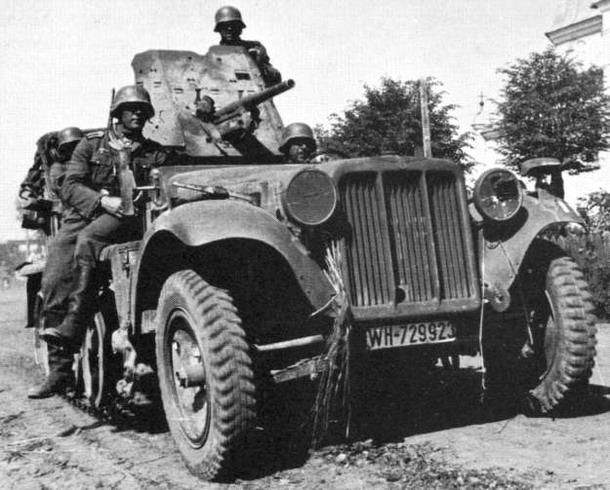
Sd.Kfz. 10 with 37 mm PaK 36 gun, source: Flickr.com, used with permission of the publishing user, edited
Production of the Sd.Kfz. 10/4 and 10/5, which had fallen to just 20 to 25 units per month after 1940, picked up again in 1943 and 1944, before finally ceasing in November 1944. The total number of vehicles built is not known, but it was probably in excess of two thousand.
Further Conversions
The Sd.Kfz. 10/4 and 10/5 were the only official conversions of this vehicle into a gun carrier. Any further self-propelled weapon variants based on the Sd.Kfz. 10 chassis were unofficial field workshop modifications. Given how widely the light tractor was distributed, various armed variants did emerge — the most common being installations of the 37 mm PaK 36 and 50 mm PaK 38 anti-tank guns.
As far as the PaK 36 is concerned, its installations took many different forms depending on the skill and ingenuity of the individual field workshop. Photographs exist of completely standard tractors with a light PaK 36 simply placed in the cargo space, complete with its wheels and trail legs. A middle-ground approach involved mounting the gun with only its standard shield, sometimes supplemented by armour over the engine cover. The most elaborate examples feature substantial additional armour protection.
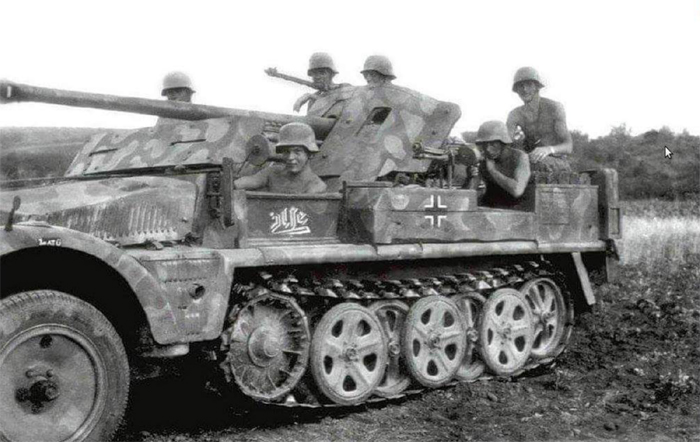
Sd.Kfz. 10 with 50 mm PaK 38 gun, source: Flickr.com, used with permission of the publishing user
The PaK 36 was not a particularly effective weapon to begin with — it was already considered obsolete by the start of the war. Combined with the minimal crew protection offered by most of these field installations, the overall combat value of the resulting vehicle was necessarily very low.
The 50 mm PaK 38 was a considerably more powerful weapon, though also heavier and larger, making its installation on the small half-track rather more challenging. The gun was mounted together with its standard shield. Photographs show that at least partial traverse was possible. In addition to the gun shield, some vehicles also received supplementary armour — sometimes only over the engine cover, in other cases extending across the entire bonnet and the front of the driver and commander's cab.
Even with the more powerful gun, the overall combat value of the combination remained limited. In theory, a 50 mm cannon could deal with lighter enemy armoured vehicles including tanks with relative ease, but in practice the crew's chances of success depended largely on the element of surprise. In a head-on engagement against an enemy tank, the minimal level of protection left the crew with very poor odds. The vehicle's limited onboard ammunition stowage was another significant weakness.
ARTICLE
CONTENTS:
Reproducing text from the Panzernet website without the written consent of the operator is prohibited.