Sd.Kfz. 7
self-propelled guns on the half-track tractor chassis
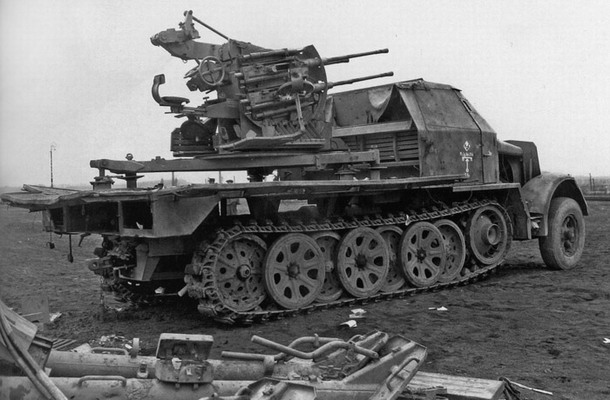
Sd.Kfz. 7/1 with the four-barrelled 2 cm Flakvierling 38 and armoured cab; this photograph gives a very clear view of the gun mounting; source: Flickr.com, Public Domain, edited
Origins of the Half-track
The German Wehrmacht was renowned — among many other things — for its intensive use of half-track cargo and artillery tractors. Most of these vehicles grew out of a large-scale rearmament programme launched by the Army in the early 1930s, and the same applies to the tractor carrying the ordnance designation Sd.Kfz. 7 (Sd.Kfz. = Sonderkraftfahrzeug = special purpose vehicle). It was a medium-class vehicle with a required towing capacity of 8 tonnes.
Its development was carried out by Krauss-Maffei. The first model entered production in 1934 under the factory designation KM m 8 (KM = Krauss-Maffei, m = mittlerer = medium). The KM m 8 had a relatively short track unit with only four road wheels and was powered by a 115 hp Maybach HL 52 engine. Production ran until 1935 and also involved Daimler Benz (whose vehicles carried the factory designation DB m 8) and Büssing NAG (under the designation BN m 8). Several hundred vehicles of this version appear to have been built.
In 1935, a new generation appeared under the designation KM m 9. It received a new Maybach HL57 engine developing 130 hp, along with a redesigned engine bonnet that already resembled the later standard vehicles. Production figures vary between 127 and 257 units depending on the source. The following year brought the KM m 10, which showed virtually no external changes compared to the KM m 9 but received a new Maybach HL 62 TUK engine rated at 140 hp. Again, production numbers in the literature vary considerably, though it was certainly in the hundreds. The firm Hansa Lloyd also participated in production, building their vehicles under the designation HL m 10.
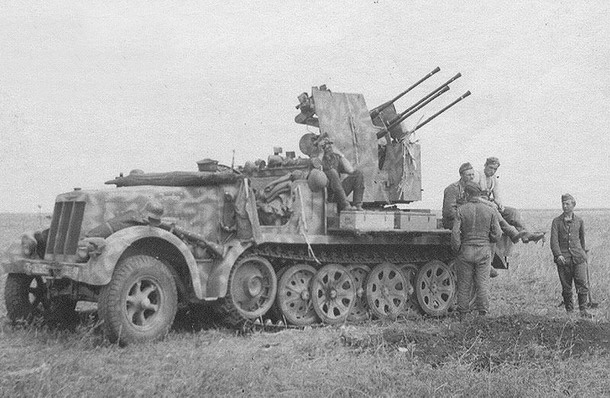
Sd.Kfz. 7/1 with the four-barrelled 2 cm Flakvierling 38, unarmoured version; source: Flickr.com, used with permission of the publishing user, edited
In 1937, the vehicle received its official Army designation mittlerer Zugkraftwagen 8t (Sd.Kfz. 7), and the definitive production variant, the KM m 11, entered service that same year. The track unit was extended by two additional road wheels, bringing the total to six on each side of the chassis. The front wheel mudguards were also redesigned. Alongside the parent factory, Krauss-Maffei, Hansa Lloyd again participated in chassis production (under the factory designation HL m 11 — as one might expect).
The KM m 11 retained the same powerplant as its predecessor: the six-cylinder Maybach HL 62 TUK, with a displacement of 6.191 litres and an output of 140 hp at 2,600 rpm. Some sources indicate, however, that from 1943 this engine was replaced by the Maybach HL 64 TR of equal power. The gearbox offered four forward speeds and one reverse, supplemented by a two-speed reduction gearbox, giving the driver a total of eight forward gears and two in reverse.
Vehicle Description
The chassis consisted of a front steered axle and a rear track unit. The front axle was sprung by a single large transversely mounted leaf spring. The track unit on each side comprised six road wheels with lightening holes and rubber tyres around their circumference. The road wheels were double units, each made up of two steel discs — so the half-track effectively had twelve road wheel discs arranged on six axles. The wheels were arranged in interleaved rows overlapping one another, a configuration typical of German half-tracks and, later, tanks as well. The discs of the even-numbered wheels were mounted further apart on their axles, with the odd-numbered wheels — whose discs sat close together — fitting into the gap between them. Viewed from the side, only the even-numbered wheels were fully visible, specifically their outer discs. Unusually, the road wheels were sprung not by torsion bars but by leaf springs.
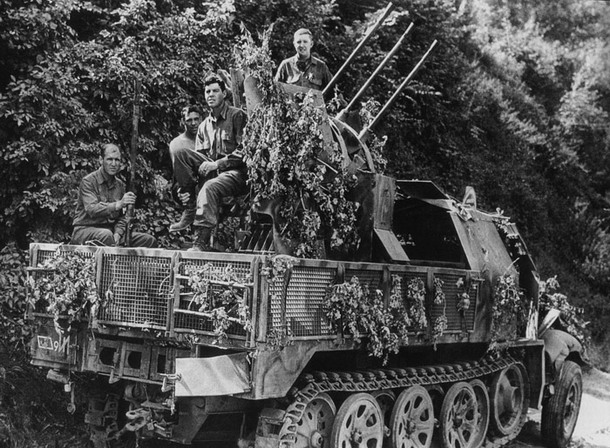
Sd.Kfz. 7/1 with the four-barrelled 2 cm Flakvierling 38 and armoured cab, captured by American forces; source: Flickr.com, Public Domain, edited
The engine compartment occupied the front of the vehicle, followed by the open driver and commander's cab, with the main payload area behind. In its basic configuration, the Sd.Kfz. 7 was intended to tow heavy artillery pieces such as the 150 mm sFH 18, the 100 mm sK 18, or various versions of the 88 mm Flak. The cargo area in this standard variant was fitted with two rows of seats and a small load space at the very rear. Including the driver and commander, the half-track could carry up to 12 soldiers. In addition to towing guns, it was also used as a recovery vehicle for various lighter armoured vehicles, including tanks.
The tractor itself weighed approximately 9.7 tonnes, while being able to carry a payload of up to 1.8 tonnes and tow a further load of up to 8 tonnes. Top speed was an impressive 50 km/h. Fuel capacity figures vary across sources, from 203 to 215 litres, though the tank size may genuinely have changed during the production run. In any case, range was around 250 km on roads and approximately 120 km cross-country.
Sd.Kfz. 7/1
For those interested in combat vehicles, it is the other variants of the half-track that are of particular interest. The first of these was designated Selbstfahrlafette auf m.Zgkw.8t (Sd.Kfz. 7/1) mit 2cm Flakvierling 38. As the name suggests, this was a self-propelled mounting for the four-barrelled 20 mm Flakvierling 38 anti-aircraft system. This assembly of four cannons had an impressive theoretical rate of fire of 1,800 rounds per minute (4 × 450). The practical rate of fire was "only" around 720 to 800 rounds per minute — still a thoroughly formidable figure.
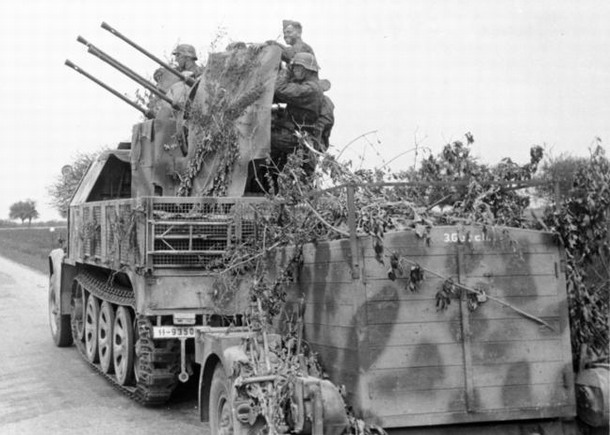
Sd.Kfz. 7/1 with the four-barrelled 2 cm Flakvierling 38 and ammunition trailer; source: Bundesarchiv_Bild_164-12-6-09A, Wikimedia, Creative Commons, edited
The rear cargo area of the vehicle was converted into a flat fighting platform, enclosed at the sides and rear by only a low railing of heavy-gauge wire mesh. Before engaging targets, sections of this railing were folded down — which both cleared the arc of traverse and enlarged the working area (the folded sections did not drop all the way down, but locked horizontally, extending the floor of the platform), making it easier for the gun crew to work. The only protection for the crew in this open fighting space was the gun's own shield, which was fairly large but by no means fitted to all vehicles. The prototype and initial production vehicles had a special gun mounting manufactured specifically for this vehicle (photo HERE). This was later replaced by the standard tripod mounting used with the towed Flakvierling 38, which simplified production and also allowed the weapon to be removed from a damaged vehicle and used in a conventional static emplacement. Some sources indicate that as many as four different mounting configurations were used during the production run of the Sd.Kfz. 7/1. Whether or not this is accurate, all of them allowed full 360-degree horizontal traverse. The vertical elevation of the standard tripod mounting ranged from -10 to +100 degrees, making the weapon equally capable of engaging ground targets.
The vehicle's weight rose to 11.5 tonnes with the gun installed. The crew numbered 10 men: the driver, the commander, and an eight-man gun team. The gunner was seated directly behind the cannon assembly. On each side of the four-barrelled mount sat two loaders, as each of the paired cannons had to be loaded independently, requiring magazines to be inserted from both sides simultaneously. The remaining crew members apparently ensured a steady supply of ammunition — a necessity given that the practical rate of fire for the entire assembly reached up to 800 rounds per minute, and each magazine held only 20 rounds. That amounts to 40 magazines per minute, or one magazine every 1.5 seconds. The on-board ammunition supply was a mere 600 rounds; a further 1,800 rounds were carried in the Sonderanhänger 56 ammunition trailer.
From 1942, the Sd.Kfz. 7/1 began to be fitted with armour for the cab and engine compartment. The armour consisted of flat riveted plates just 8 mm thick. It enclosed the driver and commander's cab on all sides except the rear, and the side panels were extended rearward to also cover the bench seating for part of the crew in the fighting compartment. The front armour plate featured two closeable observation ports; each side panel had a single entry door, also fitted with a vision slot. In the roof of the cab were two hatches with covers.
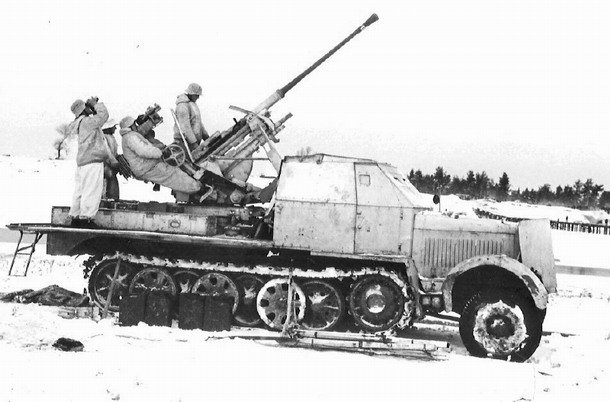
Sd.Kfz. 7/2 with a 37 mm Flak 36 (or 37) cannon, armoured version; source: worldwarphotos.info, used with permission of the operator, edited
The first hundred vehicles were ordered as early as late 1939 and delivered during 1940 and 1941. Production then dropped to a minimum before resuming at full pace again in 1942. By the end of 1944, somewhere between 750 and 800 of these self-propelled guns had been completed in total. As of 1 March 1945, the Army reportedly still had 319 of these vehicles on its books.
Sd.Kfz. 7/2
In 1942, another armed variant entered production under the designation 3,7cm Flak 36 auf Selbstfahrlafette (Sd.Kfz. 7/2). This was again a self-propelled anti-aircraft vehicle, this time armed with the 37 mm Flak 36 cannon. Two more modern versions of the weapon — the Flak 37 and the Flak 43 — were also mounted on the half-track, with the vehicle designation changing accordingly.
The structural modifications to the half-track were essentially identical to those of the Sd.Kfz. 7/1 described above. A flat open platform was again created behind the commander and driver's cab, onto which one of the aforementioned generations of 37 mm cannon was mounted. The same low wire-mesh railing was fitted, folding out to the sides and rear. On the last production vehicles, this railing was replaced by a simple wooden plank surround as a cost-saving measure. The gun's own shield remained the crew's only protection on the platform, and here too it was not fitted to all vehicles by any means. The gun mounting allowed full 360-degree horizontal traverse. Vertical elevation ranged from -8 to +85 degrees for the Flak 36 and 37, and from -10 to +90 degrees for the most modern Flak 43 variant.
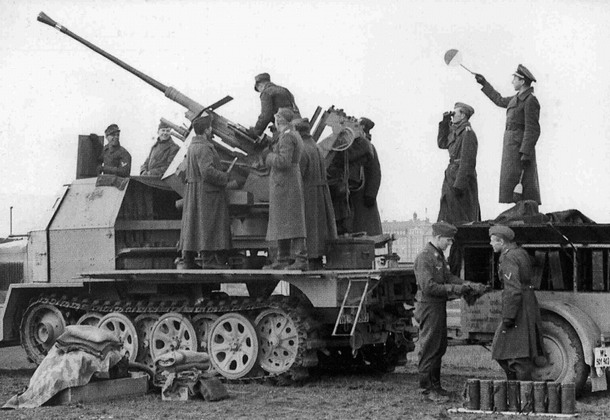
Sd.Kfz. 7/2 with a 37 mm Flak 36 (or 37) cannon and armoured cab; note the ammunition trailer; source: Flickr.com, used with permission of the publishing user, edited
The Flak 36 and Flak 37 differed only in their sighting equipment; their tactical and technical characteristics were otherwise identical. The theoretical rate of fire was 160 rounds per minute, with a practical rate of around 80 to 100 rounds. The gun was fed from six-round clips. Maximum ceiling was approximately 4,800 metres, though effective engagement altitude was only around 3,500 metres. The weapon was also very well suited to engaging ground targets, including enemy armour — at 600 metres it could penetrate up to 27 mm of armour plate angled at 30 degrees. Maximum theoretical horizontal range was around 6,500 metres, though effective range was of course considerably less.
The most modern variant, the Flak 43, differed more substantially from the two earlier versions. It was lighter, had a shorter barrel, and achieved a theoretical rate of fire of up to 250 rounds per minute, with a practical rate of 150. Accordingly, it used larger magazines with a capacity of eight rounds rather than six.
The vehicle's weight was again around 11.5 tonnes. The crew numbered seven: the driver, the commander, and five soldiers manning the gun. Only 120 rounds of ammunition were carried on board; a further 432 rounds were stored in the accompanying trailer. From 1943, the same armoured cab and engine compartment protection as fitted to the Sd.Kfz. 7/1 began to be installed on the Sd.Kfz. 7/2 as well. Production ran from 1942 until January 1945, with around 1,000 vehicles built in total. As of 1 March 1945, 123 of these vehicles remained in service.
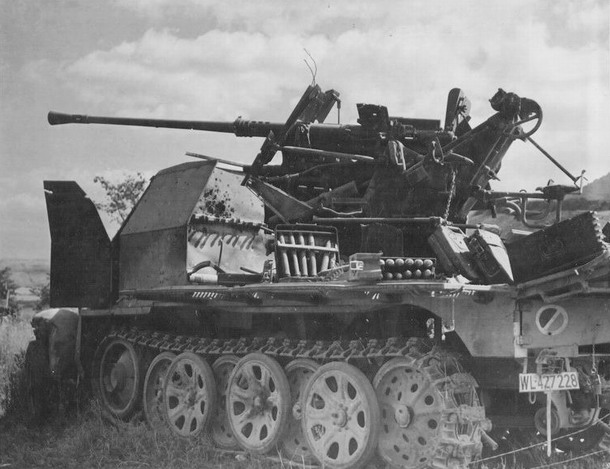
Destroyed Sd.Kfz. 7/2 with a 37 mm Flak 36 (or 37) cannon; note the ammunition boxes; source: internet, Public Domain, edited
Both of the self-propelled guns described above shared a common shortcoming, the most significant of which was the negligible or non-existent protection afforded to their crews. Even so, they undoubtedly proved highly effective — particularly in defence of columns on the move, where the half-tracks themselves were not the target but rather provided protection for whatever was travelling alongside them.
As with other types of armed half-tracks, a proportion of Sd.Kfz. 7/1 and 7/2 vehicles were delivered without their weapons, to serve as maintenance and ammunition carriers for the armed vehicles. If necessary, these unarmed vehicles could be fitted with their weapons fairly quickly and brought into action — for example if another vehicle in the unit was put out of action.
Photographs confirm that at least one further armed variant of the Sd.Kfz. 7 tractor existed, fitted with a 20 mm Flak 30 light anti-aircraft cannon (photo HERE). Particularly interesting is also an image showing a field installation of the Flak 30 on an early-production KM m 9 or KM m 10 tractor (photo HERE). In both cases, however, these were almost certainly nothing more than unofficial field conversions.
As a fully official prototype, an Sd.Kfz. 7 was also built armed with the 50 mm Flak 41 cannon. A notable feature of this vehicle was a pair of foldable outriggers on either side, intended to provide stability when firing such a powerful weapon. In all likelihood only this single prototype was ever built, and the project did not progress to production.
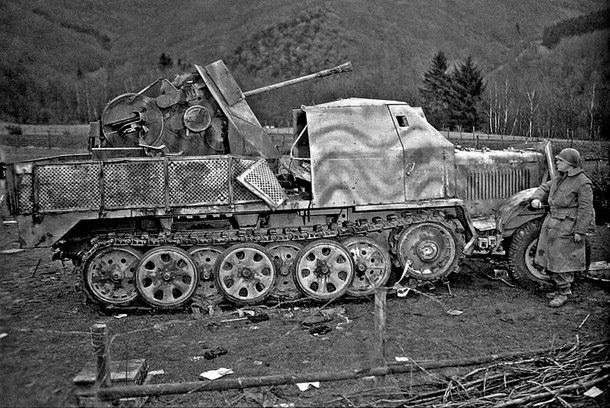
Sd.Kfz. 7/2 with a 37 mm Flak 43 cannon; note the distinctive shield of this cannon variant; source: internet, Public Domain, edited
There was apparently also a project to convert the Sd.Kfz. 7 into a self-propelled anti-tank gun. This project was closely linked to the planned tank destroyer Diana (named after the Roman goddess of the hunt), which was based on the chassis of the lighter Sd.Kfz. 6 half-track tractor. The Sd.Kfz. 7-based vehicle was reportedly to carry the combat name Artemis (the goddess of the hunt in Greek mythology). Artemis was to be armed with the modified captured Soviet cannon designated PaK 36(r), calibre 76.2 mm. Both the Artemis project and the lighter Diana, however, ultimately remained on paper only.
ARTICLE
CONTENTS:
Reproducing text from the Panzernet website without the written consent of the operator is prohibited.