WIRBELWIND
anti-aircraft tank on the Panzer IV chassis
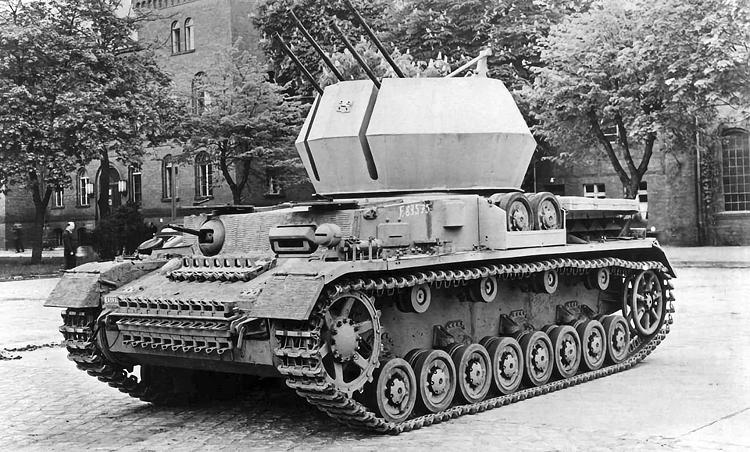
most likely the first prototype of the Wirbelwind anti-aircraft tank, source: Flickr.com, used with the publishing user's permission, edited
Tank crews need Flakpanzers
At the end of May 1943, a joint meeting was held between two military-technical committees, the so-called Panzerkommission and Waffenkommission, which among other things addressed the question of air defence for German tank units. Until then, this role had been filled by self-propelled anti-aircraft guns on half-tracked chassis such as the Sd.Kfz. 6, Sd.Kfz. 7 or Sd.Kfz. 10. German tanks, however, needed protection right in the thick of front-line combat ever more urgently, and half-tracked vehicles simply were not suited to that role. The reason was their lack of armoured protection - the crew of a gun mounted on a half-track was essentially standing on an open platform, exposed to the enemy's fire from every direction.
At that May 1943 meeting, it was therefore decided that tank units needed a far better armoured anti-aircraft escort. Every German tank regiment was to receive, as soon as possible, 18 so-called anti-aircraft tanks (in German, Flakpanzer) - meaning an anti-aircraft gun mounted on a fully tracked, fully armoured tank chassis. A commendable idea, no doubt, but there was one small snag: the Germans didn't actually have any such anti-aircraft tanks. They would first have to be developed, tested, and then rushed into production.
The Luftwaffe tries first
The Luftwaffe's representatives were the first to take the initiative, since air defence of German ground forces generally fell under the air force's remit. The Office of the Chief of Air Armament (Generalluftzeugmeister) accordingly opened negotiations with the Krupp company to build an anti-aircraft tank on the chassis of the medium Panzer IV tank. The result of their effort was a Flakpanzer that became known under the unofficial name Möbelwagen.
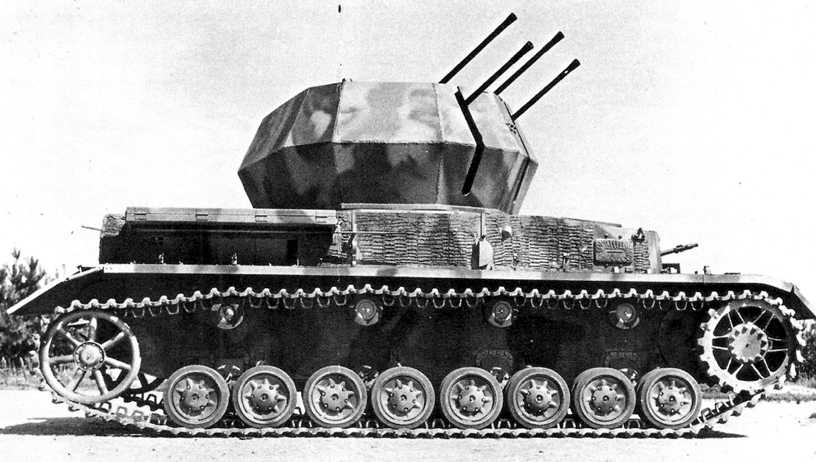
Wirbelwind anti-aircraft tanks were built on already-used Panzer IV chassis, source: Flickr.com, used with the publishing user's permission, edited
Unfortunately, neither the Luftwaffe's representatives nor the engineers working on the vehicle managed to step out of the shadow of earlier vehicles built for the same purpose. They came up with no innovative design solution at all - they simply took a 37 mm Flak 43 cannon, mounted it on the hull of a Panzer IV, and surrounded it with folding armour plates. The gun could fire even with the plates raised, but only at aerial targets, since the barrel then had to point upward. Firing at ground targets was only possible with the fighting compartment's walls folded down - and in that position, the gun crew was every bit as exposed as on the older half-tracked vehicles, meaning completely unprotected.
Guderian takes the initiative
When the Inspector General of Armoured Troops, Heinz Guderian, saw the Möbelwagen prototype in October 1943, he raised no formal objections, but he was certainly not satisfied. Guderian then decided that rather than keep arguing with the Luftwaffe over the shape of the Möbelwagen, he and his tank crews would build their own Flakpanzer instead - one of a far more advanced design, fitted with a rotating armoured turret that would protect the crew regardless of whether it was engaging an aerial or a ground target.
But not every combat turret is created equal. Developing a fully enclosed turret is fundamentally more demanding than developing one with an open top. A fully enclosed fighting turret raises two entirely new technical challenges: venting propellant gases during intense firing, and above all giving the crew a proper view of the sky. Guderian knew time was against him, so he decided that, for the first round, a vehicle with an open-topped turret would have to do. Crew protection would therefore have its limits, but it would still be far better than what the old half-tracks or the new Möbelwagen could offer - and above all, such a machine could be made available fairly quickly. Development of a further, more elaborate generation of Flakpanzer with a fully enclosed turret was also meant to begin and proceed in parallel (a story for another article).
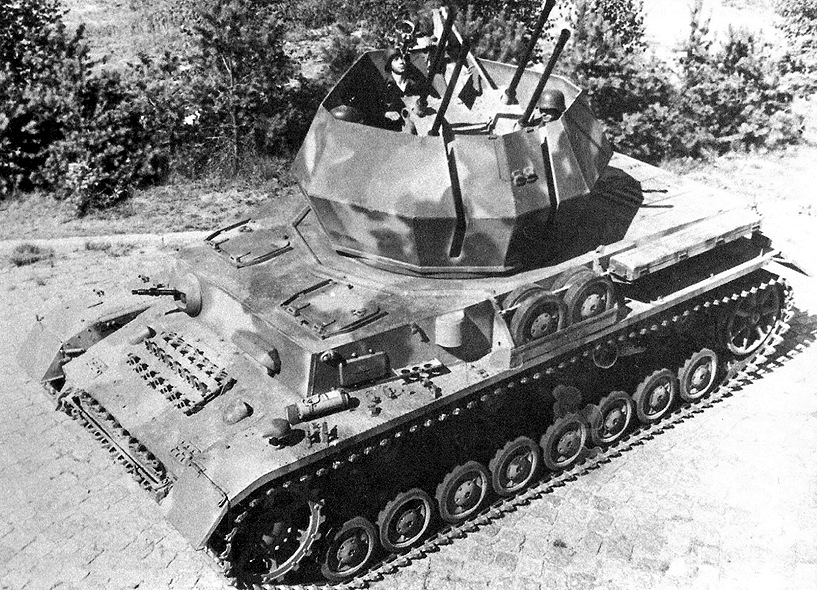
this overhead view of the Wirbelwind nicely shows how the crew was arranged inside the open fighting turret, source: Flickr.com, used with the publishing user's permission, edited
Guderian was well aware that he was bending established rules by having a representative of the ground forces develop his own anti-aircraft weapon, and resistance from the air force was to be expected. One of the Luftwaffe's main arguments in such a dispute with the tank arm would likely have been that yet another Flakpanzer would place unnecessary further demands on the already overloaded arms factories. Guderian therefore took the unusual step of trying, as far as possible, to bypass the German arms industry altogether.
The complete design of the new Flakpanzer was to be drawn up directly within Guderian's own Inspectorate No. 6 (Inspektion der Panzertruppen). Production itself was to be handled by the soldiers themselves, specifically members of the training tank battalion Panzer Ersatz und Ausbildungs Abteilung 15 in the town of Sagan (today Żagań in Poland). A workshop named Ostbau-Sagan was set up there for that purpose.
Guderian's new Flakpanzer was to be based on the Panzer IV chassis simply because there was, in practice, no other option. The Panzer III was already out of production, and demand for the Panther among front-line units so far outstripped supply that production couldn't keep pace. Given its cost, the chassis of the heavy Tiger tank wasn't even worth considering. And, in keeping with the goal of minimising additional demands on German arms factories, the Flakpanzers were to be built on older, already-used chassis undergoing general overhaul.
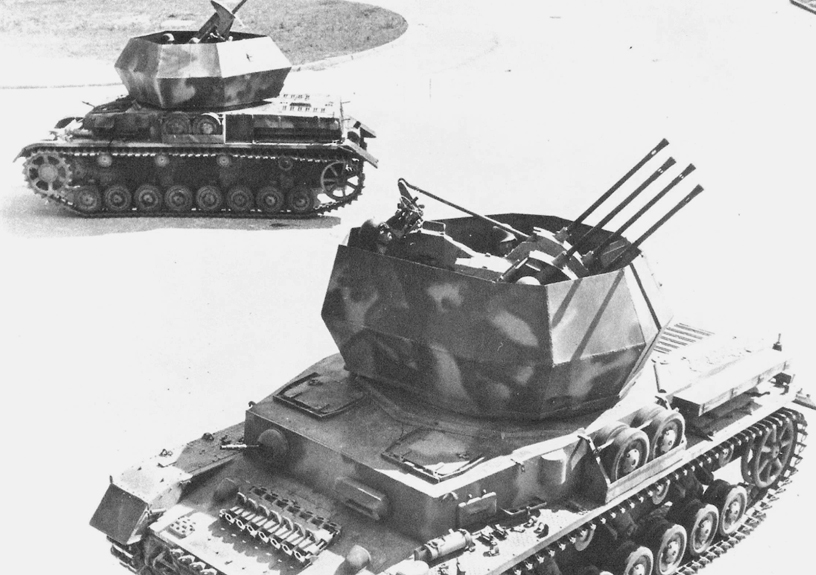
two "brothers in arms," the Wirbelwind (in front) and the Ostwind (further back), photographed most likely in the yard of Ostbau-Sagan, source: Flickr.com, used with the publishing user's permission, edited
There was, however, still the question of armament, and that proved somewhat more complicated. The first choice was the four-barreled Flakvierling 38 in 20 mm calibre, though there were doubts about whether it would be effective enough. The alternative was the 37 mm Flak 43 cannon, the same weapon fitted to the already-mentioned Möbelwagen. In the end, Guderian decided that, to be on the safe side, his team would design and build two variants of the new Flakpanzer at once, one with each weapon.
Responsibility for the vehicle's design at Inspectorate No. 6 was given to a young lieutenant and trained engineer, Josef von Glatter-Götz. According to some authors, the team looked for inspiration to the 12th SS Panzer Division "Hitlerjugend" - specifically to Untersturmführer Karl Wilhelm Krause, who was (apparently) the commander of the anti-aircraft platoon attached to the staff of the 2nd Battalion of the 12th Tank Regiment. Untersturmführer Krause had, within his own unit, been experimenting with converting several Panzer IV tanks into improvised Flakpanzers fitted with the four-barreled Flakvierling 38 20 mm mount. Ostbau-Sagan reportedly even sent one of its employees to the 12th Panzer Division in France (or Belgium, depending on when it took place) to inspect Krause's creation and gather as much information as possible.
Other sources, on the other hand, don't mention this episode at all, and to be honest, the whole story has one significant catch. The main challenge facing the designers of the new Flakpanzer wasn't really the placement of the weapon on the tank chassis, but above all the design of the combat turret - that was the truly crucial and completely new element of the design. And Untersturmführer Karl Wilhelm Krause's improvised Flakpanzers had no combat turret at all, so what inspiration could they really have offered in that respect?
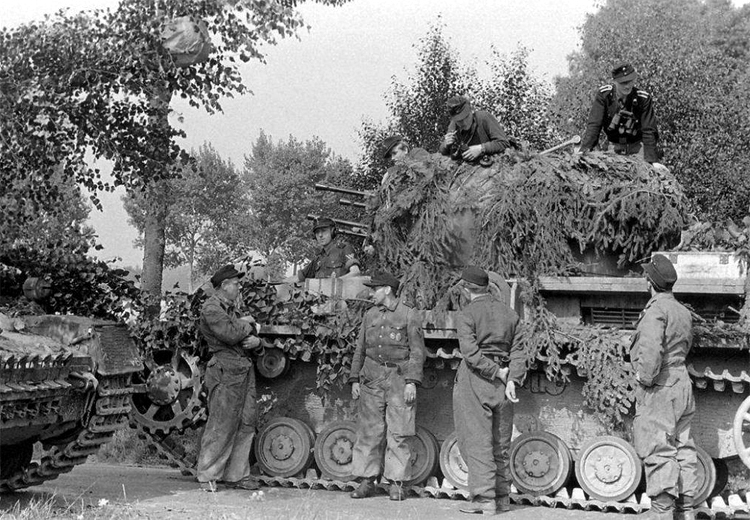
a thoroughly camouflaged Wirbelwind anti-aircraft tank on the Western Front, source: Flickr.com, used with the publishing user's permission, edited
Description of the vehicle
Whatever the truth of that story, designs for two differently armed Flakpanzers on the Panzer IV chassis were ready by June 1944. The vehicle armed with the 37 mm Flak 43 cannon, which became known as the Ostwind, is covered in a separate article. Here we will focus solely on the vehicle armed with the Flakvierling 38 20 mm mount. Its design called for a nine-sided turret with an extended rear, an open top, and sloped walls 16 mm thick. The turret sat within the ring of the original tank turret but, unlike it, did not extend down into the hull interior - it had no turret basket. In short, the new turret's floor sat level with the roof of the hull. Inside the turret were housed the four-barreled Flakvierling 38 20 mm mount and its three-man crew.
The Flakvierling 38 was, in essence, nothing more than four Flak 38 cannons joined together into a single mount. It was developed in 1940 by the Rheinmetall company with the aim of offsetting the weapon's small calibre with a tremendous rate of fire. The quadruple automatic cannon could genuinely blanket its target in lead: the theoretical rate of fire was around 1,800 rounds per minute (each barrel managing 420 to 480 rounds per minute). The practical rate of fire ran "only" around 700 to 800 rounds per minute, but even that is a rather impressive figure. Each of the four linked cannons was loaded independently, using twenty-round magazines.
A loader sat in the turret on each side of the gun, while the gunner had a seat directly behind it. A total of 160 magazines, i.e. 3,200 rounds, were carried aboard the Flakpanzer. Of these, 32 magazines (640 rounds) were stored directly in the turret as ready-use ammunition, with the rest kept inside the hull beneath the floor of the fighting compartment. Secondary armament consisted of an MG 34 machine gun in the hull, for which 1,350 rounds were carried. Besides the three men in the turret, the crew also included a driver and a radio operator/machine gunner, seated at the front of the hull just as in a standard Panzer IV. Communication equipment consisted of a Fu 5 radio set with a rod antenna.
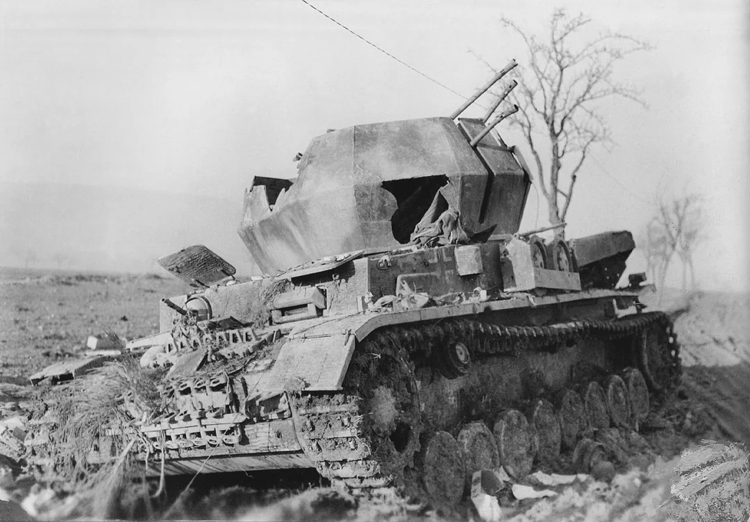
the wreck of a Wirbelwind anti-aircraft tank on the Western Front, source: Public Domain, edited
The Panzer IV chassis brought with it road wheels 470 mm in diameter, fitted with rubber tyres for a smoother ride and sprung in pairs by leaf springs. There was a toothed drive sprocket at the front, a spoked idler wheel at the rear, and four return rollers supporting the upper run of track. The tracks themselves were 400 mm wide, each made up of 99 links. Propulsion came from a liquid-cooled, 11.9-litre Maybach HL 120 TR petrol V12, delivering 300 hp at 3,000 rpm.
The engine sat at the rear of the hull and was connected by a driveshaft to a Zahnradfabrik SSG 76 gearbox mounted at the front, between the driver's and radio operator's stations. The gearbox offered six forward gears and one reverse gear. Fuel capacity was 470 litres, giving the vehicle an operational range of roughly 200 km on roads and 130 km cross-country. On roads, the machine could reach a top speed of 38 km/h. With full tanks and a full ammunition load, the Flakpanzer weighed exactly 22 tonnes. It measured 5.92 metres in length, 2.9 metres in width, and stood 2.76 metres tall.
Production and service
The new armoured vehicle received the official designation Flakpanzerkampfwagen IV (2 cm Flak 38-Vierling) and the ordnance inventory code Sd.Kfz. 161/4. It became far better known, however, under its battle name Wirbelwind, which literally means "whirlwind," though in German it is also used figuratively to describe a person of a wild, tempestuous nature. Most likely sometime in early July 1944, a photograph of one of the first Wirbelwinds built was shown to Hitler, who (by then, after the fact) gave his approval to begin production.
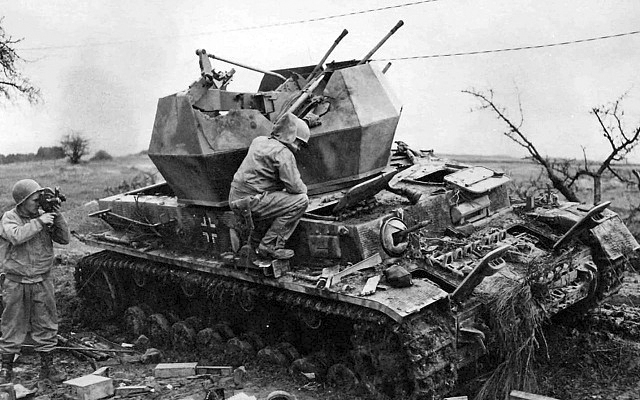
American soldiers inspect the wreck of a Wirbelwind anti-aircraft tank, source: Public Domain, edited
With that, Guderian's until-then rather maverick project was officially approved, and the tank inspectorate ordered exactly one hundred units of the new Flakpanzer. As already mentioned, assembly of the vehicles was handled by the Ostbau-Sagan workshop, part of the 15th training tank battalion in Sagan. Chassis came from older, previously used Ausf. G and Ausf. H tanks, the cannons arrived either directly from Rheinmetall-Borsig or from other licensed manufacturers, and delivery of the combat turrets was contracted out to the Deutsche Röhrenwerke company.
The first 17 Wirbelwinds were completed as early as July 1944, while the last 3 of the ordered hundred were delivered in January 1945. Wirbelwinds were assigned to anti-aircraft platoons (Pz.Fla-Zug), where they were typically mixed in a ratio of 4 + 4 with Möbelwagen Flakpanzers.
A combat report from the 503rd Heavy Tank Battalion dated 25 November 1944 singles out the Wirbelwind as a highly effective fighting machine. Its main advantage, the report notes, was its ability to open fire instantly on both aerial and ground targets alike, without any loss of crew protection - something that, as we've seen, was not true of the older Möbelwagen. Thanks to the enormous rate of fire of its guns, the Wirbelwind also proved highly effective against infantry and unarmoured vehicles.
Tactical and technical data
|
weight: |
22 t |
|
length: |
5.92 m |
|
width: |
2.90 m |
|
height: |
2.76 m |
|
engine: |
Maybach HL 120 TRM |
|
engine power: |
300 hp |
|
max. speed: |
38 km/h |
|
fuel capacity: |
470 l |
|
range - road: |
200 km |
|
range - cross-country: |
130 km |
|
crew: |
5 men |
|
armament: |
Flakvierling 38, 4 x 20 mm 1 × MG 34, 7.92 mm |
ARTICLE
CONTENTS:
Reproducing text from the Panzernet website without the written consent of the operator is prohibited.