MÖBELWAGEN
Panzer IV-based anti-aircraft tank
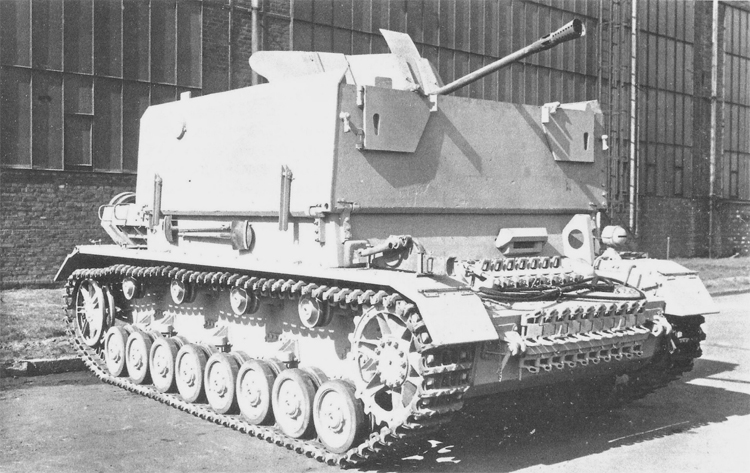
Production Möbelwagen armed with the 37 mm Flak 43 gun. Even with the armored side panels fully raised, the weapon could still traverse provided its barrel was elevated sufficiently. Source: Flickr.com, published with the photographer's permission, edited.
Tank Units Need Flakpanzers
If there is one event that can truly be regarded as a turning point in the development of German self-propelled anti-aircraft tanks, it was undoubtedly the meeting of two military-technical committees—the Panzerkommission and the Waffenkommission—held on 27 May 1943. One of the principal topics on the agenda was the growing need to protect German armored formations from low-level attacks by Allied ground-attack aircraft. Existing anti-aircraft weapons mounted on half-tracks offered no armored protection for their crews, leaving them dangerously exposed in frontline combat. Operating alongside tanks in the heat of battle therefore posed an unacceptable risk.
The members of both commissions agreed that Germany's armored divisions required a far better protected anti-aircraft escort. It was decided that every German tank regiment should eventually receive eighteen Flakpanzers—fully tracked, fully armored fighting vehicles mounting anti-aircraft guns. Reaching that goal, however, was easier said than done. At the time, no German factory was producing a dedicated Flakpanzer in series. Such a vehicle first had to be designed, tested and then rushed into mass production.
The first step was selecting a suitable tank chassis. Realistically, only two candidates were available: the Panther and the Panzer IV. Of the two, only the Panzer IV offered the possibility of rapid series production. Manufacturing of the Panther had only recently begun and the vehicle was still plagued by numerous reliability problems. To accelerate the project, the Germans therefore chose the proven Panzer IV chassis.
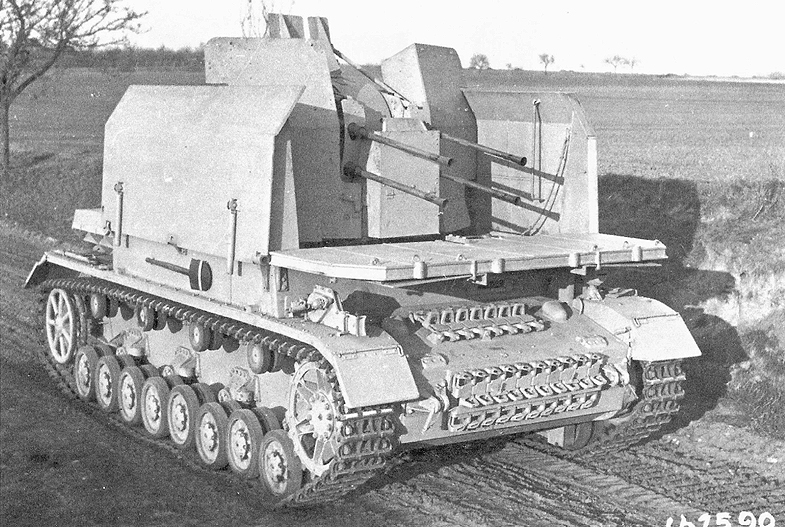
The Möbelwagen prototype armed with the quadruple 20 mm Flakvierling 38 mount. The lowered front panel clearly shows its double-layer construction. Source: Flickr.com, published with the photographer's permission, edited.
Under Luftwaffe Supervision
Responsibility for providing ground forces with air defense generally rested with the Luftwaffe, and the planned Flakpanzer was no exception. Development of the new armored vehicle was therefore supervised by the office of the Generalluftzeugmeister, specifically Department No. 4, which was responsible for anti-aircraft weapons. Between 29 May and 1 June 1943, representatives of the Luftwaffe met with engineers from Krupp, the principal manufacturer of the Panzer IV. By 8 June 1943, they had already presented a proposal for a vehicle armed with the quadruple 20 mm Flakvierling 38 mounted inside a simple fighting compartment protected by folding armored panels.
The proposal, officially designated Versuchs-Selbstfahrlafette für 2 cm Flak-Vierling auf Fahrgestell PzKpfw IV, was approved and Krupp received an order to build a fully operational prototype. Responsibility for the project was assigned to the Krupp-Grusonwerk plant in Magdeburg, which also assembled standard Panzer IV tanks. The prototype was completed at the end of September 1943 and presented to Luftwaffe representatives on 3 October. It then drove under its own power from Magdeburg to the Kummersdorf proving ground, roughly 160 kilometers away near Zossen, where firing trials were conducted. After firing 800 rounds, the vehicle proved completely stable, even when all four barrels fired simultaneously. On 16 October 1943 it was demonstrated to representatives of the German Army, including Colonel General Guderian. The vehicle received unanimous approval, and series production was authorized. Krupp was expected to deliver the first production vehicles in April 1944.
The prototype was reportedly built on the chassis of a Panzer IV Ausf. G. Not only was the turret removed, but the entire crew compartment was cut away. The exposed hull roof was then covered with a new armored deck, creating a flat platform on which the anti-aircraft gun was mounted. The forward section of this deck was raised to accommodate the driver and radio operator beneath it. Beneath the rear section, a spacious ammunition compartment was created, accessible through two large hatches.
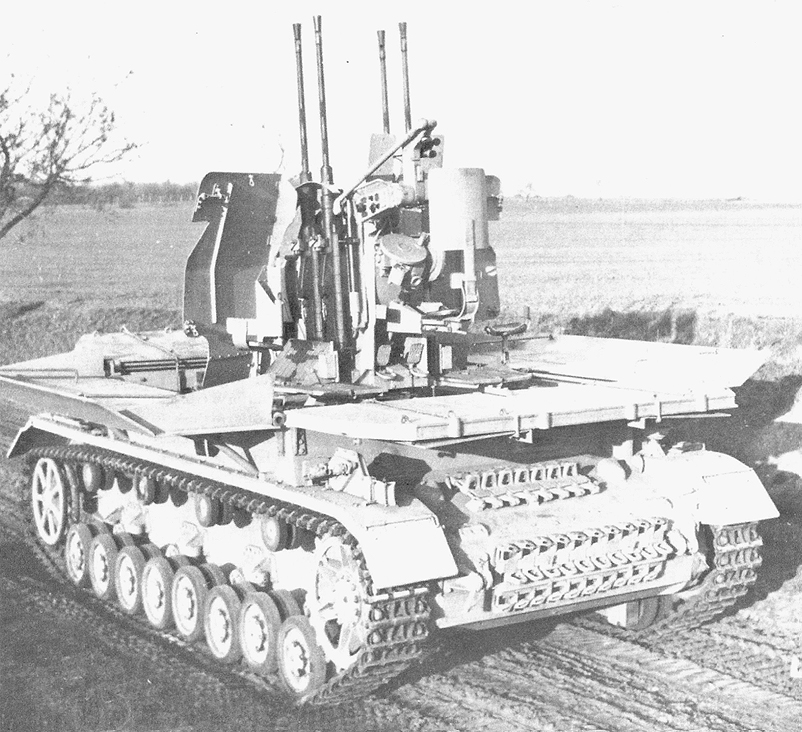
The Möbelwagen prototype with the 20 mm Flakvierling guns. Lowering all four armored panels was essential whenever the vehicle was required to engage ground targets. Source: Flickr.com, published with the photographer's permission, edited.
Around the newly installed fighting compartment floor ran a low armored guard. The front plate was 50 mm thick and incorporated the driver's vision port on the left as well as a closable firing port for a submachine gun on the right. This was not the original front wall of the Panzer IV superstructure, but an entirely new design. Along the sides, the armored guard extended almost to the edges of the track guards.
Mounted on top of this low armored guard were the tall folding armored panels that provided the main protection for the fighting compartment. These panels were of double-wall construction, each consisting of two 12 mm steel plates separated by a 55 mm air gap. Both side panels and the rear panel contained small circular firing ports for the crew's personal weapons.
With all four panels raised, they formed an open-topped armored box surrounding the Flakvierling 38 gun mount. The gun shield itself was narrowed and fitted with cut-outs so that the weapon could still traverse while the armor remained raised, provided the barrels were elevated sufficiently. The side panels could also be locked in a partially lowered position, increasing both the working space for the crew and the weapon's field of fire. Complete freedom of movement, however, was only achieved once all four panels had been folded down into the horizontal position. In this configuration the gun could rotate freely through its full arc, the crew had unrestricted room to operate the weapon, and the vehicle could effectively engage ground targets as well as aircraft. The price for this flexibility was the complete loss of armored protection for the gun crew.
A Change of Armament
As noted above, the decision to begin series production of the new Flakpanzer was taken on 16 October 1943. Barely two months later, however, at a meeting of the Panzerkommission on 21 December 1943, it was concluded that the quadruple 20 mm Flakvierling 38 no longer provided sufficient firepower. Instead, the vehicle should be armed with the far more effective 37 mm Flak 43. The original production order was therefore cancelled, and the existing prototype was to be re-equipped with the new weapon before undergoing a fresh series of driving and firing trials. At the same time, production was expected to begin as early as February 1944.
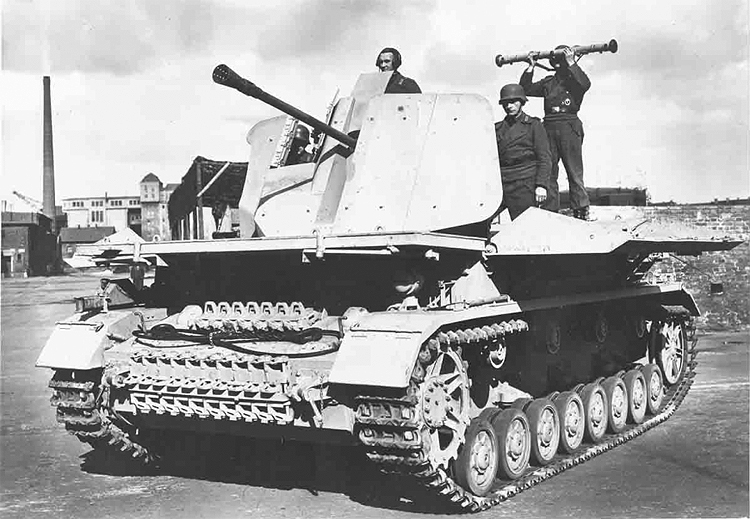
An early production Möbelwagen armed with the 37 mm Flak 43. This vehicle still features the original double-layer armored panels around the fighting compartment. The commander is holding a coincidence rangefinder. Source: Flickr.com, published with the photographer's permission, edited.
A single example of the 37 mm Flak 43 was immediately dispatched to Krupp-Grusonwerk, where engineers began redesigning the vehicle. The changes proved to be more extensive than might be expected. Whereas the Flakvierling 38 mounting on the original prototype incorporated a leveling mechanism to compensate for uneven ground, the mounting for the heavier Flak 43 was bolted directly to the fighting compartment floor. For reasons that remain unclear, the folding armored panels were reduced in height by approximately 25 cm. The gun shield also had to be redesigned so the weapon could still traverse between the raised side panels. Finally, the access hatches for the driver and radio operator, located beneath the raised front section of the fighting compartment floor, were modified to prevent interference with the larger gun shield when opened.
Production responsibilities were divided among several manufacturers. Krupp-Grusonwerk supplied the modified Panzer IV chassis, Krupp's main plant in Essen manufactured the armored fighting compartment components, while Deutsche Eisenwerke in Duisburg carried out final assembly. The Flak 43 guns themselves were supplied either directly by Rheinmetall-Borsig or by other licensed manufacturers.
The planned February production start naturally proved unrealistic. The revised prototype equipped with the 37 mm gun was not demonstrated to the military until 8 and 9 March 1944. During the same month, two additional design changes were introduced. On 1 March it was decided to reduce the thickness of the double-layer armored panels from 2 × 12 mm to 2 × 10 mm. Since armor for the first twenty vehicles was already in production, this modification was applied only from the twenty-first vehicle onward. Then, on 10 March 1944, another decision followed: beginning with the forty-fifth production vehicle, the folding panels would consist of a single 25 mm armor plate instead of the earlier double-wall construction.
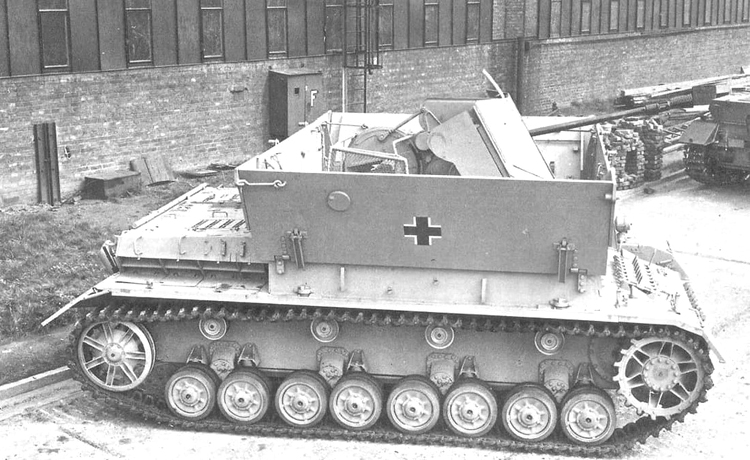
A late-production Möbelwagen featuring the simplified single-plate armored panels around the fighting compartment. Source: Flickr.com, published with the photographer's permission, edited.
The production version armed with the 37 mm Flak 43 retained the same basic operating characteristics as the original 20 mm prototype. The gun could still traverse with the armor panels raised, although only if the barrel was elevated sufficiently. Officially, the vehicle was designated Flakpanzerkampfwagen IV (3,7 cm Flak 43) and assigned the ordnance number Sd.Kfz. 161/3. History, however, remembers it almost exclusively by its unofficial nickname, Möbelwagen ("Furniture Van"), inspired by its distinctive box-like appearance.
The Panzer IV Chassis
Production Möbelwagens were built on newly manufactured Panzer IV Ausf. H chassis. Each side of the suspension featured eight road wheels measuring 470 mm in diameter, fitted with rubber tires to ensure a smoother ride. The road wheels were paired on common bogies, each suspended by a quarter-elliptic leaf spring. The 400 mm-wide tracks consisted of 99 links per side, while the upper track run was supported by four all-steel return rollers. Drive sprockets were located at the front and idler wheels at the rear.
Power was provided by the liquid-cooled Maybach HL 120 TRM twelve-cylinder gasoline engine with a displacement of 11.9 liters, developing 300 horsepower at 3,000 rpm. The engine was mounted in the rear of the hull and connected by a driveshaft to the Zahnradfabrik SSG 76 transmission located at the front, between the driver and radio operator. The gearbox offered six forward gears and one reverse gear. Fuel capacity amounted to 470 liters, providing an operational range of approximately 200 kilometers on roads or around 130 kilometers cross-country. Maximum road speed reached 38 km/h. Fully fueled and carrying its complete ammunition load, the Möbelwagen weighed exactly 25 tonnes. It measured 5.92 meters in length, 2.95 meters in width and stood 3 meters high.
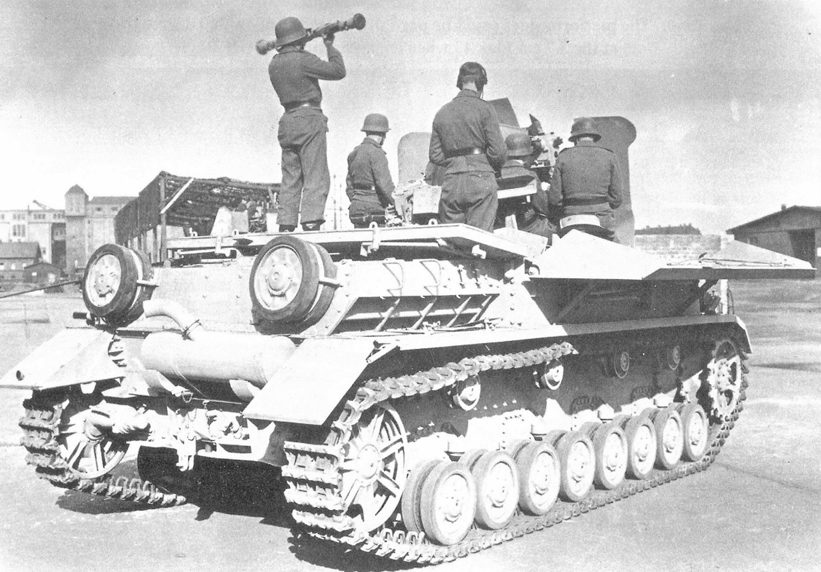
An early-production Möbelwagen armed with the 37 mm Flak 43 in its combat configuration. With the armored panels lowered, the gun crew was left completely exposed to enemy fire. Source: Flickr.com, published with the photographer's permission, edited.
The 3.7 cm Flak 43 Gun
The Flak 43 anti-aircraft gun itself was developed by Rheinmetall-Borsig. Its mounting allowed full 360-degree traverse together with an elevation range from −7° to +90°. The weapon operated automatically, using gas tapped from the barrel to cycle the action. Ammunition was supplied in eight-round clips, which were fed horizontally into the gun from the left-hand side.
The loading mechanism was deliberately positioned exactly at the gun's center of gravity, ensuring that the constantly changing weight of the ammunition during firing had virtually no effect on aiming accuracy.
The gunner and his assistant sat on seats attached to the right side of the gun mount. Immediately behind them was the ejection port through which spent cartridge cases were expelled. These were caught in a wire mesh collector before most likely dropping into a fabric bag suspended beneath it. A specialized Schwebekornvisier 43 anti-aircraft sight, featuring an optically projected aiming point, helped the gunner estimate the correct lead when engaging fast-moving aerial targets.
The standard Flak 43 weighed 1,248 kilograms. Its theoretical maximum rate of fire was 250 rounds per minute, although the practical rate averaged around 180 rounds per minute. Its standard ammunition was the high-explosive tracer round designated 3,7 cm Sprenggranate Patrone Leuchtspur 18 (abbreviated 3,7 cm Sprgr Patr L'spur 18). A complete cartridge weighed 1.5 kilograms, of which the projectile accounted for 635 grams, including a 24-gram bursting charge. Fired at a muzzle velocity of 820 m/s, the projectile could reach an altitude of up to 4,800 meters, while its effective anti-aircraft ceiling was approximately 4,200 meters. Against ground targets, its maximum range was around 6,585 meters.
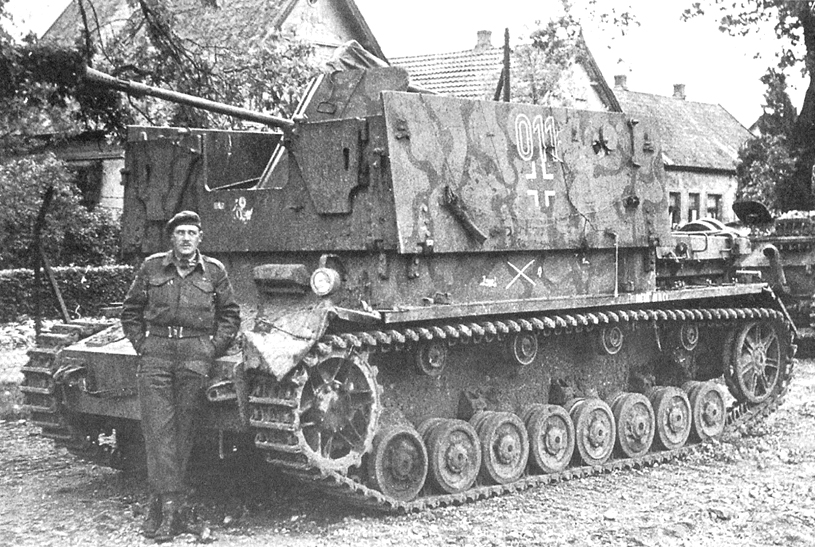
Late-production vehicles featured a cut-out in the front armored panel, allowing limited engagement of ground targets. Source: Public Domain, edited.
For use against armored vehicles, the Flak 43 could also fire the 3,7 cm Panzergranate Patrone 18 armor-piercing round, weighing 1.54 kilograms with a projectile weight of 680 grams. A fully loaded Möbelwagen carried 320 high-explosive rounds together with 80 armor-piercing rounds.
The vehicle's crew consisted of six men. The driver occupied the left front corner of the hull beneath the raised front section of the fighting compartment floor, while the radio operator sat to his right. The remaining crew comprised the commander, gunner, assistant gunner and loader. Communications were provided by the Fu 5 radio set, which allowed both transmission and reception. Its whip antenna was mounted on the left rear corner of the engine deck and could be folded remotely from inside the fighting compartment by means of a linkage.
None of the available sources mention any mechanical assistance for raising or lowering the heavy armored panels, nor is such a mechanism visible in period photographs. A rough estimate suggests that each side panel measured approximately 2.8 meters in length and just under one meter in height. At a thickness of 25 mm, a single panel would have weighed roughly half a tonne. If these massive armor plates were indeed operated entirely by hand, raising or lowering them must have required the combined effort of the entire six-man crew. Under such circumstances, quickly restoring armored protection in the event of a sudden threat would have been virtually impossible.
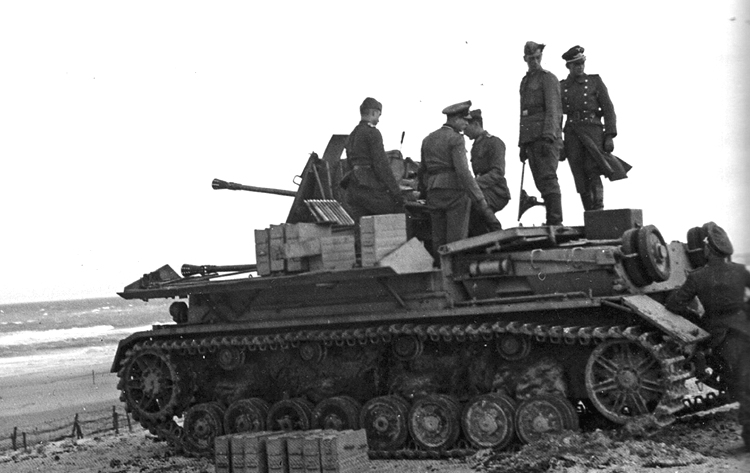
A Möbelwagen armed with the 37 mm Flak 43, apparently photographed during firing trials at the Putlos proving ground on the Baltic coast. Source: Flickr.com, published with the photographer's permission, edited.
Production and Organization
The first twenty production Flakpanzers were finally completed in March 1944. These vehicles featured the original double-layer fighting compartment armor, consisting of two 12 mm plates separated by an air gap. The following twenty-five vehicles received slightly lighter protection with 2 × 10 mm armor. The last double-layer armor panels in this configuration were delivered by Krupp-Essen in May 1944. From that point onward, Deutsche Röhrenwerke took over production of the armored components and supplied only the simplified single-layer 25 mm armor plates. Beginning around December 1944, the front armor panel was modified with a cut-out that allowed the gun barrel to be secured in a horizontal position during transport and, at least in theory, permitted limited engagement of ground targets while the front panel remained raised.
By the end of August 1944, a total of 150 Möbelwagens had been delivered. Production plans called for another thirty vehicles in September and twenty-five in October, after which the Möbelwagen was to be replaced on the assembly lines by the more advanced Flakpanzer designs, the Ostwind and Kugelblitz. As so often during wartime, however, reality differed considerably from the original plans. Production therefore continued until March 1945, with either 240 or 243 vehicles completed in total. It was not German planning that ultimately brought manufacturing to an end, but Allied bombing raids. The decisive blow came on 5 March 1945. After assessing the damage, Deutsche Eisenwerke announced on 8 March that it was no longer capable of continuing Flakpanzer production. Although efforts were made to relocate manufacturing elsewhere, these plans appear never to have materialized.
Completed Möbelwagens were first delivered to an army ordnance depot before being transferred to the training battalion Flak-Ers.Abt. 204. After completing their training, crews were organized into operational anti-aircraft platoons (Pz.Fla-Zug). The first three such platoons were formed on 15 June 1944 and assigned to the 9th, 11th and 116th Panzer Divisions. According to the K.St.N. 1196 organization table issued in April 1944, each platoon consisted of eight Flakpanzers. From September 1944 onward, these platoons generally fielded a mixed establishment of four Möbelwagens and four Wirbelwind vehicles.
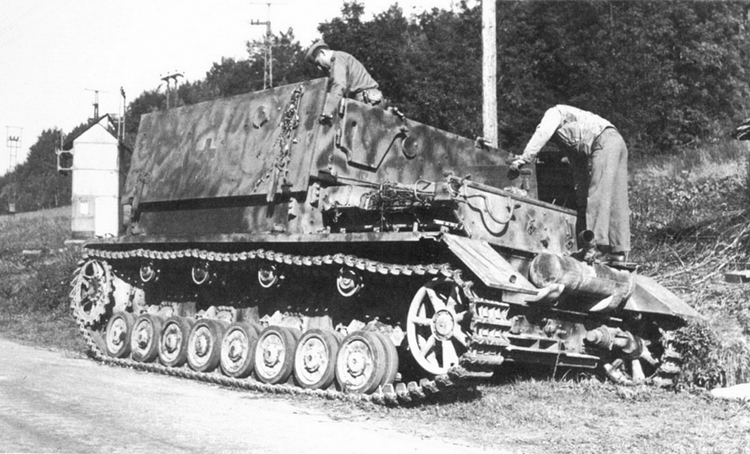
A Möbelwagen captured by Allied forces on the Western Front. Source: Public Domain, edited.
Assessment
The Möbelwagen's greatest weakness lay in the design of its crew protection. With the armored panels raised, the vehicle was effectively unable to engage ground targets. Lowering the panels solved this problem by providing the gun with unrestricted traverse and excellent fields of fire, but at the cost of leaving the entire gun crew completely exposed. In this respect, the Möbelwagen offered little improvement over the earlier half-track-mounted anti-aircraft vehicles it was intended to replace. Another drawback was the extensive modification required to convert a standard Panzer IV hull, a process that unnecessarily complicated production.
Technical Specifications
|
Weight: |
25 t |
|
Length: |
5.92 m |
|
Width: |
2.95 m |
|
Height: |
3.00 m |
|
Engine: |
Maybach HL 120 TRM |
|
Engine output: |
300 hp |
|
Maximum speed: |
38 km/h |
|
Fuel capacity: |
470 l |
|
Road range: |
200 km |
|
Cross-country range: |
130 km |
|
Crew: |
6 men |
|
Armament: |
1 × 3.7 cm Flak 43 |
ARTICLE
CONTENTS:
Reproducing text from the Panzernet website without the written consent of the operator is prohibited.