LEICHTER VERSUCHSFLAKWAGEN
a Flakpanzer on the Luchs tank chassis
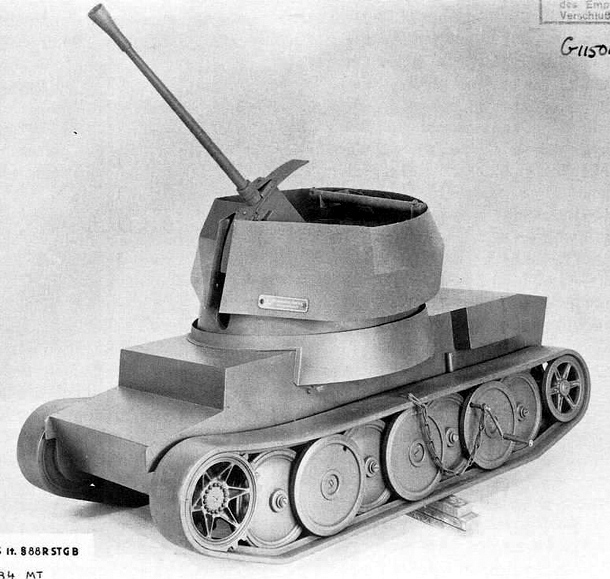
scale model of the anti-aircraft tank on the extended Luchs tank chassis; the model was highly detailed — turning a crank inserted into an opening in the running gear raised the gun barrel, source: Flickr.com with the permission of the publishing user, edited
Origins of the project
Germany's first Flakpanzer — a tank armed and adapted primarily for destroying enemy aircraft — had been built as early as 1941, but it was a rather improvised vehicle and a true short-run affair (the Flakpanzer I, of which only 24 examples were produced). Moreover, this first Flakpanzer was followed by a long period during which no further vehicle of the same type entered production. It was not until May 1943 — almost four years into the war — that the German Army High Command came to the realisation that Wehrmacht armoured units would benefit from some form of air defence capability that could keep pace with them during movements and in combat. A decision was therefore taken that every German tank regiment would receive 18 self-propelled anti-aircraft guns on fully tracked chassis. This effectively launched the development programme that would ultimately produce the entire family of Flakpanzers based on the Panzer IV chassis — namely the Möbelwagen, the Wirbelwind and the Ostwind.
The truth is, however, that quite a lot of interesting work in the field of anti-aircraft tanks had been going on in the intervening period as well. First, in June 1942, Krupp put forward the idea that its fully tracked Pz.Sfl. IVc chassis — originally developed for a different purpose — might serve well as the basis for a new Flakpanzer armed with the 88 mm Flak 41 gun. Then, in September of the same year, the German Weapons Office (Waffenamt) — quite possibly inspired by Krupp's initiative — came up with its own idea for a new Flakpanzer. On 2 September 1942, Ing. Klein of the Amtsgruppe für Flakentwicklung (L Flak) — the department for anti-aircraft weapon development — met with representatives of Krupp to outline the army's vision for the new vehicle.
Luchs or Leopard?
The Weapons Office had no grandiose ambitions — quite the opposite: it wanted a light tracked armoured vehicle carrying either a 37 mm Flak 36 gun or the four-barrelled 2 cm Flakvierling. As for the chassis, drivetrain and steering, the vehicle was to be based on components from the light tank Panzer II Ausf. L — the Luchs — which was just entering series production at MAN. The project received the designation leichter Versuchsflakwagen (also cited as Versuchsflakwagen-Leichte) — literally "light trials anti-aircraft vehicle". On 1 October 1942, the Weapons Office supplied Krupp with engineering drawings for the 3.7 cm Flak 36, for the 2 cm Flakvierling quadruple mount and for the Luchs tank. Also supplied, however, were drawings of the Leopard reconnaissance tank (VK 16.02), then under development. The Waffenamt had apparently concluded that the more robust chassis of this MAN (resp. MIAG) reconnaissance tank offered greater potential in terms of payload capacity and speed, and so included it in the project as an alternative to the Luchs chassis.
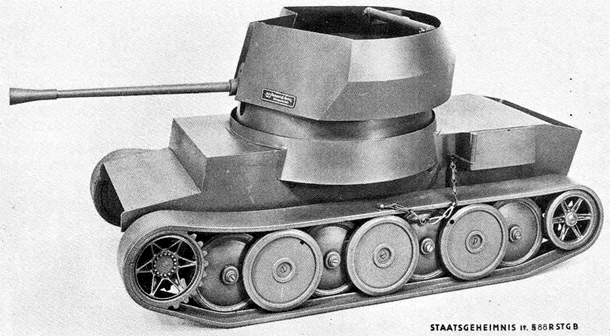
according to some authors, this scale model of the anti-aircraft tank depicted the Flakpanzer design submitted by Rheinmetall, source: Flickr.com with the permission of the publishing user, edited
On 4 November 1942, Krupp presented a conceptual design for the new armoured vehicle based on Leopard components, in no fewer than four different variants distinguished by their armament. These included the already-mentioned 20 mm quadruple gun mount and the Flak 36 and Flak 43 cannons, both of 37 mm calibre — the Flak 43 was still under development at the time. The fourth variant was apparently designed to carry a 105 mm light howitzer — why a self-propelled howitzer found its way into a Flakpanzer development programme is not mentioned in the literature. Perhaps Krupp wished to demonstrate the versatility of its design. The weight of the vehicle in all its versions was expected to be around 25 tonnes.
January 1943 arrived, however, and with it a decision that was to prove absolutely critical for the further development of the light Flakpanzer — the Leopard reconnaissance tank project was cancelled. From this point on, the literature becomes deeply confused. According to some authors, Krupp reverted to the originally intended Luchs chassis after the cancellation of the Leopard project. According to others, the firm effectively developed an entirely new chassis using components from the Panzer IV. And then there is the information that Rheinmetall-Borsig also became involved in the light Flakpanzer development, and that it was Rheinmetall that based its design on the Luchs chassis. It is, frankly, a considerable muddle. In any case, surviving photographs of a scale model clearly demonstrate that at least one of the firms involved was indeed working with the Luchs chassis.
Vehicle description
Development of the Luchs tank had proceeded from essentially the start of the war, first under the designation VK 1301, then VK 1302 and finally VK 1303. In this third and final version, the tank was to be powered by a Maybach HL 66 P engine developing 200 horsepower at 3,800 rpm, coupled to a six-speed Zahnradfabrik SSG 48 gearbox. The tank had five road wheels on each side, arranged in two partially overlapping rows — two in the outer row and three in the inner. The road wheels were of solid construction, 735 mm in diameter, with rubber tyres for a smoother ride. Suspension was by torsion bars. The tracks were 360 mm wide.
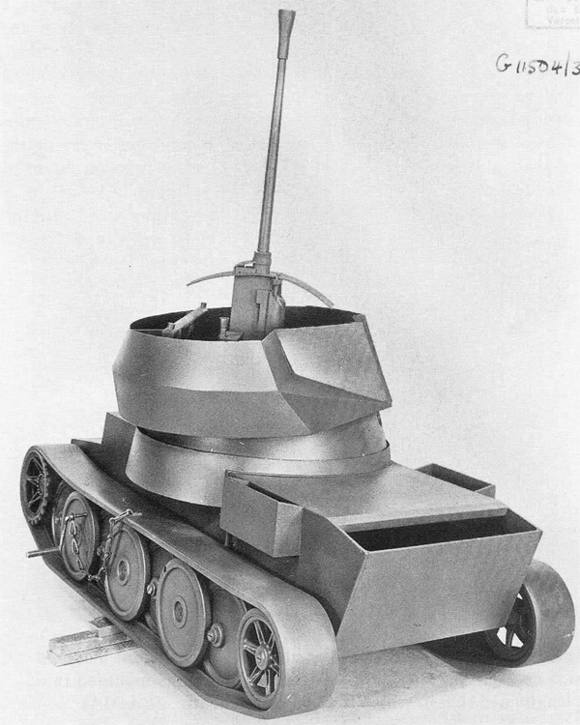
when the crank was inserted into the opening further forward, it could be used to rotate the model's fighting turret, source: Flickr.com with the permission of the publishing user, edited
It transpired, however, that the standard Luchs chassis was too short and its hull too narrow for use as a Flakpanzer. The scale model of the anti-aircraft tank — whether prepared by Krupp or Rheinmetall — therefore provided for an extended chassis and a widened hull. Each side of the Flakpanzer was to have not five but seven road wheels — three in the outer row and four in the inner — and the hull was to be widened in its central section by a circular ring with lateral overhangs extending over the tracks. The chassis with its extended running gear was, according to some authors, given the development designation VK 1305. The basic hull layout remained conventional: gearbox at the front, fighting compartment in the middle and engine at the rear. The scale model showed a 37 mm gun — most likely a Flak 43 with an extended barrel — installed in a fully rotating open-topped turret. The vehicle was apparently also to be equipped with a coincidence rangefinder for determining target distances.
The scale model clearly demonstrates the intended capability to engage not only aerial but also ground targets — the gun had an enormous positive elevation approaching 90 degrees, as well as a slight negative depression. The Flak 36 offered a theoretical rate of fire of 160 rounds per minute, with a practical rate of around 80 to 100 rounds. The gun was fed by six-round clips. Its maximum effective altitude was approximately 4,800 metres, and against ground targets its range was around 6,500 metres. The weapon was also reasonably capable of destroying enemy armour — at a range of 600 metres it could penetrate up to 27 mm of armour plate angled at 30 degrees.
Project cancellation
The course of development from January 1943 onwards is shrouded in uncertainty, but the end of the project is at least perfectly clear. In the autumn of 1944 development of the light anti-aircraft tank was definitively terminated as part of a broader consolidation of all development activities. On paper, at least, a Flakpanzer based on the Luchs tank with a 37 mm gun represented a very well-balanced fighting vehicle. It would have been fast — the Luchs itself was capable of 60 km/h — adequately armoured, and its armament would have been perfectly sufficient for the intended role of providing close cover for armoured columns against low-level enemy air attack. Before this project was cancelled, the position of standard Flakpanzer in the German army had already been taken by vehicles based on the Panzer IV chassis — namely the Möbelwagen, the Wirbelwind and the Ostwind. Although the Panzer IV chassis offered considerably greater payload capacity, none of these Flakpanzers was armed with a gun of larger calibre than 37 mm — because that was all the role required.
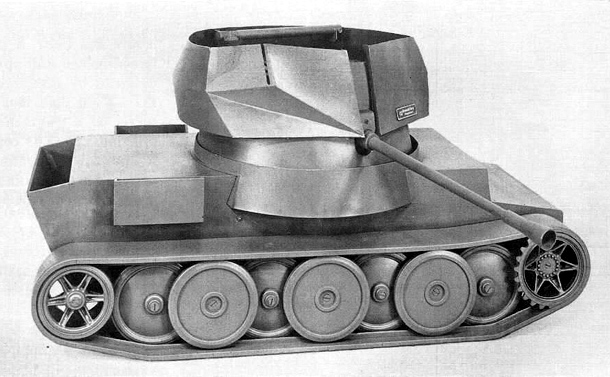
scale model of the anti-aircraft tank on the modified Luchs reconnaissance tank chassis, source: Flickr.com with the permission of the publishing user, edited
On the other hand, it must be acknowledged that from a purely economic standpoint, the cancellation was a rational decision. The VK 1305 chassis — the extended variant of the Luchs chassis — would most likely have had to be manufactured exclusively for this Flakpanzer. The Panzer IV chassis, by contrast, was being produced in large numbers as the basis for a whole range of fighting vehicles — the Panzer IV itself, the Jagdpanzer IV, the StuG IV and the Brummbär. Furthermore, the Wirbelwind and Ostwind Flakpanzers were built on older, previously used chassis, which substantially reduced production costs. From the perspective of production consolidation and spare parts logistics, the cancellation of the leichter Versuchsflakwagen project therefore made clear sense — particularly in the wartime conditions of autumn 1944.

ARTICLE
CONTENTS:
Reproducing text from the Panzernet website without the written consent of the operator is prohibited.