STANDARDPANZER E-50/75
a new generation of standard tanks
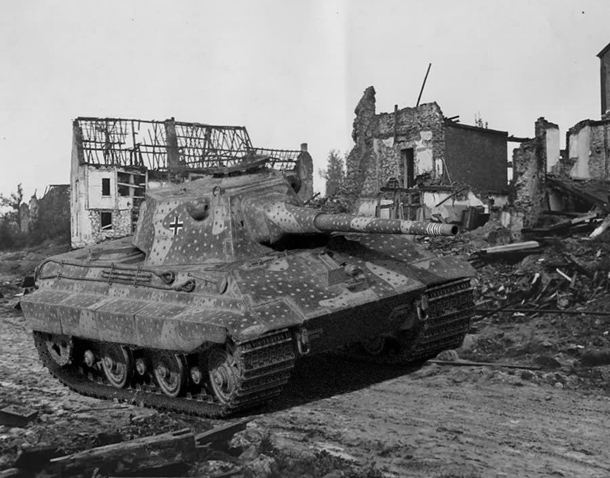
Standard medium tank E-50 in the streets of a ruined German town near the end of the war. Background: internet (public domain), tank model: Flickr.com, composite image: Panzernet
Entwicklungsreihe
The enormous cost of wartime production and Germany's limited industrial capacity forced the Germans to seek every possible means of making their output more efficient — not least in the field of armoured vehicles. It was precisely in pursuit of this goal that the highly ambitious programme known as the Entwicklungsreihe (or more commonly Entwicklungserie, abbreviated E-Serie — roughly "development series" in English) was launched in April 1943. In the area of tanks, its aim was nothing less than replacing the Panther, Tiger, and Königstiger with new "standardised" types and adding an even heavier super-heavy tank alongside them. The programme encompassed the development of five new fighting vehicles in total: the tank destroyers E-10 and E-25, and the tanks E-50, E-75, and E-100. Here we focus solely on the E-50 and E-75.
The Entwicklungsfahrzeug E-50 was intended to be a standard "medium" tank in the 50-tonne-plus weight category, replacing the existing Panther and Tiger. It is telling that the Germans now considered a vehicle weighing over 50 tonnes a "medium" tank — whereas the Tiger I, at 57 tonnes, had been classified as heavy. In any case, the idea of replacing both the Tigers and the Panthers with a single standard type that would be more heavily armoured, more powerfully armed, and yet simpler to produce certainly made sense — at least in theory. The Tiger was enormously expensive to manufacture, and the Panther left something to be desired in terms of armour protection. Above all, they were two completely different machines, which of course meant separate production lines and duplicate spare parts logistics. Alongside this stood the second planned project, the E-75, which was to become the standard heavy tank and replace the existing Tiger II. Its weight was expected to be in the region of 75 tonnes or more. Both the E-50 and E-75 are sometimes referred to by the collective designation Standardpanzer.
Army Specification
The specifications for the E-50 and E-75 were very similar to one another. To allow the front armour to be as thick as possible, the gearbox and all steering components were to be moved to the rear of the vehicle. The road wheel suspension system was to be mounted entirely externally, so that it could be replaced without any need for work inside the vehicle. Moving the gearbox to the rear naturally also meant that the drive sprockets would be at the rear — highly unusual for the German tank design tradition. The Weapons Office acknowledged that front-mounted drive sprockets were technically superior, but the military argument pointed the other way: a rear-mounted drivetrain was not exposed to enemy fire. Equally, if the tank ran over a mine, the drive sprocket could not be damaged, making repairs far less demanding. In theory, the track could simply be shortened in such a case, fitted back over the undamaged road wheels, and the tank would remain mobile — at least to a limited degree. Service access to a gearbox located in the rear of the hull was of course also far easier than when it was buried inside the fighting compartment.
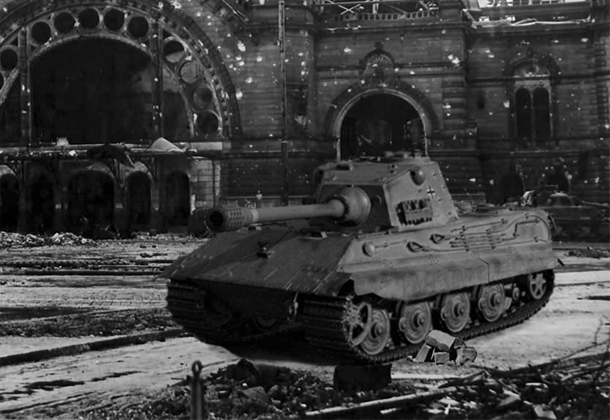
Standard heavy tank E-75 in the streets of a ruined German town near the end of the war. Despite appearances in this visualisation, the tracks were to be driven by the rear wheels. Background: internet (public domain), tank model: Flickr.com, composite image: Panzernet
The specification also placed strong emphasis on maximum component sharing between the E-50 and E-75 — to the extent that the two could essentially be described as variants of the same tank. Both were to use identical road wheels, including the aforementioned external suspension system. The heavier E-75 would simply have a greater number of wheels. The armoured hulls were to have the same external dimensions and shape, with the only difference being the thickness of the armour plate and consequently the internal dimensions of the fighting space. (The hull shape, incidentally, bore a strong resemblance to that of the Tiger II.) The engine and its cooling system, fuel tanks, idler wheels, tracks, and numerous other components were also to be identical. The two tanks could therefore largely be built on the same production line.
The New Running Gear
Development of the running gear for the E-50 and E-75 was entrusted to Adlerwerke of Frankfurt. The army's requirements ruled out proven solutions such as torsion bars or coil springs, so Adlerwerke devised an entirely new suspension system. The road wheels were paired, each pair mounted on opposing swingarms. The movement of each arm up or down was transmitted via a rack-and-pinion mechanism to a horizontally sliding rack-piston housed inside a large tubular unit. This piston could slide horizontally in either direction against a stack of pre-loaded conical disc springs fitted around it. Behind each pair of adjacent wheels, therefore, two such tubular units with pistons were arranged side by side, combined into a single block.
Pre-loaded conical disc springs — sometimes called Belleville washers, after their French creator Julien Belleville — were also planned for the other vehicles in the Entwicklungsreihe. It is a fairly common type of washer available at any hardware shop: it has a slightly conical shape, and when placed under a bolt head it flattens as the bolt is tightened and springs back to its original form when the bolt is loosened. A single ordinary hardware-shop washer of this type allows only a few millimetres of travel under compression, but if you take somewhat larger washers and stack several dozen of them together — alternating the orientation of each one as you go — you end up with a spring with a surprisingly useful working range (a spring of this kind looks something like THIS).
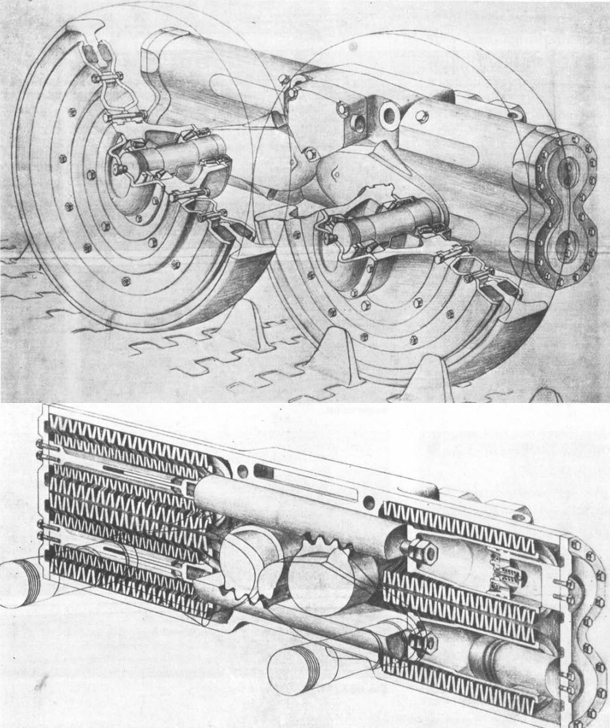
The road wheel suspension system for the E-50 and E-75, using stacked conical disc spring assemblies — first an overall view of the suspension block for a pair of adjacent wheels, and below it a cross-section through the same block. Source: internet (public domain)
The suspension mechanism designed by Adlerwerke for the E-50 and E-75 thus consisted of a block housing two internal tubular units. This block was bolted to the side wall of the armoured hull. Viewed from the side, it was hidden behind the road wheels and completely invisible. When a road wheel was pushed upward by an obstacle, the piston was displaced in one direction; when the wheel dropped into a depression, the piston moved the other way. On the side dealing with wheel drop, a set of 33 larger-diameter conical washers was fitted. On the other side, dealing with wheel lift, two sets were required — 33 larger and approximately 40 smaller washers — which is logical, as this side typically bore the greater load. The suspension system described allowed each road wheel a vertical travel of 300 mm: 170 mm upward from neutral (when riding over a bump) and 130 mm downward (when crossing a depression).
The Adlerwerke engineers calculated that just six road wheels per side would be sufficient to support the expected weight of the E-50. At a total weight of 50 tonnes, this meant a static load of 4.17 tonnes per wheel — considerable, but still less than the Porsche-suspension variant of the Jagdtiger. With such a low wheel count, the E-50's running gear looked somewhat unusual, almost incomplete. The E-75, in contrast, was planned with eight road wheels per side — four paired units — which at 75 tonnes gave a load of 4.69 tonnes per wheel, almost exactly matching the Porsche-suspension Jagdtiger. The road wheels themselves for both tanks appear to have been derived from those of the Tiger II, with a diameter of 800 mm and a rubber tyre concealed beneath a thin steel band.
As for the powerplant, series production of both standard tanks was expected to use an uprated Maybach HL 230 engine fitted with direct fuel injection and a supercharger. Until that unit was available, an interim Maybach HL 234 engine was planned, which was also to receive direct fuel injection, boosting its output to 900 horsepower. The gearbox was to be an eight-speed unit with pre-selector gear changing and a hydraulic servo. Maximum speed was expected to be around 60 km/h for the E-50 and around 40 km/h for the heavier E-75.

Standard medium tank E-50 in the streets of a ruined German town near the end of the war. Despite appearances in this visualisation, the tracks were to be driven by the rear wheels. Background: internet (public domain), tank model: Flickr.com, composite image: Panzernet
Turret and Armament
According to some sources, both tanks were to receive a turret of the same basic design, differing only in armour plate thickness. Other sources, however, suggest that each tank was to carry a different turret type — the E-50's being derived from the Panther turret, and the E-75's from that of the Tiger II. Either way, both turrets were most likely to be fitted with a coincidence rangefinder, its lenses projecting through armoured "blisters" on either side of the turret — similar to what was planned for the Panther Ausf. F. Considerable uncertainty also surrounds the intended armament of both types. The 8.8 cm KwK 43 L/71 (as used in the Tiger II) is sometimes cited for both vehicles. Other sources suggest the E-50 was to carry an 88 mm gun with a barrel of 100 or even 130 calibres in length (i.e. L/100 or L/130), while the heavier E-75 was to be armed with a 105 mm gun with a 100-calibre barrel. Neither of these weapons was ever built, even as a prototype — which, of course, is equally true of the E-50 and E-75 themselves. They too were overtaken by the end of the war while still on paper, in the early stages of development.
ARTICLE
CONTENTS:
Reproducing text from the Panzernet website without the written consent of the operator is prohibited.