OPERATION TYPHOON
The German Attack on Moscow
"With bated breath and a blessing on their lips, your whole homeland will be watching your deeds in the difficult days ahead!"
From the Order of the Day to soldiers on the Eastern Front, Thursday 2 October 1941, the day Operation Typhoon began
"With bated breath and a blessing on their lips,
your whole homeland will be watching your deeds
in the difficult days ahead!"
From the Order of the Day to soldiers on the Eastern Front, Thursday 2 October 1941, the day Operation Typhoon began
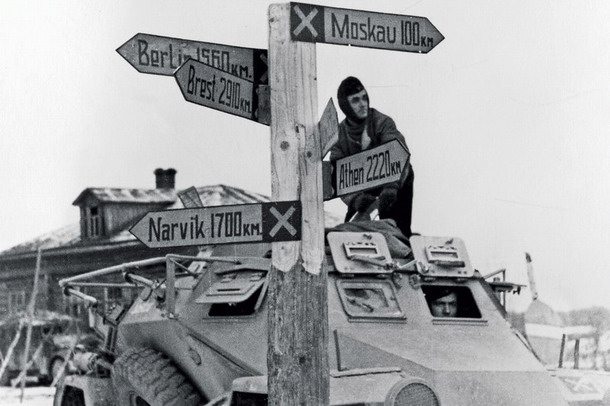
An Sd.Kfz. 223 armoured radio vehicle. The distances shown on the signpost do not quite converge at a single point, but this photograph was most likely taken somewhere in the area of the towns of Volokolamsk or Mozhaysk, source: Flickr.com with permission of the publishing user, edited
Prologue
It was late in the evening of 30 November 1941. Under cover of darkness, a small group of motorcycles and cross-country vehicles moved cautiously through a snow-covered landscape. The soldiers kept a constant watch on the surrounding terrain, for any flash of light could mean the presence of the enemy. The group pressed further and further south. Silence and stillness reigned all around, as if they were not behind the front line at all, several kilometres into Soviet-controlled territory. It was already past midnight on 1 December when houses appeared out of the darkness ahead — first just a few, then more and more. Some of the inhabitants, woken by the noise, came out to see what was happening. When they saw the Balkenkreuz on the sides of the cross-country vehicles, they could not believe their eyes. The column of German vehicles drove all the way to the railway station in the middle of the settlement. The commander stepped out, stood before the station building and read: "Khimki." When he then looked at his map, he too could not believe what he saw.
The men in question were reconnaissance soldiers from the German Pionier-Bataillon 62, who that night had stumbled upon a gap in the Soviet 16th Army's sector entirely by chance. At that moment, these soldiers stood just 8 kilometres from the outskirts of Moscow and 19 kilometres from the Kremlin itself. Once they realised this, they quickly retraced their route back to the nearest German units in the area of the village of Krasnaya Polyana to report what they had found. Once again they managed to slip through unnoticed and pass their findings up the chain of command. The German units present in the area — principally the 2nd Panzer Division — had, however, been fighting without interruption for more than five months and were simply no longer capable of mounting the kind of attack that would exploit the discovered gap in the Russian lines. No German soldier would ever get closer to Moscow — except those who would pass through the city as prisoners of war.
Operation Barbarossa
But let us start at the beginning. When the Germans invaded the USSR on 22 June 1941, they divided their forces into three army groups. Army Group North (Heeresgruppe Nord) set out from East Prussia with orders to destroy Soviet forces in Lithuania, Latvia and Estonia and to advance toward Leningrad. Army Group South (Heeresgruppe Süd) was responsible for the longest section of the front and was tasked with eliminating Soviet forces in Ukraine and capturing Kyiv. And finally, Army Group Centre (Heeresgruppe Mitte) advanced from Polish territory through Belorussia with the aim of securing the corridor Minsk – Orsha – Smolensk, which was essential for any further advance on Moscow. Moscow itself, however, was not its primary objective. Hitler did not want to conquer cities — his overriding aim was to destroy the Russian armies in the field and prevent them from falling back further east, from where they might one day return.

Ever eastward! The commander of the 2nd Panzer Army, Generaloberst Heinz Guderian, watches his tanks roll past. What was he thinking at that moment? Source: Flickr.com with permission of the publishing user, edited
Opposing the German Army Group Centre on the Soviet side were the units of the Western Front, commanded at the time (for the moment, but not for long) by General Dmitry Pavlov. Army Group Centre was given two powerful panzer groups for its task: Panzergruppe 2 (Generaloberst Guderian) and Panzergruppe 3 (Generaloberst Hoth). These formations served as the jaws of enormous pincers, which snapped shut for the first time east of Minsk on 27 June 1941 and again a month later east of Smolensk. At Minsk the Red Army lost a total of 420,000 soldiers, of whom roughly 341,000 were taken prisoner. Destroyed or captured were 4,799 Soviet tanks, 9,427 guns and mortars, and 1,777 aircraft. At Smolensk the Russians lost a further 486,000 men, of whom approximately 302,000 were taken captive. Equipment losses amounted to 3,205 tanks, 3,120 guns and mortars and 1,098 aircraft. In roughly six weeks of fighting, the Soviet Western Front in Belorussia had lost 80 per cent of its original strength, and Hitler had ceased to regard it as a coherent threat.
The Detour North and South
The other two German army groups were also making progress, but not as fast as the Führer had envisioned. Already on 19 July 1941 he therefore issued Directive No. 33, which ordered Army Group Centre to release both of its Panzergruppen to assist the neighbouring army groups. Hitler regarded the destruction of Soviet forces in the north near Leningrad and in the south near Kyiv as more important than a further advance on Moscow. Hoth's Panzergruppe 3 was therefore to push north, while Guderian's Panzergruppe 2 was to swing south. Army Group Centre was then to continue its advance temporarily without its armoured forces. It was still an extremely powerful formation — with reserves it comprised 37 infantry divisions, 5 motorised infantry divisions and various other units — but without its tanks it lacked the essential spearhead, and its advance slowed considerably (in places it even went on the defensive against minor Soviet counterattacks).
Army Group Centre commander Field Marshal von Bock, Generaloberst Guderian and Generaloberst Hoth all pressed Hitler to leave the armoured units on the central sector of the front and order an immediate advance on the Soviet capital. Hitler, however, held firm to his intention of destroying the Russian armies rather than capturing "prestigious" objectives. He did promise his commanders that as soon as the enemy in the north and south had been defeated, Panzergruppe 2 and Panzergruppe 3 would return to their original sector, and would moreover be joined by Panzergruppe 4, which had until then been assigned to Army Group North. With these three Panzergruppen, Army Group Centre would at last be able to launch its long-awaited drive on Moscow.

Endless columns of German military vehicles rolling through the Soviet Union — here vehicles of the 7th Panzer Division on the road to Vyazma, source: Wikimedia, Public Domain, edited
The German armour completed its new missions in the north and south as ordered. At Kyiv the largest encirclement operation in the history of warfare to that point took place, in which the Red Army lost 700,000 men — more than 600,000 of them taken prisoner by the Germans. In the north, German units reached the shore of Lake Ladoga on 8 September 1941, completing the encirclement of Leningrad. Panzergruppen 2, 3 and 4 now turned around as planned and made their way back to the central sector of the front, where they were to prepare for the attack on Moscow, which received the codename Operation Typhoon. The order instructed Army Group Centre to first encircle and destroy the forces the enemy had moved into the area east of Smolensk during the intervening period, and then continue toward the Soviet capital.
Army Group Centre commander von Bock had hoped to launch Operation Typhoon as early as September 1941. The transfer of armoured units from north and south and the logistical difficulties arising from how far from home the German forces now were all combined to slow the preparations considerably. Guderian's Panzergruppe 2, returning from the Kyiv area, was going into the operation some 200 to 250 kilometres south of the main axis of attack. For this reason it jumped off two days earlier than the rest of the German forces, already on 30 September 1941. Everyone else set out from their starting positions on 2 October. At this time, incidentally — apparently in order to confuse future historians — the German panzer groups (Panzergruppe) were redesignated as panzer armies (Panzerarmee).
German Forces
What exactly was the fighting strength the Germans were bringing to Operation Typhoon? On the northern wing, the 9th Army attacked alongside the 3rd Panzer Army (the former Panzergruppe 3); on the southern wing the 2nd Army was paired with the 2nd Panzer Army (the former Panzergruppe 2); and in the centre, the 4th Army advanced with the 4th Panzer Army (the former Panzergruppe 4). In total this meant 47 infantry divisions, 14 panzer divisions, 8 motorised infantry divisions, 1 cavalry division and various smaller units. These were not, however, the same divisions that had crossed into Soviet territory three months earlier. Of the panzer divisions, only the 2nd and 5th Panzer Division were at full strength, having just arrived from France. The average number of serviceable tanks in the remaining 12 panzer divisions stood at only around 50 per cent of their June 1941 establishment. The rest had either been lost or were under repair.

Operation Typhoon began for most attacking units on 2 October 1941; among those taking part were these vehicles of the 2nd Panzer Division, assigned to the 4th Panzer Army, source: Flickr.com with permission of the publishing user, edited
In total the Germans had 1,537 serviceable tanks available for Operation Typhoon, though 127 of these were command tanks. The most numerous combat type was the Panzer III with 460 vehicles, followed by 427 light Panzer II, 171 Panzer 38(t), 102 Panzer 35(t) (all concentrated in the 6th Panzer Division), 169 medium Panzer IV and finally 81 obsolete Panzer I. In addition, Army Group Centre had around 350 StuG III assault guns at its disposal. The infantry divisions of Army Group Centre were generally at around 75 to 80 per cent of their established strength, which together amounted to more than a million men. Also available were roughly 19,000 guns and mortars and 549 aircraft. It should be noted, however, that very different figures can be found across various sources.
Soviet Forces
And what of the Soviets? Facing the German offensive were now units from three fronts: the Western, Bryansk and Reserve Fronts. The cited troop numbers vary considerably here as well, partly because the Russians were continuously feeding new reinforcements into the area throughout Operation Typhoon. At the start of the German attack, however, they probably had approximately 864,000 soldiers in the region, 849 tanks, 364 aircraft, just under 2,000 guns of 107 mm calibre and above, and an unknown number of guns of smaller calibres.
Operation Typhoon Begins
As already mentioned, Guderian's 2nd Panzer Army launched its attack on 30 September 1941. Its main striking force was formed by the 24th and 47th Panzer Corps (XXIV Panzer-Korps and XLVII Panzer-Korps), which jumped off roughly from the area between the Ukrainian towns of Hlukhiv and Novhorod-Siverskyi. The attack from this direction caught the enemy off guard, and Guderian's tanks rolled forward with almost no resistance. In a single day, the 24th Panzer Corps (XXIV Panzer-Korps) covered some 60 kilometres, and by noon on 1 October had already taken the town of Sevsk. A day later — 2 October 1941 — the corps had pushed a further roughly 100 kilometres and captured the town of Kromy. The following day it maintained its racing pace, and at 4 p.m. on 3 October its soldiers entered the city of Orel. This means that the XXIV Panzer-Korps of the 2nd Panzer Army covered more than 200 kilometres in barely four days. Orel was seized so swiftly and unexpectedly that German tanks were still encountering trams running in its streets. The success was undeniable — but from Orel to Moscow there were still more than 300 kilometres to go.

October 1941 — the 20th Panzer Division of the 4th Panzer Army advancing toward Moscow; the first mud is beginning to appear on the roads... a foretaste of things to come, source: Bundesarchiv Bild 101I-213-0267-13, Wikimedia, Creative Commons, edited
The Bryansk Pocket
The 47th Panzer Corps (XLVII Panzer-Korps) of Guderian's 2nd Panzer Army was also doing well. From its starting area it traced a wide arc first eastward and then north. On 6 October it captured the towns of Bryansk and Karachev, cutting off two Soviet armies that were left in the area southwest of Bryansk. A further advance north from Karachev completed the encirclement of another Russian army north of Bryansk. Guderian, however, was not inclined to waste time sealing the encirclement properly, which allowed a substantial number of Red Army soldiers to escape from the pocket. Even so, approximately 130,000 Soviet soldiers were killed, wounded or captured during the subsequent reduction of the Bryansk pocket (we will return to these figures later).
Generaloberst Hoth's 3rd Panzer Army launched its part of Operation Typhoon early on the morning of 2 October 1941, from the area north of Smolensk. The army's main striking force was formed by the 41st and 56th Panzer Corps (XLI and LVI Panzer-Korps), which together encompassed three panzer divisions (1st, 6th and 7th Panzer Division). The primary objective of Hoth's army was the town of Vyazma, which it was to reach from the north. Already on 3 October the soldiers of the 56th Panzer Corps managed to cross the Dnieper river near the village of Kholm-Zhirkovsky over an intact bridge. On the evening of 6 October the forward elements of the 7th Panzer Division arrived from the north at the main Smolensk–Moscow highway just a few kilometres east of Vyazma. There they halted and waited impatiently for the tanks of Höpner's 4th Panzer Army advancing from the south to close the encirclement.
The 4th Panzer Army, commanded by Generaloberst Höpner, also entered Operation Typhoon on the morning of 2 October 1941, from the area east of the town of Roslavl. This army had three panzer corps (40th, 46th and 57th — XL, XLVI and LVII Panzer-Korps) encompassing a total of six panzer divisions (2nd, 5th, 10th, 11th, 19th and 20th Panzer Division). On the evening of Saturday 4 October the 11th Panzer Division captured the town of Spas-Demyansk, and the very next day the 10th Panzer Division entered Yukhnov. The 40th and 46th Panzer Corps could now focus entirely on the advance toward Vyazma, which they were to reach from the south.
The Vyazma Pocket
The forward elements of the 10th Panzer Division reached Vyazma on the morning of 7 October and linked up with units of Hoth's 3rd Panzer Army. The jaws of the German pincers had snapped shut, trapping approximately 400,000 Russian soldiers in an enormous pocket west of Vyazma (we will return to these numbers). The 7th of October was also, however, the day on which the first snow fell on the sector of the German Army Group Centre — a sinister portent of the ordeal that lay ahead.
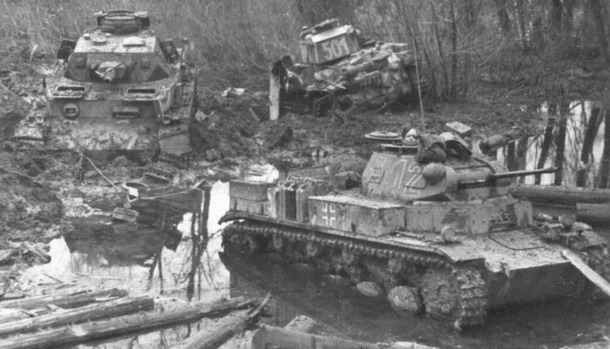
The autumn rains turned the landscape — roads included — into literal oceans of mud; tank crews and supply lorry drivers alike prayed for the frost to arrive soon, source: worldwarphotos.info with permission of the operator, edited
Closing the Vyazma pocket was a success of strategic significance, but it quickly became clear that sealing and clearing this enormous encirclement required vast numbers of troops. Only part of the German forces could therefore continue toward Moscow, and the pace of the German advance inevitably slowed. The Germans were not even sure at first just how many enemies they had encircled — and in truth the precise number remains unclear to this day. The clearing of the Vyazma pocket was declared complete on 12 October 1941, though in reality the destruction of the remaining smaller pockets of Soviet resistance continued for several more days. The Germans subsequently announced that in both the Bryansk and Vyazma pockets combined they had captured 673,000 Red Army soldiers and killed a further 300,000. Soviet command admitted the loss of roughly half a million men.
Whatever the exact figures for killed and captured Red Army soldiers, it is certain that all three Soviet fronts involved — the Western, Bryansk and Reserve Fronts — had been decimated, and the Soviet high command rightly feared that the remnants of these formations would not have the strength to halt the further German advance on Moscow. A large number of fresh Soviet units from the Far East were already on their way to help the capital, but the journey was long and the Russians needed time. General Zhukov (who was given command of the Western and Reserve Fronts on 6 October) ordered a defensive line to be built along the line of the towns of Volokolamsk, Mozhaysk, Maloyaroslavets and Tula. Soldiers in Moscow commandeered lorries, rounded up men and women in the streets and drove them to this line to help dig trenches and anti-tank ditches.
Further East
The clearing of the Vyazma pocket did not involve those German units operating far from it. In the north this meant the 41st Panzer Corps (XLI Panzer-Korps) of the 3rd Panzer Army, and in the south virtually the entire 2nd Panzer Army under Guderian. The 41st Panzer Corps therefore continued northeast, helping the German infantry take the town of Rzhev on 13 October, then occupying Staritsa, and on the afternoon of 14 October the 1st Panzer Division entered the town of Kalinin (today's Tver), which represented the northern approach to Moscow. It was a bold stroke by the 1st Panzer Division — but the German supreme command failed to capitalise on it. Instead of the 41st Panzer Corps continuing south from Kalinin toward Moscow, 150 kilometres away, it received orders to turn toward Torzhok to help eliminate Russian infantry in that area. The 41st Panzer Corps was thus advancing not toward Moscow but away from it, assigned a task of entirely secondary importance. A serious mistake that further weakened the German pressure on the Russian capital and gave the Soviets the breathing space they so desperately needed.
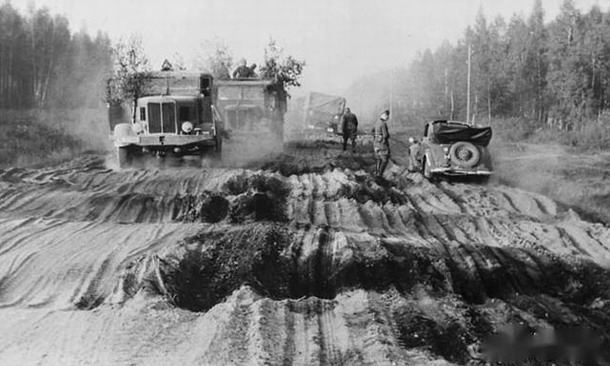
The state of roads in the USSR was generally very poor — this is what a typical road looked like after hundreds and thousands of combat and supply vehicles had passed over it, source: Flickr.com with permission of the publishing user, edited

And this is what it became after the autumn rains, in the season known as the "rasputitsa" — no wonder the supply of German forward units was literally collapsing, source: Flickr.com with permission of the publishing user, edited
Guderian's 2nd Panzer Army, as we know, was operating considerably further south than the others and could not participate in the clearing of the Vyazma pocket. It did have to deal with its own Bryansk pocket, but that was considerably smaller, and above all Guderian had his priorities arranged rather differently. He left the destruction of the encircled Russians at Bryansk to the infantry and did not trouble himself with wasting his tanks on sealing the pocket more tightly. A rapid advance toward Moscow was, in his view, worth more than the few tens of thousands of Red Army soldiers who would manage to escape from the poorly sealed encirclement. But Guderian had another problem — and that was fuel.
Guderian was driving his tanks northeast at such a pace that the inevitable supply problems soon caught up with him. When the 4th Panzer Division from Guderian's 24th Panzer Corps entered the city of Orel on the afternoon of 3 October, it was already virtually out of fuel. At the start of the offensive this division had set off with around a quarter of a million litres of petrol — just enough for those 200 kilometres to Orel. Guderian requested an emergency air resupply, but this was not feasible. The division therefore sent all its available tanker trucks back southwest to the town of Novhorod-Siverskyi, where the nearest German-controlled railway station was located. The consequence was that Guderian's most promising offensive force sat helplessly idle for two days — for the Germans, two precious days of good weather lost; for the Soviets, two precious days to strengthen their defences.
Only on the evening of 5 October did the column of tankers return to Orel, and Guderian's 4th Panzer Division could move forward again. The next objective on the road to Moscow was the town of Mtsensk, barely 50 kilometres northeast of Orel. The Germans advanced the first half of the distance without any resistance, until they reached the Lisitsa river. Immediately after crossing it, however, they drove into a Russian trap. From both sides they were hit by fire from dug-in Soviet tanks. To the Germans' misfortune, these were largely modern T-34 and KV-1 types. There was nothing for it but to retreat quickly back to the western bank of the Lisitsa. It cost the 4th Panzer Division 10 tanks destroyed, 7 soldiers killed and 25 wounded — and Guderian's leading combat unit had lost yet another day.

The wet snow that fell on 7 October only meant more mud in practice — a StuG III assault gun from the 2nd Panzer Army, source: Flickr.com with permission of the publishing user, edited
Guderian realised he would first have to consolidate his forces before attacking Mtsensk. This was achieved by 9 October, when he moved on the town with Luftwaffe support and proper artillery preparation. On the morning of 10 October, a motorcycle reconnaissance unit seized the bridge over the Zusha river and entered Mtsensk. It was, however, no occasion for great celebration. The advance from Orel to Mtsensk — barely 40 kilometres away — had taken Guderian's tanks nine days. Ahead of them still lay 120 kilometres to Tula, and from there another 160 kilometres to the gates of Moscow. The Russians had moreover used the time gained to strengthen their defensive positions beyond Mtsensk, and as it turned out, Guderian's forces did not have the strength to break through them. The advance of the 24th Panzer Corps ground to a halt beyond Mtsensk for a full two weeks.
But there were also units in the central sector of the front that were not drawn into the clearing of the Vyazma pocket and continued their attack. Among these was the 57th Panzer Corps (LVII Panzer-Korps) of the 4th Panzer Army, which had until now been held back in reserve but now set out from Yukhnov and on 11 October captured the town of Medyn, roughly 130 kilometres from Moscow. The day after, German infantry took the nearby town of Kaluga. Also advancing was the Waffen-SS division Reich under Paul Hausser, assigned to the 40th Panzer Corps (XL Panzer-Korps) of the 4th Panzer Army. This division set out from Vyazma along the main road to Moscow. On Thursday 9 October, after hard fighting, it captured the town of Gzhatsk (today's Gagarin), bringing it to within 180 kilometres of the Soviet capital. Hausser was preparing to continue toward Borodino and Mozhaysk but was stopped by tanks from the Soviet 18th and 19th Tank Brigades. Four days of fierce fighting followed, during which SS-Division Reich advanced at the cost of severe losses at a rate of only about 10 kilometres per day.
By 13 October — four days into the defensive battle — the Soviet 18th and 19th Tank Brigades had only a quarter of their original number of tanks remaining. That day they finally received orders to withdraw, and the defence in the Borodino and Mozhaysk area was taken over by fresh Soviet reinforcements from Siberia (primarily the 32nd Rifle Division), which had in the meantime been transported and deployed to the area. At the same time, however, relief came also for the German forces, as the clearing of the Vyazma pocket was finally complete and most of the units tied up there could again push toward Moscow. SS-Division Reich, now reinforced by the 10th Panzer Division, slowly but relentlessly chewed its way through the fresh Russian defences at Borodino and Mozhaysk, until on 18 October it finally captured both towns. That same day, the towns of Maloyaroslavets and Borovsk also fell to the Germans a little further south. On 27 October Volokolamsk was also taken, and the so-called Mozhaysk defensive line in front of Moscow had finally collapsed completely.

The onset of frost hardened the ground again and allowed the second phase of Operation Typhoon to get under way — here Panzer 35(t) tanks of the 6th Panzer Division (3rd Panzer Army) near Kalinin, source: Bundesarchiv Bild 101I-268-0185-05A, Wikimedia, Creative Commons, edited
At least five German panzer divisions were now within 100 kilometres of Moscow. In the Soviet capital, panic broke out. The evacuation of most government departments was set in motion, and key infrastructure was mined for demolition — bridges, power stations, railway stations, the metro, as well as theatres and government buildings. The civilian population stormed department stores and food warehouses; rumours spread that German paratroopers had been seen landing in the centre of the city.
Logistical Problems
German units now stood in many places less than 100 kilometres from their objective, but the weather was deteriorating day by day and the state of the roads with it. Supply routes that were already stretched to the limit became impassable. The quantities of fuel and ammunition reaching the forward units fell far below their actual needs.
On the 70-kilometre road between Gzhatsk (today's Gagarin) and Mozhaysk alone, approximately 3,000 fully loaded lorries were stuck, according to German reports. They were mired in bottomless mud and could move neither forward nor back — and there they sat for an entire week. The infantry, which had been occupied clearing the Vyazma pocket until mid-October, was still unable to catch up with the forward tank formations to assist in the attack. Field Marshal von Kluge, commanding the 4th Army, had 11 infantry divisions at his disposal but seemed almost deliberately unhurried about moving them from Vyazma further northeast.
Let us return now to Guderian's 2nd Panzer Army fighting on the southern wing. Recall that the main striking force of this army — the 24th Panzer Corps (XXIV Panzer-Korps) — had become bogged down in mid-October without fuel and supplies before Mtsensk. By now the corps had two significant advantages working in its favour. Over those two weeks it had managed to accumulate solid reserves of fuel and ammunition and was ready to renew the advance. The second advantage was provided by the Russians themselves, who had begun to treat the quiet on this sector as permanent and shifted their strongest units further north. On 22 October 1941 the 24th Panzer Corps launched an attack on Mtsensk, supported by additional units. After initial difficulties the town was taken and Guderian's tanks were rolling forward again. On 24 October they took Chern, and three days later Plavsk. On 29 October the Germans approached Tula, but their attempt to take the town by direct assault was repulsed. After advancing roughly 120 kilometres in five days, Guderian was once again at a standstill and once again had to gather his strength for the assault on Tula.
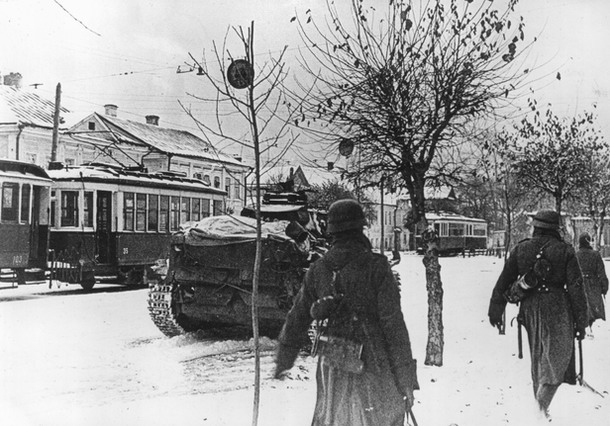
On the afternoon of 14 October 1941 the 1st Panzer Division entered the town of Kalinin (today's Tver), placing it 150 kilometres from Moscow, source: Wikimedia, Public Domain, edited
Operational Pause
By the end of October 1941 a strange relative calm had settled before Moscow. The muddy roads and fields made movement of heavy vehicles and supply lorries impossible. Both sides were moreover completely exhausted after four months of continuous fighting and needed rest, replenishment and consolidation. For the Germans, however, this was also the time for a fundamental decision on how to proceed. There were essentially two options: use the fact that the forward units stood just 90 kilometres from Moscow and, as soon as the ground froze and allowed tank movement, launch one final decisive blow; or select a suitable winter line, dig in securely, sit out the winter and renew the attack at the start of 1942. The Germans chose to strike while the iron was hot and renew the attack as soon as weather and supply conditions allowed. Author's note: as part of this consolidation of German forces, a number of units were redistributed between corps, so the order of battle described in the opening of this article no longer applied fully in the second phase of Operation Typhoon.
The Soviets used the quiet period to bring in additional reinforcements from the east and position them on the key approaches to the capital. Zhukov anticipated that the Germans would resume their activity as soon as the ground froze solid. He decided, however, to make their preparations and rest as difficult as possible, and constantly sent out smaller units on local counterattacks to keep the enemy off balance. One First Lieutenant G. Heysing of the 4th Panzer Army noted in his diary at this time: "The villages, packed with our billeted soldiers, are systematically shelled by guns, mortars and rocket launchers and set on fire. The few houses still standing are crammed to bursting. In the evenings, the utterly exhausted tankers sit inside them in the dim light of a lamp, picking lice from the seams of their shirts." In the area of Guderian's 24th Panzer Corps near Tula, the Russian counterattacks were so intense that Guderian had effectively gone over to the defensive.
The Second Phase of the Offensive
The winter that year came several weeks earlier than usual. The first frosts arrived on 3 November, and by 6 November it was freezing hard enough that the Germans began planning the resumption of the advance. It was to be the final and decisive blow from three directions. Guderian was to take Tula and press on toward the town of Kolomna, thereby cutting Moscow off from the south. The 3rd Panzer Army was to advance from Kalinin (today's Tver) further east, cross the Moscow–Volga Canal (today known as the Moscow Canal) and cut Moscow off from the northeast. And finally the 4th Panzer Army was to advance from Mozhaysk and Volokolamsk northeast and encircle Moscow from the north. The panzer armies were of course to be supported by the "infantry" armies — the 2nd, 4th and 9th. The German units were not to attempt to enter Moscow; the objective was to encircle and cut off the city. Operation Typhoon was entering its second phase.

The frost allowed the advance to resume but brought the soldiers entirely new hardships, source: Flickr.com with permission of the publishing user, edited
On paper this plan looked perfectly fine, but the German command had severely underestimated the number of forces the enemy had managed to bring up and deploy around the capital during the quiet period. At the same time, the plan took no account of the actual condition of the forward German units after long months of fighting. By way of example, the 6th Panzer Division (from the 56th Panzer Corps, 3rd Panzer Army) reported just 63 serviceable combat tanks (i.e. excluding command tanks) as of 31 October 1941. Of these, 34 were Panzer 35(t), 15 were Panzer II and 10 were Panzer IV. This meant the division was at 36 per cent of its strength at the start of Operation Typhoon and at a mere 25 per cent of its strength at the start of Operation Barbarossa. The average mileage accumulated by the serviceable Panzer 35(t) vehicles in this division stood at 12,500 km — which made it obvious that these machines were long overdue for a complete overhaul, not another offensive.
Even though the ground had finally hardened with frost (minus 15°C was recorded on 12 November), the Germans still faced enormous difficulties getting war materiel to their distant forward units. Consider: at that time, the requirements of Army Group Centre for deliveries of ammunition, fuel and supplies amounted to 26 fully loaded freight trains per day. Only 8 to 10 such trains were arriving at the forward railheads every day. It is widely known that many German soldiers had to endure the first winter on the Eastern Front without proper winter clothing. It is not true, however, that the Wehrmacht command was so short-sighted as to have made no provision for winter equipment at all. Winter clothing had been prepared in time — there were warehouses full of it in the territory of former Poland. The command simply had to choose whether the freight trains going to the front would carry shells and petrol, or warm coats. Hitler gave priority to the former — and even that was not enough. Most armoured units had fuel for around 150 kilometres of travel at the start of the second phase of Operation Typhoon, which bore no resemblance whatsoever to the plans on paper. The artillerymen complained that when ammunition finally arrived, the horse fodder did not come with it, and the horses were literally dying of starvation.
Air support for German units had also declined sharply, partly due to losses but also because of a command decision that simply transferred part of the air force to another theatre. Army Group Centre commander Field Marshal von Bock was well aware of the true strength of his forces and drew attention to it repeatedly. He also informed his superiors that recent combat experience gave no indication that the enemy was on the verge of collapse, as Hitler and his inner circle believed. And he was right, for the Soviets had managed to move ten rifle divisions, one cavalry division, five militia divisions and a collection of armoured units scraped together from wherever they could be found to the capital during the second half of October. The flow of Soviet reinforcements continued through November, with a further 22 rifle and 14 cavalry divisions arriving. Even von Bock ultimately conceded — having little choice in the matter — that attempting to complete Operation Typhoon was actually preferable to the prospect of wintering in the cold wastes before Moscow, under constant Russian counterattacks.

A Panzer III without winter camouflage and soldiers without warm clothing. Only the soldier directing traffic appears to be wearing captured Russian felt boots, source: Flickr.com with permission of the publishing user, edited
The second phase of Operation Typhoon effectively began on the morning of 15 November 1941, at the northernmost tip of the German positions. Units of the 27th Army Corps launched an attack that day in the area between Kalinin (today's Tver) and the Volga reservoir (then known as the Moscow Sea). On 17 November the 56th Panzer Corps (LVI Panzer-Korps) of the 3rd Panzer Army joined the attack north of Volokolamsk. The following day, the 2nd Panzer Division joined in south of Volokolamsk along with two infantry divisions, advancing together toward the town of Klin. Zhukov ordered the town held to the last man, and the defenders did indeed distinguish themselves — they held out until 23 November, when they were finally forced to withdraw.
The evacuated Klin was immediately occupied by the Germans, who then struck out in two directions. The 2nd Panzer Division headed southeast and that same day captured Solnechnogorsk, from which only 50 kilometres remained to the gates of Moscow. The 56th Panzer Corps continued east-northeast from Klin, and the following day (24 November) occupied the town of Rogachevo. From Rogachevo the 56th Panzer Corps pressed on eastward according to plan toward the Moscow–Volga Canal (the Moscow Canal), reaching it on 27 November at the town of Yakhroma. The Germans immediately crossed the canal and began establishing a bridgehead on its eastern bank. They soon found themselves under strong pressure from the Soviet 1st Shock Army, however, and prudently withdrew back to the western bank. By 30 November the German units on the western bank of the Moscow–Volga Canal had effectively gone over to the defensive and were no longer capable of continuing to execute the plan of Operation Typhoon.
The Furthest Point
Meanwhile the 2nd Panzer Division, which as we know had been heading from Klin toward Solnechnogorsk, was still advancing toward Moscow. On 30 November this division managed to capture the village of Krasnaya Polyana, and its forward patrol actually reached the town of Lobnya (today the two settlements have merged), just 30 kilometres as the crow flies from the Kremlin itself. It was here, during the night of 30 November to 1 December 1941, that the reconnaissance group from Pionier-Bataillon 62 managed to slip unplanned through the Russian defences and drive all the way to the settlement of Khimki — just 8 kilometres from the edge of Moscow. There was no longer any German unit available in the area capable of exploiting the discovered gap effectively. The northern advance toward Moscow had stalled.
In the central sector of the front, assigned to the 4th Panzer Army, the 40th Panzer Corps (XL Panzer-Korps) set out from the area southeast of Volokolamsk and, using the strength of the 10th Panzer Division and the Waffen-SS Division Reich, pressed eastward to reach the town of Istra on 25 November. The town was held by the fresh 78th Rifle Division recently brought in from Siberia. The exhausted Germans needed almost three days of hard fighting before finally dislodging the defenders from Istra on 27 November. From there it was only about 40 kilometres to the edge of Moscow, but the German attack was beginning to break apart here as well. The 4th Panzer Army had consumed most of its fuel and ammunition reserves. When combined with the losses suffered and the sapping cold, it is no surprise that the actions of the 4th Panzer Army were reduced to limited attacks by smaller formations. Even so, the Germans made a few more kilometres of progress in this sector before the advance finally stopped somewhere around the level of today's Dedovsk.
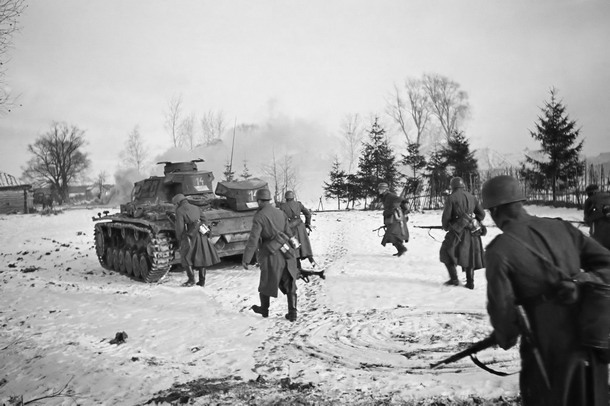
The 11th Panzer Division of the 4th Panzer Army during the fighting before Moscow, source: Flickr.com with permission of the publishing user, edited
The commander of the 4th Army, Field Marshal von Kluge, also consistently dragged his feet throughout the second phase of Operation Typhoon when it came to fully committing his infantry divisions to the offensive. He preferred to cover his flanks and remained on the defensive against Russian counterattacks, even though these were apparently not particularly serious. Only on 1 December, as if suddenly roused from his lethargy, did von Kluge launch a lightning attack and capture the town of Naro-Fominsk, briefly placing himself roughly 55 kilometres from the outskirts of Moscow. At the first Russian counterattack, however, he withdrew again on 2 December to the western bank of the Nara river. Von Kluge's conduct during Operation Typhoon was, in the opinion of some historians, excessively cautious and significantly reduced the operation's chances of success. The German supreme command apparently saw things differently, however, since not only was von Kluge not reprimanded in any way — he was shortly afterwards entrusted with command of the entire Army Group Centre.
And how did the second phase of Operation Typhoon unfold on the German southern wing? Guderian's 24th Panzer Corps spent the first half of November south of the town of Tula on the defensive, repelling Russian counterattacks while accumulating strength and supplies for a renewed advance. Smaller reconnaissance attacks on the town showed that there was no point attempting to take it by direct assault. Guderian therefore decided to bypass Tula from the east. On 18 November Guderian's units set out eastward, captured Stalinogorsk (today's Novomoskovsk) and advanced to the line of the villages of Gorlovo and Mikhailov. The 17th Panzer Division was now to continue north toward the town of Kashira, while the Grossdeutschland regiment was to push west toward Aleksin, thereby completing the desired encirclement of Tula. On both axes, however, the Germans encountered unexpectedly tough Soviet resistance. A final attempt to cut off Tula was made on 2 December 1941. Two days later Guderian was forced to acknowledge that he was incapable of further advance and ordered his soldiers to go over to the defensive.
On 27 November the temperature dropped to minus 40°C and frostbite began spreading rapidly among the German soldiers. Through December, similarly severe frosts were anything but exceptional. The frost that soldiers had been praying for while sinking in the mud just a few weeks earlier had now become their merciless enemy. On 1 December 1941 Army Group Centre commander Field Marshal von Bock sent his superiors a report in which he declared that any further attempt to continue the attack was, in his view, senseless and futile. The reply he received from the Chief of the Army General Staff, General Halder, stated that one more attempt must be made to crush the enemy with a final supreme effort. Von Bock therefore turned to the commander of land operations at OKW, Generaloberst Jodl — but found no support there either. Hitler insisted on continuing the attack. A desperate von Bock took the weight of the decision on his own shoulders and on 3 December issued orders to halt offensive activity on the northern and central sectors of his front. He even allowed the divisions in the central sector a partial withdrawal to more defensible positions.

Late November 1941 — German infantry, a StuG III assault gun and armoured cars near the town of Klin, just 75 kilometres from the edge of Moscow; the exhaustion on the soldiers' faces is impossible to miss, source: Flickr.com with permission of the publishing user, edited
The End of the Offensive
4 December 1941 can be considered the effective end of Operation Typhoon — the day on which all participating German units definitively ceased offensive activity and went over to the defensive. In the early hours of the following day, the Soviet 31st Army launched a counterattack south of the town of Kalinin (today's Tver). Just a few hours later the 29th Army joined in to the north of the town. Only now did Hitler heed the entreaties of his subordinates and officially call off the attack on Moscow. He was convinced, however, that the Russians had exhausted all their reserves and would not be capable of launching a general counteroffensive in the near future. He regarded the counterattack at Kalinin as a local action and had absolutely no intention of withdrawing his units from their positions before Moscow to more suitable defensive ground. He wanted to hold the territorial gains made so far and use them in the spring of the following year when the advance resumed. He therefore ordered his forces to hold in place and build a defence in depth on which they could sit out the winter. This decision was formally promulgated in Directive No. 39 on 8 December 1941. Neither Hitler nor his generals, however, had any inkling of what the enemy was preparing.
Already on 25 November, the Chief of Staff of the Soviet Supreme Command, Marshal Shaposhnikov, had prepared the first draft of a general counteroffensive against the German Army Group Centre. While Zhukov oversaw the repulse of the German attack and the securing of Moscow, Shaposhnikov — acting on Stalin's authority — was quietly and steadily collecting every available reserve and concentrating them south, east and north of Moscow. The forces assembled were not particularly powerful, but against the completely exhausted Germans they appeared to be enough. In total there were 58 divisions (around one million soldiers), divided between three fronts: the Kalinin Front in the north, the Western Front immediately before Moscow, and the Southwestern Front further south. On 30 November 1941 Stalin approved the counteroffensive plan.
As already noted, the Soviet winter counteroffensive began on Friday 5 December 1941 with the attack of the 31st and 29th Armies on both sides of the town of Kalinin (today's Tver). More and more units joined in subsequently, pushing the Germans back from Moscow with varying degrees of success. By 7 January the Soviet forces had exhausted themselves and the counteroffensive came to a halt. The German front line had been pushed back to between 100 and 250 kilometres from Moscow. Operation Typhoon had failed. It was the first strategic defeat of the German Wehrmacht since the beginning of the Second World War. Hitler was of course furious and carried out a sweeping purge in Army Group Centre. He sacked the commander of the entire army group, three of the six army commanders, four of the 22 corps commanders and numerous division commanders.

On 5 December 1941 the Soviet counteroffensive began — the retreating Germans left behind enormous quantities of equipment and materiel, source: Flickr.com with permission of the publishing user, edited
Assessment
Historians naturally differ considerably in their views on the reasons for the operation's failure. In the final analysis it was undoubtedly a combination of several causes, principally: faulty operational decisions by the German command, failing supply lines, determined Russian resistance and of course the weather — mud and frost. During Operation Typhoon itself, the German Army suffered losses of approximately 110,000 men (killed, wounded and missing). As for Soviet losses, the picture is rather less clear. The most commonly cited figure of 658,000 killed, wounded and missing seems somewhat low given the enormous forces encircled at Bryansk and Vyazma, but one must work with what is available.

ARTICLE
CONTENTS:
Reproducing text from the Panzernet website without the written consent of the operator is prohibited.