ARMOURED CARS – INTRODUCTION
origins, development and purpose of armoured cars
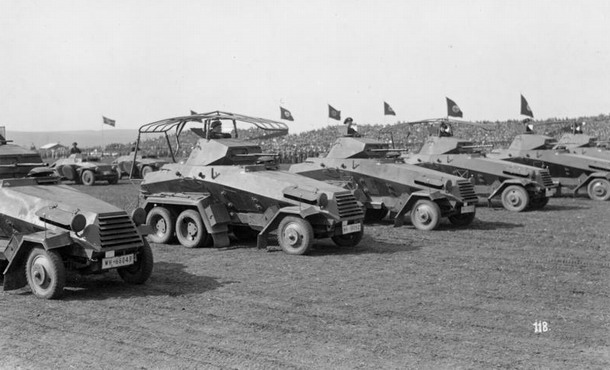
six-wheeled armoured cars Sd.Kfz. 231 and radio car Sd.Kfz. 232 on military manoeuvres in 1936, source: Bundesarchiv_Bild_146-2005-0139, Wikimedia, Creative Commons, modified
The Birth of the Armoured Car
The armoured car is the oldest type of motorised fighting vehicle of all, predating the tank itself by more than ten years. The very invention of the automobile must have immediately sparked military thinking about its potential uses not only for transport but in combat as well. Attempts to build such fighting vehicles were already being made in the late nineteenth century in the United States and Great Britain — a machine gun and a sheet-metal frontal shield were simply bolted onto an ordinary car that still resembled a horse-drawn carriage more than anything else. The first true armoured car, however, is generally considered to be the vehicle known as "Simms' Motor War Car", designed by the British engineer F. R. Simms and completed in 1902 — powered, incidentally, by a German Daimler engine.
As with tanks themselves, the German army was something of a latecomer in the field of armoured cars. It is true that in 1905 a remarkably modern armoured vehicle appeared under the name Daimler 1905 — arguably the very first armoured vehicle with four-wheel drive — but this was the work not of the parent German firm Daimler-Motoren-Gesellschaft but of its Austrian subsidiary Austro-Daimler. Historically the vehicle should therefore be regarded as an Austro-Hungarian machine. The Austrian army failed to fully recognise or exploit its potential, however, and the car never achieved any great distinction.
The First German Types
The first truly German armoured car appeared in 1906 under the designation Panzerkraftwagen Ehrhardt 5cm BAK (BAK = Ballon Abwehr Kanone = balloon defence gun). As the weapon fitted to it suggests, the purpose of this vehicle was to destroy enemy observation balloons. A modernised version followed in 1909. These vehicles could of course also be used in ground combat, but that was not their primary role. It might therefore be said that Germany entered the First World War without armoured cars in the proper sense of the term.
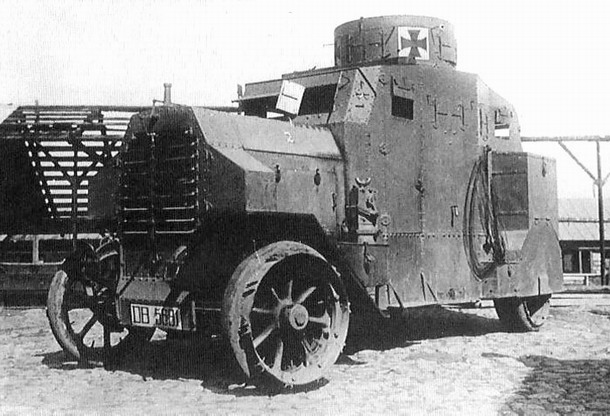
armoured car Panzerkraftwagen Ehrhardt 1915/1917, source: Wikipedia, public domain, modified
What jolted the Germans out of their sceptical attitude towards this type of fighting vehicle was the success with which their opponents — the British and Belgians in particular — deployed them. In response to these experiences, the German general staff decided in 1915 to develop armoured cars of their own for use against ground targets, commissioning three firms simultaneously: Daimler, Ehrhardt and Büssing. The result was the prototype armoured cars Daimler M1915, Büssing A5P and Ehrhardt E-V/4.
These were large and heavy vehicles, armed with several machine guns and crewed by 8 to 9 men. The prototypes were committed to action first on the Western Front and then on the Eastern. The Ehrhardt vehicle appears to have proven itself best, as a further 20 were ordered — albeit in a lighter modified version. The army designated the original car Panzerkraftwagen Ehrhardt 1915, while the new vehicles, nearly two tonnes lighter, were designated Panzerkraftwagen Ehrhardt 1917.
On the Eastern Front these armoured cars served until the end of fighting and were then handed over to the German police. The army apparently had no further use for them in the conditions of trench warfare on the Western Front. Paradoxically, it turned out that the vehicles were better suited to police work than to military service. Their great height, once a liability, now proved an advantage — the car offered a good view over crowds of demonstrators, making it easier to maintain control. The police used it almost exclusively in urban environments, so limited cross-country mobility was no longer a concern. On firm roads, on the other hand, the car could travel at over 50 km/h. The transfer of the Ehrhardt armoured car to police units was in many ways a foretaste of this type of vehicle's future role in Germany.
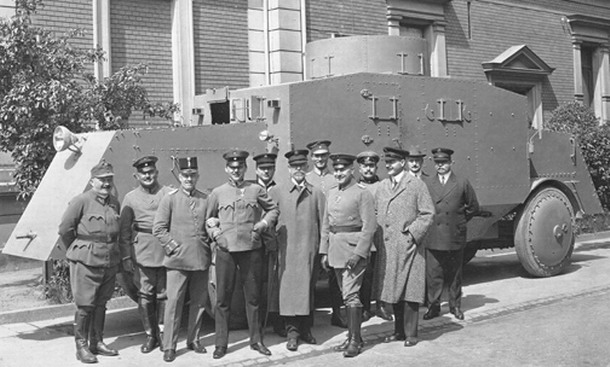
armoured car Büssing A5P, source: Flickr.com, public domain, modified
After the Great War
The First World War ended in defeat for Germany, and the Treaty of Versailles brought further development of military armoured cars to a halt. The use of armoured cars was permitted only to the police — specifically the Schutzpolizei, the police units responsible for maintaining order in cities. In a postwar Germany full of unrest and violent attempts to seize power, shooting was an everyday occurrence, which is why the victorious powers allowed armoured vehicles for the police — though their number was capped at a maximum of 150.
In 1919 the Schutzpolizei therefore approached Daimler, Ehrhardt and Benz with a requirement for armoured vehicles for their own use. Over the following years these firms delivered more than a hundred vehicles collectively designated Schutzpolizei Sonderwagen 21, or Schupo-Sonderwagen 21 for short. All three designs were very similar in construction and were based on the earlier Panzerkraftwagen Ehrhardt. The police used these vehicles throughout virtually all of the 1920s and into the early 1930s.
One example of the Daimler Sonderwagen 21 even found its way into the history of the Second World War — albeit in microscopic print :-). Out of sheer desperation it was apparently pressed into the defensive fighting in Berlin itself in 1945, and its wreck was found in one of the courtyards of the Reich Chancellery.
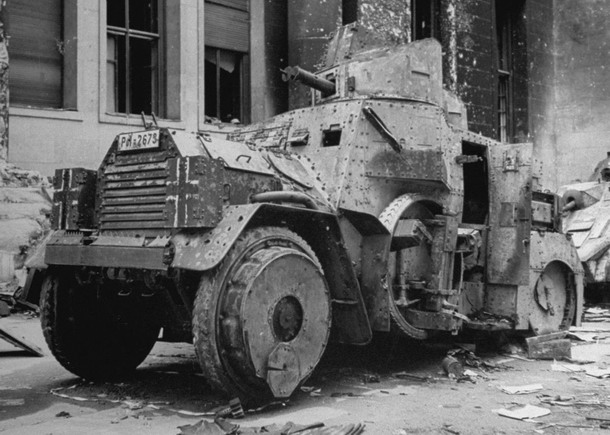
police Schupo-Sonderwagen 21 Daimler destroyed in the courtyard of the Reich Chancellery, source: Flickr.com, Public domain, modified
After the First World War the German army had its hands tied in the field of armoured cars. Its activities were perforce limited to minor expedients such as the construction of the unarmed Sd.Kfz. 3, officially classified as an armoured infantry transporter (Gepanzerter Mannschaftstransportwagen) rather than a fighting vehicle. In 1927 the army ventured to launch an illegal project to build a fully-fledged armoured car under the working designation ARW (also known as ZRW). This promising project ultimately foundered for lack of funds.
To allow the Reichswehr to develop at least the tactics of armoured car operations, it resorted in 1930 to the use of pseudo-armoured cars — much as tank crews trained on mock-up tanks. The vehicle generally known as the Panzerwagen Adler Standard 6 was, as its name suggests, built on the chassis of the commercial Adler Standard 6 passenger car. At first glance it looked like a real armoured car, complete with a rotating turret. Its "armour", however, was merely aluminium, and no weapon was installed in the turret. Some sources do mention a machine gun in the turret, but this is in all probability untrue. The inspection commissions of the victorious powers would never have permitted an armed vehicle to be built, and it is beyond doubt that this project was not secret — it was, for example, reported in the British press.
The Panzerwagen Adler Standard 6 had a futuristic appearance and looked very modern, but in combat it would have been utterly useless. Its sole purpose was to serve as a training aid for both crews and commanders of armoured units. The car had a four-man crew consisting of commander, driver, gunner and radio operator — though the last two were little more than passengers, as there was nothing to fire and no radio set was fitted.
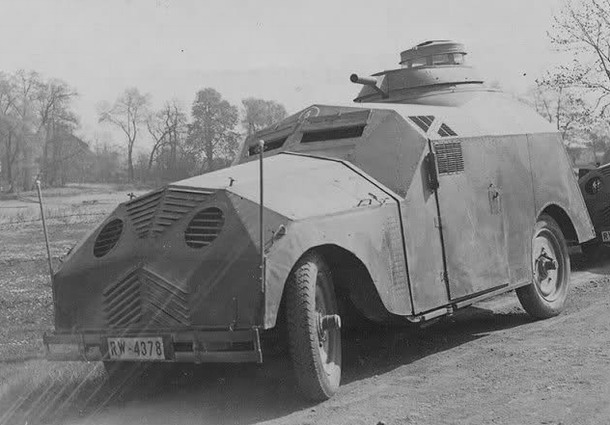
training "armoured" car Panzerwagen Adler Standard 6, source: Flickr.com with the permission of the publishing user, modified
In 1932 the light armoured car Kfz 13 appeared. Again it was a training vehicle, again based on the Adler Standard 6 chassis — but this time the car had real steel armour and a machine gun mounted in its cab. Although it was a far from fully capable fighting vehicle, the Kfz 13 eventually saw active combat in Poland and France because the Wehrmacht did not have enough more modern armoured cars to go around.
After 1933
From 1933 and the rise to power of Hitler's NSDAP, Germany stopped paying any heed to the restrictions enshrined in the Treaty of Versailles and development of armoured cars accelerated rapidly. The direction of development was clear: from light four-wheeled vehicles such as the Sd.Kfz. 221 and Sd.Kfz. 222, through the six-wheeled Sd.Kfz. 231 (6-Rad), to the heavy eight-wheeled Sd.Kfz. 231 (8-Rad) and Sd.Kfz. 234.
The primary role of armoured cars in the Second World War was reconnaissance, and their design was shaped accordingly. The modern German vehicles were considerably smaller, lighter and faster than their predecessors. A single turret with one main weapon and possibly a coaxial machine gun was all they needed. Nobody expected armoured cars to carry an infantry section in addition to their crew — that function had been taken over by armoured personnel carriers.
Armoured cars were almost ideally suited to reconnaissance. They were fast, highly manoeuvrable, and afforded their crews a relatively decent level of protection. They also carried their own armament, often of considerable destructive power. Their fundamental weakness, however, was the wheeled chassis, which severely restricted their deployability — wheeled vehicles simply could not match the cross-country capability of tracked ones. The Germans tried to minimise this handicap by developing and building heavy armoured cars with three or even four axles. But when the Eastern Front turned into an ocean of mud every autumn and spring, the number of axles made no difference whatsoever.
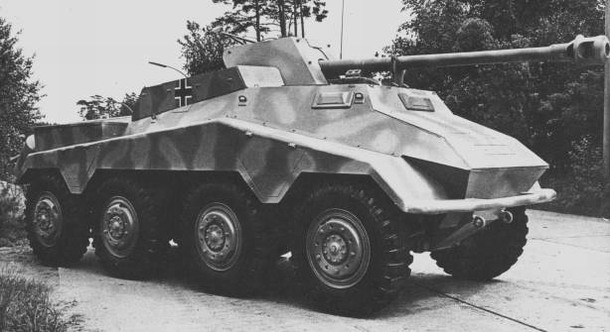
the eight-wheeled Sd.Kfz. 234/4 was more comparable to a tank than a conventional armoured car in terms of its firepower, source: Flickr.com with the permission of the publishing user, modified
Beyond reconnaissance, armoured cars were also widely used as command vehicles for junior officers, providing relatively safe and above all fast movement between fighting units and the rear. The later heavy armoured cars additionally served as carriers for artillery weapons of relatively large calibre. The eight-wheeled Sd.Kfz. 234/4, for example, was armed with a powerful 75 mm anti-tank gun and was therefore comparable to a tank in terms of its armament. This development was the result of Germany's desperate efforts to reduce the enormous numerical superiority of Russian tanks by every means available.

ARTICLE
CONTENTS:
Reproducing text from the Panzernet website without the written consent of the operator is prohibited.