KFZ 13 & KFZ 14
armoured car for the Reichswehr and Wehrmacht
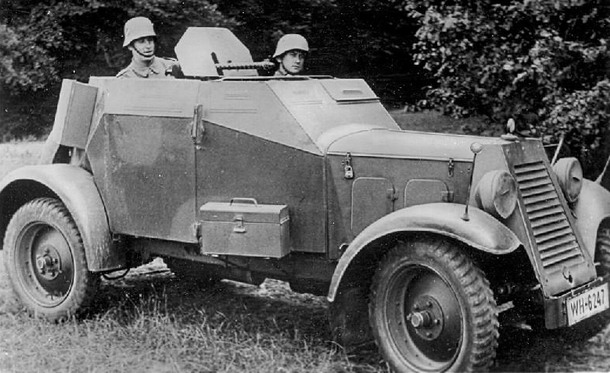
Armoured car Kfz 13. Source: Flickr.com, used with permission of the publishing user, edited
An Armoured Car for the Reichswehr
In the early 1930s, at the request of the Reichswehr, development began on a light armoured car with machine gun armament, intended for infantry support and reconnaissance duties. For reasons of cost, the new vehicle was to be as simple as possible and was to make maximum use of components already established in standard automotive production.
Several firms were involved in the development. The vehicle was based on the chassis of the commercial passenger car Adler Standard 6, produced by Adlerwerke of Frankfurt. The chassis had four single wheels with rear-wheel drive, suspended on leaf springs. The powerplant was the six-cylinder Adler Standard 2.9 litre engine producing 60 horsepower at 3,200 rpm. The gearbox offered four forward gears and one reverse. According to some sources the chassis was modified for its new purpose — the wheel suspension, engine cooling system, and other elements being strengthened accordingly.
Vehicle Description
A new armoured crew compartment was fitted to the automotive chassis. The engine bonnet appears to have been taken directly from the civilian passenger car without modification — only a new armoured front grille was added. It was only on later vehicles that certain changes to the engine bonnet were made: photographs show that at minimum the original louvred side panels were replaced by solid openable plates. The new front grille itself was angular, with metal louvres covering most of its area to allow airflow to the engine. At its lower section was a circular closable opening for inserting the starting crank.
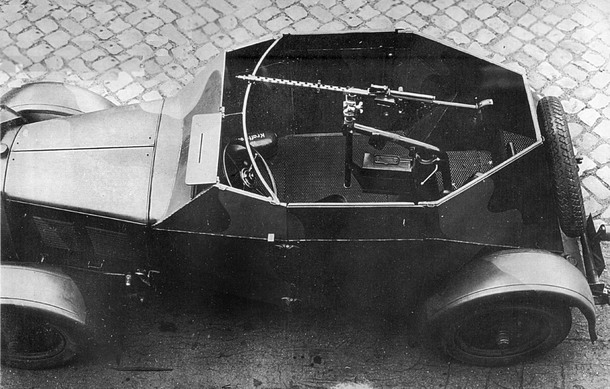
Fine view into the interior of the Kfz 13. Source: Flickr.com, used with permission of the publishing user, edited
On either side of the engine compartment were the large automobile-style front wheel mudguards, with standard headlights mounted on them. These features — to say nothing of the radiator cap badge — gave the vehicle the appearance of an ordinary road car rather than a fighting machine.
The armoured compartments were supplied by Deutsche Edelstahlwerke of Hannover. Their solution was extremely simple: flat welded steel plates, 8 mm thick. The compartment had a hexagonal plan, with its walls first flaring outward from the engine section, then reaching their widest point, before narrowing again toward the rear. In the left section of the front wall was an elongated driver's vision port, which was closed by a cover fitted with an observation slit when moving in a dangerous area. A further large vision port was provided in the rear wall. Thanks to the angled front grille and front wall, the vehicle could resist 7.92 mm armour-piercing ammunition from the front. From the sides and rear, the armour was only sufficient to stop standard rifle-calibre rounds.
The roof of the compartment was left completely open. The overall shape of the compartment is said to have earned the vehicle the nickname "Badewanne" — bathtub — among its crews.
Inside the compartment were positions for the vehicle's only two crew members. The driver, who also served as commander, sat at the front left and operated the vehicle with a conventional steering wheel. In the rear section of the compartment, a rotating pedestal for a 7.92 mm MG13 machine gun was bolted to the floor, allowing full 360° traverse. Maximum positive elevation was 65°. The great majority of vehicles had a small simple gun shield fitted to the machine gun, providing some protection for the gunner. On some vehicles the MG13 was later replaced by the more modern MG34 of the same calibre. The vehicle carried 1,000 rounds of ammunition. The floor of the compartment was made from chequerplate to prevent the gunner from slipping while operating the weapon.
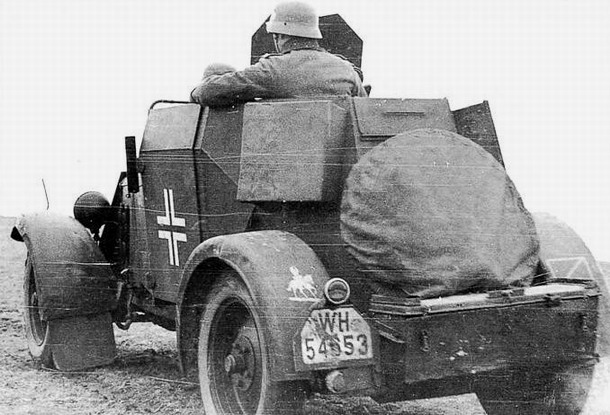
Armoured car Kfz 13. Source: Flickr.com, used with permission of the publishing user, edited
Both crew members entered and exited through large doors in the sides of the compartment. These covered practically the entire widest section of the side walls and opened toward the front of the vehicle, just like a conventional car door. At the rear, stowage boxes were mounted on the tapering sections of the side walls. The flat rear wall was almost entirely occupied by the stowed spare wheel. Below the spare wheel, in place of a rear bumper, sat another large box — presumably for tools.
The vehicle weighed approximately 2.2 tonnes and could reach a maximum road speed of around 60 km/h (some sources give up to 70 km/h). A fuel supply of 70 litres gave a range of around 250 km. The vehicle's full official designation was Maschinengewehrkraftwagen — literally "machine gun car" — with the code designation Kfz 13. Series production began at the end of 1932 and continued until 1934, carried out by Daimler-Benz. A total of 147 examples were built.
According to many sources, 14 examples of the Kfz 13 were built on the chassis of a different civilian passenger car — the Mercedes-Benz 10/50 PS type Stuttgart 260. Given the very similar chassis dimensions, this is theoretically plausible. The only feature by which such vehicles might perhaps be distinguished in photographs is the wheels. I have not, however, found a single photograph showing wheels corresponding to the Stuttgart 260 design — that is, the pressed steel disc type produced from 1933 onward. This cannot, of course, be taken as proof that the claim is false.
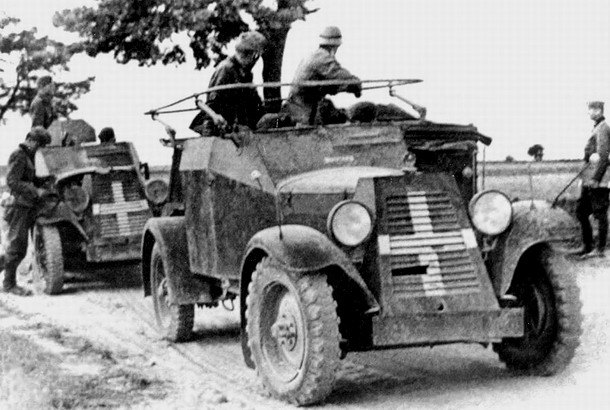
Armoured radio car Kfz 14. Source: Flickr.com, used with permission of the publishing user, edited
What is, however, entirely clear from photographs is that two different wheel designs were used during the production run. On the first series vehicles the wheels were taken directly from the Adler Standard 6 civilian car along with the chassis, and had flat pressed steel discs. They were later replaced by wheels from the Adler 12 N-3G cross-country vehicle, produced from 1933, which had discs with a domed centre hub.
The Kfz 14 Radio Car
Alongside the standard Kfz 13, a modified version was produced simultaneously under the name Funkkraftwagen with the designation Kfz 14. As the name implies, this was an armoured radio car. A total of 40 examples of this variant were built.
The Kfz 14 was unarmed, as the machine gun mount had to give way to the Fu 9 radio set (and presumably also to a third crew member). Alongside the radio, a large frame aerial was installed, mounted on four supports above the fighting compartment. The supports were hinged, allowing the aerial to be folded down. Some sources state that the crew of the Kfz 14 grew to three — driver, commander, and radio operator. In the absence of a machine gun, the crew's only weapons were their personal sidearms.
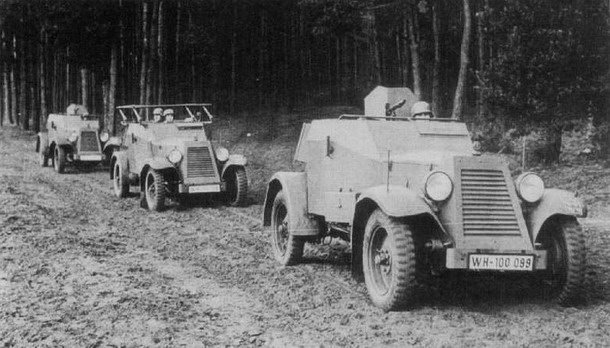
Two Kfz 13 vehicles and a Kfz 14. Source: Flickr.com, used with permission of the publishing user, edited
The Kfz 13 and Kfz 14 were by no means fully capable fighting vehicles — nor could they have been, since the restrictions of the Treaty of Versailles were still in force. Even so it is rather surprising that nobody moved to ban their production. By the early 1930s the enforcement of the Versailles terms was evidently no longer as strict as it had once been. Moreover, the machine gun was not permanently built into the vehicle's body but merely suspended on a mount inside the compartment, so with a degree of wilful blindness the vehicle could be presented as an unarmed infantry transport.
Combat Deployment
The Germans themselves did not count on the Kfz 13 seeing genuine combat. Its primary intended role was training crews for the more advanced armoured cars that would follow. Nevertheless, these vehicles were ultimately deployed in action against Poland in 1939 and France in 1940, simply because more modern equipment was not available in sufficient numbers.
As expected, the vehicles performed no feats of glory. Their design and single-axle drive imposed severe limitations on cross-country mobility, and the level of crew protection was very low. As soon as it became possible, these vehicles were therefore withdrawn from front-line units and replaced by the more capable Sd.Kfz. 221. The last examples reportedly remained in service as late as 1941.
Technical Data
|
weight: |
2.2 t |
|
length: |
4.13 m |
|
width: |
1.65 m |
|
height: |
1.50 m |
|
engine: |
Adler Standard 2.9 l |
|
engine output: |
60 hp |
|
max. speed: |
60 km/h |
|
fuel capacity: |
70 l |
|
range – road: |
250 km |
|
armour: |
8 mm |
|
crew: |
2 men |
|
armament: |
1 × 7.92 mm MG 13 machine gun |
ARTICLE
CONTENTS:
Reproducing text from the Panzernet website without the written consent of the operator is prohibited.