Sd.Kfz. 221
light four-wheeled armoured car

Light armoured car Sd.Kfz. 221, source: www.forum-auto.com, edited
In Search of a New Standard
The light armoured car Kfz 13, whose production had begun in 1932, was regarded by the army primarily as a training vehicle on which soldiers could learn the basic principles of operating this type of armoured vehicle. Military officials were well aware that this machine, built on the chassis of an ordinary civilian passenger car, could hardly meet the demands of modern warfare. The fact that the Kfz 13 ultimately found itself in combat in Poland and France is another matter entirely.
It was therefore clear that the German army would need a new armoured vehicle of a far more advanced design. The first step towards obtaining one was taken by the German Army Weapons Office (Waffenamt) as early as 1934, when it drew up a plan for the development of a universal chassis for heavy military passenger vehicles. The requirements issued to all vehicle manufacturers cooperating with the army were genuinely demanding: the chassis was to be four-wheeled with all-wheel drive, the wheel mounting and suspension were to be robust and rugged for cross-country use, and both axles were to be steerable.
These exacting requirements ruled out any existing truck or car chassis and called for an entirely new design. Trials of the submitted proposals took place in 1935 or 1936 (sources differ), and the winner was Horch, a member of the Auto Union conglomerate based in Zwickau. Horch submitted two variants of its new chassis — one with a front-mounted engine and one with a rear-mounted engine. The first proved more suitable for the construction of cross-country passenger and cargo vehicles. The second, with the engine at the rear, turned out to be ideal as the basis for armoured cars. The army designated these chassis Einheitsfahrgestell I (rear engine) and Einheitsfahrgestell II (front engine).
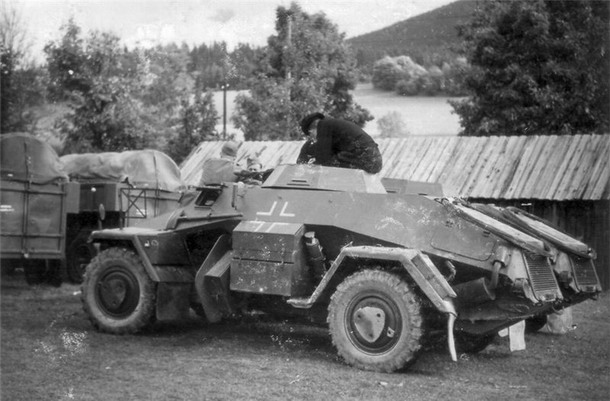
Sd.Kfz. 221 armoured cars — note the open access hatch in the side wall. Source: uludagsozluk.com, edited
Horch was immediately also commissioned to develop an armoured hull which, together with the Einheitsfahrgestell I chassis (its factory designation was Horch 801/EG I), would form a new armoured car for the German army.
Design Description
The hull developed by Horch consisted of flat armour plates welded together at various sharp angles, meaning there was virtually no surface on the entire vehicle that an enemy projectile could strike at a perpendicular angle — a feature that naturally improved the armour's effectiveness. The upper and lower halves of the hull were angled in opposite directions: from the lower tub the hull first widened outward, then the walls broke angle and tapered back inward toward the roof. Armour thickness ranged from 14.5 mm on the front plate, through 8 mm on the sides and rear, down to just 5 mm on the floor and roof. The vehicle prototype was completed in the same year (1935 or 1936), the army accepted it under the designation Sd.Kfz. 221, and series production began immediately. Its full official designation was Leichter Panzerspähwagen (MG) (Sd.Kfz. 221).
The hull's front plate was shaped like an isosceles trapezoid widening from bottom to top. At the very nose of the hull, a simple metal bar was mounted horizontally, serving as a basic bumper. Beneath it were two hooks for tow ropes, and photographs frequently show vehicles with tow ropes already fitted and threaded around the bar. The front headlights were attached on either side of the front plate, with the horn on the left. The upper portion of the front plate transitioned into the relatively short and steeply angled cover of the driver's position. The front wheel mudguards essentially joined the front plate on either side at this point. On the left mudguard, most vehicles carried a Notek blackout driving light. A noteworthy detail was the triangular armour guard with rounded corners protecting the wheel hubs.
Rising from the front cover was the raised front wall of the driver's cab, featuring his vision port. There was only one, though it was quite large and rectangular in shape. It was closed by a cover fitted with two narrow observation slits, which the driver used when in a combat zone where opening the full port would have been too dangerous. Photographs indicate that on at least some vehicles the driver's front vision port was glazed and even fitted with two small wipers. This large port was custom-designed for the Sd.Kfz. 221. In the interest of production simplification it was later replaced by the standard vision port used across the armoured car range — again rectangular, but somewhat smaller, and positioned slightly to the left of centre on the cab's front wall (reflecting the position of the driver's seat) rather than centrally as on the original.
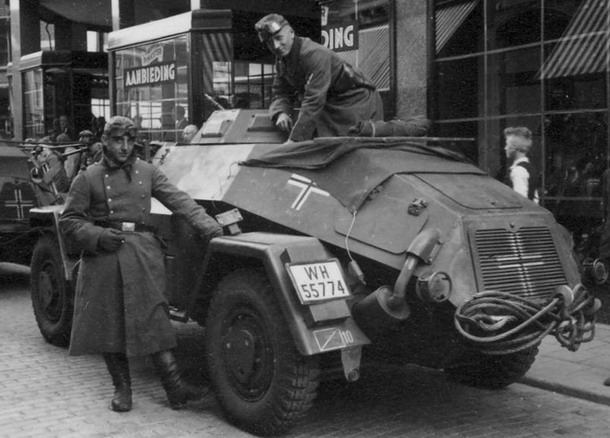
Rear view of the Sd.Kfz. 221, source: warwheels.net, used with permission of the site operator, edited
The driver also had one vision port in each side wall of his position — smaller than the front port, again fitted with a cover with a single observation slit. Above each port, a small profile section was welded on to catch rainwater running down the armour and divert it away from the opening.
The driver sat in the nose of the vehicle, slightly to the left of the centreline, and steered using a conventional car steering wheel. To enter and exit, he could use either of the access hatches cut into both side walls beside his position, located in the lower portion of the sides. The hatches were shaped as irregular trapezoids, and their single-piece cover opened toward the rear of the vehicle. The roof above the driver's head was slightly raised compared to the rest of the roof.
Behind the driver's position, at the widest part of the hull, was the main fighting compartment with a fully rotating turret. The roof of the compartment in front of the turret was solid, formed by a steel plate; behind the turret it consisted only of a dense wire mesh, which extended partly over the engine compartment and allowed airflow to the radiator housed there. The turret — or rather cupola — was welded from 8 mm plate and formed an irregular nine-sided truncated pyramid. The literature frequently describes it as octagonal, but photographs make it quite clear that this is incorrect. A slot was cut into the edge between the two front faces of the cupola, through which passed the barrel of the MG34 machine gun — the vehicle's sole organic armament. The cupola had no roof; only its front section was covered by a fine wire mesh guard, whose side flaps could be folded outward. The mesh was obviously not bullet-proof, but its main purpose was to prevent hand grenades from being dropped into the vehicle.
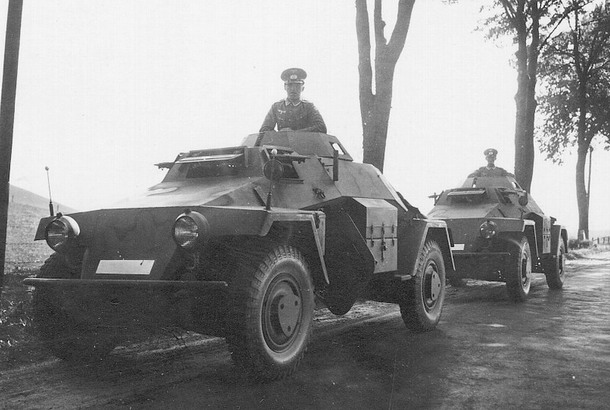
A pair of Sd.Kfz. 221 vehicles — these appear to be freshly completed examples, not yet fitted with armament or even with the vision ports in the turret walls. Source: warwheels.net, used with permission of the site operator, edited
The turret and the fighting compartment below it were the station of the second — and last — crew member, who simultaneously served as commander, loader, and machine gunner. His view of the outside world from within the protected turret interior was provided by several slit-type vision ports in the turret walls; photographs suggest their design and arrangement changed during the course of production. No vision ports were provided from the fighting compartment below the turret. To enter and exit, the commander apparently used the same side hatches as the driver. He could also leave the vehicle through the open top of the turret.
As already noted, the Sd.Kfz. 221's sole armament was the 7.92 mm MG34 machine gun, for which 1,050 to 1,200 rounds of ammunition were carried. The gun's vertical elevation ranged from -10° to +69°, which meant it could be used against low-flying aircraft. For this purpose it was sometimes fitted with an additional aircraft sight — the so-called Fliegervisier — alongside the standard sights. The crew also carried a submachine gun, either the MP38 or MP40, as supplementary personal armament inside the vehicle.
The fighting compartment marked the end of the widest part of the hull, which then tapered toward the rear where the engine and gearbox were housed. The wire mesh roof behind the turret gave way to a solid armour plate over the engine compartment, which sloped gently downward toward the tail. The radiator filler neck was situated almost at the junction of the flat and sloped sections of the roof. Fuel capacity is variously quoted in sources as either 100 or 110 litres.
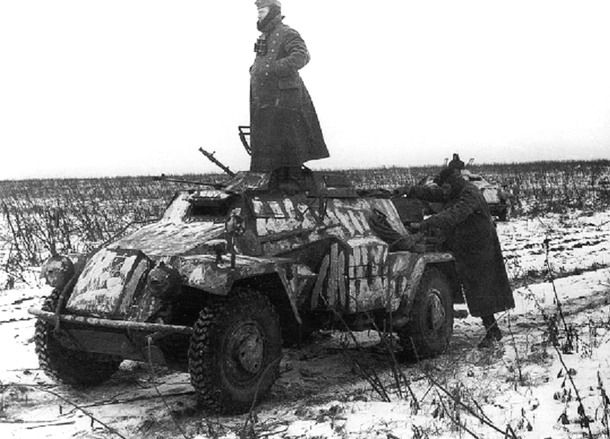
Sd.Kfz. 221 armed with a machine gun and the 7.92 mm Panzerbüchse 39 anti-tank rifle. Source: Flickr.com, used with permission of the publishing user, edited
The Sd.Kfz. 221 received its engine together with the chassis — the Horch V8 3.5 litre petrol unit. This 3,517 cc engine produced a maximum of 75 horsepower at 3,600 rpm. The Horch Einheits gearbox offered five forward gears and one reverse. So equipped, the four-tonne vehicle could reach a maximum road speed of 80 km/h, with a road range of around 350 km.
Virtually the entire rear wall of the hull was taken up by the engine access cover, which was louvred to allow airflow to the engine and shaped as a trapezoid with only a very gentle taper toward the top — almost rectangular. Access to the engine was also possible through a large service hatch in the top of the bonnet and two smaller ones in its side walls. One exhaust pipe emerged on each side from the engine compartment, disappearing behind the rear mudguard and running beneath the hull.
The space on the hull sides between the front and rear mudguards was used for stowing various equipment. On the left side of the vehicle, behind the driver's hatch, a large tool box was mounted. The spare wheel hung on the right side. Some vehicles were quite literally festooned with additional stowage boxes, a jack, a fire extinguisher, jerry cans for fuel and water, and similar items.
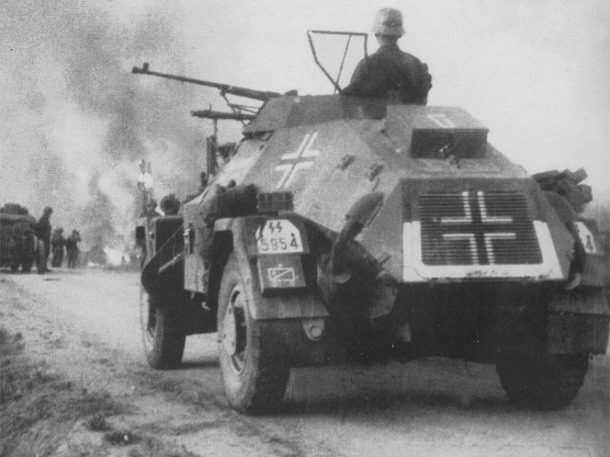
Another Sd.Kfz. 221 with machine gun and 7.92 mm Panzerbüchse 39 anti-tank rifle — this photograph clearly shows the barrels of both weapons. Source: Flickr.com, used with permission of the publishing user, edited
To make steering easier, the Sd.Kfz. 221 had both axles steerable. The rear wheel steering could, however, be locked out — which was apparently also recommended when driving at higher speeds. A study of photographs suggests that crews locked out the rear steering very frequently: despite considerable effort, I have not found a single photograph showing this armoured car with its rear wheels turned, whereas there are quite a few images showing the front wheels angled while the rear ones remain straight.
The Sd.Kfz. 221 was not fitted with a radio as standard. Some photographs, however, clearly show a rod aerial attached, usually to the rim of the turret, suggesting that a radio was installed in at least some vehicles — either as a factory fit or in a field workshop.
Series Production
Series production of the Sd.Kfz. 221 began in 1935 or 1936 (sources differ) and continued until 1940, with several firms involved. The chassis was manufactured by the already-mentioned Horch, part of the Auto Union group in Zwickau. The hull was supplied by Eisenwerk Weserhütte, and final assembly was carried out by the Schichau and MNH (Maschinenfabrik Niedersachsen Hannover) factories. A total of 339 Sd.Kfz. 221 armoured cars were produced. The vehicle was assigned to the reconnaissance units of armoured divisions, self-propelled artillery divisions, and others.
Panzerbüchse 39
The MG34 machine gun alone was obviously not a very effective weapon, particularly when facing enemy armoured vehicles. Accordingly, in approximately 1941 a number of Sd.Kfz. 221 examples were retrofitted with a Panzerbüchse 39 anti-tank rifle in 7.92 mm calibre alongside the machine gun. The rifle was mounted independently of the machine gun so that each weapon could be elevated separately. A new aperture was cut in the turret armour for the rifle barrel, to the right of the machine gun.

Sd.Kfz. 221 armed with the 28 mm Panzerbüchse 41 anti-tank rifle. Source: Flickr.com, used with permission of the publishing user, edited
Panzerbüchse 41
The Panzerbüchse 39 was itself no miracle weapon and did not bring any fundamental improvement to the vehicle's combat capability. A smaller number of vehicles — reportedly 34 in total — were therefore re-armed in early 1942 with the more modern Panzerbüchse 41, a 28 mm weapon with a squeeze-bore barrel (the chamber diameter was 28 mm while the muzzle was only 20 mm). With this gun the Sd.Kfz. 221 could penetrate up to 50 mm of armour at a range of 500 metres. This weapon was, however, quite large, and its installation required the removal of the original machine gun and the cutting away of a substantial section of the turret's front wall. The anti-tank rifle was mounted complete with its fairly sizeable gun shield, which more than compensated for the removal of the turret armour section. Due to its weight and recoil, the Panzerbüchse 41 had to be rigidly mounted, meaning the turret could no longer be rotated.
Combat Deployment
The Sd.Kfz. 221 served on the Western and Eastern Fronts as well as in Africa, and despite being obsolete, some examples apparently remained in service with units until the end of the war. In 1938 the Chinese army purchased 18 of these vehicles, which it would later put to use fighting Germany's ally — Japan — in something of an ironic turn. In the combat conditions of Poland and Western Europe the Sd.Kfz. 221 proved reliable and mobile, but woefully under-armoured and poorly armed. In Russia, as with all wheeled vehicles, it frequently lost even its mobility advantage.
One of its design shortcomings was the complex wheel suspension, which was prone to failure — particularly on the muddy tracks of Russia where it easily became clogged. The problem of inadequate armament was addressed through the improvised anti-tank rifle installations described above. To improve armour protection, a bolt-on supplementary armour plate (Zusatzpanzer) was sometimes fitted in front of the hull's front wall — but this too was essentially a stopgap measure. A proper solution to both the armour and armament shortcomings came only with the successor vehicle built on the same chassis and designated Sd.Kfz. 222.
Technical Data
|
weight: |
4.0 t |
|
length: |
4.80 m |
|
width: |
1.95 m |
|
height: |
1.70 m |
|
engine: |
Horch 3.5 l |
|
engine output: |
75 hp |
|
max. speed: |
80 km/h |
|
range – road: |
350 km |
|
hull armour: |
|
|
- front: |
14.5 mm |
|
- sides: |
8 mm |
|
- rear: |
8 mm |
|
turret armour: |
8 mm |
|
crew: |
2 men |
|
armament (by variant): |
7.92 mm MG 34 machine gun Panzerbüchse 39 anti-tank rifle Panzerbüchse 41 anti-tank rifle |
ARTICLE
CONTENTS:
Reproducing text from the Panzernet website without the written consent of the operator is prohibited.