Sd.Kfz. 260 and 261
light armoured communications vehicles
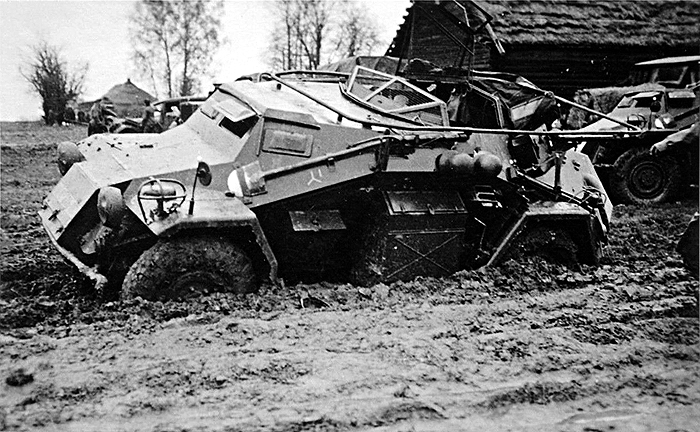
Sd.Kfz. 261; this photograph shows clearly the absence of a turret, source: Flickr.com with the permission of the publishing user, edited
Origins of the Vehicle
From the mid-1930s, a family of light armoured vehicles built on the four-wheeled Einheitsfahrgestell I chassis by Horch was introduced into German Army service. This family comprised the armoured cars Sd.Kfz. 221, Sd.Kfz. 222 and the radio car Sd.Kfz. 223. In 1940, two further radio car types were developed as follow-ons to this family, and production began a year later. These were the vehicles officially designated "kleine Panzerfunkwagen (Sd.Kfz. 260)" and "kleine Panzerfunkwagen (Sd.Kfz. 261)" respectively (note for those unfamiliar: the code Sd.Kfz. abbreviates Sonderkraftfahrzeug, literally "vehicle for special purposes").
Design Description
The chassis and hull of the Sd.Kfz. 222 Ausf. B served as the basis for construction — given the timing of their development, no other version could in any case have been used. The radio car's hull was built from flat armour plates welded together at various angles, such that virtually no surface on the entire vehicle could be struck by an enemy projectile at a right angle. The upper and lower halves of the hull had walls sloped in opposite directions: the hull widened from the lower pan upwards, the walls then kinked outward, and from there narrowed again towards the roof.
The front hull plate was shaped as an isosceles trapezoid narrowing towards the top. At the very nose of the hull a simple metal bar was mounted horizontally, serving as a basic bumper, with two tow hooks below it. The front headlights were attached to the sides of the front wall, along with a horn on the left. The upper portion of the front plate transitioned into the relatively short, steeply raked glacis of the driver's station. On either side of this glacis the front mudguards were attached, cleverly incorporating storage boxes for small items within their profile. On the left mudguard a Notek blackout headlight was fitted, which on some vehicles was protected by a wire grille. Since the vehicle was based on the Sd.Kfz. 222 Ausf. B chassis, it did not have the triangular wheel hub protectors found on earlier versions.
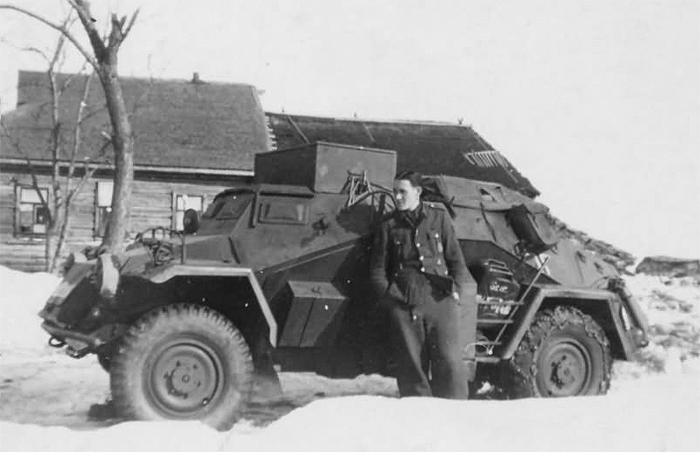
Sd.Kfz. 260, the vehicle has no frame antenna, which clearly distinguishes it from the Sd.Kfz. 261, source: worldwarphotos.info with the permission of the site operator, edited
From the forward glacis, the front wall of the driver's compartment rose with two vision ports. The left-hand port was considerably larger than the right and, unlike the right one, could be opened. The driver also had one vision port in each side wall of his station, likewise fitted with an openable cover and an observation slit.
The driver sat at the front of the vehicle, slightly to the left of the centreline, and steered using a conventional automotive steering wheel. Both axles were steerable for easier cornering, though the rear-wheel steering could be locked — which was presumably recommended at higher speeds. For entry and exit the driver could use either of the hatches in the lower portion of both side walls beside his station. These hatches were irregular trapezoid in shape; their single-piece cover opened towards the rear of the vehicle. The roof above the driver's head was slightly raised compared to the rest of the roof.
Behind the driver's station, in the widest part of the hull, was the vehicle's main compartment. There was no fighting turret on the roof — unlike the older "cousins" of the Sd.Kfz. 22x family. The front portion of the roof was solid, formed by a standard steel plate. The rear portion had a large opening covered by a raised frame fitted with wire mesh. The frame had two openable panels that could be lifted upwards away from each other; when open, they stuck up from the centre of the roof like the raised wing-cases of a beetle. The wire mesh was obviously not bulletproof — its purpose was primarily to prevent hand grenades from being thrown into the vehicle. In bad weather the crew had to protect themselves with a waterproof tarpaulin drawn over the opening.
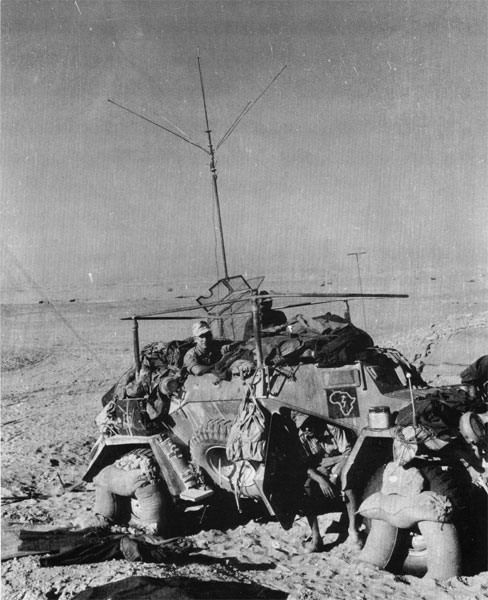
Sd.Kfz. 261 used as a static radio station in Africa, with the rod Stabantenne extended, source: uludagsozluk.com, edited
Neither the Sd.Kfz. 260 nor the 261 had any built-in weapons. The vehicle's sole "armament" was its radio equipment. This consisted of the Fu7 and Fu Spr.Ger. "a" sets on the Sd.Kfz. 260, and the Fu12 and Fu Spr.Ger. "a" sets on the Sd.Kfz. 261. On the Sd.Kfz. 261, a frame antenna (Rahmenantenne) rose above the hull on four struts. The struts were fitted with hinges so the entire assembly could be folded rearward until the antenna frame lay flat at roof level. At least some vehicles were also fitted with a large telescopic rod antenna — the Stabantenne — which, due to its length, could only be fully extended with the vehicle stationary. The Sd.Kfz. 260 used a rod antenna. The antenna is typically the only feature by which the two types can be distinguished in photographs, since otherwise they were externally identical in every respect. In addition to the driver already mentioned, the crew comprised three further men: two radio operators and a commander. For entry and exit they apparently used the same side hatches beside the driver's position and the hatch in the roof of the main compartment.
The main compartment marked the end of the hull's widest section; from here rearward the hull narrowed continuously. The rear portion housed the engine and gearbox. The roof, which behind the main compartment opening was formed only by the wire mesh frame, reverted to solid armour plate over the engine compartment. This plate was flat for a short distance before stepping down and then continuing to slope gradually toward the rear. In the flat section just before this step, the radiator filler cap was located. Fuel capacity is variously given as 100 or 110 litres depending on the source.
The Sd.Kfz. 260 and 261 inherited their powerplant along with their chassis. As already noted, both were taken from the Sd.Kfz. 222 Ausf. B, meaning the chassis was the modernised Einheitsfahrgestell I with the factory designation Horch 801/v, and the engine was the Horch V8 3.8l with a displacement of 3.823 litres. The unit produced a maximum output of 81 horsepower at 3,600 rpm, though it is possible that a uprated version with a higher compression ratio and a maximum output of 90 horsepower was also used. The Horch Einheits gearbox offered five forward and one reverse ratio. Weight was 4.26 tonnes for the Sd.Kfz. 260 and 4.3 tonnes for the Sd.Kfz. 261.

probably an Sd.Kfz. 260 onto which the crew has fitted their own improvised frame antenna (a fairly common occurrence particularly among units in Africa), source: Wikimedia, Public domain, edited
Virtually the entire rear hull wall was taken up by the cover of the engine compartment access hatch, which on these vehicles was fully armoured rather than louvred as on the early version of the Sd.Kfz. 222. Access to the engine was also possible through a large service hatch in the roof of the rear bonnet and two smaller ones in its side walls. One exhaust pipe emerged from the engine compartment on each side, disappearing behind the rear mudguard and running under the hull.
The free space on both sides of the hull between the front and rear mudguards was used to carry various equipment. On the left side of the vehicle, behind the driver's hatch, a large tool box was mounted. On the right side hung a spare wheel. Vehicles were sometimes literally festooned with additional mounted boxes, a jack, fire extinguisher, fuel and water jerrycans, and blankets — even on the roof, since nothing there obstructed the fire of any weapon.
Production of the radio cars continued until 1943, apparently at the Maschinenfabrik Niedersachsen Hannover factory (which also built the older radio cars Sd.Kfz. 223). A combined total of 493 vehicles of both types were produced, though different — sometimes considerably lower — figures can also be encountered. The primary role of these vehicles was to provide communications at higher levels of command.
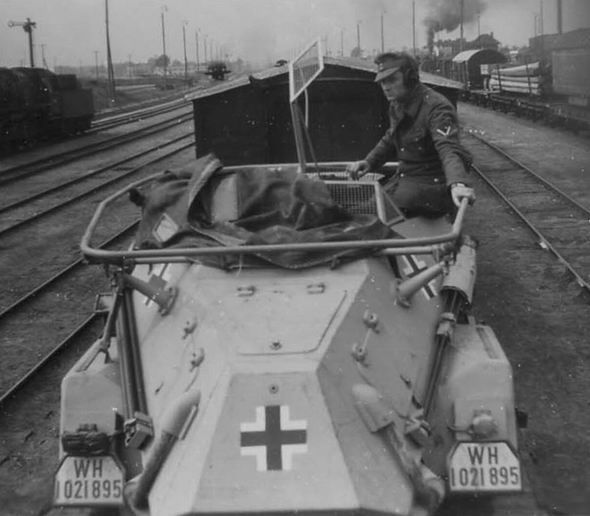
Sd.Kfz. 261 on a railway flatcar, source: uludagsozluk.com, edited
Conversions and Modifications
Finally, a supplementary note. Apparently due to a shortage of other light radio cars, a certain number of standard Sd.Kfz. 221 vehicles were converted into radio cars and fitted with a frame antenna. These vehicles are sometimes incorrectly referred to as Sd.Kfz. 261. The distinction is, however, unambiguous — it comes down to the base vehicle used: Sd.Kfz. 221 versus Sd.Kfz. 222. An example of such a conversion can be seen in the photograph HERE, Bundesarchiv_Bild_101I-268-0178-13, Wikimedia, edited. Note that the vehicle has wheel hub protectors, which the Sd.Kfz. 261 never had, and the single large driver's vision port is also clearly visible, identifying the vehicle as an Sd.Kfz. 221.
To add a further complication, on some Sd.Kfz. 260 or 261 vehicles the crews apparently mounted a machine gun and a shield on the roof themselves, to give the vehicle at least some defensive capability. These vehicles are then sometimes mistakenly identified as Sd.Kfz. 223, even though they have no small turret — only a bare machine gun with a shield (a photograph can be seen HERE, uludagsozluk.com, edited).

ARTICLE
CONTENTS:
Reproducing text from the Panzernet website without the written consent of the operator is prohibited.