Sd.Kfz. 223
light armoured communications vehicle

The Sd.Kfz. 223 radio car was equipped with both a frame aerial and a machine gun turret. Source: Flickr.com, used with permission of the publishing user, edited
Origins of the Vehicle
The Sd.Kfz. 223 was a successor within the family of light armoured vehicles — Sd.Kfz. 221 and Sd.Kfz. 222 — built on the unified four-wheel Horch chassis. In this case, however, it was not primarily a fighting vehicle but a radio car intended to maintain communications between reconnaissance units and their command. Its full official designation was "leichte Panzerspähwagen (Fu) (Sd.Kfz. 223)" (a note for the uninitiated: Sd.Kfz. was an abbreviation of Sonderkraftfahrzeug, literally "special-purpose vehicle"). The chassis and hull of the Sd.Kfz. 222 served as the basis for the Sd.Kfz. 223, and as a result the radio car underwent the same design changes during production as its "222" counterpart. Despite not being primarily intended for combat, the Sd.Kfz. 223 was armed — a machine gun turret, or rather cupola, taken from the Sd.Kfz. 221 was fitted to the hull.
Design Description
The radio car's hull consisted of flat armour plates welded together at various sharp angles, so that there was virtually no surface on the entire vehicle that an enemy projectile could strike perpendicularly — a feature that naturally improved the armour's effectiveness. The upper and lower halves of the hull were angled in opposite directions: from the lower tub the hull widened outward, then the walls broke angle and tapered back inward toward the roof.
The hull's front plate was shaped as an isosceles trapezoid narrowing toward the top. At the very nose of the hull a simple metal bar was mounted horizontally as a basic bumper, with two tow rope hooks beneath it. Photographs frequently show vehicles with tow ropes already fitted and threaded around the bar. The front headlights were mounted on either side of the front plate, with the horn on the left. The upper portion of the front plate transitioned into the short and steeply angled cover of the driver's position. The front wheel mudguards joined the front plate on either side, incorporating neatly integrated stowage compartments for small items of equipment. A Notek blackout driving light was later added to the left mudguard. A noteworthy feature was the triangular armour guard with rounded corners protecting the wheel hubs.

Excellent overhead view of two Sd.Kfz. 223 vehicles — the machine guns are removed from both, as this is most likely a photograph taken somewhere in the rear area rather than at the front. Source: worldwarphotos.info, used with permission of the site operator, edited
Rising from the front cover was the cab's front wall, fitted with two driver's vision ports. The driver also had one vision port in each side wall of his position. On early vehicles all four ports were identical — rectangular, with a single-piece hinged cover fitted with an observation slit, used in combat areas where opening the full port would have been too dangerous. A small profile section was welded above each port to catch rainwater and divert it away from the opening. Unlike the original Sd.Kfz. 222 hull, however, the right-side port on the Sd.Kfz. 223 was positioned noticeably further toward the rear — apparently so that the radio operator, who would otherwise have had no view out of the vehicle, could make use of it.
During the course of production the vision port arrangement was changed, as it was on the Sd.Kfz. 222 itself. The front wall still retained two ports, but of a new and mutually different design: the left was considerably larger and could be opened, while the right could not. The side wall ports were also redesigned with an openable cover and observation slit. As photographs show, even in the new port configuration some vehicles retained the right-side port in the rearward position. And to make things yet more complicated, examples with only a single front vision port are also well documented — see photograph HERE, Bundesarchiv_Bild_101I-216-0401-25, Wikimedia, edited.
The driver sat in the nose of the vehicle, slightly to the left of the centreline, and steered using a conventional car steering wheel. Both axles were steerable to aid turning, though the rear wheel steering could be locked out — apparently recommended at higher speeds. To enter and exit, the driver could use either of the access hatches cut into both side walls beside his position, in the lower portion of the sides. These were shaped as irregular trapezoids with single-piece covers opening toward the rear. The roof above the driver's head was slightly raised compared to the rest of the roof.

Sd.Kfz. 223 with the telescopic aerial fully extended. Source: Flickr.com, used with permission of the publishing user, edited
Behind the driver's position, at the widest part of the hull, was the vehicle's main fighting compartment, topped by the machine gun cupola taken from the already-mentioned Sd.Kfz. 221. The roof of the compartment in front of the cupola was solid steel plate; behind it, the roof consisted only of dense wire mesh, extending partly over the engine compartment to allow airflow to the radiator. The cupola was welded from 8 mm plate and shaped as an irregular nine-sided truncated pyramid. A slot was cut into the edge between its two front faces, through which passed the barrel of the MG34 machine gun — the vehicle's sole armament. The cupola had no roof; only its front section was covered by a fine wire mesh guard whose side flaps could be folded outward. The mesh could not stop bullets, but its main purpose was to prevent hand grenades from being dropped into the vehicle. In poor weather the crew had to protect themselves with a waterproof tarpaulin draped over the open top.
The cupola and fighting compartment below it housed the remaining two crew members — the radio operator and the commander, who also served as machine gunner. Only the commander had a view outside, through the vision ports in the cupola walls. The fighting compartment below had no ports of its own, and the radio operator's only means of looking out was presumably the already-mentioned rearward-positioned port in the right side of the driver's position. To enter and exit, both the radio operator and the commander apparently used the side hatches beside the driver's post, though they could also leave through the open top of the cupola.
Communications Equipment
The vehicle's primary "weapon" was not the machine gun in its cupola but the radio equipment in the fighting compartment below. This changed during the course of production, but the sets generally used on board were the Fu10 SE 30, Fu12, and Fu Spr.Ger. "a" types. Above the hull, a frame aerial (Rahmenantenne) was mounted on four supports. These supports were hinged, allowing the entire aerial assembly to be folded rearward and lowered down to roof level. At least some vehicles were also fitted with a large extendable rod aerial — the so-called Stabantenne — which, due to its length, could only be fully raised when the vehicle was stationary.
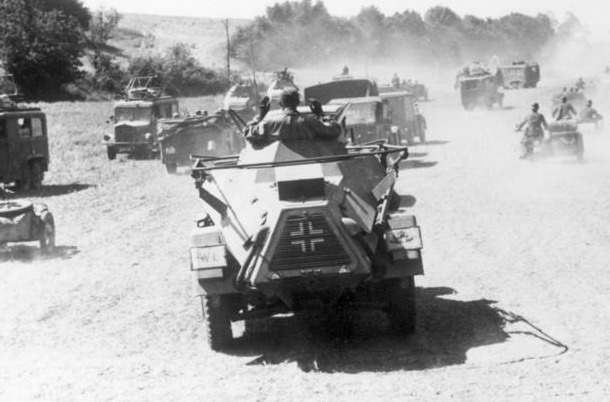
Rear view of the Sd.Kfz. 223. Source: Bundesarchiv_Bild_146-1987-019-34, Wikimedia, Creative commons, edited
The fighting compartment marked the end of the widest part of the hull, which then tapered toward the rear where the engine and gearbox were housed. The wire mesh roof behind the cupola gave way to solid armour plate over the engine compartment. This plate was flat for a short distance behind the cupola, then stepped down and continued sloping toward the tail. The radiator filler neck was located in the flat section just before the step. Fuel capacity is variously quoted as either 100 or 110 litres.
The Sd.Kfz. 223 received its engine together with the chassis — the Horch V8 3.5 litre petrol unit, displacing 3,517 cc and producing a maximum of 75 horsepower at 3,600 rpm. In this respect too the radio car apparently mirrored the development of its basis, the Sd.Kfz. 222, and from 1940 began receiving the more powerful engine — but more on that shortly. The Horch Einheits gearbox offered five forward gears and one reverse. The Sd.Kfz. 223 weighed approximately 4.4 tonnes, and its armour was the same thickness as on the "222": 14.5 mm on the front plate, 8 mm on the sides and rear, and 5 mm on the floor and roof.
Virtually the entire rear wall of the hull was taken up by the engine access cover, louvred for airflow and shaped as a trapezoid tapering toward the top. During production a supplementary armour plate began to be fitted across the rear wall, visually extending the tail of the vehicle. Some authors suggest this was not so much additional armour as a dust filter intended to keep dust out of the engine. Both interpretations have merit and it is quite possible the cover served both purposes at once. Access to the engine was also available through a large service hatch in the bonnet roof and two smaller ones in its side walls. One exhaust pipe emerged from each side of the engine compartment, disappearing behind the rear mudguard and running under the hull.

Wreck of a destroyed Sd.Kfz. 223. Source: Flickr.com, Public domain, edited
The hull sides between the front and rear mudguards were used for stowing various equipment. A large tool box was mounted on the left side behind the driver's hatch, while the spare wheel hung on the right. Some vehicles were quite literally festooned with additional stowage boxes, a jack, a fire extinguisher, fuel and water jerry cans, and similar items.
Series Production
There is some disagreement over when the Sd.Kfz. 223 first appeared. The year 1936 is most commonly cited, though according to most sources the Sd.Kfz. 222 was not yet in production at that point — making this date questionable. In 1940, when Sd.Kfz. 222 production switched to the revised Ausf. B variant, those changes also fed through into Sd.Kfz. 223 production. The main development was the adoption of the strengthened and updated Einheitsfahrgestell I chassis with the new factory designation Horch 801/v, which also brought a new engine: the Horch V8 3.8 litre, displacing 3,823 cc and producing a maximum of 81 horsepower at 3,600 rpm. The front armour was also increased, to 30 mm. According to some authors, a further engine upgrade followed in 1941: the Horch V8 3.8 litre was given a higher compression ratio to raise its maximum output to 90 horsepower. The Sd.Kfz. 223 likewise adopted the elimination of the triangular wheel hub guards, which no longer appeared on late-production vehicles.
Production continued until 1943 or 1944 at the Maschinenfabrik Niedersachsen Hannover factory, which also assembled the Sd.Kfz. 222 itself. A total of 567 radio cars were built. The Sd.Kfz. 223 was intended to work alongside its "cousins" the Sd.Kfz. 221 and 222 in carrying out reconnaissance missions, providing them with communications links to command. In general terms it shared the same shortcomings as its fellow vehicles — relatively thin armour, and a tendency to lose mobility in difficult terrain. It was gradually to be replaced by half-track vehicles such as the Sd.Kfz. 250, which were far more capable off-road.
Technical Data
|
|
Ausf. A |
Ausf. B |
|
weight: |
4.4 t |
4.8 t |
|
length: |
4.80 m |
4.80 m |
|
width: |
1.95 m |
1.95 m |
|
height: |
2.00 m |
2.00 m |
|
engine: |
Horch 3.5 l |
Horch 3.8 l |
|
engine output: |
75 hp |
81 hp |
|
max. speed: |
75 km/h |
80 km/h |
|
hull armour: |
|
|
|
- front: |
14.5 mm |
30 mm |
|
- sides: |
8 mm |
8 mm |
|
- rear: |
8 mm |
8 mm |
|
turret armour: |
8 mm |
8 mm |
|
crew: |
3 men |
3 men |
|
armament: |
7.92 mm MG 34 machine gun |
7.92 mm MG 34 machine gun |

ARTICLE
CONTENTS:
Reproducing text from the Panzernet website without the written consent of the operator is prohibited.