TANK T-60
a tank born out of necessity
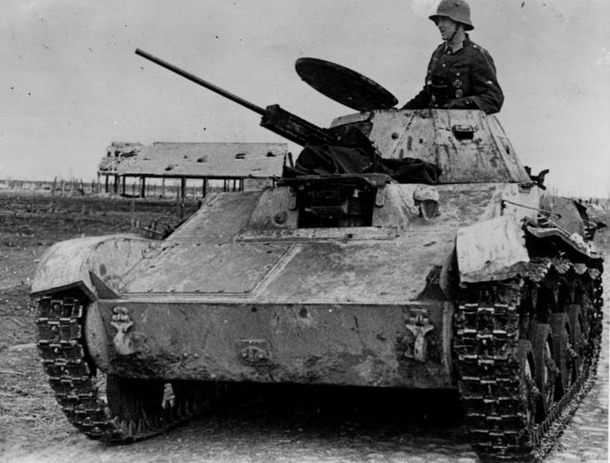
T-60 tank captured by the German Army, source: Wikimedia, Bundesarchiv Bild 183-J19893, Creative Commons, edited
Origins of the Tank
In May 1941, factory No. 37 in Moscow received orders to begin production of the new light tank T-50, which according to Soviet military plans was to replace the ageing light tanks BT and T-26. The T-50 was, however, a highly complex and technically demanding vehicle, and it was clear to the management of factory No. 37 that introducing production of this tank in the modest conditions of their plant was simply not possible. Progress on setting up T-50 production was running behind schedule across the board due to the vehicle's complexity, to the point that when war with Nazi Germany broke out in June 1941, the Red Army did not have a single tank of this type available.
The German advance was relentless and Soviet losses enormous, which meant factory No. 37 could not simply refuse to produce tanks. Instead, its designers under N. A. Astrov began work on developing a different, less complicated vehicle. Astrov knew that time was the overriding priority, and he completed the design of the new tank in just 15 days. The proposed vehicle, given the working designation T-30, made use of a large number of components from the older amphibious tank T-40 then in production at factory No. 37. This meant the transition to building the new type could be made relatively quickly — certainly faster than switching production to the T-50 would have taken.
Once the design and a mock-up of the new tank were complete, Astrov wrote a letter to Stalin himself, together with Lieutenant Colonel V. P. Okunev. In it he explained that it was not possible for factory No. 37 to switch to T-50 production quickly enough as ordered, and at the same time presented the plan for the new light tank of his own design. The Soviet political and military leadership responded with unusual flexibility: the very day after Stalin read the letter, his representative V. A. Malyshev arrived at the Moscow factory to study the project.
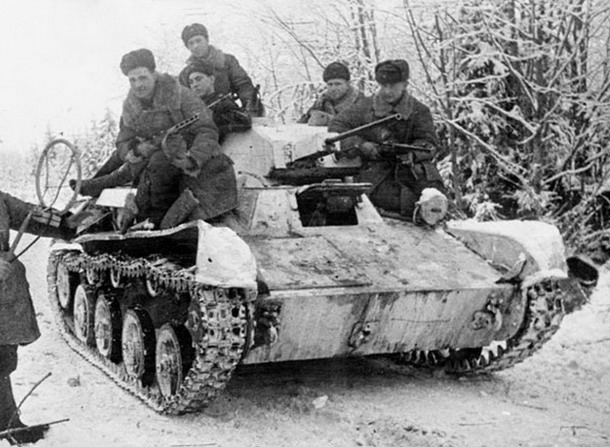
T-60 tank in winter camouflage carrying infantry, source: Waralbum.ru with permission, edited
Malyshev discussed the characteristics of the proposed tank with Astrov and asked whether it would be possible to arm it with a more powerful 20 mm automatic cannon instead of the planned 12.7 mm DShK machine gun — specifically the ShVAK aircraft cannon. Astrov confirmed that the change of weapon was feasible. Malyshev contacted the cannon's design bureau, OKB-15, and instructed them to begin developing a tank version of the weapon immediately. That same evening, the decision was taken to accept Astrov's tank for production and service — a measure of the extreme time pressure the Soviet Union was under at the time. Over the following fourteen days the technical documentation was drawn up and series production prepared. On 15 September 1941 the production lines at the Moscow factory started rolling.
Series Production
The tank received the official designation T-60, and an immediate order was placed for 10,000 of them. Besides the Moscow factory, production was to take place at four additional plants — factory No. 176 in Gorky (today Nizhny Novgorod), factory No. 264 in Stalingrad, the KPZ plant in Kolomna, and the Kharkov Tractor Factory. Several further factories also contributed components. The last-mentioned Kharkov plant was evacuated shortly after production began, and in its place production of the tank was extended to factory No. 38 in Kirov. On 26 October 1941, the Moscow factory too had to be evacuated — specifically to Sverdlovsk (today Yekaterinburg), where production subsequently continued. It is worth noting that in the mere month and eleven days between production starting and the evacuation, Moscow's factory No. 37 managed to turn out an astonishing 245 T-60 tanks. Production in the new Sverdlovsk facility resumed on 15 December. The largest factory involved in T-60 production was the already-mentioned plant No. 176 in Gorky, better known under the abbreviation GAZ (Gorky Automobile Factory), which produced the tank in large series. By the end of 1941 combined output from all factories reached a full 1,548 vehicles!
Technical Description
The T-60 had running gear consisting of four road wheels on each side, each independently suspended and sprung by a torsion bar. At the front was the toothed drive sprocket and at the rear the idler wheel, which was of the same design as the road wheels but raised above ground level. Three return rollers supported the upper run of the track. Three different road wheel types appeared on the tank during its production run. Early vehicles can be found with two types of spoked wheel — a more complex design without rubber tyres and a simpler design with rubber tyres around the rim, the latter being considerably more common of the two. The third type, solid wheels, appeared later alongside further upgrades to the tank.
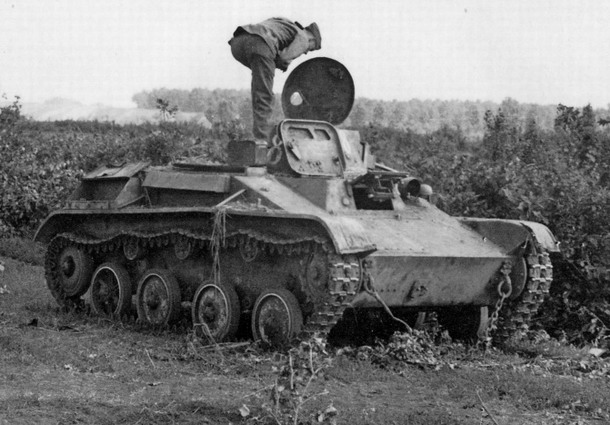
an abandoned T-60 falls into German hands, source: Waralbum.ru with permission, edited
The T-60's hull was simple but not without a certain elegance. The armour was of homogeneous rolled steel, with the individual plates joined in the great majority of cases by welding. The hull nose was formed by two plates meeting at a sharp angle. The upper plate in particular was steeply angled. Rising from its centre was the angular driver's cab, with a closable vision port in its front wall. In combat the port was closed and the driver could observe only through the slit in its cover. The driver's entry and exit hatch was in the cab roof. The lower nose plate was 20 mm thick; the upper was only 15 mm, but its steep angle greatly improved its effective protection. The front face of the driver's cab had armour 20 mm thick.
In the middle section of the hull was a flat deck, in the left half of which the turret was mounted. The turret was octagonal with sloped walls 20 mm thick (some sources give 25 mm). The tank's armament was installed in the 35 mm thick front face of the turret. The primary weapon, positioned on the left, was the TNSh 20 mm cannon — a newly developed tank version of the originally aircraft-derived ShVAK cannon. The designation TNSh only came into official use from 1 January 1942, so strictly speaking early T-60s should be described as armed with the ShVAK cannon.
To the right of the cannon was a 7.62 mm DT machine gun. The first prototype built did not yet have the cannon and carried only the originally planned 12.7 mm heavy machine gun. The new cannon was available by the time the second prototype was built, and its testing proceeded essentially in parallel with testing of the tank itself. Ammunition types for the cannon included anti-personnel fragmentation rounds, incendiary rounds, and armour-piercing anti-tank rounds. Later, sub-calibre armour-piercing ammunition also became available, significantly increasing effectiveness against armoured targets: with this ammunition the 20 mm cannon could penetrate 35 mm of sloped armour at 500 metres. With such capability the T-60 could even take on early versions of the German Panzer III and Panzer IV. Ammunition stowage was 780 rounds for the cannon and 940 for the machine gun.
It is worth noting that the supplementary DT machine gun was installed in such a way that it could be quickly dismounted for use in direct combat outside the tank. In an emergency the crew could in theory also carry off the cannon itself, as it weighed "only" 68 kg.
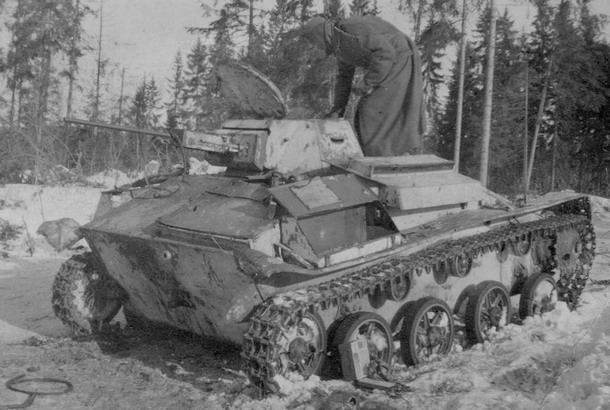
an abandoned T-60 falls into German hands, source: Flickr.com with permission, edited
The T-60's crew of two consisted of the already-mentioned driver and the commander, who was stationed in the turret. The commander also served simultaneously as gunner and loader for both weapons — an obvious recipe for overload in combat conditions. His entry and exit hatch was a circular opening that effectively spanned the entire turret roof, closed by a single-piece cover that opened forward.
The rear of the hull housed the engine — a water-cooled GAZ-202 producing 70 horsepower — giving the tank a maximum speed of 45 km/h. Two fuel tanks with a combined capacity of 320 litres gave an operational range of around 450 km on road and 250 km cross-country. The weight of tanks from this production period was 5,800 kg. It is also worth noting that these early tanks were not standardly fitted with radios.
In 1942 the T-60 received an upgrade. The tank was given new solid road wheels with rubber tyres around the rim, with the idler wheel changed to match. A new GAZ-203 engine of 85 horsepower was installed. Armour was also strengthened: where the hull and turret frontal armour had previously been 20 mm, it now became 35 mm. The upgrade brought a weight increase to 6.4 tonnes, but the more powerful engine prevented any drop in maximum speed. Production of the modernised T-60 continued, but the type began gradually being superseded by the more modern T-70. From August 1942 production was wound down factory by factory until it ceased entirely in February 1943. A total of 5,839 modernised tanks were built in all — though higher figures are also cited.
Combat Deployment
The T-60's combat debut came at the end of September 1941 near Poltavshchina. Fighting against German equipment very quickly exposed the tank's main shortcomings. The 20 mm cannon was insufficient against the armour of German tanks and could effectively destroy only lightly armoured vehicles. The tank's own thin armour offered the crew inadequate protection. The tanks also got bogged down fairly frequently in soft ground and had to be recovered by other vehicles. Among Soviet tankers the vehicle reportedly earned the bleak nickname "brotherly double grave".
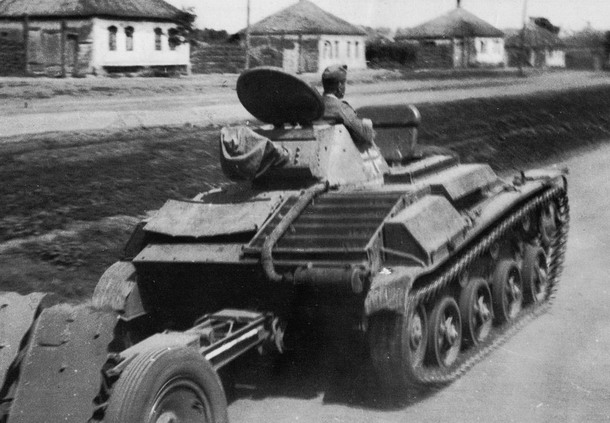
T-60 tank in Wehrmacht service, source: Aviarmor.net with permission, edited
Attempts at Improvement
During the production period several projects were undertaken to increase the combat value of the light tank. A number of vehicles were experimentally fitted with a new ZIS-16 engine of 88 horsepower. Why this unit did not become standard is unknown, but it most likely failed to meet expectations. Further experiments focused particularly on the tank's armament. A prototype was tested armed with the 37 mm ZIS-19 cannon, which was actually installed and trialled — but the entire project ultimately foundered on a shortage of ammunition for this gun. In April 1942 a trial installation of the 45 mm ZIS-19BM cannon was undertaken. This weapon was too large for the existing turret, however, requiring a complete turret replacement. The modified test vehicle received the designation T-45, sometimes also referred to as T-60-2. Although the conversion was evidently successful, it never entered production because by that point it was already clear that the T-60 would be gradually replaced in full by the more modern T-70, making further development of the T-60 a dead end.
In the second half of 1942 the GAZ factory built a prototype anti-aircraft tank on the T-60 chassis, armed with twin paired 12.7 mm machine guns. The vehicle, designated T-60 Z (Z = zenitny, anti-aircraft), never entered production due to technical problems.
One T-60 derivative that did reach production was a self-propelled rocket launcher on the tank's chassis. The turret was removed and in its place a launching rack for 24 rockets was installed on the hull. The rack was of very simple construction, consisting of metal rails from which the rockets were suspended both above and below. The rockets were of 82 mm calibre with a range of around 5 kilometres. Several hundred of these rocket launchers were reportedly produced during 1942. They were accepted into Red Army service under the designation BM-8-24.
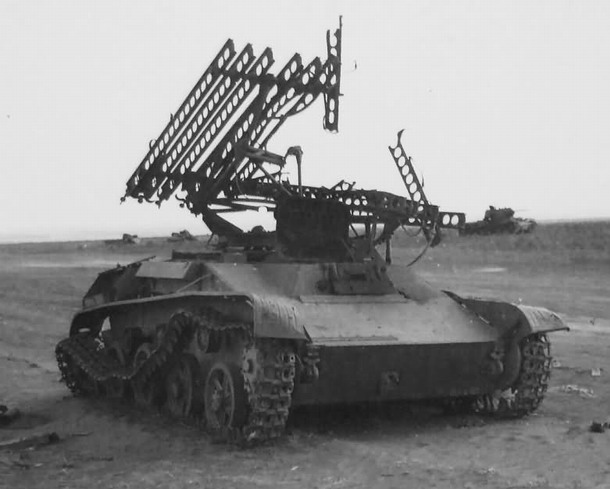
a destroyed BM-8-24 self-propelled rocket launcher on the T-60 chassis, source: Worldwarphotos.info with permission, edited
The T-60 also underwent some interesting modifications in Romania. The Romanian Army, fighting on the Eastern Front alongside Nazi Germany, suffered from a serious shortage of mobile anti-tank weapons. Developing its own vehicle was beyond Romania's means in terms of both time and finances, so it was decided to make use of captured Soviet equipment. Lieutenant Colonel Constantin Ghiulai was tasked with developing a tank destroyer. He selected the T-60 chassis as the basis and armed it with the Soviet 76.2 mm F-22 cannon.
The prototype was completed on 12 January 1943 at the Leonida factory in Bucharest. An armoured superstructure of 15 mm plate was built on the Soviet tank's chassis, but this protected the fighting compartment only from the front and partially from the sides — the two-man gun crew was completely exposed to the rear and above. The vehicle passed its trials and series production was launched. It received the official designation Tun Anticar pe Afet Mobil T-60 (literally self-propelled anti-tank gun on a T-60 chassis), abbreviated TACAM T-60. A total of 34 were produced over the following months and committed to combat on the Eastern Front. In October 1944 all surviving TACAM T-60s were confiscated by the Red Army.
Probably the most remarkable conversion of the T-60 was its flying version, designated A-40 KT (Krylya Tanka — Wings of a Tank), sometimes also written A-T, which was developed in the summer of 1942. The impetus for this remarkable vehicle was the Soviet desire to supply partisan units with armoured vehicles. Partisan formations were operating behind enemy lines, however, and delivering tanks to them across the front line was no straightforward matter. The solution proposed was a tank that could fly to the partisans itself. The project's designer was Oleg Konstantinovich Antonov.
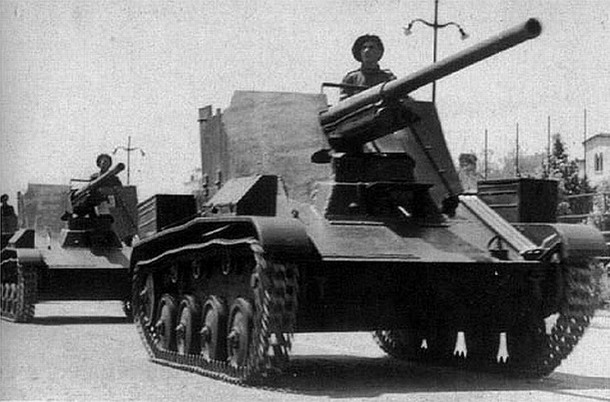
Romanian TACAM tank destroyer on a T-60 chassis, source: Wikimedia, Public domain, edited
A tail unit with two rudders and biplane wings were attached to the tank, on which it would then glide. Everything was made of wood and fabric. The machine had no independent propulsion for flight and had to be towed to its objective by another aircraft — heavy bombers Petlyakov Pe-8 or Tupolev TB-3 were used for this purpose. The wingspan is variously given as either 15 or 18 metres, and the entire assembly measured around 12 metres in length. For flight the tank had to be stripped down as much as possible, with minimal ammunition and fuel loaded. The intended flight speed was 160 km/h and the landing speed 110 km/h. After touchdown the wings were to be detached and the tank would be ready for combat — at least in theory. Prototype trials took place at the turn of August and September 1942 at an airfield near Moscow, with a TB-3 as the tow aircraft. Some sources report the test was successful, others claim the exact opposite. The fact is that the flying tank was not approved for series production.
As production of medium tanks — above all the T-34 — grew, T-60s began to be withdrawn from frontline units to second-line service. They went on to serve as artillery and cargo tractors and as training vehicles for new tank crews. Captured vehicles were used by the Germans and their allies, but again mainly in towing roles rather than combat.
Technical Specifications
|
Model 1941 |
Model 1942 |
Weight |
5.8 t |
6.4 t |
Length |
4.1 m |
4.1 m |
Width |
2.3 m |
2.3 m |
Height |
1.75 m |
1.75 m |
Engine |
GAZ-202 |
GAZ-203 |
Maximum output |
70 hp |
85 hp |
Maximum speed |
45 km/h |
45 km/h |
Fuel capacity |
320 l |
320 l |
Range – road |
450 km |
450 km |
Range – cross-country |
250 km |
250 km |
Turret armour |
20 mm |
35 mm |
Hull armour |
20 mm |
35 mm |
Armament |
1 x 20 mm ShVAK cannon 1 x 7.62 mm DT machine gun |
1 x 20 mm TNSh cannon 1 x 7.62 mm DT machine gun |
Crew |
2 men |
2 men |

ARTICLE
CONTENTS:
Reproducing text from the Tankist website without the written consent of the operator is prohibited.