TANK T-50
too complex for wartime production
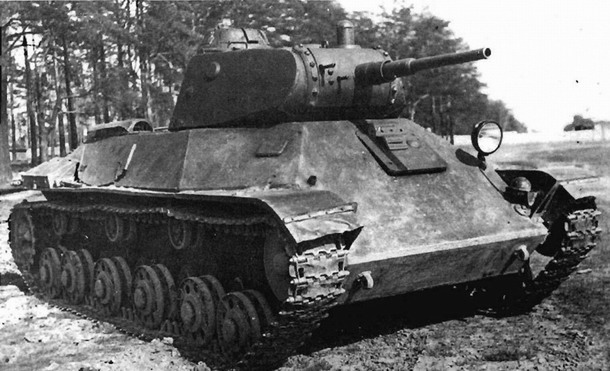
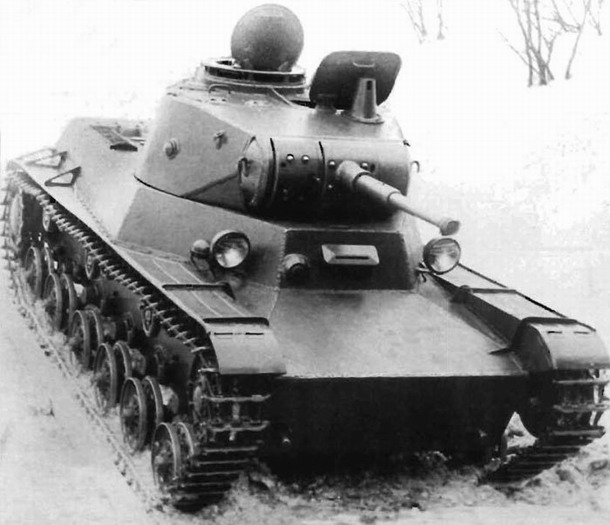
T-50 tank, source: Waralbum.ru with permission, edited
Origins of the Tank
The light tank T-50 was intended, according to army planners, to replace the obsolete but very widely used T-26. Combat deployment of the older T-26 in the Spanish Civil War had demonstrated that it was no longer adequate for the modern battlefield — above all because of its thin armour, which could not withstand even fire from 37 mm anti-tank guns. In 1939 the experimental design bureau (also known as OKMO) at the Leningrad S. M. Kirov factory No. 185 was tasked with developing a successor. The project was led by S. A. Ginzburg, with designers L. S. Troyanov and I. S. Bushnyov also taking part.
The project specification called for a new infantry support tank — "soprovozhdeniya pekhoty" in Russian. This is the origin of the letters SP used in the designation of the first prototype. The army required a tank of around 14 tonnes, armed with a 45 mm cannon and protected by armour of similar thickness to that of the concurrently developed T-34.
The First Prototype
In the summer of 1940 the Leningrad factory No. 185 completed a trial prototype designated T-126 SP, or Object 126. The prototype had 45 mm armour on all hull and turret walls, with the exception of the floor and roof which were 20 mm thick. The walls — particularly those of the hull — were also steeply angled, significantly increasing their resistance to penetration. This level of armour protection was truly exceptional for a tank of this category at this period in history. The consequence, however, was that the vehicle's originally planned weight was exceeded: the prototype came in at 17 tonnes.
In the right section of the hull's front plate was a combined hatch for the driver and the radio operator/machine gunner, closed by a single-piece cover with a vision slit. To the left of the hatch was a hull machine gun — probably a DS-39 of 7.62 mm calibre — operated by the radio operator/machine gunner, who observed through a further vision slit in the front plate to the left of the weapon. Additional observation apertures were located in both angled transition panels between the front and side hull walls.
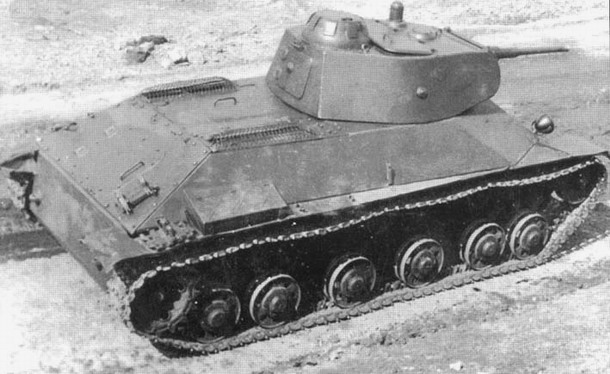
T-50 tank, source: Aviarmor.net with permission, edited
The turret's basic shape was reminiscent of that of the T-34 then under development. Its front face mounted a 45 mm cannon with a coaxial machine gun — in this case probably a DT of 7.62 mm calibre. 150 rounds were carried for the cannon and 4,250 for the machine guns. The turret roof had three hatches in total — two rectangular and one circular in the commander's cupola — giving each of the men inside their own entry and exit point. An additional opening in the rear turret wall served for loading ammunition and probably also for removing the cannon during repairs.
Beyond its strong and effectively designed armour, the prototype incorporated several remarkably progressive design features. One was the commander's cupola, which projected above the turret roof and provided the tank commander with an all-round view of the battlefield through eight observation ports around its circumference. The designers were probably inspired by the German Panzer III, and in the Soviet context this feature was genuinely ahead of its time — commander's cupolas only became standard on Soviet tanks several years later. The German vehicle may also have inspired the three-man turret arrangement: dividing combat tasks among three crew members had proven optimal in practice, though again the Soviet Union did not learn this lesson until later — the T-34 retained a two-man turret until the introduction of the 85 mm gun version. It is also worth noting that a radio was planned as standard equipment for the new tank, which was decidedly above-standard in Russia at that time. The prototype was fitted with a 71-TK-3 set.
The prototype's running gear consisted of six small-diameter road wheels on each side, each independently sprung by a torsion bar. Three return rollers supported the upper run of the track. At the front was the idler wheel and at the rear the toothed drive sprocket. The engine and gearbox were mounted in the hull rear. The prototype used a six-cylinder diesel V-3 engine producing 250 horsepower, giving the tank a maximum speed of 35 km/h. The gearbox offered four forward gears and one reverse.
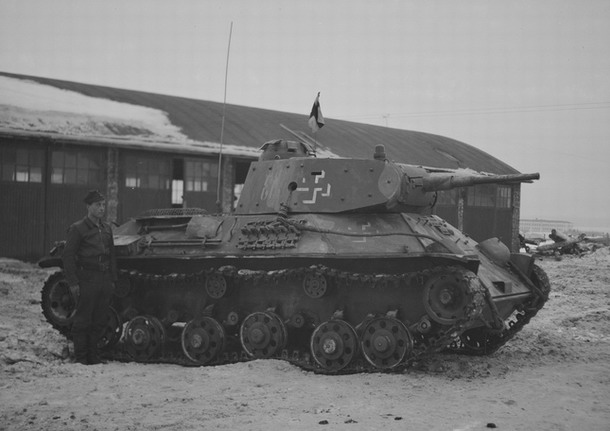
T-50 with additional armour, captured by the Finnish Army, source: Waralbum.ru with permission, edited
The Revised Prototype
From the army trials of the prototype the designers brought back, among other tasks, the homework of reducing the tank's weight, increasing its speed, and somehow relieving the cramped conditions for the crew inside. The tank therefore underwent a slimming programme in which armour thickness was reduced from 45 mm to 37 mm, and in places less. The hull and turret roofs were reduced to 15 mm and the hull floor to just 12 mm. The resulting weight was successfully brought down to an acceptable 13.8 tonnes. To increase speed, a new engine developed specifically for this tank was installed: the V-4 diesel producing a maximum of 300 horsepower, giving the tank a top speed of 52 km/h.
In the drive to free up interior space, the hull machine gun was removed and its opening sealed with a bolted steel plate. The radio set was relocated from the hull to the turret, allowing the radio operator/machine gunner's role to be eliminated entirely. From this point on the tank was to have a four-man crew. This certainly created more space in the hull, but had the opposite effect on the turret — the radio was now moved there, with its operation assigned to the tank commander. The type of radio also changed, to a 9P set. The turret therefore remained very cramped and uncomfortable, and to fit everything inside — cannon, machine gun, radio, and three Red Army men — the commander had to sit partially turned relative to the vehicle's centreline. Another visible change from the original prototype was the adoption of rubber-tyred road wheels, which were easier on the tracks. Various other details were also modified. This revised prototype is sometimes designated Object 127, or T-127.
The Series Version
In autumn 1940 the prototype was transferred to the Leningrad K. E. Voroshilov factory No. 174, where series production of the new tank was to take place. As part of the preparations for production, a final round of modifications was carried out. The provisional blanking plate over the hull machine gun aperture was removed — as was the vision slit for the no-longer-existing radio operator — allowing the driver's hatch to be repositioned further to the left. The rubber-tyred road wheels were replaced by all-steel ones, probably to reduce the already high production cost of the tank. There is a suggestion in some sources that the final version prototype received the designation Object 135, though whether this was actually the case is uncertain. In any event this was already the tank in its series production form. After factory and army testing, a decision was taken to accept the tank into Red Army service under the designation T-50 and to begin mass production. Sources disagree on the exact date, with both February 1941 and April 1941 cited.
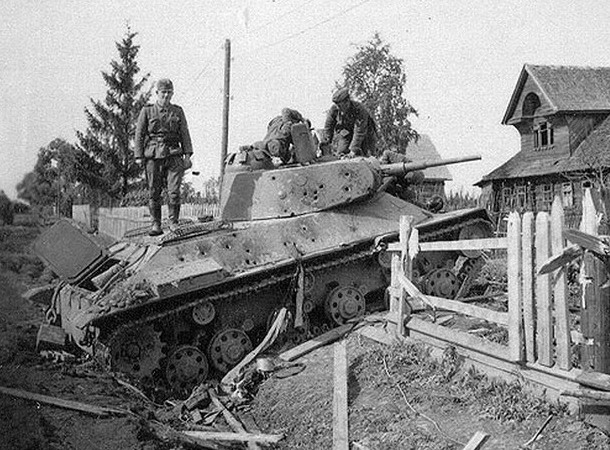
German soldiers at a wrecked T-50 — note the large number of penetrations, source: Aviarmor.net with permission, edited
According to army plans, T-50 production was to be truly massive — figures of up to fourteen thousand vehicles are cited. Factory No. 37 in Moscow was to join the production effort as well. From the very start, however, production was dogged by problems. The tank was technically complex and demanding to manufacture. The Moscow factory never managed to get production underway at all, and the Leningrad factory had not completed a single vehicle by the time war with Germany broke out. A major source of difficulty, among others, was the V-4 engine, which was unreliable and at the same time relatively expensive. The engines were to be supplied by factory No. 75 in Kharkov, but deliveries were slow. By the end of 1941 only 50 tanks had been completed.
In August 1941 factory No. 174 had to be evacuated from Leningrad — primarily to Omsk, but partly also to Nizhny Tagil and Barnaul. The engine supplier, Kharkov factory No. 75, also had to be evacuated in due course, further compounding the production difficulties. In October 1941 the GKO (State Defence Committee) therefore decided to build two entirely new factories in Barnaul specifically for T-50 production — one to manufacture the V-4 engines and the other to assemble the tanks themselves. Less than four months later, however, this decision was reversed and production of the tank was cancelled entirely. Over the entire brief production run, only 69 T-50s were built — and some of those were probably not fully complete.
What finished the T-50 was the combination of all the unfortunate circumstances already described. Beyond the production complexity and high unit cost, the timing of the tank's emergence played a significant role. Work on establishing series production was brutally disrupted by the outbreak of war and the subsequent factory relocations. The troublesome V-4 engine, whose deficiencies the designers never managed to fully resolve, was a persistent and already-mentioned problem. And finally, from the autumn of 1941 British Valentine tanks began arriving in the Soviet Union under the aid programme, and these were capable of filling the T-50's role in terms of purpose and characteristics. The Soviets therefore chose to focus their efforts on maximising output of established types, above all the T-34. Despite this, the T-50 was a genuinely advanced vehicle for its time — with adequate armour, good speed and mobility, and a main weapon capable of taking on virtually any German opponent of the era. There were even plans to eventually replace the 45 mm gun with a more powerful 57 mm weapon, which would have increased the tank's combat value further still. This upgrade never came to pass.
the competing Object 211 prototype, source: Topwar.ru with permission, edited
Combat Deployment
The T-50 did see combat, albeit with few details recorded. The tanks were committed to the defence against the advancing German and Finnish forces in the northern regions of Russia. A large proportion were apparently lost quickly in the fierce fighting — either in direct combat or through lack of spare parts for such a rare vehicle. Not all of them disappeared, however: according to army records, at least one T-50 was still in fighting condition as late as 1943. The Finns captured one T-50 during the fighting — specifically a vehicle of the appliqué-armoured variant described below — and operated it until 1944. Two T-50s and one T-127 (the T-126 SP after its first round of modifications) have survived to the present day and can be seen in museums in Finland and Russia.
Despite the negligibly small number of vehicles built, the T-50 did receive one field modification. On a number of vehicles the armour was reinforced by bolting additional plates to the upper section of the hull front and to the turret sides. These modified tanks are fairly easy to identify in photographs by the bolt heads holding the appliqué armour in place. This feature reportedly earned the modified tank the nickname "little Klim", after the heavy tank KV-1E (Kliment Voroshilov), which had its supplementary armour attached in exactly the same way.
Object 211
Also worth a mention is the Object 211 prototype, which was developed as a competing design to the T-126 SP. It was built in 1941 by the Leningrad factory No. 100 — the Kirov plant. Yes, this factory too bore the name of the same S. M. Kirov as factory No. 185, which had built the T-126 SP. Moreover, the two factories had previously competed against each other on a similar basis — for example on the heavy tank project that produced the SMK and the T-100 — but that is another story. Object 211 was built at Kirov factory No. 100 under the direction of designer A. S. Yermolaev. In terms of design it bore a loose resemblance to the "standard" T-50, again featuring six small road wheels on each side and torsion bar suspension — though the wheels were of a different design and differently spaced. Object 211 had an entirely different stepped front hull plate, a longer hull, and a differently arranged turret with a notably lower commander's cupola. Without keeping anyone in suspense: the built prototype was the first and last of its kind. It offered nothing significantly better than the T-126 SP and was therefore not selected for series production. According to many sources it was committed to combat during the defence of Leningrad and vanished in the crucible of war.
Technical Specifications
Weight |
13.8 t |
Length |
5.20 m |
Width |
2.47 m |
Height |
2.16 m |
Engine |
V-4 |
Maximum output |
300 hp |
Maximum speed |
52 km/h |
Fuel capacity |
350 l |
Range – road |
245 km |
Armament |
1x 45 mm cannon 1x 7.62 mm machine gun |
Crew |
4 men |

ARTICLE
CONTENTS:
Reproducing text from the Tankist website without the written consent of the operator is prohibited.