TANK SMK
the rejected heavy tank prototype
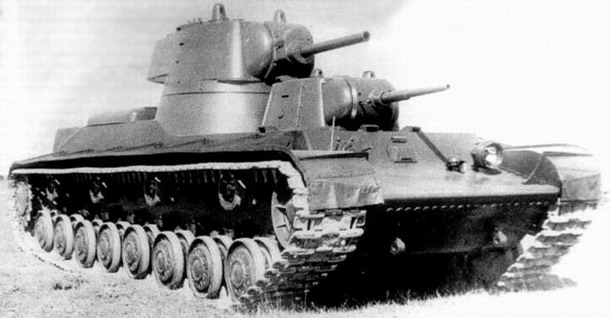
SMK prototype, source: Wikimedia, Public domain, edited
Origins of the Project
Although it cut an impressive figure at military parades, military experts knew perfectly well that the heavy five-turret tank T-35 was far from an ideal fighting machine. In 1938 the army therefore began considering a new heavy tank to replace it. The primary role of the heavy tank was to be the breaking of enemy defensive lines. The emphasis was therefore placed not so much on speed as on heavy armour and powerful — preferably multiple — armament.
Even through the 1930s, Soviet designers had not entirely shaken their attachment to the multi-turret concept, and the first proposals for the new vehicle envisaged three fighting turrets. Eventually, however, the project settled on just two, and with that specification development was launched in 1939. Two design teams worked in parallel on competing proposals under the same brief. The first was the team around chief designer Zh. Y. Kotin, working in collaboration with the Leningrad S. M. Kirov plant. The second team involved in the development was that of S. A. Ginzburg and E. Sh. Paley, whose work produced the tank T-100, which is covered in a separate article.
As early as August 1939, Kotin's team and the Leningrad factory completed the first prototype of their heavy tank, which received the designation SMK. The abbreviation stood for the name of the prominent Leningrad communist Sergei Mironovich Kirov, whom Stalin had executed and then pinned the blame on the opposition — a move that turned Kirov into a celebrated martyr. This was the same S. M. Kirov after whom the Leningrad factory where the tank was built was itself named.
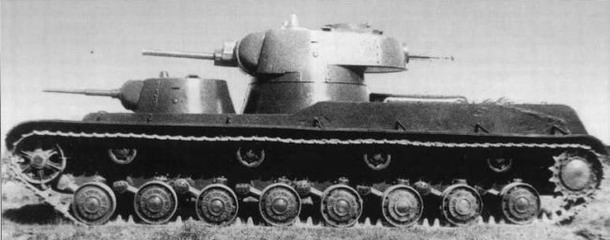
SMK prototype, source: Wikimedia, Public domain, edited
Technical Description
The SMK prototype was a vehicle of truly impressive dimensions. It measured 8.75 metres in length, 3.4 metres in width, and 3.25 metres in height. Its weight was a full 55 tonnes. The considerable length was due primarily to the fact that the two turrets were mounted one behind the other, while the enormous weight was a consequence of the extremely thick armour on the most exposed parts of the vehicle.
The running gear consisted of eight road wheels on each side, each independently suspended and sprung by a torsion bar. The wheels were all-steel and paired. At the front was a spoked idler wheel, and at the rear a solid toothed drive sprocket. Four return rollers supported the upper run of the track. The hull was relatively low. Behind the sharply sloped nose plates rose the front wall of the fighting compartment housing the first two crew members. In the centre of this plate was the driver's vision port, with a 7.62 mm DT hull machine gun to its right.
In the forward section of the hull was the tank's smaller front turret, with a 45 mm cannon and a coaxial DT machine gun in its front face. Behind it, roughly amidships, was the main turret, mounted on a raised circular-section pedestal. This turret housed the tank's primary weapon, the 76.2 mm L-11 cannon. A DT machine gun was coupled to the cannon, and a further machine gun was installed in the extended rear section of the turret. This rear-facing gun, covering the space behind the tank, was not the standard DT but the heavier DShK of 12.7 mm calibre. The modern L-11 cannon was a highly capable weapon, and equipped with it the tank could theoretically destroy any known opponent at a safe distance.
Ammunition stowage comprised 113 rounds for the L-11 cannon and 300 rounds for the secondary 45 mm gun. Thanks to its elevated position on the pedestal, the main turret could traverse a full 360°. The secondary turret's traverse was blocked by the main turret's pedestal and was therefore limited to 270°. While the main turret was positioned on the vehicle's centreline, the secondary turret was offset slightly to the left — most likely to free up space in the forward hull roof for the driver's and machine gunner's hatches.
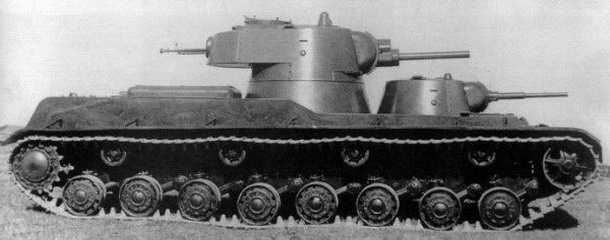
SMK prototype, source: Aviarmor.net with permission, edited
The crew totalled seven men. The two already mentioned — the driver and the hull machine gunner — sat side by side in the very front of the hull, sharing a single circular hatch in the roof above them on the right-hand side. The smaller turret housed the gunner and loader, while the main turret was home to a second loader, the rear machine gunner, and finally the tank commander, who also served as gunner for the main cannon. Each turret had one large circular hatch in its roof. The crew observed their surroundings through a system of periscopes — two mounted in the roof of each turret — and through vision slits in the side walls. Crew members communicated with one another via the internal TRU-6a intercom, while external communications were handled by a 71-TK-3 radio set.
The engine compartment in the rear of the hull housed the GAM-34-BT petrol twelve-cylinder engine producing a maximum of 850 horsepower, connected to a five-speed gearbox. The designers of the SMK were truly unsparing with the armour. The hull nose plates were 60 mm thick, while the front plate in front of the driver's position was a hefty 75 mm. The hull side walls were 60 mm, the rear wall 55 mm, and the roof 30 mm. Turret walls were again 60 mm, with turret roofs at 30 mm. It is hardly surprising, then, that the tank weighed what it did.
Combat Deployment
In September 1939 the SMK prototype underwent factory trials followed by army testing, and when the Winter War with Finland broke out, the decision was taken to send the vehicle into live combat as part of the 20th Tank Brigade. On 17 December the tank arrived by rail at Chyornaya Rechka and was then to advance under its own power toward Summa. Finnish 37 mm anti-tank guns put the armour of the Soviet colossus to the test — but rounds of such a small calibre proved unable to cause the SMK any damage. What eventually halted the tank's advance was a mine, which it ran over, severing a track and probably damaging the running gear as well. The tank was left immobile in no man's land, and the crew had no choice but to abandon it.
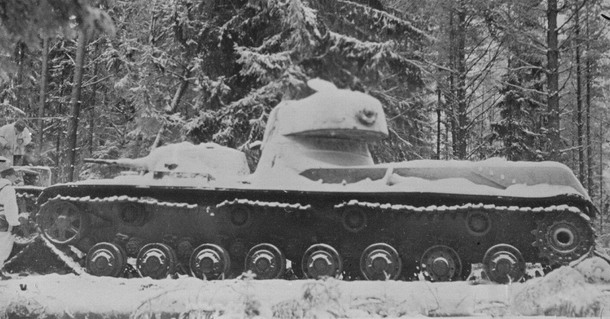
The SMK was committed to combat in Finland on a trial basis, but was disabled by a mine that broke its track — the immobilised vehicle then remained stranded on the spot for several months, source: Waralbum.ru with permission, edited
The Russians found themselves in a decidedly uncomfortable position. They had no recovery vehicle capable of dealing with a 55-tonne monster. Abandoning the tank to its fate was out of the question, however — one can only imagine what would have become of those who allowed the latest Soviet vehicle to fall into enemy hands only lightly damaged. Artillery was therefore moved up alongside the immobilised SMK to prevent the Finns from attempting to tow it away. The Finns reportedly did manage to reach and examine the wreck, but made no attempt to recover it themselves, as they too had no suitable recovery equipment. The stricken SMK remained where it sat until the end of the Winter War, after which the Russians were finally able to tow it away and send it back to Leningrad for repairs. It reportedly took six T-28 tanks harnessed together to haul it away.
Although the SMK was unquestionably more modern and practical than the T-35, it was never approved for series production as the latter's replacement. The episode in Finland almost certainly contributed to this decision, confirming that even such awe-inspiring and expensive steel colossi were in fact easily put out of action. The SMK prototype thus remained the first and last of its kind. Its final fate is unknown, but it seems very likely that the vehicle was scrapped and never saw action in the Second World War. A similar fate befell its rival the T-100, and as the Red Army's standard heavy tank the far simpler and more conventional KV was ultimately chosen instead.
Technical Specifications
Weight |
55 t |
Length |
8.75 m |
Width |
3.40 m |
Height |
3.25 m |
Engine |
GAM-34-BT |
Maximum output |
850 hp |
Maximum speed |
35.5 km/h |
Range – road |
220 km |
Turret armour |
60 mm |
Hull armour |
60 mm |
Armament |
1 x 76.2 mm L-11 cannon 1 x 45 mm cannon 3 x 7.62 mm DT machine gun 1 x 12.7 mm DShK machine gun |
Crew |
7 men |

ARTICLE
CONTENTS:
Reproducing text from the Tankist website without the written consent of the operator is prohibited.