TANK T-100
rejected heavy tank prototype
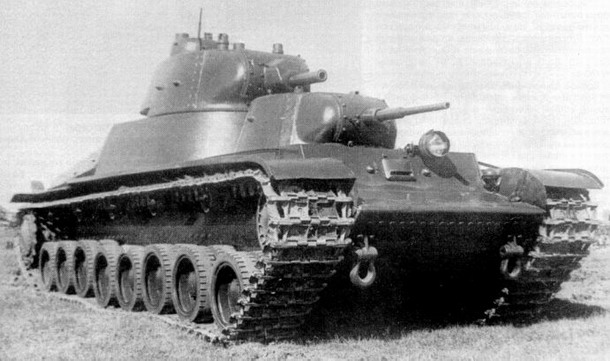
T-100 tank prototype, source: Wikipedia, public domain
Origins
In 1938 the Red Army issued a requirement for a new heavy tank to replace the ageing and unsatisfactory five-turret T-35. In 1939 the specification was handed to two competing manufacturers. Two Leningrad design teams were set against each other: the first led by Zh. Y. Kotin, the second by S. A. Ginzburg. Kotin produced his prototype SMK, while Ginzburg presented the T-100. Since both prototypes were developed to the same specification, their designs were also very similar. Originally three turrets had been planned for both, but on Stalin's personal suggestion the number was reduced to two. In parallel with these two, a third prototype was also under development — one with a single turret — which later entered history as the production heavy tank KV.
Design Description
The T-100 rode on a chassis consisting on each side of eight paired road wheels of solid construction with rubber tyres around the rim, each independently suspended and sprung by leaf springs. At the front was a spoked idler wheel; at the rear the drive sprocket. Five small-diameter return rollers supported the track from above. The hull was welded. At the front was a very sharply pointed nose from which the front wall of the fighting compartment rose. In the centre of this wall was the driver's vision port, which in combat areas could be closed by a cover, leaving only a narrow slit for observation. Behind this port sat the driver — and according to some sources, a radio operator as well.
Behind the fighting compartment was the first, smaller turret. It was conical with a circular footprint, from which a front plate protruded carrying the armament: a 45 mm Model 1938 gun and, to its left, a 7.62 mm DT machine gun. In the turret roof was a large hatch closed by a single-piece cover. Behind the first turret, a raised section of hull began, and on top of it sat the second, main turret. The raised hull and main turret restricted the traverse of the forward turret. The main turret had no such restriction and could rotate through a full 360°. It had an elongated rear and conically sloped walls. In its front wall was the L-10 gun of 76.2 mm calibre, with a DT machine gun to its left. The gun was later probably replaced by the more modern L-11. In the left section of the main turret roof was a hatch; to the right was the commander's cupola. The cupola rose above the roof line and housed a third DT machine gun.
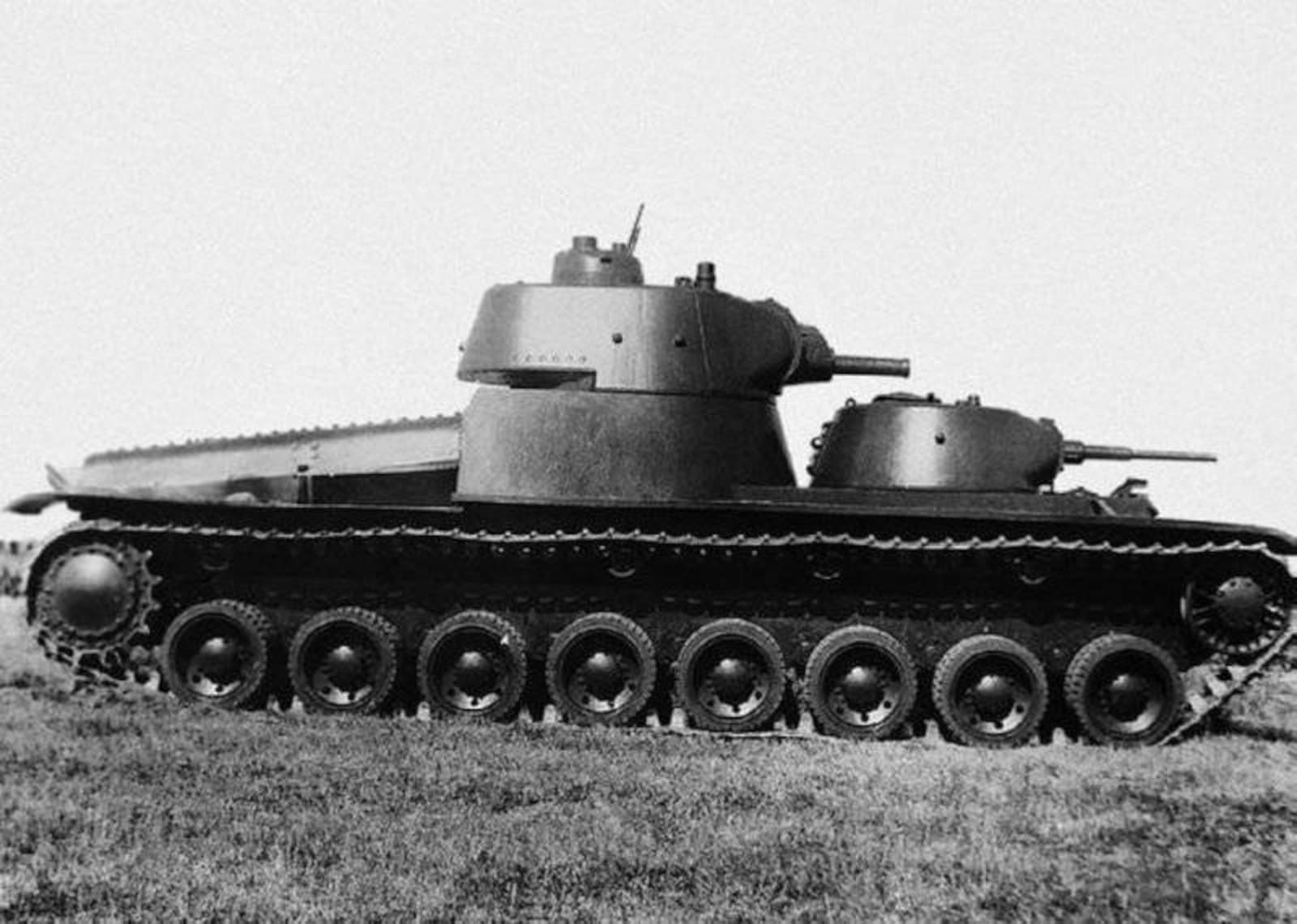
T-100 tank prototype, source: Flickr.com
Ammunition stowage comprised 150 rounds of 76.2 mm, 300 rounds of 45 mm and 4,284 machine gun rounds. Armour thickness was 60 mm on all walls except the roof panels and hull floor. Roofs were 20 mm and the floor 20 to 30 mm. At the rear was the engine compartment housing a twelve-cylinder GAM-34-BT developing a maximum of 850 hp. The crew consisted of six or seven men: the driver seated in the centre of the hull, a gunner and loader in the secondary turret, and a gunner, loader and commander in the main turret. The disputed seventh crew member was a radio operator, mentioned only in some sources, whose theoretical position was in the hull alongside the driver.
Combat Service
Assembly of the prototype was completed in August 1939, and trials began shortly afterwards. In September the T-100 was sent to Moscow, where on the 23rd of that month it was demonstrated to senior military and political figures alongside the competing prototypes SMK and KV. During these comparative trials the single-turret KV performed best of all, but none of the three prototypes was yet written off as a candidate for series production.
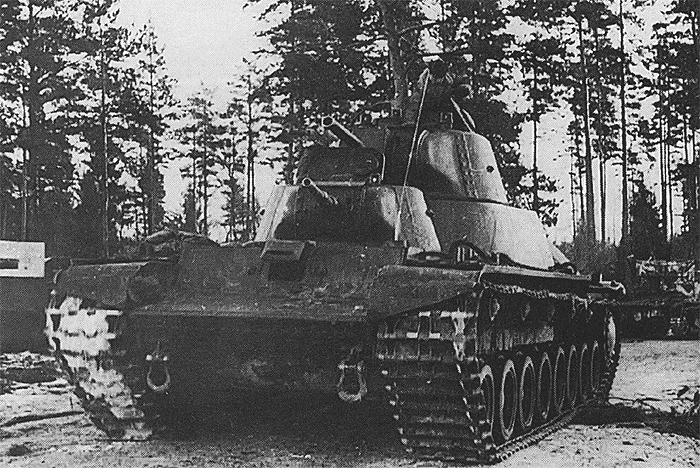
T-100 tank prototype deployed during the Winter War against Finland, source: Flickr.com
When the Winter War with Finland broke out on 30 November 1939, a decision was made to commit all three prototypes to live combat. It is evident that this was done primarily for testing purposes rather than out of any shortage of other equipment — the Soviets enjoyed a tank superiority over the Finns of roughly 200:1. The T-100 was deployed as part of the 20th Heavy Tank Brigade. This was, however, not only the vehicle's first combat appearance but also its last. After the Winter War ended, the T-100 was transported back and most likely scrapped. The SMK prototype likewise came to nothing, and the far simpler heavy tank KV was selected for series production.
Originally two prototypes of this tank had been ordered, but instead of the second example, a self-propelled gun designated SU-100Y was built on the tank's chassis.
Technical Specifications
Weight |
58 t |
Length |
8.49 m |
Width |
3.40 m |
Height |
3.43 m |
Engine |
GAM-34-BT |
Maximum power |
850 hp |
Maximum speed |
35.7 km/h |
Range – road |
200 km |
Turret armour |
60 mm |
Hull armour |
60 mm |
Armament |
1 × L-10/L-11 gun, 76.2 mm 1 × gun, 45 mm 3 × DT machine gun, 7.62 mm |
Crew |
6–7 men |

ARTICLE
CONTENTS:
Reproducing text from the Tankist website without the written consent of the operator is prohibited.