TANK T-35
the mastodon with five fighting turrets
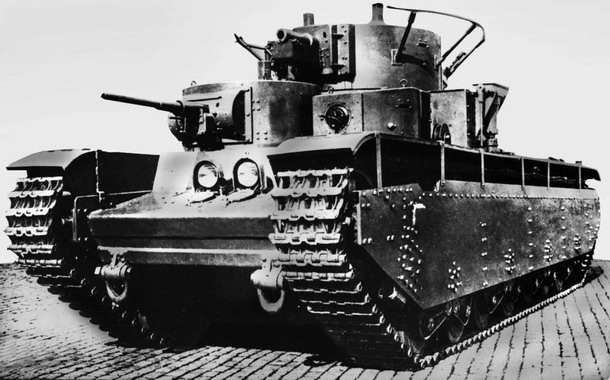
T-35 tank with a frame antenna mounted around the turret, source: Wikimedia, Public domain, modified
Origins of the Tank
Around the turn of the 1920s and 1930s, a genuine craze for multi-turreted tanks swept across the European powers. The prevailing theory held that tanks with multiple turrets could engage several targets simultaneously, making them highly effective on the battlefield. Vehicles of this concept were developed and tested in Britain, France, and — illegally — in Germany as well, though most nations quickly abandoned the idea. The Soviet Army, naturally, did not want to be left behind, and so the Russians too began work on multi-turreted designs in both the medium and heavy weight categories. While other European armies soon concluded that the disadvantages of such a complex design outweighed the benefits, the Soviets pressed on and brought two of their multi-turreted machines all the way to series production. These were the medium tank T-28 and the heavy T-35.
Development of the T-35 began in 1930, led by a Leningrad design team under N. V. Baryakov. The prototype was completed in July 1932 and immediately entered military trials, first at the Moscow Military Academy and later at the Kubinka proving ground. A second prototype was finished in 1933 and underwent further testing.
Early Prototypes
The first prototype weighed 37.7 tonnes. Its running gear consisted on each side of six road wheels, a rear drive sprocket, a front idler wheel, and six return rollers supporting the track from above. Nearly the entire suspension was covered by armoured skirts intended to protect it from enemy fire. The hull was constructed from flat steel plates joined by a combination of welding and riveting. The prototype differed from the later production tanks in a number of ways — most notably in the design of the frontal hull armour, which was angled, with a hull machine gun embrasure recessed into its right half.
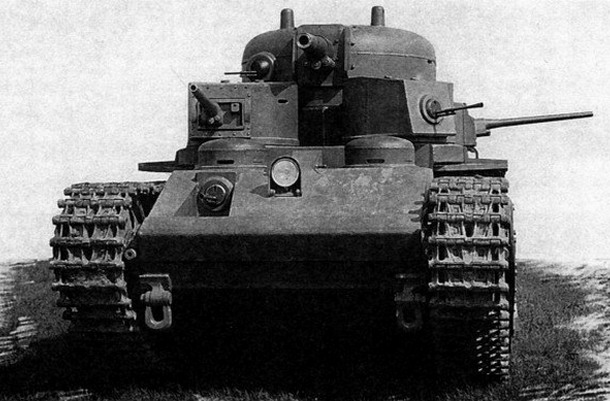
T-35 prototype — note the hull machine gun embrasure and the rounded roof of the main turret, source: Topwar.ru with permission, modified
Arranged over the front two-thirds of the hull were five independent turrets. The main turret sat centrally, aligned with the vehicle's longitudinal axis. Unlike the production vehicles, the first prototype's main turret had a rounded transition between the roof and the side walls. It housed the tank's primary weapon, the PS-3 gun of 76.2 mm calibre, co-axially paired with a 7.62 mm DT machine gun. Ahead of and behind the main turret were two pairs of smaller turrets. In each pair, one turret carried a 37 mm B-3 gun, while the other was armed with a machine gun only. At the front, the gun turret was on the right and the machine gun turret on the left; at the rear, the arrangement was mirrored. The gun and machine gun turrets were very similar in size and construction.
The rear of the hull housed the engine compartment, containing a petrol M-17 M engine developing a maximum of 500 horsepower, paired with a four-speed gearbox. The prototype was crewed by nine men. In the very front of the hull sat the driver and the hull machine gunner side by side — driver on the right, gunner on the left. The rest of the crew were stationed in the turrets. The main turret housed the tank commander, the gunner, and the loader. Each subsidiary turret had one man who served simultaneously as both gunner and loader.
The second prototype represented a transitional step between the first vehicle and the eventual production standard. Like the later series tanks, it featured a main turret with a flat roof and a sharp edge between the roof and the side walls — a far simpler arrangement to manufacture than the rounded design of the first prototype. The running gear, however, remained unchanged with only six road wheels. This second prototype weighed 42 tonnes.
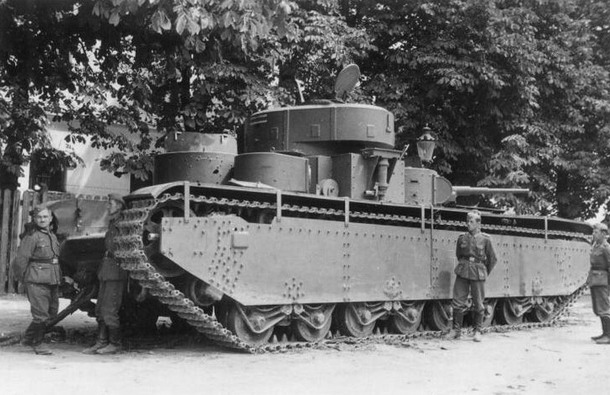
German soldiers beside an abandoned T-35 tank, source: Aviarmor.net with permission, modified
Series Production
The results of testing on both prototypes evidently convinced Soviet officials of the new heavy tank's merits, as series production was approved on 11 August 1933. Manufacturing was entrusted to the Kharkov Factory No. 183. Before production began, however, several design changes were introduced to improve the series vehicles over the prototypes. Most significantly, the running gear was redesigned: each side now carried eight road wheels with rubber tyres, mounted and sprung in pairs. The increased number of wheels was intended to improve the tank's ride characteristics.
The main turret received a new weapon in the production version — the more modern KT-28 gun of 76.2 mm calibre. The subsidiary gun turrets were also entirely new, noticeably larger than the machine gun turrets. Along with this came a change of armament: the original 37 mm subsidiary guns were replaced by the 20K model 1932 gun of 45 mm calibre, and a machine gun was added to each of these turrets as well. The hull machine gun of the prototype disappeared entirely, as the front hull design was completely revised. The arrangement of the turrets remained unchanged from the prototypes. Ammunition stowage amounted to approximately 100 rounds for the main gun, 225 rounds of 45 mm ammunition, and nine to ten thousand rounds of machine gun ammunition.
The crew of the production tanks grew to eleven men. Since the subsidiary gun turrets were now larger, a dedicated loader was added to each. The position formerly occupied by the hull machine gunner — who had lost his weapon — was taken by a mechanic responsible for dealing with any technical problems that might arise on the move. The driver and mechanic shared a single access hatch located above the driver's seat. The turrets had their own roof hatches: one per machine gun turret, and two each for the gun turrets and the main turret.
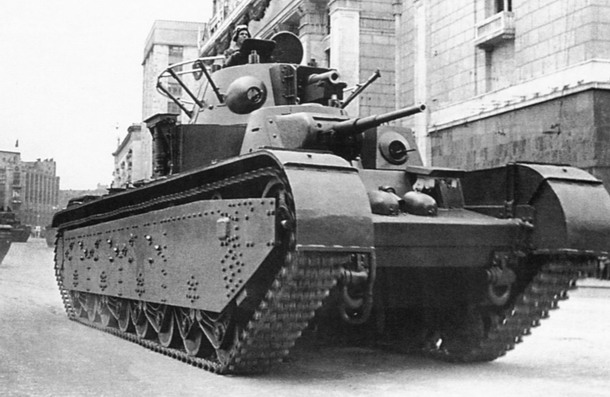
Late-production T-35 with conical turrets, source: Topwar.ru with permission, modified
The tank was a truly imposing machine. It measured 9.72 metres in length, 3.20 metres in width, and stood 3.44 metres tall. The frontal hull armour was 30 mm thick, with 20 mm on the sides and rear. The main turret had 25 mm of armour at the front and 20 mm on the sides and rear.
From 1937, tanks began to receive armour that was three millimetres thicker, pushing the total weight up to 52 tonnes. To compensate for the increased mass, the powerplant was also upgraded — a new M-17 engine with a displacement of 46.9 litres and a maximum output of 580 horsepower was fitted. The engine was notably thirsty, consuming around 600 litres of petrol per 100 kilometres on road; cross-country consumption was even higher. Given that the fuel tanks held "only" 900 litres, the tank's operational range was not particularly impressive. A radio for communication with other tanks was not part of the standard equipment; vehicles that carried one can be identified by the frame antenna mounted on brackets around the main turret. For internal communication among the large crew, a TPU-7 intercom system was fitted.
Series production of the T-35 in this form ran from 1934 to 1938, yet in that entire period only 43 tanks were built. In 1939 an upgraded version entered production, in which all five turrets were replaced with new ones featuring sloped walls that offered greater resistance to enemy fire. The frontal hull armour was also increased to 50 mm, which pushed the weight up to 55 tonnes. Only six of these upgraded T-35s were completed.
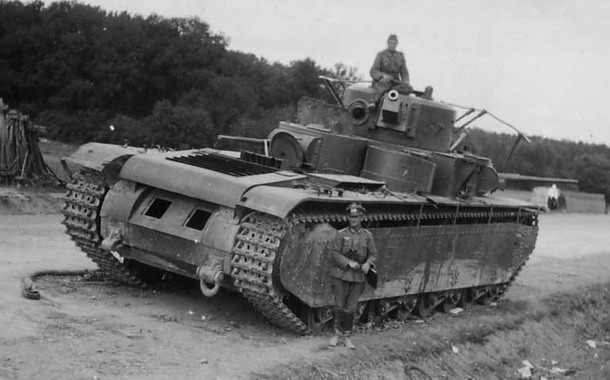
German soldiers beside a knocked-out T-35 tank, source: Aviarmor.net with permission, modified
Combat Deployment
The T-35s enjoyed their golden age in the pre-war years, when they never failed to impress crowds and military officials at parades and reviews. Only experts and insiders knew the truth behind those spectacles. Before such events, selected tanks were placed in garages and given the best possible care. Their crews had very little practical experience, since they were barely permitted to train with their own vehicles. Soviet propaganda, meanwhile, boasted of photographs and footage of steel colossi unlike anything fielded by any other nation — and indeed, other countries had wisely recognised that the whole multi-turret concept delivered far less than promised, and had not wasted resources building such monsters.
The war with Nazi Germany, which broke out on 22 June 1941, exposed the T-35's shortcomings in full. During the retreat of Soviet forces from Ukraine eastward, the majority of these tanks were lost not to enemy action by the Wehrmacht, but primarily to mechanical breakdowns that could not be repaired quickly in the field. The Germans came across abandoned hulks from which the Russians had stripped the weapons and then either blown up or simply left behind. Some T-35s did see active combat against the Germans, though their successes are not widely recorded — which says a great deal about how little there was to record.
To this day, only a single T-35 survives, and it can be seen at the Kubinka Tank Museum.
Technical Specifications
Weight |
52 t |
Length |
9.72 m |
Width |
3.20 m |
Height |
3.44 m |
Engine |
M-17m |
Maximum Power |
580 hp |
Maximum Speed |
30 km/h |
Road Range |
150 km |
Turret Armour |
20–25 mm |
Hull Armour |
20–30 mm |
Armament |
1 × 76.2 mm gun 2 × 45 mm gun 5 × 7.62 mm DT machine gun |
Crew |
11 men |

ARTICLE
CONTENTS:
Reproducing text from the Tankist website without the written consent of the operator is prohibited.