TANK CREW UNIFORMS
what soldiers of the German armoured force wore
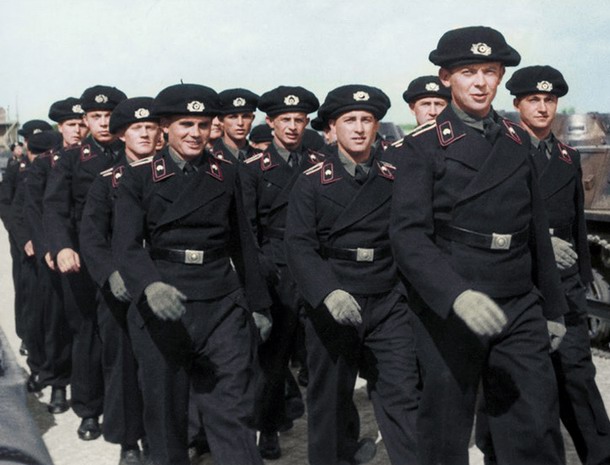
German tank crewmen in a pre-war photograph wearing the black Sonderbekleidung der Kraftfahrkampftruppen uniform with first-pattern jackets, source: flickr.com, edited
World War One
The first German tank crewmen, who served aboard A7V tanks toward the end of the "Great War", had no specialised uniforms. Inside their vehicles, however, they wore a linen overall with asbestos fibres over their regular uniform, intended to protect them both from grime and from the risk of fire. Another "clothing accessory" was a leather helmet designed to prevent head injuries against the tank's interior walls. Crew members also received face masks with metal mesh eye guards, meant to protect the wearer from splinters that might penetrate through the narrow vision slits if these were struck from outside. Among the crews, however, these masks were reportedly highly unpopular and in practice were most likely seldom used. In any case, one man in full kit (i.e. overall, leather helmet and face mask) can be seen in the photograph HERE.
The Black Uniform
German tank crews did not receive their own proper uniforms until many years later, in 1934. The so-called Sonderbekleidung der Kraftfahrkampftruppen was first described in Army Gazette Allgemeines Heeresmitteilung No. 85 of 12 November 1934. This entirely new-cut black uniform was designated, according to that gazette, for the crews of tanks and armoured cars, and was to be worn only while serving on the vehicle. Responsibility for designing, specifying and preparing a pattern for the new type of uniform rested (as with other uniform types) with the army office known as the Allgemeines Heeresamt. This office subsequently also contracted commercial clothing companies to produce the uniforms in series to precisely defined specifications — among them, for example, the firms of Hugo Boss and Peek & Cloppenburg (no joke). Other firms supplied accessories such as buttons, buckles, metal eagles, cockades and so on — for example, the firm of F. W. Assmann und Söhne, whose catalogue can be viewed HERE, HERE or HERE.
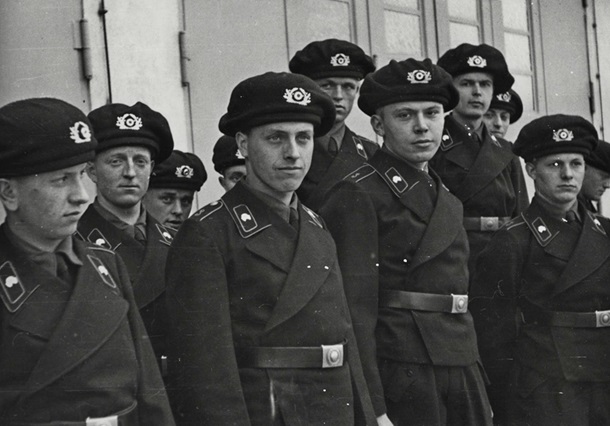
Most likely a group of new tank force recruits outside barracks garages; the soldiers are wearing first-pattern jackets and early-version berets on which the Reich eagle has not yet been added, source: flickr.com, edited
For commercial companies this was highly attractive business, as the army placed orders for uniforms in runs of many thousands. Deliveries went to clothing depots (Heeresbekleidungs-Abteilung) and from there to individual units and the soldiers themselves. The army also allowed soldiers to have a uniform tailored privately at their own expense, provided the basic regulations were observed. The main advantages of such a privately obtained uniform were naturally a made-to-measure fit and the option to choose higher-quality materials. The relevant unit commander then had to assess whether such a "private" uniform met the standard before its owner could wear it on duty (such a privately tailored uniform can be seen, for example, in the photograph HERE — notice the very non-standard size and shape of the collar lapels). Officers, as a somewhat separate category, generally sourced their uniforms at their own expense as a matter of course.
Back to the tank crews. The design of the new tank uniform was by no means produced solely at a drawing board. Research and testing aimed at refining the uniform's form had been underway in motorised transport units since 1932. Enormous emphasis was placed on practicality. The result was a garment consisting of comfortable loose trousers, a short close-fitting jacket and a beret with an internal protective lining — all in black (plus a number of other clothing items, which will be discussed below). Everything was well thought out and tested. The loose trousers were intended to provide comfort during long periods of sitting and crouching inside the vehicle (standing upright inside a tank was essentially impossible). The close-fitting jacket without any external pockets reduced the risk of the garment catching on the many protrusions inside the fighting vehicle's interior. The beret with its internal padding protected the head against injury on the tank's walls, while black concealed the oil and petrol stains that would have badly disfigured a lighter-coloured uniform. Under the jacket, a dark grey shirt and a black clip-on tie were normally worn.
Panzerfeldjacke
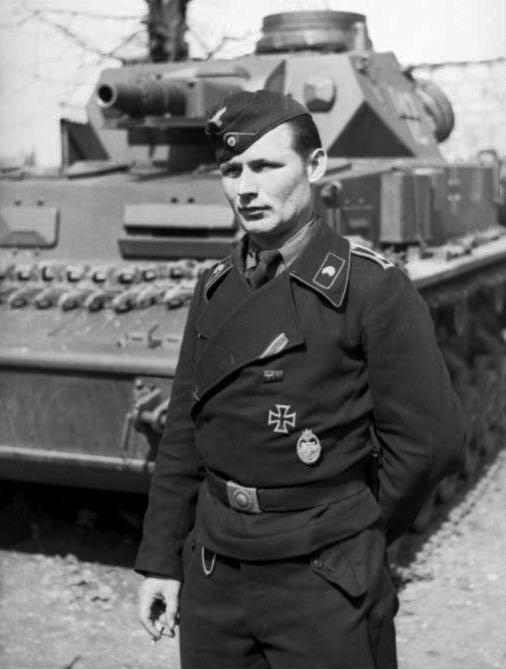
This tank crewman is wearing a second-pattern jacket and the M34 "Schiffchen" side cap for NCOs and other ranks, source: Bundesarchiv_Bild_101I-246-0743-03, Wikimedia, Creative Commons, edited
The most distinctive element of the tank uniform was undoubtedly the black jacket, the so-called Panzerfeldjacke. The jacket was made of wool and had large lapels around the collar, whose upper section was edged with a piping of pink artificial silk — pink being the branch-of-service colour (Waffenfarbe) of the tank arm. The lapels were further adorned with the tank corps insignia: white-grey death's head skulls with crossbones on a black rhombus with a pink border. The skulls were metal and were clipped to the backing fabric by hooks on their reverse side. These insignia did not indicate the wearer's rank but only his membership of the tank troops, and were therefore the same for all grades. Rank distinction was provided by the shoulder straps (which also had pink piping) and by the standard rank insignia on the left sleeve.
The body of the jacket was sewn from four main panels — rear left and right joined by a central back seam, and front left and right. When fastening the jacket, the left front panel was folded over the right and secured by internal buttons. Virtually all buttons on the jacket were internal, to eliminate the risk of snagging during rapid movement inside the fighting vehicle. For the same reason the jacket had no external pockets — it did, however, have two large internal pockets, one in each front panel. The pocket in the left panel was positioned so that it remained accessible even with the jacket fastened. The lower part of the left lapel, which was fully visible when the jacket was fastened, also served as a place to display award ribbon bars such as the ribbon of the Iron Cross 2nd Class. Actual decorations were worn on the left front of the jacket beneath the lapel. The lower part of the left lapel could also be folded upward and fastened with a hook beneath the right collar, bringing the jacket up to the neck and providing extra warmth. The first black jackets of 1934 and 1935 did not yet have the German eagle with swastika sewn onto the right breast — this was introduced in November 1935 and became standard from that date.
The jacket also had shoulder straps. On the earliest tank uniforms the shoulder straps were sewn to the jacket all the way around their perimeter — again most likely to eliminate the risk of snagging on something inside the tank. Later shoulder straps came in two variants: one was sewn to the shoulder only at the outer end while a button held the collar-side end in place; the other was attached only by a loop and button and could therefore be easily removed. On early uniforms, embroidered numerals or letters (or combinations of both) appeared on the shoulder straps. The large Arabic numerals indicated the wearer's assignment to a specific armoured unit — in this case the number of the Panzer Regiment. A letter indicated the type of unit: for example A for Aufklärung (reconnaissance), P for Panzerabwehr (and later Panzerjäger, anti-tank), or L for Panzer-Lehr (training units).
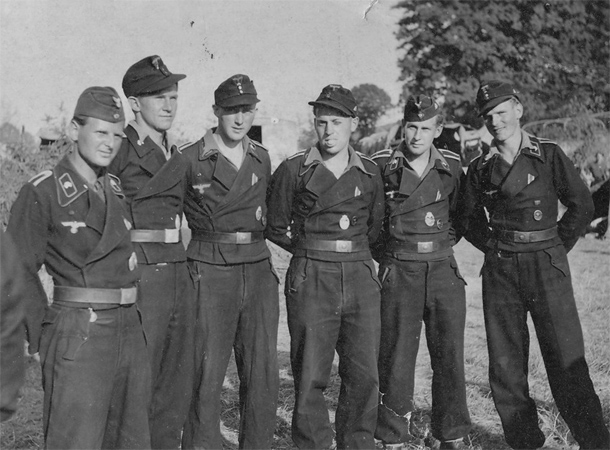
This photograph dates from a later period; the soldiers are wearing second- and third-pattern jackets and M34 and M43 caps (with peaks), source: flickr.com, edited
Specific letter combinations also appeared on shoulder straps indicating assignment to various "élite" units — for example GD for the Grossdeutschland regiment. Before the war and in its early stages, the number of units whose members wore tank uniforms was not particularly large, so the use of permanently embroidered numerals and letters on shoulder straps was quite manageable. As the number of such units grew, soldier turnover between them naturally increased as well. To avoid having to re-embroider a shoulder strap for each such transfer, simple removable strips onto which the relevant markings were embroidered were introduced from around 1940, and these were simply slid onto the jacket's shoulder straps. Over time even this practice was abandoned.
Tank crews inherited pink as their Waffenfarbe from the motorised transport units of the inter-war Reichswehr, the Kraftfahrtruppen — the very units from which the German armoured force was born and whose pink colour it adopted. The allocation of colours to the various branches of service was not quite as straightforward as it might seem, but more on that later. The origin of the German tank crews' symbol — the death's head skull with crossbones — is not entirely clear from the literature. It is true that the first German panzer division was formed by reorganising the 3rd Cavalry Division of the Reichswehr, which included, among other units, the 13th Prussian cavalry regiment. Prussian hussars had worn the skull and crossbones on their shakos as far back as the 19th century. It is also true that German tank crews had been painting skulls and crossbones on their A7V tanks as early as the First World War (though at that time it was not any official emblem of the tank arm but rather a kind of "ornament" intended to strike fear into the enemy). In any case, the skull became — one way or another — the symbol of the German armoured force, and enemies reportedly sometimes confused captured Wehrmacht tank crewmen with members of the Waffen-SS, whose symbol was a similar death's head skull. (For interest: Scott Pritchett, in his monograph Panzerfeldjacke, describes 18 different versions of the metal skull badge used on the collar of tank crew uniforms.)
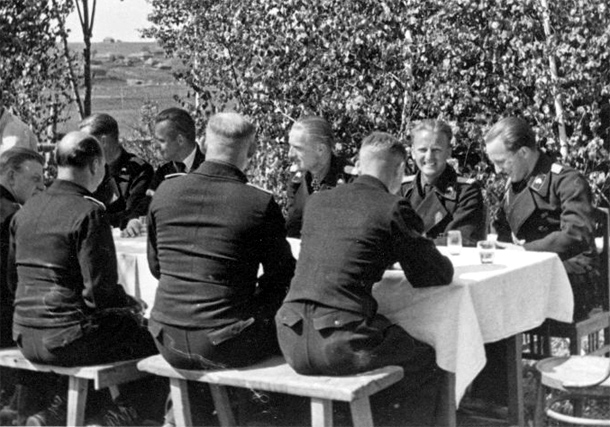
The Wehrmacht tank crew jacket had its back cut from two pieces of fabric joined by a central back seam, while the Waffen-SS tank jacket had its back cut from a single piece, source: flickr.com, edited
As noted above, the new black uniform was not issued only to tank crews but also to armoured car crews, who fell primarily under various reconnaissance units. The same uniform was also issued to crews of armoured vehicles serving with the artillery as forward observation posts, to recovery and support armoured vehicle crews from engineering units, and later to the crews of the first self-propelled guns and first tank destroyers as well. As a result, the black jackets can be found with piping in colours other than pink. In addition to the tank arm's pink, a further six Waffenfarben were authorised for use on the black Panzerfeldjacke during the years 1936 to 1945: red (hochrot) for artillery personnel, golden yellow (goldgelb) and brown (kupferbraun) for reconnaissance units, lemon yellow (zitronengelb) for signals, black-and-white interwoven (schwarz-weissdurchwirkt) for engineers, and finally pure white (weiss) designated solely for the Führer-Begleit-Bataillon. In practice, however, the use of the correct Waffenfarbe within a panzer division was not rigidly enforced, so many soldiers wore uniforms with pink piping simply because the right size happened to be available.
Sometime around the turn of 1936–37, a new version of the tank jacket was introduced with a revised fastening method and enlarged upper collar lapels. It is precisely by the lapels and the position of the rhombus badge with the skull that this version can be distinguished from the first pattern. Apparently from around 1940 a third and final version of the jacket began to appear in production, in which the pink piping on the upper part of the lapels was eliminated — leaving only the piping around the collar tabs (around the rhombus badge with the skull). From 1942 onwards only this version was manufactured. A simplified comparison of the individual jacket patterns can be seen HERE.
Trousers
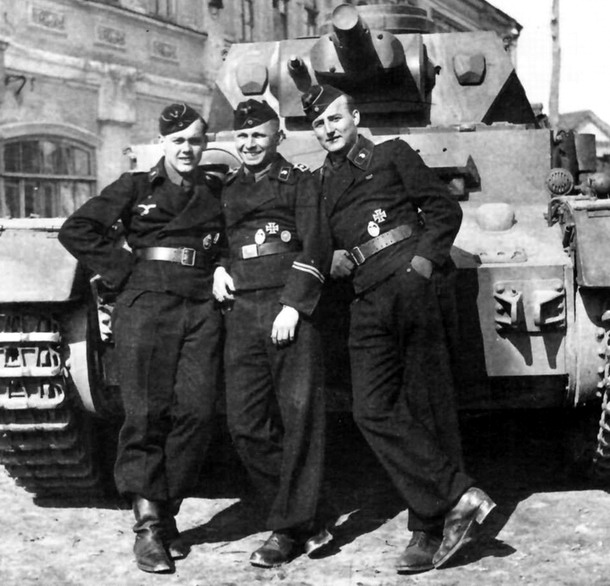
While the tank crew jacket was close-fitting to prevent snagging on obstacles during movement, the trousers were relatively loose-cut to allow comfortable movement even when crouching, source: worldwarphotos.info with permission of the operator, edited
Trousers were of course also part of the black uniform. As already mentioned, these were loose-cut trousers with a front button fly and three pockets, each closed by a three-pointed scalloped flap with a button. The trousers also incorporated a concealed fabric waistband with a simple buckle. The standard leather belt worn over the jacket did not therefore hold the trousers up (nor could it, being worn over the jacket). For tank crewmen the leather belt did not serve to carry ammunition, a dagger or a canteen as it did for infantrymen — it served only to carry the black leather holster for a personal pistol. And only outside the vehicle; inside the tank itself, a holster on the hip would have been more hindrance than help, as it would catch on various protrusions. The trouser legs had a short slit with a button and a drawstring at the bottom, making it easier to tuck the cuffs into boots.
Headgear
Headgear was another component of the uniform. The first version was a special beret called the Schutzmütze. The beret consisted of an inner rubber protective liner over which the outer fabric shell was fitted. The inner liner was intended to protect the head from injury against the tank's wall, for example when driving over rough terrain. The liner had seven ventilation holes and a leather sweatband for the forehead. On the front of the outer beret, the national eagle (Reichsadler), cockade and wreath of oak branches were machine-embroidered in white thread. Originally these motifs were embroidered directly onto the beret; later they were embroidered onto a black backing which was then sewn onto the beret.
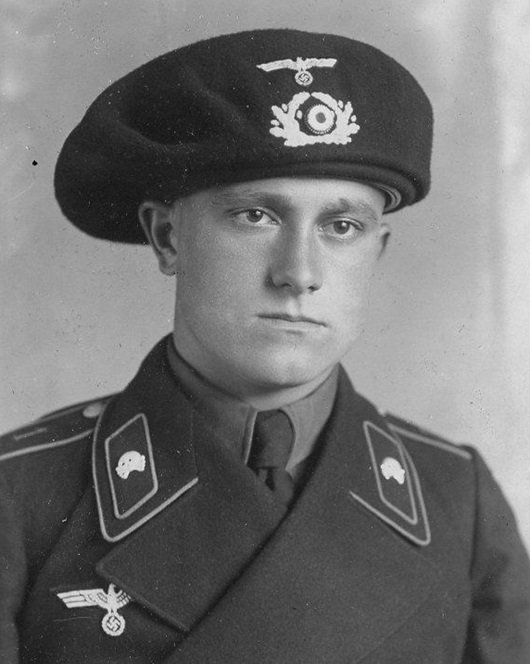
The early tank crew beret provided good head protection but also interfered with the fitting of headphones (the beret in this photograph already has the Reich eagle in addition to the cockade), source: flickr.com, edited
The beret was officially withdrawn from tank crew kit by an order of 15 January 1941. It had proved impractical in combination with the communication headphones. The headphones were connected across the top of the head by a metal band (usually covered in leather or leatherette) and the bulky beret prevented comfortable fitting of the headphones. Nor was the beret particularly elegant — quite the contrary — and it was therefore not especially popular either. Production of these berets also ended in 1941, though they continued to be used in smaller numbers thereafter.
Already in March 1940, two further types of headgear had been officially authorised for the armoured force alongside the beret. These were derived from two commonly used field caps known as Schiffchen (literally "little boats" — the equivalent of the English term "side cap"). In official German nomenclature these were the M34 and M38 caps. The tank crew variant was naturally produced in black, and the inverted-V peak embroidered on the front of the cap was done in pink. The cap based on the M38 pattern was intended for officers, while the M34 was for NCOs and other ranks. As is clear at a glance, these new types of headgear offered considerably less head protection than the old beret. They did not, however, interfere with fitting headphones, with the use of optics and vision ports, and were light and comfortable to boot — all of which made them far more popular than the original berets. In 1943 a new "universal" field cap arrived, the Einheitsfeldmütze or M43. This too was produced in black, and toward the end of the war was apparently the most common headgear among tank crewmen.
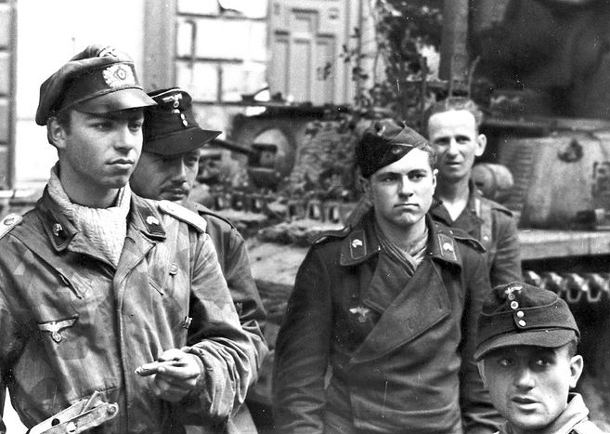
A fine collection of tank crew headgear — from left to right: the soft officer's Knautschmütze, the officer's M43, the M34 Schiffchen, and finally the M43 for other ranks, source: flickr.com, edited
Another type of headgear used in the German army as part of service dress for all ranks was the peaked cap, the Schirmmütze. In 1934 a soft (collapsible) version of this cap was introduced for officers, known as the Knautschmütze. It had a smaller, unsupported crown, a flexible peak and no chin strap. This cap was not produced in a special tank version (i.e. in black), but because it was elegant and practical it became very popular among tank force officers. Its practicality lay above all in the fact that it did not interfere with the fitting of headphones while still providing a reasonable degree of head protection. Although the Knautschmütze was officially withdrawn in April 1942, it was so popular that many soldiers continued to wear it until the end of the war. The army apparently tolerated this and the cap even acquired a new designation — Offizierfeldmütze älterer Art (officer's field cap, old pattern). Since new Knautschmützen were no longer being issued after 1942, soldiers (particularly tank crewmen) "manufactured" their own by removing the internal wire stiffener that maintained the rigid shape of the crown from a standard Schirmmütze.
Service Dress
The black uniform described above was primarily intended to be worn on duty aboard a fighting vehicle. For general wear, tank crewmen — like all other soldiers — had standard service dress at their disposal. Its principal item was a field-grey jacket. The wearer's membership of the armoured force was indicated on the jacket only by pink piping on selected elements (the edge of the fastening, the edges of the shoulder straps, or the backing of the collar tabs). For service dress wear, straight trousers, black shoes, a leather belt and a Schirmmütze were worn with the jacket (as well as a dress dagger, where applicable). For ceremonial occasions, riding breeches, high leather boots, a steel helmet, a dress belt and, for officers, aiguilettes and a sabre were worn with the jacket.
As noted, when wearing the grey service jacket the wearer's membership of the tank arm was indicated only by the unobtrusive pink accessories — not much at first glance. The black service uniform, by contrast, proclaimed its wearer's identity at a glance. Tank crewmen were very proud of their assignment and logically also proud of their black uniform. It is therefore no surprise that they wore it on every possible occasion even outside the official regulations. The army command decided not to fight this but instead to sanction the practice, and so the black uniform was officially approved in 1941 as service dress as well — meaning it could be worn off duty outside the vehicle.
The White Jacket
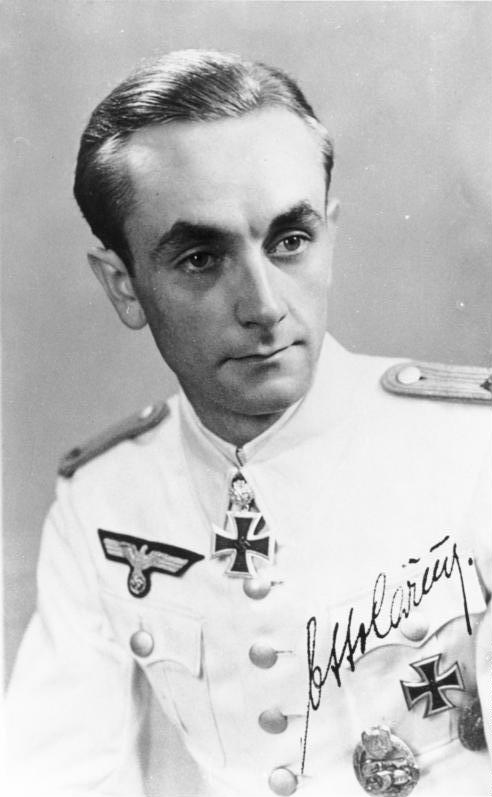
Otto Carius in the white summer jacket; the sewn-on textile eagle on the chest is very unusual for this garment — the standard version had a detachable metal eagle (for easier washing), source: Bundesarchiv_Bild_146-1979-064-06, Wikimedia, Creative Commons, edited
Officers and senior NCOs of the tank force (and not only the tank force) could also wear the so-called summer uniform — a uniform with a white jacket. Its wear was, however, permitted only from April to September, and was originally restricted to certain types of occasion such as civilian functions, sporting events, horse riding, portrait sittings and similar. From 1937 the white jacket was most likely also approved as part of service dress. For interest, it is worth noting that all accessories of the white jacket (buttons, shoulder straps and even the national eagle on the chest) were detachable — not permanently sewn on — to allow more frequent washing. Service uniform, service dress, white jacket... and we are still far from finished. By now it should be clear that a German tank crewman's wardrobe did not contain just one garment :-).
Winter Clothing
In terms of winter clothing, tank crewmen were subject to the same standard as all other German soldiers — meaning they received the long grey-green wool greatcoat with a dark green collar and double-breasted button fastening. This coat was not particularly popular among tank crewmen, however. It was unnecessarily long for their purposes and impeded movement inside the cramped interior of a fighting vehicle (soldiers were essentially treading on it). After the experience of the first Russian winter at the turn of 1941–42, the German Army supreme command concluded that the existing long coat did not meet the needs of the Eastern Front, and development of a new winter uniform was initiated. Following rapid tests in Finland, the uniform was approved in April 1942 and the army ordered production of a full one million items.
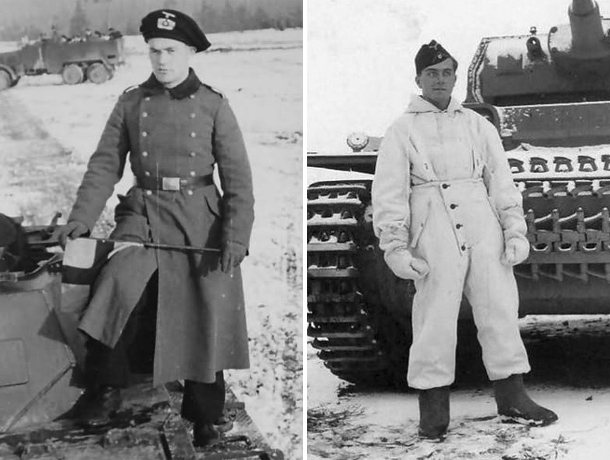
Left: the original winter greatcoat, which was rather unsuitable for movement inside a tank; right: the newer winter "set" of quilted reversible trousers and jacket (the soldier in the photograph has his jacket tucked into his trousers in a highly unusual fashion), source: flickr.com, edited
For the winter of 1942–43, German tank crewmen therefore had a new, much shorter hooded winter jacket at their disposal. The jacket was quilted and fully reversible — meaning all buttons, pockets and other features "worked" from both sides (front and back). One side of the jacket was plain white (photo HERE), while the other was initially field grey (photo HERE), though it was later made from fabric printed with a camouflage pattern (photo HERE). The white side of the uniform naturally suffered badly from the grease inside tanks and did not stay clean for long. The winter kit also included reversible quilted braces trousers (photo HERE), gloves, and sometimes a separate balaclava. The balaclava had cut-outs at the ears so as not to impede listening through headphones (photo HERE). The gloves were originally thick "trigger mittens" (photo HERE), which certainly kept hands warm but were presumably rather difficult to work in. Later, lighter knitted gloves appeared in which the index finger was separated from the thumb to allow the pressing of triggers, headphone switches and so on (photo HERE).
Africa
German tank crewmen had to contend not only with the Russian winter but also with the African heat. Their black wool uniform was of course entirely unsuitable for the African climate, yet no special tank crew uniform was available. Rommel's tank crews in North Africa therefore received the same tropical uniforms as all other German soldiers. This uniform was developed in 1940 by the Institute for Tropical Research at Hamburg University. It was made from a sturdy but lightweight cotton drill — initially in olive green, later in light brown. According to S. Pritchett, these uniforms were supplied in at least four different colours, but under the harsh conditions of the North African battlefield they faded progressively to a light khaki shade. The tropical jacket had no lining, only cotton reinforcements in the armpits and sides. Originally it was worn with riding breeches and high lace-up fabric-and-leather boots; later, long loose trousers tucked in at the ankle with ankle boots and knee-length shorts were also introduced.
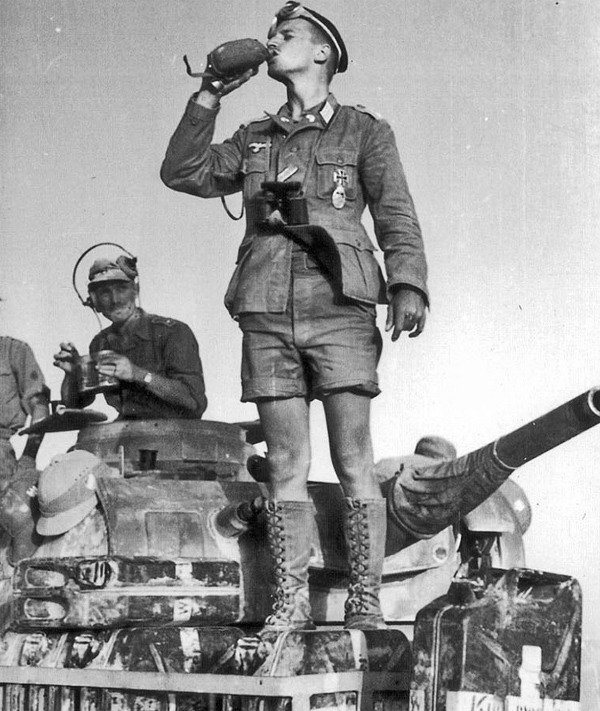
A fine example of tropical tank crew dress: the standard tropical jacket with tank crew skulls clipped to its collar, cotton shorts, and high lace-up fabric-and-leather boots; tropical helmets hang on the sides of the turret, source: flickr.com, edited
Under the jacket an olive green shirt was worn, and it should be noted that inside their vehicles tank crewmen often wore only the shirt, or were stripped to the waist entirely. Branch identification on the tropical jacket was provided by the shoulder straps, which had pink piping for tank crewmen. To emphasise their identity in a more visible way, Rommel's tank crewmen quite commonly wore their symbol — the metal death's head skulls with crossbones — clipped to the lower collar lapels. At the start of the African campaign crews were also issued with large tropical pith helmets, which were of course of no practical use inside a tank. They were therefore worn only when outside the vehicle, as protection from the sun. These helmets were not generally held in any particular esteem, however, and gradually disappeared altogether. The most common headgear for tank crewmen in Africa was therefore the lightweight M34 or M38 Schiffchen, or the M43 peaked cap.
Summer Uniform
Since 1933, every German soldier had also been issued a simple working (or training) uniform, the Drillichanzug. This consisted of a jacket and trousers in cream, made from durable cotton drill (drill being a fabric that, thanks to its specific weave, is highly resistant to mechanical wear — denim is a type of drill). The working uniform was worn during field and drill exercises, during vehicle maintenance, weapon cleaning and other duties where the regular uniform risked being soiled or damaged (photo HERE). In 1940 the colour of the working uniform was changed from cream to reed green.
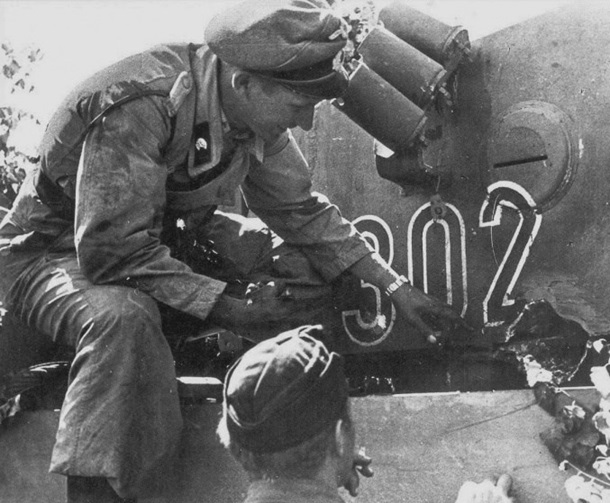
The lightweight summer uniform for the European theatre was derived from the Drillichanzug working garment; its early version was light grey, source: flickr.com, edited
The colour change made the uniform considerably less conspicuous, and it did not take long before soldiers began using this lightweight and durable garment on hot days in place of the standard field uniform. Tank crewmen were no exception. The army command noticed and concluded it was actually a very good idea — the heat was not a problem only for German soldiers in Africa but also for those serving in the southern parts of Europe (Italy, Greece, etc.) and in inland Russia. The working uniform was an established garment type and its production was cheaper than that of the standard field uniform. The command therefore decided to go along with this spontaneous trend.
The first to receive a special version of the lightweight summer uniform were the armoured car crews, for whom it was introduced as early as May 1941. The uniform used the same drill material as the working garment but was cut along the lines of the classic black tank jacket, and was officially intended to serve a dual purpose: to be worn instead of the black wool uniform in hot weather, and to be worn over it as an extra layer in cold weather. For some reason, however, this uniform was not reed green but light grey. The jacket had no coloured piping (and sometimes not even shoulder straps), but the collar did feature the characteristic rhombus badge with the skull. The trousers were long, loose-cut and had a large pocket on the front left thigh. Shortly after the introduction of this summer jacket, an updated version appeared in production with a large button-down pocket on the front left.
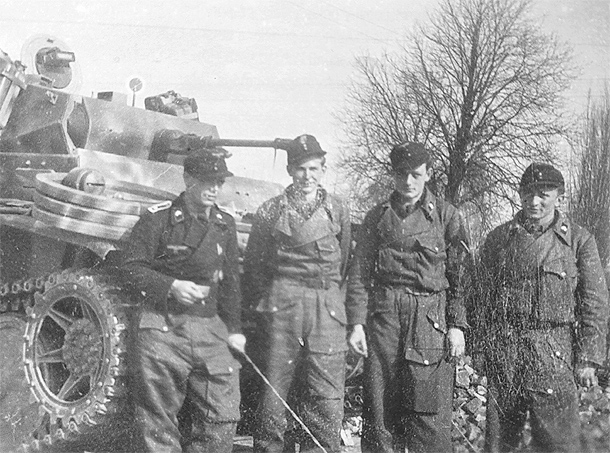
In 1942 a reed-green version of the summer uniform called Drillichschutzanzug für Panzertruppen was introduced; here the late version is visible, with pockets on the left front of the jacket and on the left thigh, source: worldwarphotos.info with permission of the operator, edited
Sometime during 1942 the colour of this summer uniform for armoured car crews was changed from light grey to reed green, and its use soon extended to the crews of other types of armoured vehicle including tanks. The reed-green jacket again existed in two versions: the early type without a pocket, and the late type with a large pocket on the front left. This lightweight summer uniform became very popular and in roughly the last year of the war was most likely the most widely worn field garment among German tank crewmen. It was produced from 1942 until the end of the war under the designation Drillichschutzanzug für Panzertruppen. In photographs and film footage it is fairly common to see soldiers wearing a combination of the standard black wool jacket and these summer trousers (for example HERE).
The Grey Uniform
In 1937 a distinctive category of artillery was created in the German army: assault artillery (Sturmartillerie). The assault gun was a self-propelled weapon designed to advance together with the infantry and provide it with very rapid and accurate fire support. Work on prototypes of the first assault guns (Sturmgeschütz) was still in progress, but there was no need to delay the choice of uniform for their crews. In 1937 it was decided that the crews of this new type of armoured fighting vehicle would receive the same black uniforms as tank crewmen and armoured car crews (see, for example, photo HERE). Very soon, however, doubts arose about the wisdom of this choice — and these were not questions of the uniform's practicality but purely questions of combat tactics.
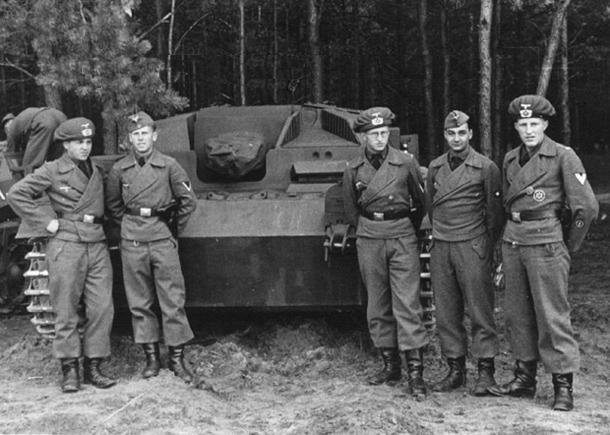
The grey variant of the tank uniform was originally created for assault gun crews; the early uniform also included a grey version of the tank beret, source: flickr.com, edited
From a military standpoint, the black uniform had two significant properties. First, among the uniforms of all other branches of service the tank crew uniform stood out considerably in colour and was therefore relatively easy for enemy observers to spot. Second, the black uniform was too closely associated with tank crewmen — meaning that if an enemy scout spotted a "man in black" on the battlefield, he would almost certainly conclude that German tanks were somewhere nearby. The enemy could then be expected to respond by sending his own tanks into the area — which would be far from ideal given that, in this case, only infantry (supported by assault guns) was operating on the German side, and that infantry would find itself in a very awkward situation as a result.
It was therefore apparently decided, sometime around 1939, that assault gun crews would receive uniforms in grey, which would blend better with the infantry and not attract enemy tanks. The resulting uniform was cut along the same lines as the tank uniform but was produced in field grey (and various other shades of grey). The first uniforms of 1939 were, however, an exception to this rule since for some reason they had a green collar. Alongside the new uniform, a new protective "helmet" was also trialled — also grey and fitted with large ventilation holes (resembling somewhat a modern cycling helmet). Neither the jacket with green collar nor that particular type of headgear caught on, and in May 1940 the official uniform was introduced which was essentially a grey copy of the tank crew uniform. The only major difference was the absence of coloured piping on the upper parts of the collar lapels. It is true that in period photographs such piping can sometimes be seen on grey uniforms, but in these cases it involves non-standard uniforms that soldiers had made to measure at their own expense (or had piping added to their issued uniform to make it more "smart").
The grey uniform quickly became very popular among assault gun crews. It was smart, practical and carried a certain élite image (the cut itself, regardless of colour, seemed to place the wearer on a par with tank crewmen — a kind of army élite). The original black uniform was not meant for just anyone, but once a grey "copy" appeared it somehow felt more attainable, and soldiers of many other unit types yearned to wear it too. As a result, the grey uniform — originally intended for assault gun crews — spread progressively throughout the war until it was worn by crews of self-propelled guns (Selbstfahrlafette), tank destroyers, armoured trains, self-propelled rocket launchers, and even panzergrenadiers or engineers serving on various armoured vehicles. Consequently, the grey jacket's accessories came to feature not only artillery red but a wide range of other Waffenfarben.
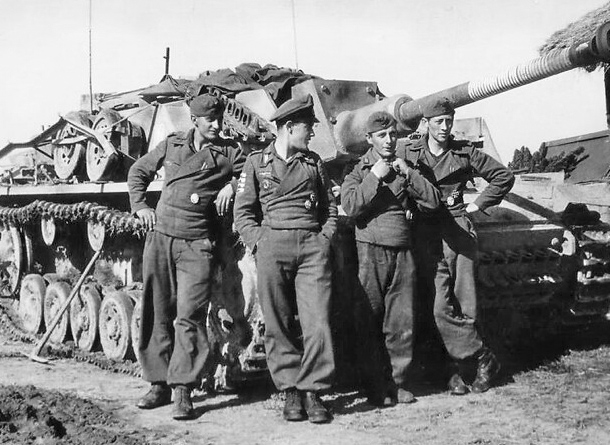
Although the grey uniform was originally developed for assault gun crews, it was ultimately also worn by self-propelled gun crews, tank destroyer crews and self-propelled rocket launcher crews, source: flickr.com, edited
Assault artillery officers could choose whether to wear the rhombus badge with the death's head skull on the collar tabs of their grey jackets — as worn by tank crewmen — or the standard German Army collar tabs known as Doppellitzen (photo HERE). NCOs and other ranks, by contrast, automatically received uniforms with the death's head skull (the badge backing was sometimes the same colour as the jacket, sometimes black, and occasionally even with Waffenfarbe piping) (photo HERE). Most likely due to the gradual spread of the grey jacket to many other units, a decision was made sometime around 1943 that these uniforms should no longer bear the tank crew skull but only the Doppellitzen. In photographs of soldiers one can also encounter empty rhombus backing fields bearing neither a skull nor Doppellitzen (photo HERE).
Not only the jacket but also the headgear for assault gun crews essentially mirrored the patterns used by tank crewmen (or those used throughout the German army generally). The first type introduced was the grey version of the two-part tank beret, the Schutzmütze, which remained in service only briefly (until early 1941) and was just as unpopular with its wearers as the original black beret had been with the tank crewmen. Wide adoption was then achieved by the Schiffchen field caps, pattern M34 (for NCOs and other ranks) and M38 (for officers). In 1943 the new "universal" Einheitsfeldmütze or M43 appeared. Among assault artillery officers, the soft peaked cap known as the Knautschmütze also became popular — as it had among tank officers.
At the start of 1940 the first so-called tank destroyers appeared in the German army — self-propelled anti-tank guns. The first such type was the vehicle known as the Panzerjäger I. Regarding the uniform for this vehicle's crew, it was decided they would receive the black tank crew uniform. Although the first battalions equipped with this type of fighting vehicle were not organisationally part of panzer divisions at all, anti-tank artillery was perceived as much more closely connected to tank crews than to conventional artillerymen, hence the black uniform. This established a precedent by which tank destroyer crews wore the black tank uniform for at least the following two war years. Change was triggered by the invasion of the USSR, which confronted the German army with an unprecedented numerical superiority of enemy tanks. Assault guns were inevitably pushed into an anti-tank role and the boundary between them and tank destroyers began to blur. In keeping with this trend, their crews' uniform was standardised in February 1942. From that point, both assault gun crews and tank destroyer crews used the same grey uniform.
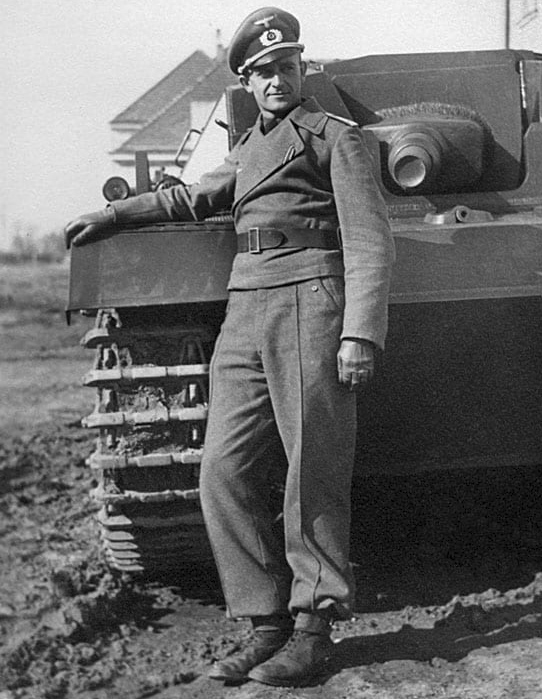
The grey uniform matched the cut of both the jacket and trousers of the black tank crew uniform, source: flickr.com, edited
Much the same applied to the first self-propelled guns, the Sturmpanzer I, which entered service in the first half of 1940. These vehicles were from the outset organisationally part of panzer divisions, so their crews — though they were essentially pure artillerymen — automatically received the black tank crew uniform. Only the crews of later self-propelled guns such as the Wespe, Grille or Hummel wore primarily the grey uniform. But to avoid making things too simple, the rules for tank destroyer and self-propelled gun crews changed over time and uniform wear was adjusted depending on the types of divisions and regiments to which a given unit was attached. It is therefore possible to see the same type of vehicle in photographs with its crew wearing the black tank jacket in one instance, the grey assault artillery jacket in another, and even the entirely standard Army field jacket M40 worn by infantry in yet another. The crews of so-called Sturmpanzers such as the Brummbär or Sturmtiger, by contrast, wore for some reason almost exclusively the black tank uniform.
As a minor footnote, the crews of PzKpfw 38(t) tanks were sometimes clearly using the light brown Czech protective overalls captured along with the tanks. They most likely wore them on cold days as an extra layer over their regular uniform (photo HERE).
Waffen-SS
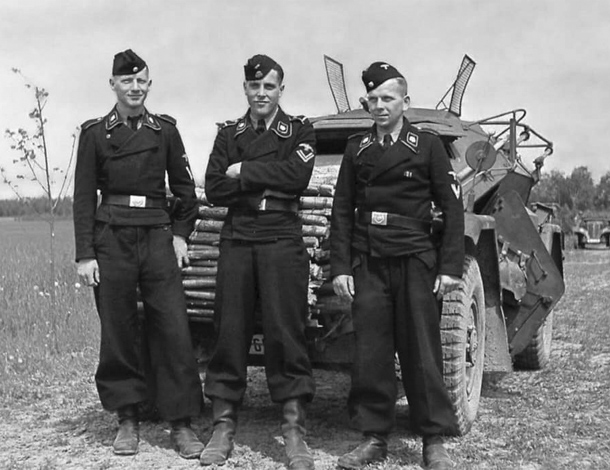
The first Waffen-SS soldiers to wear the black tank crew uniform were armoured car crews (and at the time they borrowed the uniforms from their Wehrmacht counterparts), source: flickr.com, edited
Until now we have been discussing the uniforms of the regular German army — the Wehrmacht. Alongside it, the infamous Waffen-SS units also fought for the Third Reich, and it is their uniforms we will turn to now. The relevant regulatory authority in this area was the office known as the SS-Führungshauptamt Kommandoamt der Waffen-SS, abbreviated SS-FHA. The production of SS uniforms also had its own particular characteristics. Private commercial companies were naturally involved here too, but the SS leadership ensured a significant share of production through its own enterprises. Large clothing workshops were established in the labour (later concentration) camps at Dachau and Ravensbrück which, using prisoner slave labour, covered up to 20% of the production of all uniforms for the Waffen-SS.
The first armoured car crews from the Waffen-SS used the same black uniforms as their Wehrmacht counterparts, naturally with different collar tabs and the SS eagle sewn on the left sleeve. Only in 1938 (according to some authors even later) did a variant of the black tank jacket specifically for the SS appear — though the use of army jackets continued well into 1942. In terms of overall cut, there were few differences between the army and SS jacket. The most easily identifiable difference is unfortunately not usually visible in photographs at all, as it was on the back. The body of the Waffen-SS jacket was cut from only three panels: left and right front panels and a single back panel. Unlike the army jacket, the SS jacket therefore had no prominent central back seam joining two back panels together. Two further differences did affect the front of the jacket but are again not so easily spotted. First: on the army jacket the lower edge of the left front panel angled downward at roughly 15°; on the SS jacket the edge of this panel ran straight, directly toward the ground. Second: the SS jacket had slightly smaller collar lapels than the Wehrmacht jacket. A very reliable distinguishing feature (though having nothing to do with the jacket's cut) was also the already-mentioned SS eagle on the left sleeve.
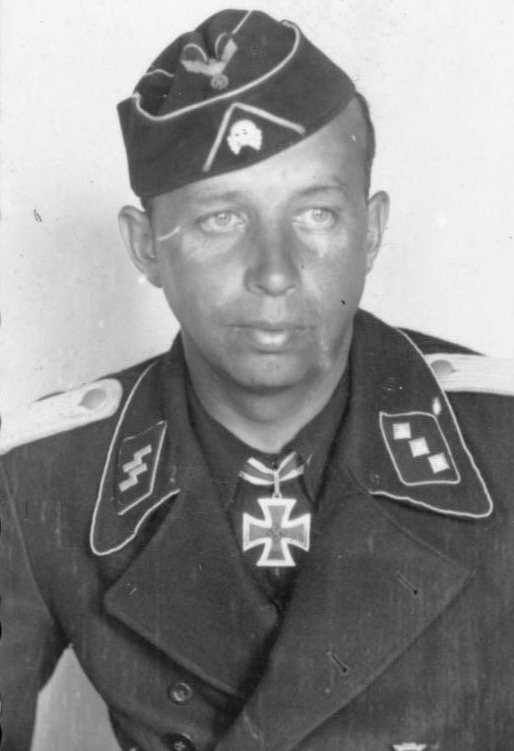
The later standard Waffen-SS tank crew uniform differed from the army version in cut details as well, source: Bundesarchiv Bild 101III-Zschaeckel-203-33, Wikimedia, Creative Commons, edited
While a Wehrmacht soldier wore death's head skulls on the collar of his black jacket, a Waffen-SS soldier had his rank insignia on the left collar tab and the SS runes on the right. Here too, however, there were several variations. On early uniforms, the regiment number was embroidered alongside the SS runes (SS1 for the Deutschland regiment, SS2 for Germania and SS3 for Der Führer). This practice was quickly abandoned when someone pointed out that it unnecessarily revealed sensitive information to the enemy (it is interesting that the later wearing of sleeve bands bearing a unit's name apparently bothered nobody). An order of May 1940 recognised only two official forms of the right collar tab for Waffen-SS tank uniforms: the rhombus could bear only the SS runes without any additional numerals or markings, or the special symbol of one of the élite units granted this privilege — which applied primarily to the Totenkopf division, whose members could wear the skull and crossbones on the right collar tab (a different version from the one worn by Wehrmacht tank crewmen).
The black SS jackets originally had no coloured piping on the collar or collar tabs of the kind familiar from army uniforms. Later (perhaps 1939?), however, silver piping was introduced for officers and black-and-white hatching for NCOs and other ranks. While the silver officer piping endured, the black-and-white hatching for lower ranks was discontinued sometime around 1940 (having been used only briefly, it is not often seen in photographs). Waffen-SS soldiers clearly considered the piping on their collar tabs and lapels to be an attractive feature, however, and had it added to their uniforms at their own expense at commercial tailor's workshops — not in black-and-white but in their Waffenfarbe colour, exactly as was the case on Wehrmacht uniforms.
This trend began to establish itself around mid-1940 and continued to spread (additional Waffenfarbe piping was sometimes even ordered at unit level for all members). The spread of black tank crew uniforms within the Waffen-SS was less extensive than in the Wehrmacht. Their wear was approved for armoured car, tank and tank destroyer crews. Around the lapels of black SS jackets, therefore, essentially only three Waffenfarben appeared: pink for tank and tank destroyer crews, and golden yellow (goldgelb) and brown (kupferbraun) for reconnaissance units (primarily armoured car crews).
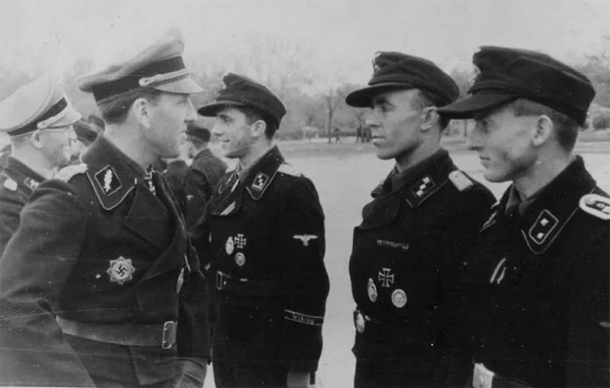
Waffen-SS tank crewmen (here specifically from the Wiking division), source: flickr.com, edited
As for the shoulder straps of the black SS jacket, these had Waffenfarbe piping for officers, NCOs and other ranks alike. Just as with Wehrmacht soldiers, letters appeared on SS shoulder straps indicating the branch of service (e.g. A for Aufklärungs, i.e. reconnaissance) or a specific unit (e.g. LAH for Leibstandarte Adolf Hitler). These letters were either embroidered directly on the shoulder strap, attached as a metal badge, or embroidered on a fabric strip slid over the shoulder strap. During the course of the war this practice was abandoned. It should also be noted that sometime around 1940 the cut of the black SS tank jacket underwent certain changes — its overall length was shortened and the collar points were rounded.
The headgear used by Waffen-SS tank crewmen went through a development similar to that in the Wehrmacht. First came the two-part black beret (with appropriate SS insignia, of course). After its withdrawal, it was replaced by the black version of the standard SS field cap, officially designated M40, and later the M43 peaked cap. Officer field caps had silver piping. The M43 was later also produced in a camouflaged version. Just as Wehrmacht soldiers did, Waffen-SS tank crewmen also became fond of the soft peaked cap, the Knautschmütze, and just like their counterparts they occasionally "manufactured" their own by removing the stiffener from a standard Schirmmütze — their caps naturally bore SS insignia.
Panzerkombi
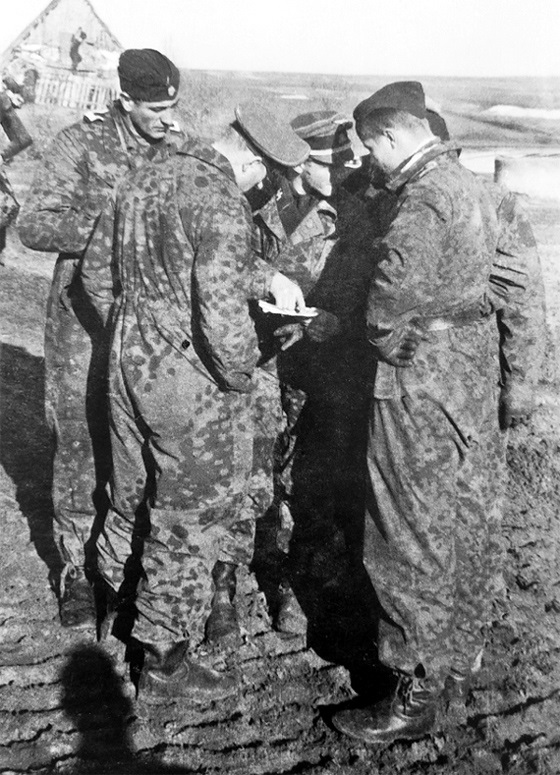
Waffen-SS tank crewmen in the one-piece camouflage coveralls known as Panzerkombi, source: flickr.com, edited
At the beginning of 1943 Waffen-SS tank crewmen began receiving new one-piece coveralls called einteiliger Schutzanzug or simply Panzerkombi. The coverall was reversible and came in winter and summer versions. The winter version was padded, white on one side and dark grey on the other. The heavy winter coverall was not particularly popular, however, as it impeded movement inside the tank, and its production ended sometime toward the end of 1943 (it can be seen, for example, in the photograph HERE). The summer coverall was sewn from high-quality cotton canvas printed with a camouflage pattern (primarily the Eichenlaubmuster oak leaf design). This was the same material used for camouflage helmet covers and tent sections, and it resisted moisture well. The summer coverall could be worn either on its own or as a second layer over the standard black wool uniform. It too was reversible — one side featured the so-called spring pattern with more green, the other the autumn pattern with a greater emphasis on brown. Unlike the winter version, the camouflage coverall became very popular among the crews — most likely for its "sexy look".
Camouflage Uniforms
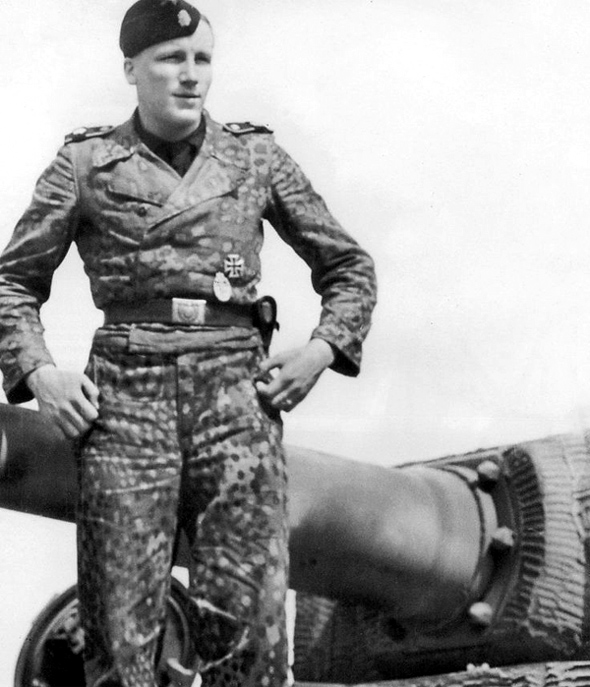
Lightweight, durable, elegant and therefore incredibly popular — the camouflage uniform of Waffen-SS tank crewmen, source: flickr.com, edited
As noted above, Waffen-SS tank crewmen took a great liking to the camouflage coveralls introduced at the beginning of 1943. Generally speaking, tank crewmen had less need for camouflage than infantrymen, since in combat they were concealed from enemy eyes inside their vehicles. Nevertheless, the Waffen-SS leadership decided to meet the "demand" from its soldiers, and at the beginning of 1944 a two-piece tank crew uniform of conventional cut — consisting of a jacket and trousers — also began to be produced in a camouflage version. This was made from cotton twill, initially with the Eichenlaubmuster camouflage pattern and later exclusively with the Erbsenmuster (pea dot) pattern. Unlike the earlier coverall, the two-piece camouflage uniform was not reversible. For completeness, it should also be noted that the Wehrmacht — unlike the Waffen-SS — never officially introduced any camouflage tank crew uniform, with the exception of one side of the winter jacket mentioned above. If you encounter a photograph of a regular army tank crewman in a camouflage jacket, it is most likely a privately tailored garment.
The Waffen-SS Grey Uniform
The grey version of the SS tank crew uniform, intended for assault gun crews, was introduced in 1940 or possibly as early as 1941. Until then, the crews of the few assault guns available to the Waffen-SS apparently wore uniforms borrowed from the Wehrmacht (supplemented with SS insignia). Although the grey Waffen-SS-cut uniform was first officially mentioned in an order of August 1942, by that time it had long been in cheerful use. Further development followed a similar path to that in the Wehrmacht — meaning the uniform quickly spread from assault guns to tank destroyer crews, self-propelled gun crews and armoured reconnaissance. The wearing of grey uniforms by tank destroyer crews was formalised by an order of December 1942.
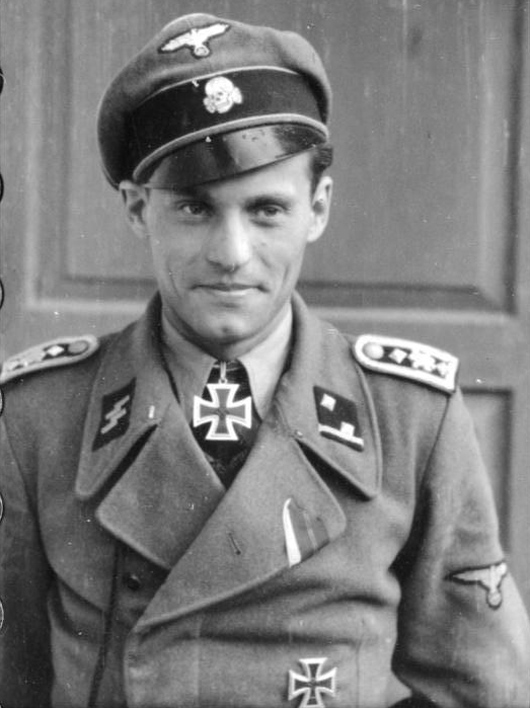
A Waffen-SS member in the grey uniform for assault gun (and other vehicle) crews, source: Bundesarchiv Bild 101III-King-047a-04, Wikimedia, Creative Commons, edited
The grey Waffen-SS jackets were based in cut on the black Waffen-SS tank jackets and differed from them, besides the colour, mainly in details. The right collar tab again bore the SS runes and the left carried the rank insignia; only in certain selected élite units were special markings again permitted on the collar tabs (for example the skull in the Totenkopf division). Standard-issue grey jackets had no Waffenfarbe piping on the collar or collar tabs. Soldiers did, however, have it added at their own expense, and later (1942?) this practice was perhaps also officially recognised, with two Waffenfarben permitted: red for artillery and golden yellow for reconnaissance. Waffenfarbe piping on the collar lapels did not appear on the grey jacket, however.
Leather Uniforms
In photographs one can sometimes also encounter Waffen-SS tank crewmen wearing black leather uniforms. In such cases it is necessary to distinguish whether the garment is a tank jacket of conventional cut made from leather, or a leather uniform of a different cut altogether. In the former case it is most likely a garment made to order for the individual soldier (for example Michael Wittmann in the photograph HERE). In the latter case it could quite possibly be uniforms originally intended for German submarine crews — at least according to some sources. These uniforms were apparently used by some tank crewmen from the 1st and 12th SS Panzer Divisions (Leibstandarte and Hitlerjugend). According to some accounts, these were indeed submarine crew uniforms that the Germans had supplied to the Italian Navy. Tank crewmen from the aforementioned 1st SS Panzer Division Leibstandarte then "borrowed" them when disarming their former allies after the Italian capitulation in September 1943. The German tank crewmen apparently saw no reason to leave such fine pieces of kit to an uncertain fate in Italian Navy warehouses.
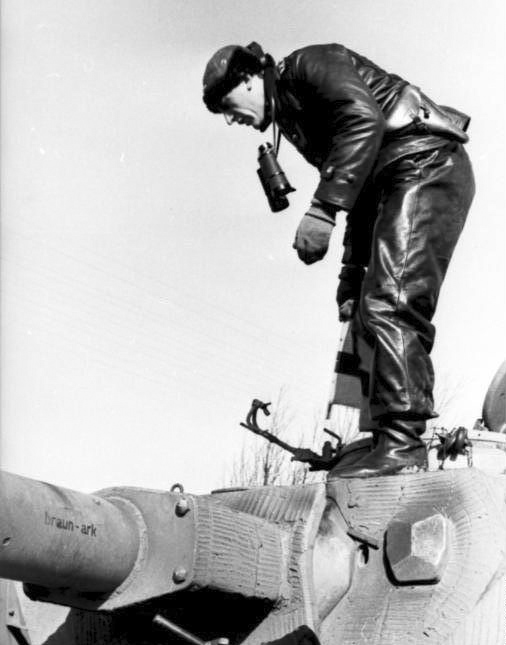
A tank crewman from the 12th SS Panzer Division "Hitlerjugend" in a leather uniform originally intended for German submarine crews, source: Bundesarchiv Bild 101I-297-1725-12, Wikimedia, Creative Commons, edited
This leather uniform consisted of a separate button-front jacket and leather trousers. Such a uniform was extremely durable and provided excellent protection against cold and wind, as well as very good protection against cuts and burns — far better than a conventional wool or cotton uniform. From photographs it appears that in cold weather tank crewmen wore the leather uniform over their regular uniform as a second layer.
ARTICLE
CONTENTS:
Reproducing text from the Panzernet website without the written consent of the operator is prohibited.