PANZER INSTANDSETZUNG
maintenance and repair of German armoured vehicles
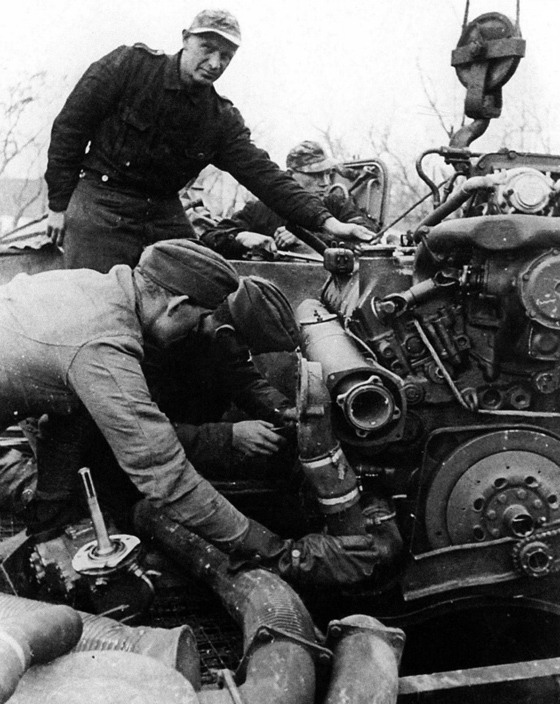
engine repair of a Tiger heavy tank in field conditions, source: Flickr.com with permission of the publishing user, edited
Note: This article contains some inaccuracies; we are working on an update and apologise for the inconvenience :-(
A Few Words of Introduction
Whether we like it or not, history does not measure everyone by the same standard. It tends to remember only the names of the leading heroes (or villains) and forgets all those without whom the wheels of history could never have turned. Almost everyone has heard of tank aces such as Michael Wittmann, Kurt Knispel, or Otto Carius. True enthusiasts might even be able to name some of the other members of their crews, but the thousands of men who worked tirelessly to keep the tanks of these famous soldiers running remain nameless to history. The tanks themselves are merely the tip of the iceberg — the part that is visible on the battlefield and reaps the glory. But behind every tank lies a vast apparatus providing all manner of support. And we don't mean only combat support (infantry, artillery, air cover, or reconnaissance), but above all technical and logistical support. A tank is an extraordinarily complex machine that must often operate under extreme conditions, all while a relentless enemy is constantly trying to destroy it.
Consider, for example, the heavy tank Tiger. Recovering and towing an immobilised Tiger required three heavy half-track prime movers — in difficult terrain, sometimes four or even five! Replacing just one of its tracks meant handling a load weighing 2.9 tonnes. When a Tiger fighting near Kursk in the summer of 1943 needed a new engine, that engine had to be transported from the Maybach Motorenbau factory in Friedrichshafen — over 2,000 kilometres away. The engine itself weighed 1,200 kg, so loading it onto a train, transferring it to a truck, and installing it in the tank all required a crane. All of this was the responsibility of the men of the so-called Panzer-Instandsetzungs-Dienste — the tank repair service. These were soldiers whose weapons were spanners, oil cans, and welding torches, and without whom no German tank ace would ever have been born.
But let us start from the beginning, as is our custom. Large-scale motorisation of any army brings its commanders a host of new concerns. Suddenly, it is no longer enough to ensure fodder for the horses — one must also arrange maintenance, repairs, fuel, lubricants, and spare parts for motor vehicles of every description. And this is by no means limited to tanks and other fighting vehicles. Half-track prime movers, staff cars, and lorries — which make up by far the largest category of motor vehicles in any army — all require maintenance and repair as well.
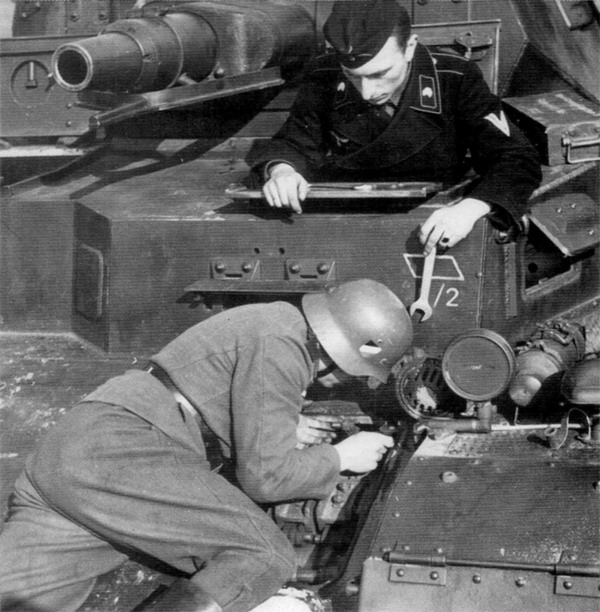
the first level of service support were the so-called I-Gruppe, which operated closest to the combat units but were capable of only lighter repairs and maintenance, source: waralbum.ru with permission of the site operator, edited
Before the War
Before 1937, German units relied for routine maintenance and minor repairs on workshops located within their own barracks, and for more substantial work on civilian contractors. Mobile service workshops did exist, but were not considered particularly important. In the first organisational table of the German panzer division from 1935, service units were not even explicitly listed — they were tucked away under the so-called Rückwärtige Dienste (rear area services), alongside other support functions such as field kitchens. This relative immaturity of service support was not a practical problem at the time. It was peacetime, and military vehicles only left the barracks for exercises, manoeuvres, or parades, after which they promptly returned. In late 1937, the Army High Command did develop a plan to establish field service units at army level, but for the time being it remained on paper.
When the Second World War broke out, the German Army was still heavily dependent on barracks workshops and civilian repair shops across Germany. It was the invasion of Poland in September 1939 that fully exposed the weaknesses of this model. That campaign revealed, for the first time, the true demands that Blitzkrieg warfare placed on vehicles and their service support. The wartime rate of mechanical failure and wear was incomparable to anything the Germans had experienced in the peacetime years. A telling example is the ordinary lorry. The trucks in Wehrmacht service at the time were essentially standard commercial models, also sold in the civilian market and built to handle specific loads. In the relentless pace of combat operations, however, soldiers constantly overloaded them — piling on whatever was needed rather than observing weight limits — and drove them day and night, on roads and across open fields, in long convoys through clouds of dust that clogged filters and radiators, all without the proper service intervals for which there was simply no time. Men and machines alike were pushed to the limit.
A New Organisational Model
Fortunately for the Germans, the war against Poland lasted only a month, after which damaged and broken-down vehicles could be transported back to Germany for repair without too much difficulty. Even so, it was already clear that this approach was no longer viable. The Wehrmacht genuinely needed to implement a model in which repair workshops would follow the fighting units and remain in their immediate vicinity at all times. A concrete proposal for organising such service support at the divisional level had in fact already existed since roughly mid-1939. The time had now come to put it into practice.
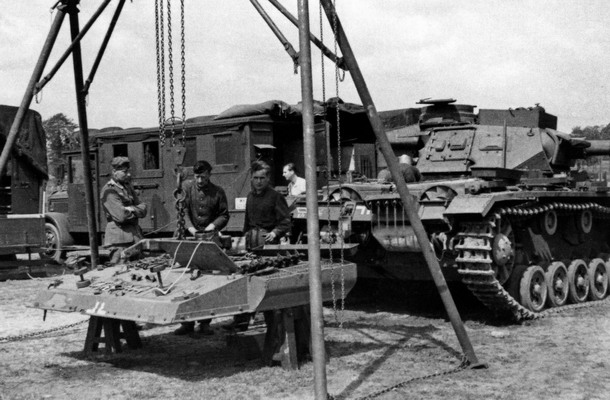
field repairs requiring the use of a crane, but still within the 60-hour work limit, were the responsibility of the so-called I-Staffel, source: Flickr.com with permission of the publishing user, edited
This proposal distinguished between vehicle maintenance and repair carried out at the level of combat units (including tank units) and that provided outside combat units. For panzer divisions, maintenance and repairs were to be conducted at three levels, through service elements known as I-Gruppe, I-Staffel, and Panzer Werkstatt (there were also so-called I-Trupp, but these did not belong to armoured units and we will therefore omit them entirely). The lowest service element was therefore the I-Gruppe (I = Instandsetzung = repair). Within a panzer division, each tank company (Kompanie) had its own I-Gruppe, as did the headquarters of each tank battalion (Abteilung) and each tank regiment (Regiment).
I-Gruppe
According to the organisational table of November 1941, an I-Gruppe assigned to a tank company consisted of 17 men in total, including one welder, one electrician, and two radio technicians. The unit's equipment included two motorcycle combinations, a Kfz.2/40 cross-country car fitted with built-in tool storage, a lorry carrying additional tools and an emergency supply of spare parts, and two light half-track prime movers Sd.Kfz. 10. This standard complement was frequently supplemented by various additional vehicles, either officially assigned or improvised by the workshop itself from captured or surplus equipment. A notable example is the so-called Instandsetzungkraftwagen I, created by converting obsolete Panzer I light tanks. When heavier tanks such as the Panther began to be introduced into panzer divisions, the repair groups were also reorganised. According to the November 1943 table of organisation, an I-Gruppe assigned to a Panther company consisted of 26 men, three staff cars, three lorries, and two Sd.Kfz. 10 prime movers.
The I-Gruppe were responsible for both routine maintenance and minor repairs for their assigned companies. The idea was something like rapid "first aid", and accordingly the I-Gruppe had to stay very close to their combat unit — typically operating just 3 to 5 km behind it. The tank crew itself was responsible only for basic operational checks and maintenance of their own vehicle and was not supposed to attempt any repairs (not that this was a trivial workload — cleaning fuel, oil, and air filters, cleaning weapons, adjusting sights, tensioning tracks, and so on). It was the I-Gruppe who carried out regular checks of the lubrication system for leaks, tightening of bolts on the drive sprockets, topping up the recoil system fluid on the gun, and similar tasks. As for actual repairs, the members of an I-Gruppe were, according to the April 1944 directive, only to undertake work requiring no more than 16 man-hours for up to four men, and which did not require the use of a crane. This typically included replacing road wheels, sealing leaking fuel or oil lines, and repairs to electrical systems.
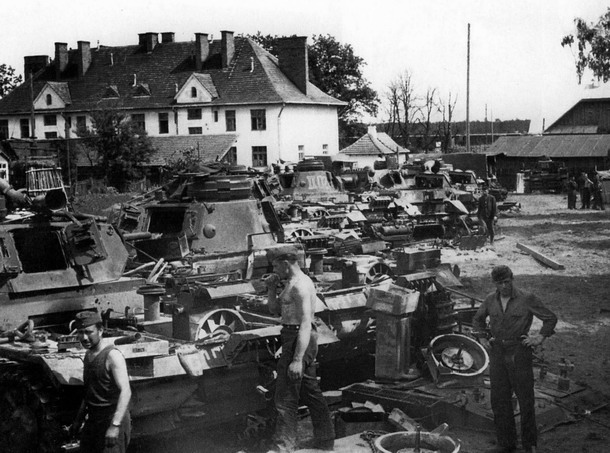
for more substantial repairs, vehicles were towed to the workshops of specialist repair platoons (Panzer-Werkstattzug) or companies (Panzer-Werkstattkompanie), source: Flickr.com with permission of the publishing user, edited
I-Staffel
Any repairs that fell outside the scope described above became the responsibility of the second service level — the so-called I-Staffel. The I-Staffel operated at battalion level, and the key difference from the smaller I-Gruppe was that they did not need to stay as close to the fighting. They could remain in one location for longer periods and therefore had time to carry out more demanding repairs. The I-Staffel typically followed the combat unit at a distance of 2 to 4 days' march. According to the April 1944 directive, the I-Staffel was responsible for repairs requiring more than 16 but fewer than 60 hours of work, and/or requiring the use of a crane. This typically included removing the turret, the armoured engine cover, dismounting the gun, replacing the engine or gearbox, and similar tasks. Interestingly, the vehicles used by service units were for some reason marked not with the letter I but with the letter J. The sources we have consulted do not explain this detail. One can only speculate that the Germans found the capital letter I confusing, as it could be mistaken for the Roman numeral one, a rune, or some other symbol — and so they simply used the next letter in the alphabet, J. It is worth noting that even in some combat unit reports, the service branch is referred to not as I-Dienste but as J-Dienste. If any of our readers happen to know more about this, we would very much welcome your message.
Panzer Werkstatt
The third level of service support within combat formations was the so-called Panzer Werkstatt — literally "tank workshop". These units existed either as workshop platoons (Panzer-Werkstattzug) or as much larger workshop companies (Panzer-Werkstattkompanie). In standard panzer divisions, workshop platoons operated at battalion (Abteilung) level, while workshop companies operated at regimental (Regiment) level. If you are starting to lose track of the structure described so far, this simplified diagram may help — though be warned that it gets more complicated from here. The heavy tank battalions equipped with Tigers (Tigers were not organised within panzer divisions but in independent battalions known as schwere Panzer Abteilung) also had their own workshop companies, and finally there were fully independent workshop companies at army level. For completeness, it should be noted that above the Panzer-Werkstattkompanie there existed a Panzer-Instandsetzung-Abteilung — a tank repair battalion. This was not, however, an additional service tier in the true sense, but rather a command layer overseeing multiple Panzer-Werkstattkompanie.
A Panzer-Werkstattkompanie organised according to the K.St.N. 1187 table of June 1942 comprised 209 men, including blacksmiths, painters, plumbers, armoursmiths, radio technicians, and many others. The company's equipment included 2 motorcycles, 22 lorries, 5 staff cars, a bus, and a large number of trailers, tank transporters, and cranes. Such a company spent most of its time in a static position and moved less frequently, since its work required a degree of fixed infrastructure. Whenever possible, a Panzer-Werkstattkompanie would set up in a factory hall, warehouse, or large farm.
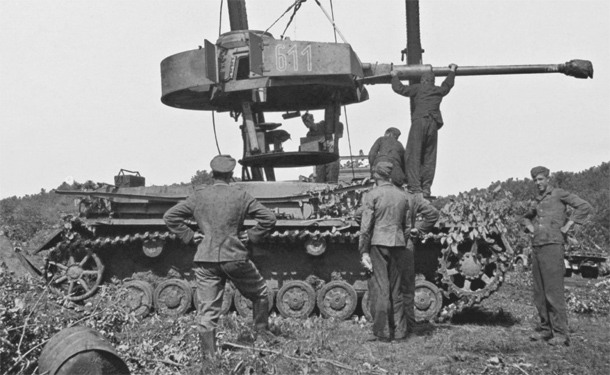
a PzKpfw IV during a repair requiring the removal of the turret; the driver will likely move the vehicle aside while the mechanics prepare a turret stand beneath the crane, source: Flickr.com with permission of the publishing user, edited
Vehicle Recovery
The workshop company also included a recovery platoon (Bergezug) equipped with 8 half-track prime movers (2x Sd.Kfz. 7 + 6x Sd.Kfz. 9). Of all elements within the Panzer-Werkstattkompanie, it was the recovery platoon that operated closest to the combat units. Its task was to tow damaged or broken-down tanks directly from the battlefield as soon as the situation permitted, then bring them either to the nearest I-Gruppe or I-Staffel, or directly to the parent Panzer-Werkstattkompanie. The general principle was always to carry out repairs as close as possible to the unit to which the vehicle belonged. If fighting was intense and many tanks were left damaged beyond the capacity of the I-Gruppe and I-Staffel, while the Panzer-Werkstattkompanie was too far away, a collection point would simply be established at a suitable location and the damaged vehicles towed there first. Only then would a decision be made as to whether the vehicles would be brought to the Panzer-Werkstattkompanie, or whether the Panzer-Werkstattkompanie would instead move to the collection point.
Towing a damaged tank was no simple matter and required careful preparation as well as cooperation from the tank's crew. Before towing, it was necessary to disconnect the final drives on the sprockets so that they could rotate freely. If the drive or idler wheels themselves were so badly damaged that they could not rotate, the track had to be removed, shortened by the required number of links, and reconnected so that it bypassed the damaged wheel (as can be seen in this photograph HERE). As a further point of interest, before an immobilised tank was taken away for repair, the crew was required to unload all ammunition and their personal belongings. Handing a damaged tank over to the Panzer-Werkstattkompanie also meant removing it from the combat unit's rolls — meaning that while repairs were being carried out by the I-Gruppe or I-Staffel, the tank remained on the combat unit's strength, but once towed to the Panzer Werkstatt, it no longer was.
If a tank was for any reason incapable of being towed — for example due to severe damage to the running gear — or if it made sense for other reasons and the terrain permitted, tank transporters were also available. For light tanks, the Sd. Ah. 115 with a 10-tonne capacity was suitable; for medium tanks, the Sd. Ah. 116 with a 23-tonne capacity. The code Sd. Ah. stood for Sonder Anhänger (special trailer); the full designation of these transporters was Tiefladeanhänger für Panzerkampfwagen 10t (or 23t), meaning literally "low-bed trailer for tanks". The transporters were typically pulled by half-track prime movers. The Sd.Ah. 116 had four wheel axles and measured 14.4 metres in length. To negotiate corners at all, all four axles had to be steerable, and the trailer even had its own driver, seated in a cab at the very rear. To load a tank, the entire rear section of the trailer — including the driver's cab and two axles — was simply uncoupled and the bed lowered to the ground. Although the Sd. Ah. 116 had an official capacity of only 23 tonnes, experience showed it could handle up to 28 tonnes without difficulty, making it usable even for later versions of the Panzer IV.
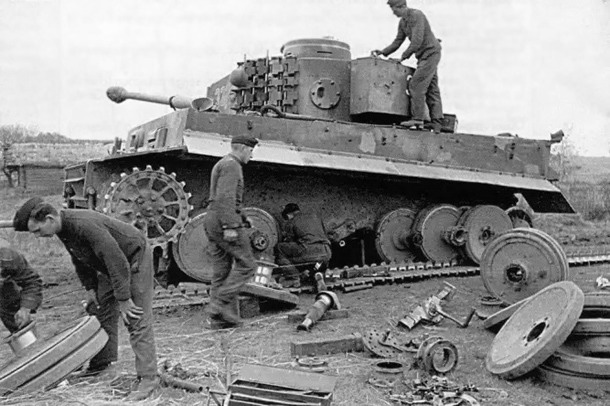
repairs to Tiger heavy tanks were a chapter in their own right — replacing a single broken torsion bar, for example, required removing most of the road wheels, source: Flickr.com with permission of the publishing user, edited
The Panzer Werkstatt was responsible for repairs exceeding 60 hours of work. However, even the Panzer Werkstatt had its limits. For instance, a penetration of the armour could only be safely repaired if the plate had not also cracked or been blown through entirely. Tanks that had suffered a fire in the crew compartment, or that had been flooded, were likewise beyond the capabilities and authority of the Panzer Werkstatt. Such vehicles were to be sent to the nearest Heereszeugamt (located in Vienna, Mainz, Magdeburg, Königsberg, and Breslau), from where the vehicle would be transported to the factory of its original manufacturer for a complete overhaul. This model, however, applied only until the end of 1941 (see below).
Heavy Tanks
As mentioned above, the independent heavy tank battalions equipped with Tigers (the so-called schwere Panzer Abteilung, or s.Pz.Abt) also had their own Panzer-Werkstattkompanie. Although such a battalion had an official establishment of only 45 tanks (even fewer before 1944), the Tigers were extraordinarily complex and demanding to maintain, so assigning the battalion its own workshop company made obvious sense. Serving in a heavy tank battalion was, among other things, a considerable challenge for the recovery platoon. The official directive stated that recovering and towing a single Tiger required three Sd.Kfz. 9 half-track prime movers working in concert. In practice, of course, experience often told a different story. On a firm road with no gradient, two Sd.Kfz. 9 could manage to tow a disabled Tiger without difficulty. In more demanding terrain, on the other hand, four might be needed.
When an unbraked Tiger was towed downhill on a road, its sheer weight pushed against the prime mover ahead of it, and it was not uncommon for the tow bar attachment points to be damaged or even for the half-track to be forced sideways. For downhill travel, therefore, some means of braking the tank was required. Trials showed that the ideal combination was three prime movers in front of the tank — pulling it on level ground and uphill — and two behind it, whose weight acted as a brake on descents. In practice, however, this was nearly impossible to achieve, both because of the limited number of prime movers available and because of the resulting overall length of the convoy. Roads in hilly terrain tend to have far more bends than those across open plains, and manoeuvring such a long convoy through corners was extremely demanding and effectively blocked all other traffic on the road.
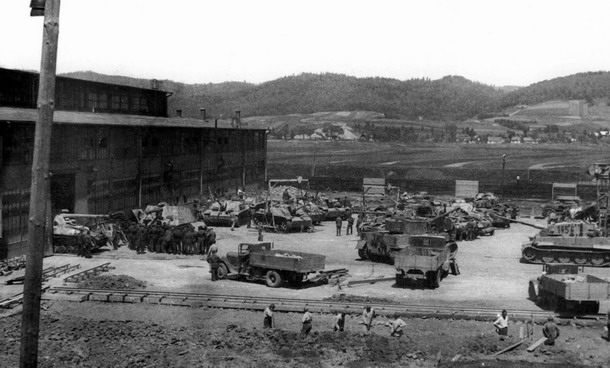
in early 1942 a new level of service support was introduced at army or army group level, designated Panzer-Instandsetzung-Kraftfahr-Werk (abbreviated K-Werk); shown here are the K-Werk workshops in Sanok in eastern Poland, apparently sometime in 1944, source: Flickr.com with permission of the publishing user, edited
Based on the experiences of the soldiers themselves — described, for example, by the commander of s.Pz.Abt 501 in March 1943 — the easiest and quickest solution was for a broken-down Tiger to be towed by another Tiger. Using a combat vehicle as a tow vehicle was, of course, a considerable waste of resources, and it is no surprise that the troops called for the introduction of dedicated non-combat recovery tanks. These arrived at the end of 1943 in the form of the so-called Bergepanthers. These recovery and service vehicles based on the Panther chassis proved very effective in practice, but demand for them consistently outstripped supply. In 1944, the smaller and less capable Bergepanzer III was introduced, of which 176 were built, and the Bergepanzer IV and Bergetiger (P) also appeared in negligible numbers.
K-Werk
In early 1942, German planners concluded that the distance between the front and the home factories had become too great, and that an additional tier of service provision was needed — sitting between the "field" repair units (comprising the I-Gruppe, I-Staffel, and Panzer Werkstatt) and the Heereszeugamt (which handled overhauls at the home factories in Germany). Furthermore, alarming reports were arriving from the Eastern Front regarding the sheer number of vehicles requiring repair (according to a report dated 28 February 1942, the total stood at approximately 300,000 motor vehicles of all types). A completely new level of service support was therefore created at army or army group level, designated the Panzer-Instandsetzung-Kraftfahr-Werk, or K-Werk for short (if you are feeling lost again, please refer to our diagram :-)).
The creation of the K-Werk essentially meant relocating part of the home manufacturers' service capacity from Germany closer to the front. On 3 January 1942, a meeting was held between the Army High Command and representatives of the leading armaments firms, including MAN, Daimler-Benz, Krupp, Alkett, Maybach, Zahnradfabrik, and others. At this meeting, it was decided to establish three large service centres near the Eastern Front. The first K-Werk (K-Werk Nord) was to be set up in the north, in Riga, Latvia, under the management of MAN. The second (K-Werk Mitte) was to be located in the central sector of the front, in Smolensk, under Daimler-Benz. The third service centre was naturally established in the south (K-Werk Süd), in Dnipropetrovsk (present-day Dnipro), Ukraine, with Krupp responsible for its operation. The creation of the K-Werks was to some degree a continuation of an existing practice from previous years, in which the home factories had also sent their own technicians directly to front-line units to assist with repairs and pass on their expertise to mechanics in the field workshops.
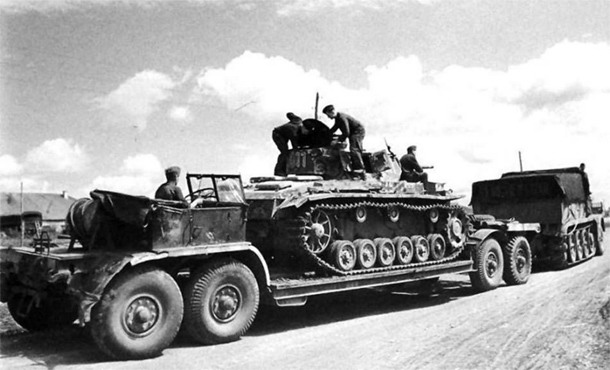
if a damaged tank could not be towed under its own tracks, it was loaded onto an Sd. Ah. 116 tank transporter; note the driver's cab at the rear of the trailer, source: Flickr.com with permission of the publishing user, edited
The staff of all K-Werk facilities consisted of civilian employees of the participating industrial firms. The K-Werks were intended to carry out extensive and labour-intensive repairs, including complete overhauls. In addition, they also performed upgrades and modifications to older tank variants to bring them up to the latest applicable standards — including rearming, fitting additional armour, or modifying the running gear for wider tracks. When the tide of the war turned and German forces were in general retreat, the three existing K-Werks naturally had to move as well. In October and November 1944, the northern K-Werk was located in Braniewo, Poland (German: Braunsberg), the central K-Werk was at a place called Kreising (which we were unable to identify), and the third K-Werk had ended up in Brzeg, Poland (German: Brieg).
As noted above, it had already been common practice before the introduction of the K-Werks for manufacturing firms to send their technicians to front-line service units — to train, assist, and supervise their work. At the same time, this was also the channel through which manufacturers gathered valuable information and practical experience from the soldiers in the field, enabling them to improve their products. The German ordnance office likewise made every effort to collect various kinds of data, particularly regarding the breakdown rates of individual vehicle types and their causes. Such statistics could help identify design weaknesses so that the manufacturer could address them in some way.
Spare Parts Logistics
In the preceding sections, we have described the organisation and functioning of the units responsible for maintenance and repair. A separate chapter in its own right, however, is the logistics of spare parts, without which a large proportion of repairs would simply not have been possible. Spare parts — and this naturally included complete engines and gearboxes — were transported from the home factories to the front primarily by rail, though in urgent cases air transport was also used. The first tier for distributing spare parts at the front were the so-called Zentral Ersatzteillagery (ZEL for short). From there, parts moved to the so-called Ersatzteilstaffel, which in turn distributed them to the workshop companies (Panzer-Werkstattkompanie) and platoons (Panzer-Werkstattzug). In the opposite direction, orders for new spare parts flowed back through the same chain. To simplify the ordering process, mechanics had access to parts catalogues for each vehicle type, known in German as Ersatzteil-Liste.
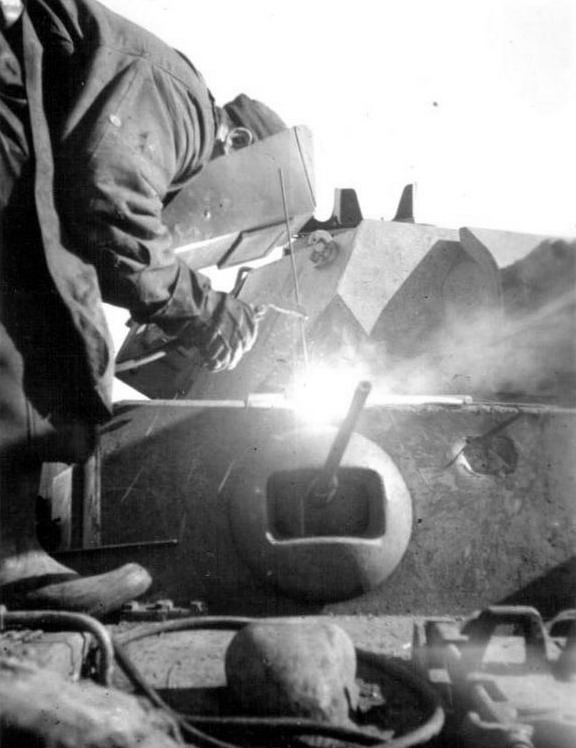
welding damaged armour in the field was not recommended, as it degraded the plate's hardness; however, on this PzKpfw IV there was apparently no alternative, source: Flickr.com with permission of the publishing user, edited
It was not only spare parts that moved through this distribution chain, but also various accessories such as fire extinguishers, tins of paint for camouflage schemes, jacks, tools, and the armour skirt plates known as "Schürzen". Organising the spare parts logistics for a million-strong army fighting a thousand or more kilometres from home — in an era without computers, mobile phones, or the internet — must truly have been a monumental challenge.
More often than not, however, the greatest enemies of the system's smooth functioning were the "users" themselves. Soldiers frequently disregarded their unit's assignment to a particular Ersatzteilstaffel and went off to source the parts they needed on their own initiative wherever they could find them. When the officially ordered parts then actually arrived at the designated Ersatzteilstaffel, nobody came to collect them. It is of course true that German tank workshops had to operate under conditions of permanent shortage and were constantly forced to improvise — but then, that is the nature of war, always has been, and always will be. Cannibalising parts from one damaged tank to repair another was certainly far from unusual.

ARTICLE
CONTENTS:
Reproducing text from the Panzernet website without the written consent of the operator is prohibited.