KURT KNISPEL
20. 9. 1921 – 28. 4. 1945
Feldwebel and the greatest tank ace of all time
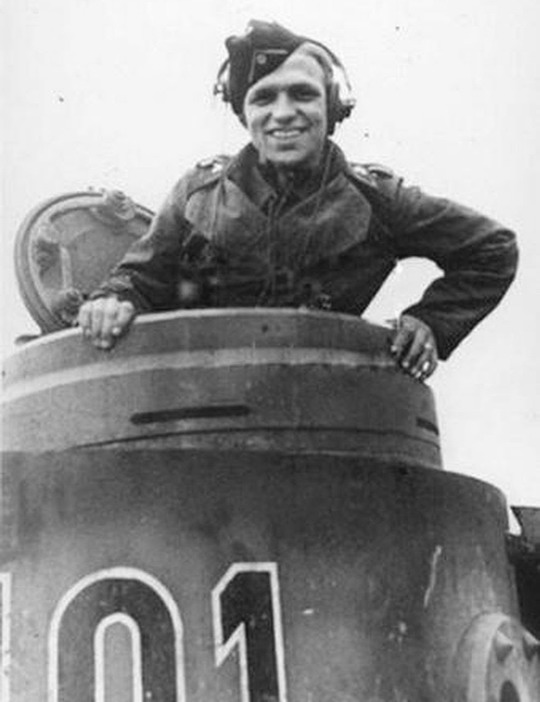
Kurt Knispel in the commander's cupola of a Tiger tank. Source: kurt-knispel.webnode.cz, used with permission, edited.
For many years, Panzernet incorrectly stated that the most successful German tank commander of the Second World War was a member of the Waffen-SS, Hauptsturmführer Michael Wittmann. The truth, however, is that Wittmann's legend was to a large extent deliberately cultivated by German propaganda, for which he was a far more convenient figure than the actual top scorer of the Third Reich — a man named Kurt Knispel. Knispel came from the Sudetenland and was therefore one of the so-called Volksdeutsche, whom many Nazis regarded as somehow "lesser Germans." What made him even less suitable for the propaganda machine was his rebellious nature, his free-spirited attitude, his low regard for authority, and his generally unkempt appearance. As a result, despite his extraordinary combat record, he remained largely unknown to the wider public. He received the recognition he deserved only after 2013, when his remains were discovered in a mass grave in Moravia — but more on that later.
Childhood and Youth
Kurt Knispel was born on 20 September 1921 in the village of Salisov (German: Salisfeld) in Silesia, in what is today the Jeseník district. Although the village lay on Czechoslovak territory, the overwhelming majority of its roughly three hundred inhabitants were ethnic Germans, including Knispel's family. After completing elementary school, Kurt Knispel trained as an auto mechanic and went on with his ordinary life.
At the end of September 1938, the Munich Agreement was signed, leading to the annexation of the Sudetenland into the Third Reich and making the Sudeten Germans its citizens — with all the consequences that entailed. Among those consequences was compulsory military service in the Wehrmacht. On 1 September 1939, Germany attacked neighbouring Poland, and the Second World War began.
Joining the Wehrmacht
A year later, on 6 September 1940, the nearly nineteen-year-old German citizen Kurt Knispel was conscripted into the army. He was assigned to the 4th Company of Panzer Ersatz Abteilung 15 in the Upper Silesian town of Sagan (today the Polish city of Żagań). In October 1940, part of the unit's personnel — including Knispel — was transferred to the newly formed Panzer Regiment 29 (29th Panzer Regiment), which formed the core of the 12th Panzer Division. Knispel was specifically assigned to the 3rd Company of the regiment's 1st Battalion (3. Kompanie, 1. Abteilung).
The fact that young Private Knispel ended up in a tank unit was likely no coincidence — he had at least two obvious qualifications. First, he was a trained auto mechanic, which was certainly useful in a tank. Second, he was of fairly short stature, which was equally useful. Knispel began his training on light vehicles such as the PzKpfw I and PzKpfw II, before progressing to the medium tank PzKpfw IV — at the time Germany's newest and most powerful tank. He completed his training qualified as both loader and gunner on the PzKpfw IV, and finished just in time to take part in the preparations for Operation Barbarossa — the invasion of the Soviet Union.
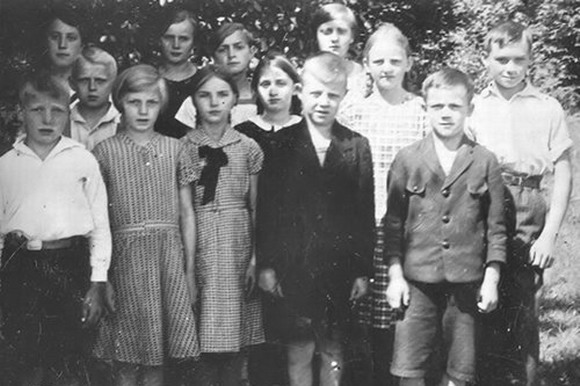
Kurt Knispel (far left) as a pupil at the village school in Salisov, around 1934. Source: kurt-knispel.webnode.cz, used with permission, edited.
Operation Barbarossa
For this operation, Knispel's unit — the 3rd Company, 1st Battalion, 29th Panzer Regiment, 12th Panzer Division — was assigned to the XXXIX. Armeekorps (mot.) (39th Motorised Army Corps), which in turn formed part of Panzergruppe 3 under the command of Generaloberst Hermann Hoth. The entire Panzergruppe attacked the Soviet Union as part of Army Group Centre under Field Marshal von Bock. Knispel himself entered the operation as a gunner in a Panzer IV commanded by a certain Lieutenant Hellmann.
Panzergruppe 3, with Knispel among its ranks, formed the northern jaw of an enormous pincer movement aimed at encircling as large a portion of the Soviet Western Front as possible. On 27 June 1941, both jaws of the pincer closed near the city of Minsk — Hoth's Panzergruppe 3 from the north and Guderian's Panzergruppe 2 from the south. During the subsequent battle to destroy the encircled pocket, gunner Knispel claimed his first combat success by knocking out a Soviet anti-tank gun.
In early July, the weather in the Army Group Centre's operational sector suddenly deteriorated. Several days of rain turned the ground to mud and slowed the German advance. The Soviets took advantage of the situation and on 6 July launched a fairly massive counterattack against Panzergruppe 3. With considerable assistance from the Luftwaffe, this Soviet effort was quickly halted, and Panzergruppe 3 continued its drive toward Smolensk. On 26 July 1941, the two Panzergruppen repeated their encirclement manoeuvre near Smolensk — Panzergruppe 3 from the north and Panzergruppe 2 from the south. As at Minsk a month earlier, hundreds of thousands of Soviet soldiers were trapped inside the resulting pocket.
Towards Leningrad
The tankers of Knispel's Panzergruppe 3 were now poised to begin the advance on Moscow. However, they received new orders: they were to move north and help Army Group North capture Leningrad. Knispel's unit therefore turned toward Lake Ilmen, then swung to the northeast with the aim of tightening the encirclement of Leningrad by pushing toward Volkhov and Tikhvin. During these battles, gunner Knispel destroyed at least eight light tanks of the T-26 type. On 25 August, he pulled off a remarkable feat by knocking out a feared Soviet medium T-34 at a range of 800 metres. While this achievement is mentioned consistently across most sources, I was unable to find any details about the specific circumstances. Destroying a T-34 with a Panzer IV was no small feat. Knispel was undoubtedly sitting in one of the early versions of the Panzer IV, still armed with the short-barrelled gun that was comparatively weak in terms of armour penetration. A standard armour-piercing round from that gun would not have been sufficient to penetrate the sides or rear of a T-34 at 800 metres. Knispel must therefore either have used more effective shaped-charge ammunition, or he fired a standard round but managed to hit the gun barrel, turret ring, or some other vulnerable spot on the enemy tank.
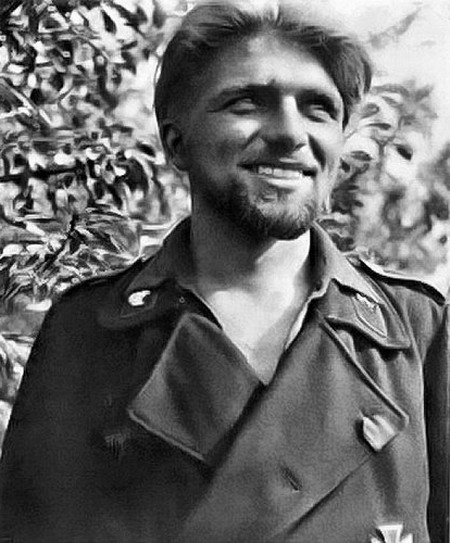
Who would have guessed that this scruffy, unshaven vagabond was the best tank gunner in the Third Reich? Source: kurt-knispel.webnode.cz, used with permission, edited.
After Leningrad was encircled, Panzergruppe 3 returned to the central sector of the front to finally take part in the advance on Moscow. This, however, apparently did not apply to the 12th Panzer Division itself, which included Knispel's regiment. That division remained in the north and, alongside troops from Panzergruppe 4, fought to maintain the encirclement of Leningrad against increasingly powerful Soviet counterattacks. Knispel therefore did not take part in Operation Typhoon — the push for Moscow. Instead, he was engaged in gruelling defensive fighting in the north, gradually falling back further and further west as the Wehrmacht ran short of fuel, ammunition, and tanks.
On 4 November 1941, Knispel was awarded the Iron Cross Second Class for his combat achievements. In December 1941, the Soviet 4th Army struck at Tikhvin, the easternmost point of the German lines. The exhausted Germans were unable to hold this attack and were forced to withdraw further west. Knispel's tank, dug in to a defensive position, managed to destroy five Soviet T-34s at close range during the retreat. The decimated remnants of the 12th Panzer Division subsequently fell back all the way to Novgorod, where the soldiers left their tanks behind and travelled by train to Narva in Estonia.
In Narva, the unit was replenished with new men and re-equipped. According to some sources, the unit was to receive brand-new Panzer IV Ausf. F2 tanks in Estonia — machines fitted with a significantly more powerful gun. However, the Panzer IV Ausf. F2 did not enter production until March 1942, and by that time the 12th Panzer Division was already back at the front. It can therefore be assumed that during this first re-equipping, the men received tanks with the same old short-barrelled guns. Knispel himself was promoted to Unteroffizier while in Estonia.
In February 1942, Knispel and his unit returned to the front. It was around this time that he was most likely assigned as gunner to a tank commanded by his soon-to-be close friend Alfred Rubbel. Serving in the same company as a tank commander was another of Knispel's friends, Hans Fendesack. The 3rd Company, 1st Battalion, 29th Panzer Regiment was deployed once again to northern Russia, where the Soviets had just launched another attempt to break the blockade of Leningrad. This time the attack was spearheaded by Vlasov's 2nd Shock Army, which managed to breach the German lines between Novgorod and Chudovo on a front roughly 30 kilometres wide and pushed northwest toward Leningrad.
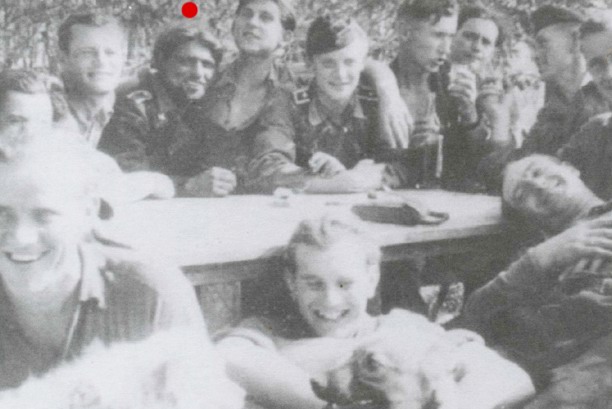
1943: Kurt Knispel (marked with a dot) at a lively celebration with comrades from the 1st Company, schwere Panzer Abteilung 503. To his right sits Hans Fendesack; the third soldier to his left (holding a glass) is Alfred Rubbel. Source: kurt-knispel.webnode.cz, used with permission, edited.
Vlasov's forces succeeded in penetrating roughly 70 kilometres into the German rear before their advance stalled — and the Germans actually managed to encircle them. Vlasov requested permission from Soviet command to withdraw to his starting positions, but was refused. He had no choice but to defend himself as best he could inside the pocket. By the time he finally received approval to attempt a breakout in May 1942, it was already too late. The 2nd Shock Army had been so badly weakened that it could not break through, and it was ultimately wiped out entirely. Knispel took part in these battles. His 29th Panzer Regiment claimed a total of 21 Soviet tanks and 24 anti-tank guns destroyed in the fighting, while losing only six of its own tanks.
After the fighting ended in May 1942, the men of the 1st Battalion, 29th Panzer Regiment — including Knispel — were ordered to hand over their tanks and prepare to be transferred back to Germany for rest, replenishment, and re-equipment. Back home, the soldiers were given leave, and Knispel went home. After a week's rest, he reported back to the army training centre at Neuhammer (today Świętoszów in Poland). A few days later, the battalion took delivery of its new tanks — the latest version of the proven Panzer IV, designated Ausf. F2, which was equipped with a new long-barrelled 75mm gun that was significantly more capable of penetrating enemy armour than its predecessors.
With their new tanks, the men moved to the town of Burg near Magdeburg. There they learned that they were being immediately transferred from the 3rd Company, 1st Battalion, 29th Panzer Regiment of the 12th Panzer Division to the 9th Company, 3rd Battalion, 4th Panzer Regiment of the 13th Panzer Division. In June 1942, men and machines were loaded onto a train and set off through Poland back to the Eastern Front. The train made a longer stop in Kraków. Virtually every biography of Knispel mentions an incident that occurred there — one that beautifully illustrates his character and the fundamental human decency he managed to preserve amidst everything happening around him.
At Kraków railway station, Knispel noticed a group of prisoners being guarded by members of the Schutzpolizei. One of the guards began brutally beating a defenceless prisoner who had apparently displeased him in some way. Knispel could not stand by and watch. He verbally confronted the policeman, and after a brief exchange of words, he grabbed the guard's rifle and smashed it against the rails, snapping off the stock. He then went after the guard himself. Afterwards, Knispel quietly slipped back among his comrades. It wasn't long before the military police came looking for him. It was a serious offence, one that carried the risk of heavy punishment. The story goes that Knispel was saved by his battalion commander, who reportedly stood with pistol in hand and told the military police that if they intended to take his soldier away, one of them would have to climb into the tank in his place.
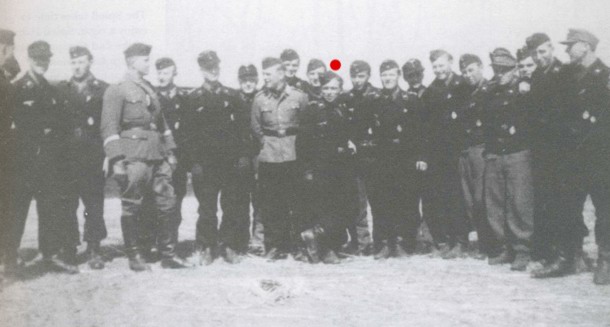
April 1944: Kurt Knispel (marked with a dot) surrounded by fellow members of the 1st Company, schwere Panzer Abteilung 503. Two things are worth noting: Knispel's short stature and the most relaxed posture of anyone in the photograph. Source: kurt-knispel.webnode.cz, used with permission, edited.
During the remainder of the train journey east, another legendary story is said to have taken place — one that again showed Knispel's irrepressible side. He allegedly broke into a supply vehicle belonging to the 5th SS Panzer Division Wiking, which was travelling on the same train, and made off with a haul of cigarettes, chocolate, alcohol, and coffee. Rather than keeping the loot for himself, he dutifully shared the dishonestly acquired spoils with his comrades.
To the Caucasus
The 13th Panzer Division, to which Knispel's battalion now belonged, was deployed to the southern sector of the Eastern Front. The train carrying the tankers arrived at the recently captured Rostov-on-Don. For the upcoming German offensive — codenamed Fall Blau — the original Army Group South was divided into two parts: Army Group A and Army Group B (Heeresgruppe). Army Group A was tasked with capturing the oil fields around Baku, while Army Group B was to take Stalingrad. Knispel's 13th Panzer Division was incorporated into the 1. Panzerarmee (1st Panzer Army, under Generaloberst Ewald von Kleist), which fell under Army Group A. Their objective was therefore the Caucasian oil fields, and the codename for their part of the operation was Edelweiss.
The Soviets had concentrated their main forces closer to Moscow, on the central part of the front, and as a result Army Group A's push southward initially went fairly smoothly. The Germans rapidly took Stavropol, Maikop, Krasnodar, Mozdok, and Novorossiysk, and pressed on toward Grozny. But they never got there. From September 1942 onwards, the advance began to slow — equipment was wearing out, soldiers were exhausted, and supply lines were stretching to breaking point. Units soon experienced a truly desperate shortage of fuel, with tank formations sometimes sitting idle for days simply because there was no petrol. By the end of September, the advance had effectively stalled in the vicinity of Malgobek and Ordzhonikidze (today Vladikavkaz) — roughly 80 kilometres from Grozny and more than 600 kilometres from Baku.
In November 1942, Stalingrad was encircled and Soviet forces began pushing west toward Rostov-on-Don. This posed an enormous threat to the German troops in the Caucasus: if the Russians took Rostov, the entire Army Group A would be cut off and almost certainly destroyed. It was also becoming clear that the remaining objectives of Operation Edelweiss — crossing the Caucasus and seizing the Baku oil fields — were no longer realistic, and the Germans began preparing for a gradual withdrawal. Knispel's 9th Company, 3rd Battalion, 4th Panzer Regiment received orders in December 1942 to pull back to Rostov and prepare for transport back to Germany. According to some sources, Knispel had added 12 destroyed Soviet tanks to his tally during the Caucasus campaign.
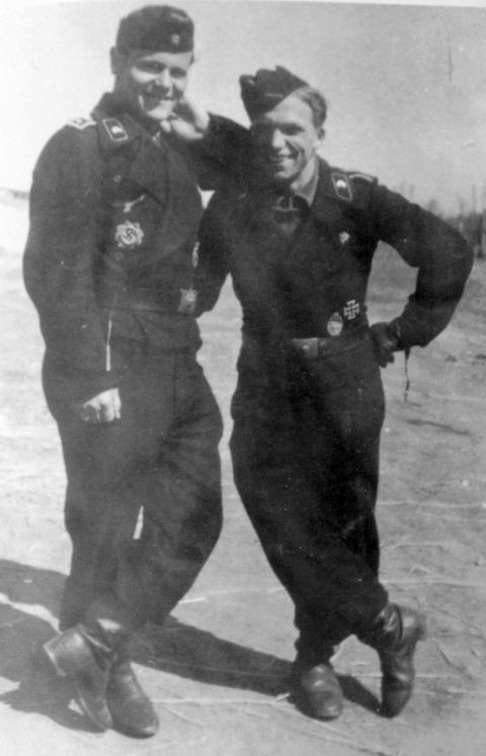
Kurt Knispel with his close friend Hans Fendesack. Source: Flickr.com, edited.
After returning to Germany, the soldiers were given a short period of leave, after which training on a new tank type was to follow. Around this time, Knispel also received the Panzerkampfabzeichen (Tank Battle Badge).
The Tiger Tank
Knispel spent Christmas and New Year at home, and in January 1943 he reported to the training centre at Putlos in northern Germany, to Panzer Ersatz Abteilung 500. He was far from alone — many tankers from the 4th Panzer Regiment where he had previously served arrived alongside him, as did men from other armoured units. In Putlos, they would all be introduced to Germany's newest and most powerful tank: the Tiger.
First impressions of the new tank were evidently mixed. Knispel's friend Alfred Rubbel later recalled expecting some kind of wonder weapon — a machine of futuristic appearance — only to find a square, angular "dinosaur" waiting for him. But the tankers soon came to appreciate that they had been handed a truly exceptional fighting machine. With 100mm of frontal armour it was nearly impervious to enemy fire, and its long 88mm gun, paired with a highly accurate sight, could destroy targets at ranges previously unimaginable. Commanders and gunners alike — including Kurt Knispel — had to learn a new style of combat: engaging the enemy at long range rather than waiting until close enough to be sure of a hit. For the gunner, the ability to accurately judge distance was crucial, and as it soon became clear, Knispel had a rare gift for it.
schwere Panzer Abteilung 503
The training battalion Panzer Ersatz Abteilung 500 — Knispel included — soon moved to the training centre in Paderborn, where training continued. Once qualified, these tankers were to become part of schwere Panzer Abteilung 503 (503rd Heavy Tank Battalion). The battalion had officially existed on paper since May 1942, but only received its first Tiger tanks in December. At that point, however, the new heavy tanks were not yet available in sufficient numbers, and when the 503rd departed for the Eastern Front on 21 December 1942, it had only two of its three authorised companies — and even those were a mix of Tigers and medium Panzer III Ausf. N tanks. The battalion needed to be reinforced with new men, ideally experienced ones, and that is precisely how Knispel and his colleagues from the 4th Panzer Regiment came to be involved.
During training, the men were organised as a heavy tank company. Those who came from the 4th Panzer Regiment were grouped together into one platoon (four tanks plus one command tank). This platoon was led by the already-mentioned Hans Fendesack, and was therefore simply known as "Zug Fendesack" — Fendesack's platoon. The men completed their Tiger training sometime around March 1943, having moved during the final phase from Paderborn to Sennelager. Roughly in the middle of March, the training unit received orders to select five crews and prepare them — along with their tanks — for transfer to the Eastern Front. Oberfeldwebel Hans Fendesack and his entire platoon volunteered for the mission. On 11 April 1943, all 25 men and their five tanks were loaded onto a train and headed east.
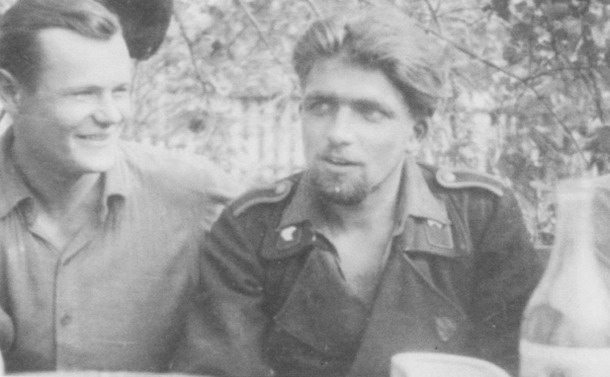
Kurt Knispel and Hans Fendesack again. Source: kurt-knispel.webnode.cz, used with permission, edited.
Operation Zitadelle
The train carried them all the way to Bohodukhiv, roughly 70 kilometres northwest of recently recaptured Kharkiv. Military transport after military transport was converging on this area in preparation for the German operation codenamed Zitadelle — an attempt to eliminate the Soviet salient around Kursk. The newly arrived crews from Fendesack's platoon were distributed among all three existing companies of the 503rd Battalion. All three friends — Knispel, Fendesack, and Rubbel — stayed together, all assigned to the battalion's 1st Company. The often-repeated claim that Knispel had by this point already been given command of his own Tiger is almost certainly untrue. He was still "merely" a gunner — in the tank commanded by his friend Hans Fendesack.
With these reinforcements, the 503rd Heavy Tank Battalion reached its full establishment strength of 45 Tiger tanks. The start of Operation Zitadelle was repeatedly postponed, and the soldiers spent virtually all of May and June in the Kharkiv area running through preparatory exercises and gunnery practice. When the operation finally got underway, the 503rd Battalion was not committed as a whole. To the frustration of its commanders, the individual companies were parcelled out to three separate panzer divisions. The 1st Company (Knispel's) was attached to the 6th Panzer Division, the 2nd to the 19th Panzer Division, and the 3rd to the 7th Panzer Division. These three divisions formed part of III. Panzerkorps (3rd Panzer Corps), which together with other units fell under Armeeabteilung Kempf (Army Detachment Kempf) commanded by General Werner Kempf — itself subordinated to Army Group South under Field Marshal Erich von Manstein. The men of the 503rd therefore took part in the attack on the southern shoulder of Operation Zitadelle, advancing from positions south of Belgorod.
The German assault began in the early hours of 5 July 1943. The units under Armeeabteilung Kempf were to cross the Donets River south of Belgorod and attack the Soviet 7th Guards Army, their mission being to cover the right flank of Hoth's 4th Panzer Army — the main striking force. The crossing of the Donets did not go according to plan, however. Although a bridgehead was established on the eastern bank, only a fraction of the attacking units made it across on the first day, causing a significant delay. By 6 July, the 6th and 7th Panzer Divisions were fully engaged against the 7th Guards Army and achieved some solid successes, for instance near the town of Krutyy Loh. The Soviet defensive positions were heavily disrupted, but the Russians were able to shore them up with reinforcements from other units, and the German advance was agonisingly slow.
Of the three panzer divisions to which the companies of the 503rd schwere Panzer Abteilung had been assigned, the most successful was the 6th Panzer Division, which had the battalion's 1st Company — including Knispel — attached to it. During the night of 10–11 July, this division achieved a breakthrough and launched an advance on Rzhavets, from where it planned to push north to Prokhorovka and link up with the II SS Panzer Corps. Rzhavets was taken by the 6th Panzer Division on 12 July, but its further advance was stopped by Soviet resistance, and it was unable to take part in the famous tank battle at Prokhorovka.
The entire Operation Zitadelle was going considerably worse for the Germans than planned. Their units were advancing — particularly on the southern sector — but only slowly and at a tremendous cost in lives and equipment. On 10 July, an unexpected complication arose with the Allied landings in Sicily. On 13 July, Hitler met with the two principal commanders of Operation Zitadelle, von Manstein and Kluge, and announced that he intended to terminate the Kursk offensive and transfer some forces to Italy to confront the Allies there. Manstein pressed for the attack to continue, arguing that the worst was behind them and success was still possible. Kluge, on the other hand, agreed with Hitler that Operation Zitadelle had no future regardless. Hitler ordered a phased withdrawal to the starting positions. On Manstein's southern flank, offensive operations could continue temporarily with the aim of destroying as many Soviet reserves as possible to prevent them from launching a counteroffensive. But the fate of the operation was sealed. The Germans gradually went over to the defensive, and the initiative passed to the Red Army.
Knispel personally had a very successful time during the Kursk operation. He claimed 27 confirmed enemy tank kills, and in at least two cases managed to destroy his targets at ranges exceeding 2,000 metres. As a gunner, Knispel had an exceptional ability to exploit the qualities of the Tiger. On 24 July 1943, he received the Iron Cross First Class for his combat achievements.
For the remainder of July and throughout August, elements of the 503rd Battalion remained dispersed, fighting alongside various formations in defensive operations while steadily pulling back further and further west. During this time, Knispel and his 1st Company were engaged in the fighting around Kharkiv. As the general German retreat unfolded, supplies of ammunition, fuel, and spare parts soon dried up. The situation around Kharkiv was unsustainable in the long run, and on 22 August the remnants of what had been Armeeabteilung Kempf began to abandon the city. The Tiger crews fought off the pressing Russians during the day and joined westbound convoys at night. Everyone was pulling back toward a more defensible line along the Dnieper River.
The Cherkasy Pocket
In December 1943, Soviet forces nonetheless managed to break through even that defensive line and crossed the Dnieper at multiple points. The Germans had no choice but to fall back further west. The rearguard during the retreat consisted of the XI. and XLII. Army Corps. From the direction of Cherkasy, the 2nd Ukrainian Front was pressing hard against the Germans, while troops of the 1st Ukrainian Front — who had crossed the Dnieper further north — swung around and attacked from the northwest. At the end of January, the two Soviet thrusts met near the town of Zvenyhorodka, encircling just under 60,000 German soldiers in what became known as the Korsun–Cherkasy Pocket.
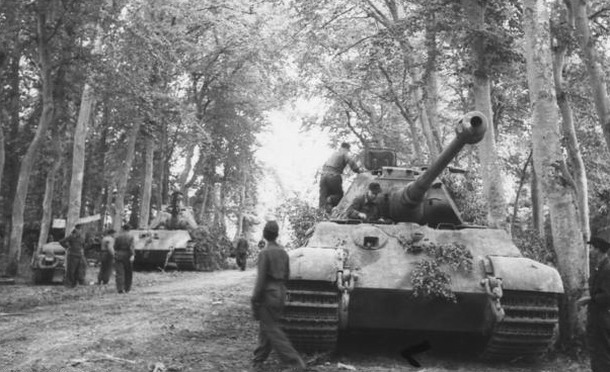
Königstiger tanks with Porsche turrets belonging to the 1st Platoon, 1st Company, schwere Panzer Abteilung 503, taking cover from Allied air power in a small wood near Canteloup, approximately 20 km from Caen, July 1944. Source: Bundesarchiv Bild 101I-721-0359-37, Wikimedia Commons, Creative Commons, edited.
The Germans began preparing a relief operation even before the Soviet encirclement was complete. A special unit was formed and named schweres Panzer Regiment Bäke (Heavy Panzer Regiment Bäke), placed under the command of the outstanding officer Oberstleutnant Dr. Franz Bäke — a dentist by profession, as it happened. The 503rd Battalion, including Knispel's tank, was incorporated into this special formation. Panzer Regiment Bäke also had at its disposal part of the 23rd Panzer Regiment with over forty Panther tanks, as well as assault guns, engineers, and infantry.
Panzer Regiment Bäke attacked the Soviets from the east, and between 23 and 31 January 1944 operated in the area between Oratov, Vinnytsia, Balabanovka, and Medvyn. In just one week of fighting, this heavily armed regiment reportedly destroyed 267 Soviet tanks and self-propelled guns with minimal losses of its own. From 1 February, the unit joined the effort to relieve the Cherkasy Pocket. The relief was only partially successful — a full breakthrough never came — but it can still be counted as an achievement, since tens of thousands of German soldiers managed to escape the encirclement, even though they had to abandon virtually all their heavy equipment. Gunner Knispel once again distinguished himself, destroying 12 Soviet tanks during the fighting. In March 1944, the 503rd Battalion itself became encircled in what was known as the Hube Pocket. The Germans managed to break out, but the battalion lost most of the tanks it still had.
In April 1944, the depleted 503rd Heavy Tank Battalion — Knispel included — was sent back to Germany for rest, replenishment, and crucially, re-equipment. By this point, Knispel's combat tally had passed the hundred mark — 101 confirmed enemy armoured vehicle kills — and even the official propaganda machine could no longer entirely ignore this unconventional hero. In early May 1944, his achievements were mentioned in the army gazette (which no doubt gave him enormous satisfaction). He was also promoted to Feldwebel, and on 20 May received the Deutsches Kreuz in Gold (German Cross in Gold). The Knight's Cross, for which he had again been nominated, was once more withheld.
The men of the 503rd gathered at the training ground in Ohrdruf to retrain on an entirely new tank type — the heavy Tiger II, also known as the Königstiger, the heaviest, most heavily armoured, and most powerfully armed German tank of the entire war. The first new tanks reached the unit on 16 June 1944, making the 503rd the very first unit to be equipped with this brand-new machine. Only 12 tanks were available at first — not even enough to fully equip one company — and all available Tiger IIs were assigned to the battalion's 1st Company, in which Knispel served.
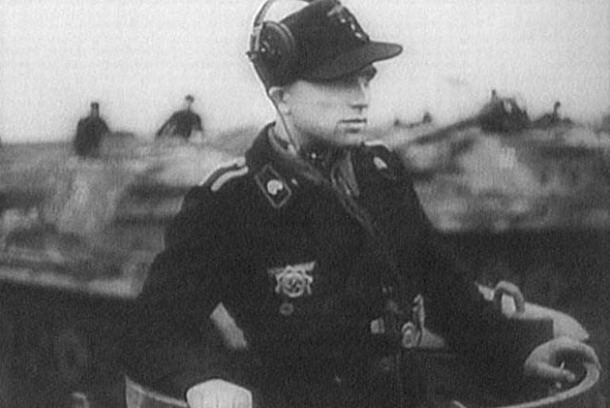
Kurt Knispel, here playing the part of a proper soldier at a propaganda parade of the 503rd Battalion at the base in Paderborn, September 1944. Source: kurt-knispel.webnode.cz, used with permission, edited.
Deployment in France
On 26 or 27 June 1944, the battalion was dispatched to the Western Front to take on the Allies. At that moment, the 1st Company had 12 Königstiger tanks (in the Porsche-turret version) and 2 Tiger tanks, while each of the remaining two companies had fourteen Tigers. Knispel entered the French campaign as a gunner in tank number 101 — one of the 1st Company's command tanks — commanded by his friend Hans Fendesack. This was an older Tiger Ausf. E, not one of the new Königstigers. On 3 July, the men detrained at Dreux, roughly 70 kilometres west of Paris, and from there made their own way toward Caen. All movements had to be carried out at night due to Allied airpower, which held complete superiority over the Luftwaffe in the skies above France. The 503rd Battalion was committed on the Western Front as part of the LXXXVI. Armeekorps.
The tanks of the 503rd sPzAbt — specifically its 3rd Company — first saw action on 11 July in the Giberville area east of Caen. The tankers were tasked with stopping an Allied breakthrough in the sector, which they managed to do. In the days that followed, the Germans were also fairly successful in repelling Allied attacks. The turning point came on 18 July, when the British launched Operation Goodwood. That morning, the assembly area of the 503rd's 3rd Company was literally buried under artillery fire and air strikes, leaving the company with only a single operational Tiger. The battalion's remaining elements, including Knispel's 1st Company, were gradually forced to fall back to Saint-Pierre-Canivet north of Falaise, where in August 1944 they were encircled along with many other units in the so-called Falaise Pocket. By late August, the remnants of the battalion — with only a handful of tanks left, perhaps as few as two — managed to escape the encirclement, after which the unit was withdrawn to Germany for rebuilding.
On 14 August 1944, Knispel's friend Hans Fendesack was severely wounded in action and died of his wounds the following day. During the fighting in France, Knispel claimed 25 Allied tanks destroyed. In September 1944, the battalion was brought back up to full establishment strength in Paderborn — 45 tanks in total — this time equipped exclusively with the new Königstiger fitted with the production-series turret. Kurt Knispel was now no longer assigned as a gunner but as a tank commander. A brief period of training for the new recruits followed, and sometime between 9 and 12 October the unit set off for the front once again. This time, the train was taking them to Hungary.
Deployment in Hungary
The 503rd Battalion had two tasks in Hungary. The first was to prevent Hungarian Regent Horthy from concluding an alliance with the Soviet Union — something that appeared increasingly imminent. The second was to hold back Soviet forces that were already crossing the Hungarian border. The first part of the mission was given the grandiose-sounding name Operation Panzerfaust, though in reality it was more of a show of force than an actual combat operation. It was led by the famous Otto Skorzeny. All Skorzeny needed was to drive up to Budapest Castle with four Königstiger tanks, and Horthy thought better of ordering his troops to resist. He was arrested, replaced, and Hungary — for the time being — remained Germany's ally. Both at the castle and elsewhere in the streets of Budapest, only tanks from the 503rd's 2nd and 3rd Companies were involved, so Knispel himself, belonging to the 1st Company, almost certainly took no part in Operation Panzerfaust.
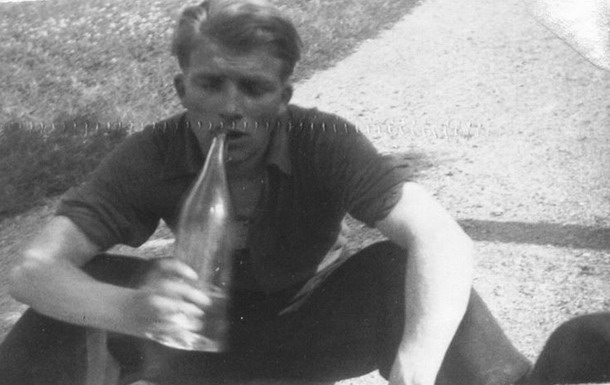
And here Kurt Knispel in a moment of leisure — he was apparently a master at sourcing alcohol in occupied territory. Source: Flickr.com, edited.
The political crisis in Budapest was resolved almost without a fight, but the situation in eastern Hungary was far more serious — Soviet forces were already advancing there. The tankers of the 503rd, Knispel among them, were quickly dispatched toward Debrecen to join the 1st and 23rd Panzer Divisions in confronting the Soviet push east of the Tisza River. Initially, they managed to hold their ground. Knispel's tank is said to have accounted for 12 Soviet tanks in this sector of the front. Given the enemy's overwhelming numerical superiority, however, the Germans could not hold out for long and soon began to fall back. By early November they had been pushed back toward Budapest.
In December, Budapest was encircled, and Knispel's unit joined the attempt to rescue more than 180,000 German and Hungarian soldiers trapped inside. This operation was codenamed Konrad, but it ultimately failed. The 503rd Battalion then retreated from Budapest, most likely first to the Balaton area and then into Slovakia. The men probably crossed the Danube at Komárno and continued withdrawing through Šurany and Vráble toward Nitra and then Trnava. Even during the retreat, the tankers continued to fight, inflicting significant losses on the Red Army's armour. But it was clear to everyone that there was absolutely no stopping the Soviet war machine now.
The Last Retreat
The unit's continued retreat led to Moravia, specifically to Hodonín. From there, the battalion was called to Austria, where it was still involved in fighting near Zistersdorf, Mistelbach, and Poysdorf. It was soon driven back out of Austria, across Nový Přerov and into Moravia once more. There is little point in listing the countless small attritional engagements during which the battalion steadily lost men and operational vehicles, while the kill marks on their tank barrels kept growing. Near Branišovice, the Germans managed to repair some of their damaged Königstigers, and on 27 April 1945 launched a counterattack near Pasohlávky. On 28 April, the fighting continued near the village of Nová Ves south of Pohořelice. This skirmish with Soviet tanks would have been unremarkable — had it not turned out to be Knispel's last. After nearly four years at the front and hundreds of tank battles in which he had never been seriously wounded, luck simply abandoned him just a few days before the end of the war.
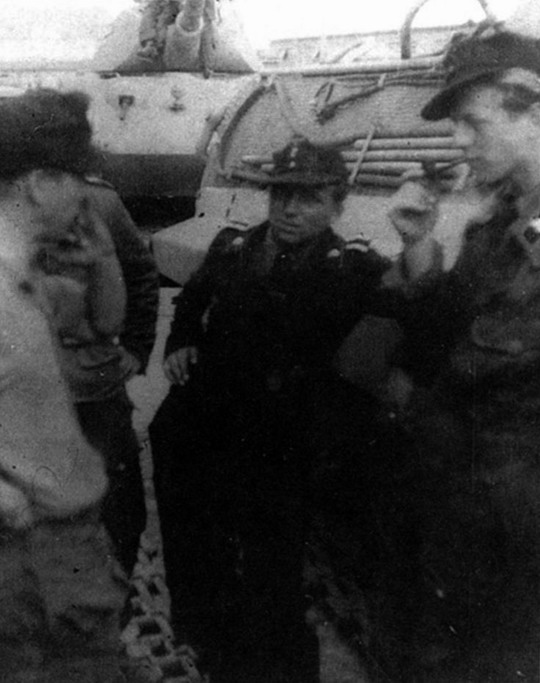
Kurt Knispel in a not particularly sharp photograph, France 1944. Source: kurt-knispel.webnode.cz, used with permission, edited.
Discovery of the Remains
In the general chaos of the final days of the war, the death and burial place of Feldwebel Knispel were never properly recorded — and even the location of his fatal wounding is not entirely certain. Some sources place it not at Nová Ves but at the village of Vlasatice, a few kilometres away. It was only 68 years later, in April 2013, that Knispel's body was found in a mass grave in the village of Vrbovec in the Znojmo district of Moravia. There had been a German field hospital at Vrbovec at the end of the war, making it likely that his comrades brought the mortally wounded — or already dead — Knispel there. There was nothing more to be done for him, however, and his body was buried together with others in a communal grave behind the cemetery wall. The site was traced and uncovered by researchers from the Moravian Museum in cooperation with their German colleagues.
The discovery of Knispel's body was confirmed by his identity disc, with which he had been buried. His remains were exhumed and, following examination, were properly interred at the Central Cemetery in Brno in November 2014. The examination also established the cause of death beyond doubt — a shrapnel wound to the head. Whether Knispel was hit while outside his tank, or whether he had been fighting with his head exposed above the commander's cupola in his characteristic manner, will almost certainly never be known.
Knispel's Score
Kurt Knispel had 168 confirmed armoured vehicle kills to his name — 143 on the Eastern Front and 25 on the Western Front. Of these, 126 were scored as a gunner and the remaining 42 as a tank commander. And these figures represent only the officially confirmed numbers. On top of them, at least 27 unconfirmed kills are typically cited — and it is quite possible that the real number was even higher, since Knispel, who had no great interest in military decorations, apparently didn't bother arguing with anyone over every tank he destroyed. This extraordinary tally made Kurt Knispel the most successful tank ace of the entire Second World War — and of all recorded military history up to the present day.
And yet he remained largely unknown both during the war and for long after it. He simply refused to play the role of the hero that Nazi propaganda needed. He wore his hair long, didn't shave, went around looking scruffy, and had little time for authority. In occupied territories he mingled freely with local civilians — especially women — and quietly obtained alcohol for himself and his friends. But those who knew him knew that he was always ready to help his comrades and people in need, and never once acted like a "star." He was a bohemian who had made up his mind not to let the war ruin his enjoyment of life. In battle he did the best he could to stay alive; outside battle he carried on living life to the full.
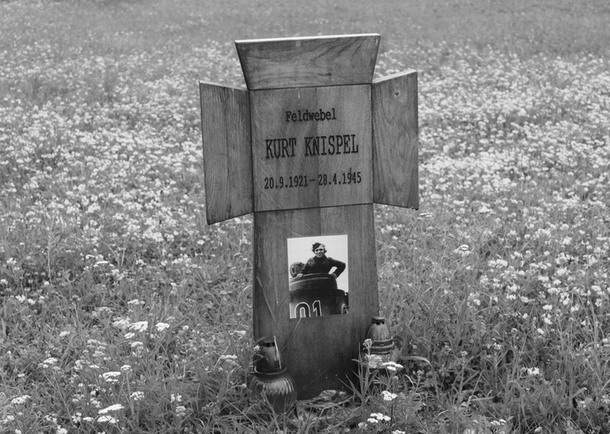
The remains of Feldwebel Knispel were recovered in 2013 from a mass grave in Vrbovec and properly laid to rest at the Central Cemetery in Brno. Source: Panzernet.net, own photo.
It is no wonder, then, that he never rose to a higher rank and was never awarded the Knight's Cross — despite being nominated for it four times by his superiors. Nor is it any wonder that in official propaganda he was completely overshadowed by more polished heroes such as Michael Wittmann. Wittmann was also a superb tanker, but he never matched Knispel's score (though who knows what might have been, had Wittmann been given the chance to fight through to April 1945 instead of falling in August 1944). Given the sheer number of engagements Kurt Knispel took part in, it is frankly a miracle that he survived as long as he did. Knispel went through virtually the entire Eastern campaign with the Wehrmacht — he was present at the vast encirclements of 1941 in the central sector of the front, he fought in the north near Leningrad and in the south on the Caucasus, he fought at Kursk and in France, and in the end he fell on the soil of the very country where he had been born. He was 23 years old.

ARTICLE
CONTENTS:
Reproducing text from the Panzernet website without the written consent of the operator is prohibited.