E-PANZER
eco-friendly warfare
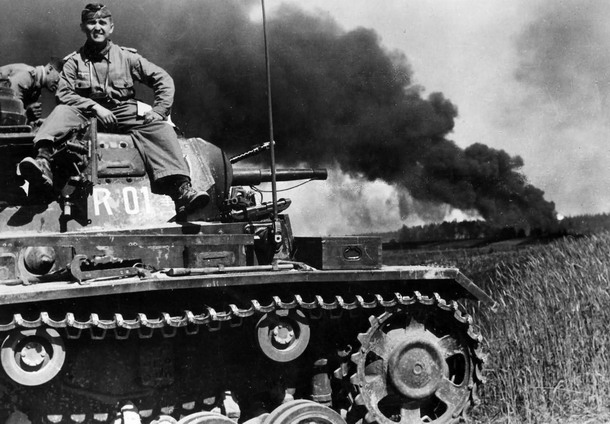
as the emissions sticker on the turret side clearly indicates, this Panzer III command tank meets the REICH 01 standard (a pity that its efforts towards greener warfare are somewhat undermined by the fire in the background), source: Flickr.com with permission of the publishing user, edited
Hitler's profound love of nature is by now well known to anyone with an interest in history. And no wonder — it permeated virtually everything the Führer did. One need only think of the places where he spent most of his time. Not in Berlin or other great cities, but in his two retreats deep in the natural world: the so-called Eagle's Nest at Obersalzberg, amid magnificent Alpine scenery, and the Wolf's Lair near Rastenburg, surrounded by fresh green forests. Whenever he could, the Führer would set out on long walks and drink in the beauty of nature.
Hitler's loyal German Shepherd Blondi hardly needs an introduction. But his love was not confined to dogs alone — it extended to all living creatures. It was, after all, the very reason for his strict vegetarianism. His ban on the use of poison gas in warfare also stemmed from his full awareness that this terrible weapon killed not only enemy soldiers but every innocent animal, bird, and insect that the wind happened to carry it to. As a tribute to living nature, the Führer selected the combat names for Germany's finest fighting vehicles. The tanks Tiger, Panther, Leopard and Maus (mouse), the self-propelled guns Wespe (wasp), Hummel (bumblebee), Grille (cricket), Heuschrecke (grasshopper), or the tank destroyers Nashorn (rhinoceros) and Marder (marten)... did you think they got those names by chance? On the contrary — through all of them Hitler was paying homage to living creatures, from the greatest to the smallest.
When it came to selecting codenames for his military operations, the Führer likewise drew inspiration from nature. Consider: the deployment of German forces in North Africa carried out under the codename Operation Sonnenblume (sunflower); the planned invasion of Britain named Operation Seelöwe (sea lion); the 1941 assault on Moscow conducted under the name Operation Taifun (typhoon); the attempt to relieve encircled Stalingrad in 1943 called Operation Wintergewitter (winter storm); the March 1945 Lake Balaton offensive designated Operation Frühlingserwachen (spring awakening); or the phase of the 1942 Caucasus offensive named Operation Edelweiss after the mountain flower. To this one must add an entire series of offensives named after individual colours of the rainbow: the planned attack on Czechoslovakia, Fall Grün (Case Green); Fall Gelb and Fall Rot (Case Yellow and Case Red), the two phases of the conquest of France; and the offensive in southern Russia under the designation Fall Blau (Case Blue).
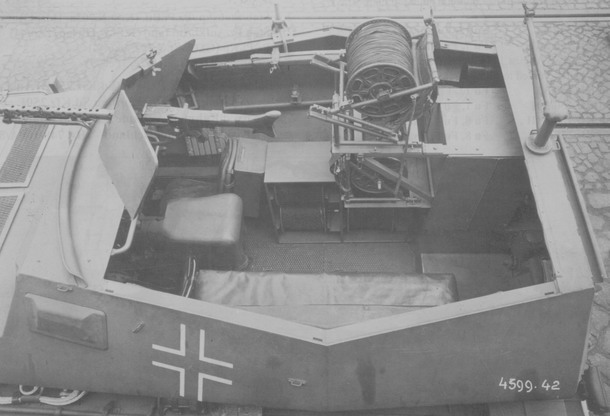
electric reconnaissance vehicles, such as this Sd.Kfz. 250, were equipped with long power cables that considerably extended their operational range, source: Flickr.com with permission of the publishing user, edited
On the one hand, then, an enormous love of nature; on the other, a burning desire to conquer the world. The result was that Hitler was in a constant state of torment over the environmental impact of his armies' activities. He commissioned dozens upon dozens of environmental analyses, spent long hours poring over tables and documents of every kind, and racked his brains over how to reduce the carbon footprint of his forces. According to a 1937 analysis, a single panzer division was expected to consume around 150,000 litres of petrol per 100 km — and this was before the heavy, thirsty tanks of the second half of the war had even appeared! Hitler was quite clear: fuel consumption, and with it the associated emissions of carbon monoxide and nitrogen oxides in the German army, simply had to come down.
The Führer did not hesitate to spend enormous sums consulting the very finest non-profit environmental organisations. In collaboration with Germany's leading climate experts, he devised a sophisticated system of limits and standards which Wehrmacht divisions were to begin meeting. It was a whole package of norms, set to come into force gradually over the coming years, progressively tightening the emissions limits. This would give divisions and armies sufficient time to prepare for the reductions required. The first standard, designated REICH 01, was set to take effect on 1 April 1940.
The incomprehension and resistance of his own generals was nothing new to Hitler, and he was not about to let their grumbling stop him. There was no choice: commanders responsible for divisions, armies, and army groups simply had to start finding ways to meet the new emissions requirements. Infantry commanders couldn't help sniggering at their colleagues in the panzer divisions, who compared to them had actually been handed a fairly easy task. The artillery en masse cancelled orders for half-tracked prime movers and went back to horse teams. Yes — it was precisely this green initiative of Hitler's that kept the Wehrmacht overwhelmingly dependent on horses throughout the entire war.
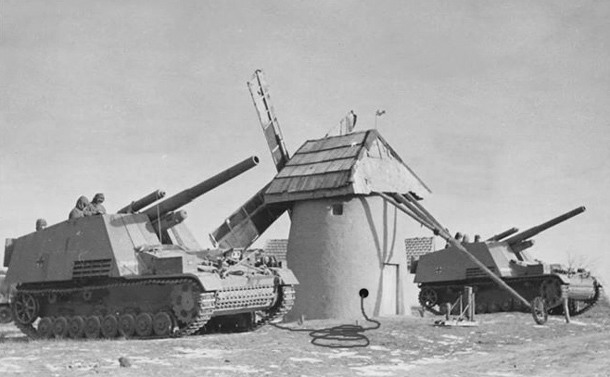
a pair of electric self-propelled guns charging their batteries at an older-type wind turbine, source: Flickr.com with permission of the publishing user, edited
The Ordnance Office (Waffenamt) was very quickly swamped with requests from the military for the development and production of new types of combat and support vehicles that would comply with the REICH 01 standard. Engineers at every armaments firm sat down at their drawing boards and began working on this novel problem. To the three traditional fundamental requirements to be balanced in the design of any fighting vehicle, a fourth had now been added. Alongside the level of armour protection, mobility, and firepower, one now also had to track fuel consumption and CO and NOx output.
A first quick and relatively simple solution that would help the Germans out of the worst of it was found fairly early on. Part of the existing combat and support fleet was simply to be converted to run on wood gas. The REICH 01 standard measured emissions across an entire formation as a whole, which meant there was absolutely no requirement to convert every vehicle — it was sufficient to convert enough of them to bring the fleet average down to the limit. Switching from petrol to wood gas naturally brought lower vehicle performance, but that was something one could learn to live with. Certain new organisational arrangements were introduced in the units. Immediately after any combat action, for example, soldiers were required to go out and collect firewood for the following day. Drivers of converted vehicles had to rise roughly two hours earlier than the rest of the men to get the boilers going and produce a sufficient supply of wood gas. Military vehicles generally used pressurised cylinders, which made the changeover quicker and easier.
It was clear to everyone, however, that wood gas was only a stopgap, and that once the stricter REICH 02 and REICH 03 standards came into force, far more radical measures would be needed. There was still plenty of time before those standards took effect (REICH 02 was set to apply from 1 April 1942, and REICH 03 not until 1 April 1944), so the soldiers sensibly focused on their other duties — such as, for instance, fighting a war. In June 1940, France was conquered; Greece followed; and on 22 June 1941 the German armies swept into the Soviet Union. What awaited them there was about to bring a dramatic twist to the whole emissions standards story.
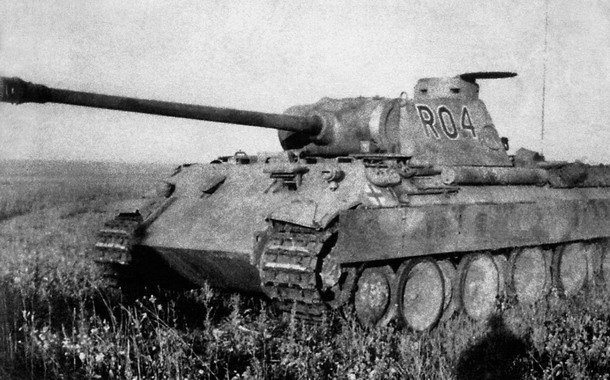
this Panther tank proudly announces to the world that it meets the stringent REICH 04 standard, source: Flickr.com with permission of the publishing user, edited
When the German advance in Russia ground to a complete halt in the bitter winter, the generals complained to their Führer that meeting the strict emissions standards was one of the reasons for this failure. Hitler, however, was having none of it. "You are confusing cause and effect!" he shouted at his subordinates. "Do you really think it's a coincidence that the moment we drive our entire army into Russia and start pumping out tonnes of those blasted exhaust fumes, we get the coldest winter in decades?! No, no, no gentlemen — this is clear proof that emitting CO and NOx causes global cooling*! It is exactly what my ecologists warned me about — there are entire studies on this! If we continue like this, next winter will be even more brutal. If we want to win in Russia, we must first reduce our carbon footprint!" In consequence, Hitler immediately announced a transition to the REICH 04 standard, which meant a fifty per cent reduction in emissions! (* At that time the Germans unfortunately lacked the kind of experts we have today, and so they incorrectly believed that the planet was cooling as a result of human activity.)
Once again the Ordnance Office was buried under demands for the development of environmentally friendly combat vehicles of every conceivable type. With a standard this strict, however, the only possible solution was now a complete departure from the internal combustion engine as such. This was the moment of glory for designer and visionary Ferdinand Porsche. His prototype heavy tank VK 45.01 (P), which used a petrol-electric hybrid drivetrain, now seemed almost like a sign from above. All that was needed was to remove both petrol engines, the fuel tanks, and the generators, and use the space freed up to install batteries to power the twin electric motors directly. The VK 45.01 (P) thus became, in February 1942, the first zero-emission fighting machine — pointing the way clearly towards an electric future for all.
Siemens, Bosch, AEG, VARTA, and other electrical engineering firms immediately threw themselves into the development and production of powerful electric motors and high-capacity batteries, but it wasn't quite as straightforward as it might seem. The transition from combustion engines to electric drive required solving a whole range of technical and logistical challenges. The standard equipment of every vehicle no longer included a jerrycan of petrol but a set of charging cables. To allow damaged batteries to be swapped more easily even in field conditions, they could not be too heavy. Combat vehicles were therefore fitted with banks of multiple smaller, compact battery units that could be changed by hand (such batteries can be clearly seen in the photograph HERE, loaded on the deck of a Sd.Kfz. 250 supply half-track). The modular battery system also allowed easy transfer of batteries from a destroyed vehicle to another that was still running, as well as a degree of scalability — the option of installing additional battery packs when needed.
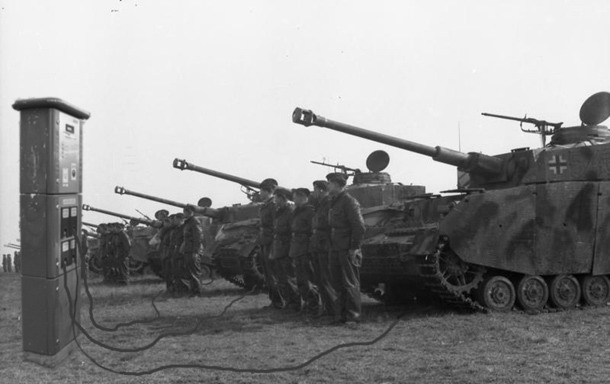
electric PzKpfw IV tanks lined up in exemplary fashion at the charging stations, source: Flickr.com with permission of the publishing user, edited
The next challenge was finding a way to extend the range of reconnaissance vehicles. The more batteries they loaded in, the heavier and slower the reconnaissance vehicles became — which was really rather bad for a vehicle whose whole point was to be light and fast. Reconnaissance vehicles such as the light half-track Sd.Kfz. 250 were therefore fitted with long electrical cables that could be paid out behind them, extending their effective range by tens of kilometres. After each combat action, armoured vehicles had to assemble at designated points for maintenance — and above all for recharging. When necessary, soldiers could also connect their tanks directly to the local power grid outside the dedicated charging areas.
Keeping such a large fleet charged was a subject in its own right. In Western Europe, the Germans could rely on the existing power grid, but in Russia it was a serious problem. In vast areas with no grid infrastructure the Wehrmacht had to improvise. Immediately behind the front-line units followed special engineer companies stringing up poles, running cables, and installing charging stations. In very remote locations they erected wind generators outright — in some places simple timber structures, in others proper steel-mast installations. Photovoltaic technology had not yet reached a sufficient level of development, so electricity from wind simply had to do. The vast open expanses of the Russian landscape, at least, were rather well suited to the purpose.
The E-Panzers, as the fully electric tanks were known, were not intended to replace every tank in the entire German army — at least not yet. The REICH 04 standard, like the milder preceding norms, measured emissions across the whole unit — in this case the panzer division. This meant that divisions continued to operate a mix of old-fashioned petrol tanks, wood-gas vehicles, and the cleanest option of all, the E-Panzers. Initially there was considerable mistrust of the new "silent" tanks among the men. Recharging the batteries took a long time, and the real-world range rarely came anywhere near the attractive figure quoted in the service manual and the promotional literature. Whenever a new batch of tanks arrived from Germany, crews would queue at the railhead for hours in advance to grab a classic petrol tank before they were all taken and only the electric ones were left.
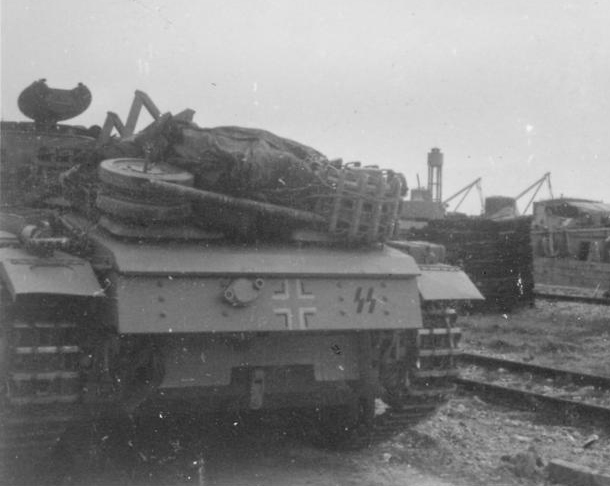
fully electric combat vehicles (such as this StuG III) were marked with a double lightning bolt; the same symbol was worn on their crews' collar tabs. Note the charging socket cover on the rear hull plate, just next to the balkenkreuz. Source: Wikipedia.org, Creative Commons, edited
News of the E-Panzer's unpopularity naturally reached Hitler before long. He was furious and immediately turned to his Minister of Propaganda, Joseph Goebbels. "If the soldiers won't choose the electric tanks voluntarily, we'll simply make them!" The experienced Goebbels rapidly devised a package of positive and negative incentives in the spirit of the classic carrot-and-stick approach. Crews of electric tanks were to receive larger cigarette rations, more of the scarce tungsten-core ammunition, priority for repairs in the field workshops, and so on. Conversely, anyone who refused to serve in an E-Panzer was reassigned to some other degrading or hazardous task — such as clearing minefields or cleaning latrines. Propaganda newspapers, magazines, and newsreels began promoting electric tank crews as the elite among elites, the best of the best. German readers found themselves increasingly confronted with headlines such as "Destroyed eight Bolshevist tanks without emitting a single gram of carbon monoxide!", or "The exhaust should come from the barrel, not the engine!", or "The silent killer saves the planet — and the front!"
And the propaganda worked. Very quickly, groups of enthusiasts — mostly young — established themselves among the tank crews, fanatically favouring electric tanks regardless of their shortcomings. Units occasionally witnessed fierce arguments, and even fistfights, between supporters of the old petrol machines and the radical e-tankists. The eco-friendly tankmen naturally also became Hitler's personal favourites. The proportion of high decorations among them was disproportionately greater than among other crews, which only further fuelled their fanaticism and sense of superiority. It was hardly surprising that electric tank crews soon felt the urge to distinguish themselves visibly from their backward-thinking colleagues. Before long, a special insignia was introduced for E-Panzer personnel: a double lightning bolt. Two lightning bolts on the right collar tab made it immediately clear that their wearer drove a battery-powered fighting vehicle. The same symbol began to be painted directly on electric armoured vehicles, which incidentally made life considerably easier for mechanics, who could tell at a glance exactly what had just rolled into their workshop.
Electric tanks naturally had their objective drawbacks — one cannot pretend otherwise. Problems were particularly pronounced in winter, in freezing conditions. Not only did the cold sap the batteries' endurance, but crews in electric tanks had no way of warming the cabin with hot air from the engine. A lesser-known fact is that the E-Panzers were substantially to blame for the failure of the German Sixth Army's breakout attempt from encircled Stalingrad. Paulus was a great advocate of environmentally friendly combat vehicles — most likely trying to curry favour with Hitler — and their proportion at Stalingrad was therefore considerable. After the German forces in the city were encircled, von Manstein organised the relief operation Wintergewitter (note — yet again a name inspired by nature!). The success of the operation, however, depended on von Paulus fighting his way out of encircled Stalingrad to meet his rescuers halfway. Paulus could not sortie, because he had no way to charge his tanks' batteries. After the encirclement the Russians had cut the city off from the power supply, and the German wind turbines in the brutal frost had simply frozen solid and stopped turning.
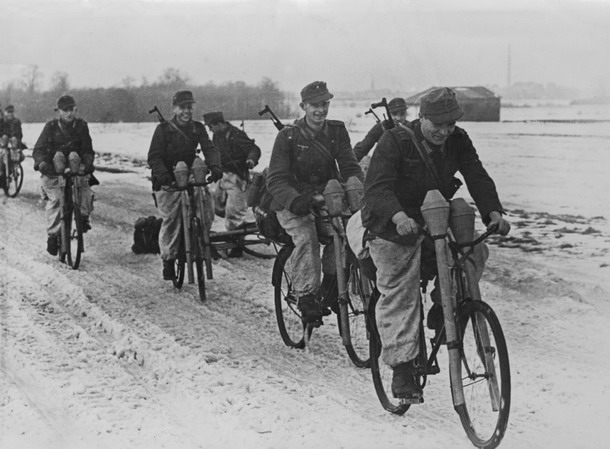
following the introduction of the strict REICH 05 standard, many commanders had their last remaining internal combustion vehicles stood down and switched to the cleanest possible form of propulsion, source: Flickr.com with permission of the publishing user, edited
The growing proportion of electric vehicles in the German army did not go unnoticed by the Allies. Long before the Normandy landings, British intelligence had been analysing the weaknesses of electric mobility and looking for ways to exploit them against the Nazis. Operation Chastise — in which specially trained aircrew used the famous bouncing bombs in May 1943 to destroy two German dams — was prepared specifically in response to the spread of the E-Panzer. The objective was, of course, to reduce electricity production so that there would not be enough to keep the electric tanks charged. This approach proved insufficiently effective, however, and the Allies did not follow it up with any further large-scale actions of the same kind.
At the start of 1945 an even stricter standard, REICH 05, came into force — which Goebbels declared to be a total declaration of war on emissions! The most fanatical commanders, utterly devoted to their Führer, responded by standing down the last remaining armoured vehicles with combustion engines and issuing their crews with bicycles. Hitler was absolutely delighted. Photographs of the greenest assault units on bicycles festooned with Panzerfäuste flooded the front pages of every newspaper in the Reich.
By March 1945 Hitler was completely detached from reality. His personal secretary Traudl Junge testified after the war that the Führer was even plagued by dreams in which the war was over and he stood before the victors' tribunal. They were asking him whether he was certain he had truly done everything in his power for the planet… and he did not know whether he could honestly say that he had. Haunted by such doubts, Hitler resolved upon one final decisive step: he issued an outright ban on diesel vehicles entering the city centres of all German cities. In purely theoretical terms it was a brilliant idea — killing two birds with one stone. On one hand it would spare the cities the poisonous emissions and particulates from diesel engines; on the other, it would effectively prevent the Red Army from occupying German cities, since the majority of Russian tanks ran — as everyone knew — on diesel.
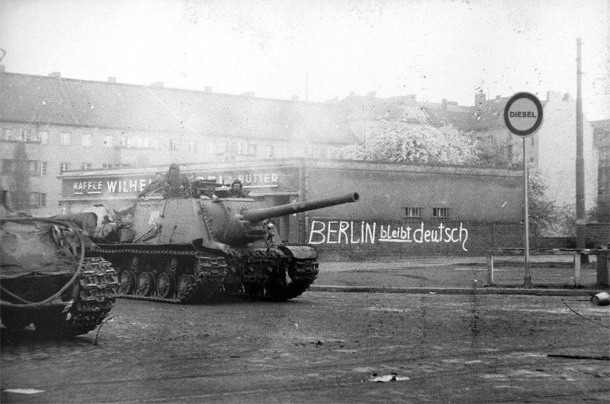
when introducing the diesel ban in German cities, Hitler looked forward to watching Russian tanks standing helplessly in front of circular no-entry signs — unfortunately for him, the Russians found a perfectly legal way around the ban, source: Flickr.com with permission of the publishing user, edited
This otherwise splendid idea had, unfortunately, two rather significant flaws. A great many Russian soldiers couldn't read at all (and most of the rest couldn't read the Latin alphabet), so no-entry signs with the word DIESEL written on them were simply not going to stop them. And then there was a legal loophole, identified by the Soviet High Command. The argument ran as follows: any territory on which a Russian soldier set foot was no longer German territory but Russian territory, and therefore no longer subject to German law but to Soviet law. And in the USSR there was no ban on diesel vehicles entering city centres. All it took was for at least one Russian infantryman to walk ahead of the tank, "rewriting the law" with his boots for the vehicles following behind. Hitler was furious — but what could he do, when even his own lawyers confirmed that the procedure was entirely legal?
A historical irony remains: in the final months of the Second World War, petrol tank crews found themselves — perhaps for the very first time — genuinely envying their colleagues with the double lightning bolts on their collars. While petrol supplies faltered and shortages were universal, the blades of wind turbines scattered across Germany kept on turning — and the E-Panzers always had somewhere to top up their charge.
1st April 2022, HAPPY APRIL FOOLS' DAY!

Reproducing text from the Panzernet website without the written consent of the operator is prohibited.