WAFFENTRÄGER
universal carrier for various weapons
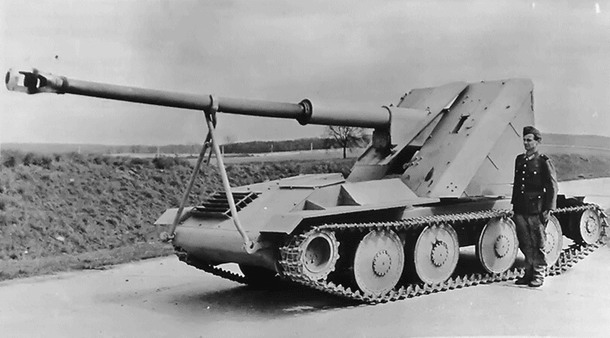
the first Waffenträger prototype by Ardeltwerke and Krupp, which was selected (after certain modifications) for series production; source: flickr.com with permission of the publishing user, edited
In Search of a Gun Mover
The driving force behind the development of the fighting vehicle designated Waffenträger is often cited as the German effort to consolidate self-propelled gun production. It is true that in 1942 in particular, the Germans were compelled to build self-propelled artillery on several different available chassis — especially in the case of anti-tank guns, as the Germans were attempting to deal with the Red Army's enormous armoured superiority by this means. However, the number of types in production and the resulting fragmentation were not quite as dramatic as they might initially appear. The Marder I, Marder II, and Marder III — the main Panzerjäger types of the period — were regarded from the outset as a kind of temporary solution until more advanced vehicles of the same type became available. They represented a conscious effort to make use of "surplus" light tank chassis and quickly obtain self-propelled weapons of adequate combat value to tide the army over the worst.
The Germans therefore planned from early on for the development of new, more mature self-propelled gun types, and consequently for a future consolidation of production. Given its fairly primitive construction, the Waffenträger was never intended to replace the far more advanced tank destroyers that entered production in 1943 and 1944 — namely the Nashorn, Jagdpanzer IV, StuG IV, Hetzer, and Jagdpanther. The impetus for the Waffenträger came from something else entirely. Following the defeat at Stalingrad, the Wehrmacht experienced its first major strategic retreat. The defeat at Kursk followed, and from that point on the German Army was essentially retreating continuously. A retreating army faces unpleasant problems entirely unknown to one on the advance. Anything left behind by withdrawing troops is irretrievably lost and falls into enemy hands.
During 1943, the 75 mm Pak 40 definitively established itself as the standard towed anti-tank gun of the German Army. Compared to its predecessors, the 37 mm Pak 36 and the 50 mm Pak 38, the Pak 40 was far more powerful — but also, unfortunately, far heavier. At around 1.5 tonnes, it was completely out of the question for the crew to move the gun under their own power without a suitable prime mover. The crews of the newer towed 88 mm Pak 43 guns were even worse off, with a weight of around 3.5 tonnes. It is no surprise that reports of needless losses of these precious weapons — simply because they could not be taken along during a retreat — began to multiply. One of the most glaring examples was a report from the Eastern Front describing how troops on the retreat had been forced to blow up 70 brand-new Pak 40 guns. These were weapons that had just arrived from the Reich and the troops had not even had time to issue them to the fighting units. They were compelled to make a hasty withdrawal before a Russian attack and no vehicles capable of towing the guns were available. (As an aside, this development is very nicely illustrated by THIS contemporary illustration.)
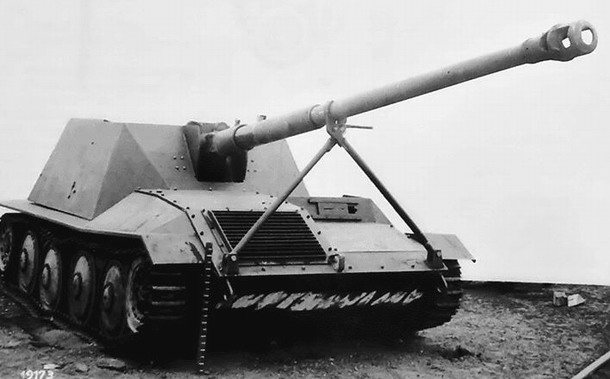
the Ardeltwerke and Rheinmetall Waffenträger prototype under testing in April 1944; source: flickr.com with permission of the publishing user, edited
Attempts were therefore already being made in 1943 to fit a small auxiliary engine directly to the wheeled carriage of a towed Pak 40, but this approach did not produce the desired results. Adolf Hitler himself ordered an analysis of how to make the largest possible proportion of anti-tank guns self-propelled at the lowest possible cost. The aim was not a new tank destroyer in the true sense of the word. The primary goal was simply to give the gun the ability to change position without depending on an external prime mover. Already in mid-1943, the same motivation had prompted a project to mount the 75 mm Pak 40 on the chassis of the Steyr-built tracked tractor RSO (Raupenschlepper Ost). This project too failed to meet expectations, and moreover the RSO tractor chassis could not, even with the best will in the world, carry the more powerful 88 mm Pak 43 or any heavier weapon. At the turn of 1943 and 1944, the project for a new, more capable weapon carrier — the Waffenträger — was therefore launched.
The Army's Specification
The specification for the required parameters was drawn up jointly by two departments of the Waffenamt: Waffenamt Prüfwesen 4 (WaPrüf 4), responsible for the development of artillery weapons, and Waffenamt Prüfwesen 6 (WaPrüf 6), responsible for tank and other motorised fighting equipment. The proposed Waffenträger was to be capable of carrying several types of weapon — both of the already-mentioned anti-tank guns, the Pak 40 and Pak 43, and the 105 mm light howitzer leFH 18. Ideally, mounting these weapons on the carrier should require no modifications to the weapons themselves (other than naturally removing them from their wheeled carriages and fitting them to the carrier).
By some route not elaborated upon in the sources, a certain First Lieutenant Günter Ardelt — apparently the son of one of the four Ardelt brothers who jointly owned the industrial concern Ardeltwerke GmbH of Eberswalde — became involved in the discussions about the new weapon carrier. First Lieutenant Günter Ardelt persuaded Waffenamt representatives that Ardeltwerke was capable of designing and producing the required carrier. The Waffenamt ultimately assigned work on the project to two, or rather four, firms. Ardeltwerke and Steyr were each to prepare a carrier design, while Krupp and Rheinmetall were to adapt the 8.8 cm Pak 43 for installation on the new carriers. Krupp was to supply the gun for the Steyr carrier, and Rheinmetall was to supply a modified gun for the Ardeltwerke carrier.
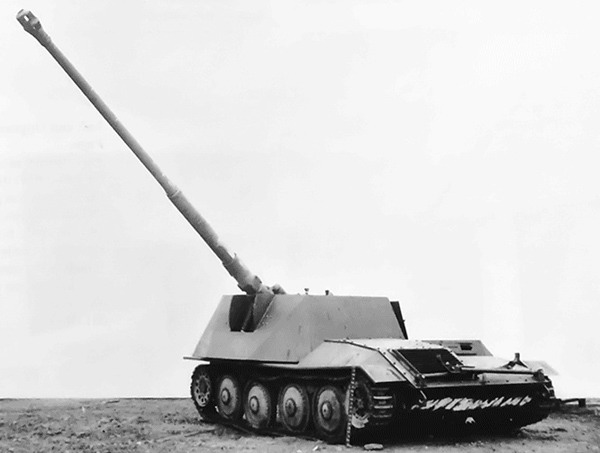
the Ardeltwerke-Rheinmetall Waffenträger during trials; per the specification, the weapon had to be capable of high-angle indirect fire; source: flickr.com with permission of the publishing user, edited
On 3 February 1944, an opening meeting was held between representatives of Ardeltwerke, Krupp, and Rheinmetall and officers from the German Waffenamt (WaPrüf 4 and WaPrüf 6). The very next day, 4 February 1944, the same meeting was held — this time with Steyr instead of Ardeltwerke. The agenda of both sessions was essentially identical. Colonel Wölhermann of the Waffenamt summarised the army's requirements for the new vehicle to all those present. The new Waffenträger was to have a fully tracked chassis, armour 20 mm thick on the front and 10 mm on the sides, a top speed of 35 km/h on road and 30 km/h off-road, a range of 140 to 200 km, and a crew of four or five. The gun must be capable of full 360-degree horizontal traverse and vertical elevation from -8 to +45 degrees. Maximum firing height must not exceed 175 cm. The gun sight or sights must allow both direct and indirect fire. Installation of a machine gun "under armour" was considered desirable but not essential.
According to the original concept, the Waffenträger was to be nothing more than a chassis to replace the "external" prime mover needed to move heavy towed guns. To fulfil this requirement, it would have sufficed to leave the gun with its original frontal shield only. The military quickly concluded, however, that it would be far preferable for the gun on the new carrier to have at least some light armoured protection on the sides as well. They were led to this view by practical experience with the deployment of the Nashorn tank destroyers. It was impossible not to notice how the number of strike marks on the side walls of the Nashorn's fighting compartment grew with each successive action — traces of small-arms fire and shell fragments from nearby artillery explosions. The army therefore added side armour protecting the gun crew to the list of requirements for the Waffenträger.
Ardeltwerke and Rheinmetall
Ardeltwerke (in collaboration with Rheinmetall) completed the first prototype of its Waffenträger in April 1944. To speed up and reduce the cost of development, the designers borrowed certain components from the Prague-based ČKD (BMM). Specifically these were the drive and idler sprockets, tracks, return rollers, road wheels with their suspension and torsion-bar spring system, and probably also the engine and gearbox. These components appear to have been taken from the Hetzer tank destroyer then under development. For any future series production of the Ardeltwerke Waffenträger, the Tatra T 103 diesel engine was reportedly planned (the same engine that was also intended for future development versions of the Hetzer).
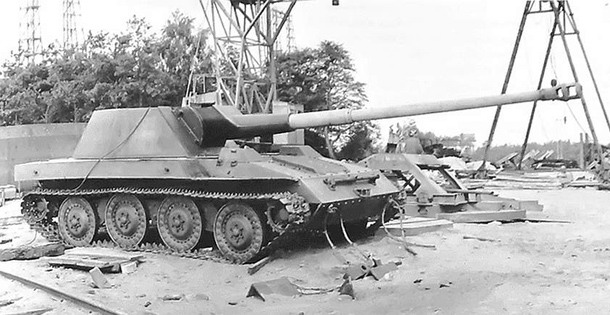
the Steyr and Krupp Waffenträger prototype drew inspiration from the RSO tractor chassis; source: flickr.com with permission of the publishing user, edited
The chassis carried a low, wide armoured hull. In the right-hand front section of the hull sat the engine and gearbox. Slightly further back and on the left was the driver's station. His head was protected by a frontal and side wall, but there was no roof above him. The rear almost two-thirds of the hull was occupied by a large open-topped rotating turret with an entry hatch in its rear wall. Mounted in the fighting turret was the already-mentioned 88 mm Pak 43. The long gun barrel literally stuck out from the small vehicle like a pointer — particularly noticeable when the turret was traversed to any direction other than straight ahead.
The Pak 43 had a barrel approximately 71 calibres long. The primary type of armour-piercing ammunition for this gun was the Pzgr. 39/43 (Pzgr. = Panzergranate). This armour-piercing shell, weighing 10.2 kg with a small bursting charge, left the muzzle at approximately 1,000 m/s. At a range of one kilometre it could penetrate 165 mm of sloped homogeneous armour; at two kilometres it defeated armour 132 mm thick. If even that performance proved insufficient, the gunner could reach for the Pzgr. 40/43 — a sub-calibre round with a tungsten core, available if this relatively scarce ammunition type was to hand. This projectile weighed only 7.3 kg, left the gun at 1,130 m/s, and at 1,000 metres penetrated 193 mm of sloped armour; at 2,000 metres it defeated 153 mm. Against unarmoured targets (including enemy infantry), the high-explosive Sprgr. 43 (Sprgr. = Sprenggranate) was used.
Firing trials of the first prototype took place on 27 and 28 April 1944 at the Hillersleben range. On the first day, a total of 129 rounds were fired in all possible gun positions. On the 129th shot, the gun's muzzle brake was damaged, bringing the day's testing to a close while the brake was repaired. Test firing then continued the following day. Over the two days of testing, the Ardeltwerke-Rheinmetall Waffenträger prototype fired a total of 277 rounds, including 210 armour-piercing (which place greater stress on the weapon). These were followed by brief driving trials during which the vehicle covered approximately 200 km, of which 130 km were off-road (the prototype had reportedly already accumulated around 120 km before formal trials began).
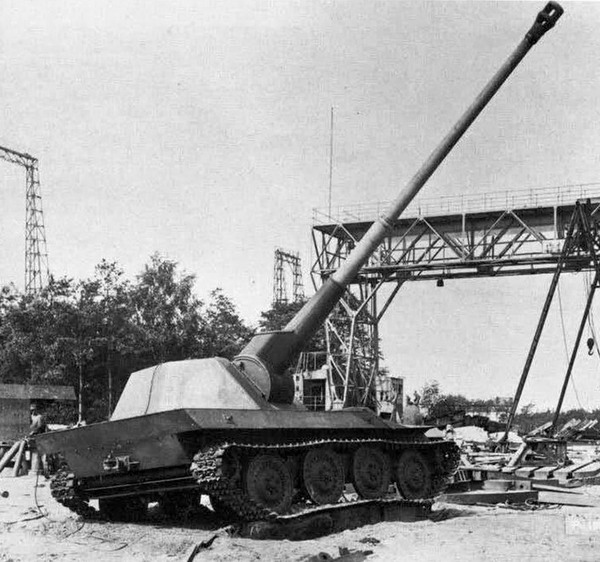
the Steyr-Krupp Waffenträger also had to achieve a large positive elevation for indirect fire; source: flickr.com with permission of the publishing user, edited
The results of the firing trials were generally satisfactory. The gun installed on the tracked carrier demonstrated comparable accuracy to the same weapon on a fixed mounting. Only in certain specific positions did the elevation mechanism display a degree of play, though this was relatively easily remedied. The soldiers praised the quality of the chassis suspension, which absorbed recoil shocks so effectively that firing caused only negligible disturbance to the gun sight's aim. The shortcomings identified were mainly minor details — for example, an awkward position for the fuel filler neck, or difficult communication between commander and driver (for which the troops requested the installation of a voice tube).
The Waffenamt was apparently not fully satisfied, however, as it ordered development to continue. According to some sources, the vehicle weighed a full 13.5 tonnes, which may well have been one of the reasons for the Waffenamt's dissatisfaction. Rheinmetall was forced to withdraw from the project in April 1944, apparently for capacity reasons, and Ardeltwerke therefore began collaborating on the further development of its Waffenträger with Krupp instead. In this new partnership, the two firms prepared a further proposal — which we will get to shortly.
Steyr and Krupp
Let us now turn to how the second pair of collaborating firms — Steyr and Krupp — was progressing. Steyr had been somewhat behind Ardeltwerke from the start, and so while the rival Ardeltwerke-Rheinmetall Waffenträger was undergoing firing trials at the end of April 1944, the Steyr-Krupp carrier existed only as a full-scale wooden mock-up. Steyr used components from the RSO tracked tractor (Raupenschlepper Ost) for its vehicle's chassis, suitably reinforced — the road wheels, for example, were entirely new, all-steel, and without lightening holes. The planned powerplant was a newly developed twelve-cylinder boxer engine producing 140 horsepower. Development of this engine was running behind schedule, however, which by June 1944 was beginning to delay the Waffenträger project as well. On 15 June 1944, Steyr reported that its carrier was ready and was only waiting for the powerplant, expected to be available within six weeks. Since the military were eager to begin firing trials, they requested that the RSO tractor's 85 hp engine be provisionally fitted to the carrier in the meantime. Whether this was done or not is not recorded in the available sources.
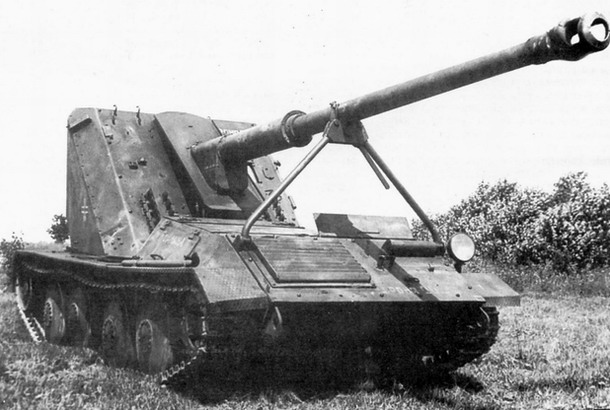
one of the seven "series-production" Krupp-Ardelt Waffenträgers, this vehicle fell into the hands of the Red Army; source: topwar.ru, edited
The Steyr-Krupp Waffenträger was conceptually similar to the rival Ardeltwerke-Rheinmetall vehicle. Again it featured a very low hull with the engine in the front — this time positioned centrally across the hull width. On either side of the engine were the driver's and commander/radio operator's stations, their heads protected by raised armoured cupolas protruding from the hull roof plate. At the rear was a hexagonal-plan fighting turret with sloped walls and an open roof. The main armament chosen was the KwK 43 L/71 gun. This weapon — which also armed the heavy tank Königstiger — was derived from the Pak 43 described above, and its performance was therefore essentially identical. The primary armour-piercing round was again the Pzgr. 39/43, weighing 10.2 kg with a muzzle velocity of around 1,000 m/s, which at one kilometre penetrated 165 mm of sloped homogeneous armour. The sub-calibre Pzgr. 40/43 with a tungsten core was also available — 7.3 kg, leaving the gun at 1,130 m/s, and defeating 193 mm of sloped armour at 1,000 metres. And finally the high-explosive Sprgr. 43 for use against soft targets.
Unfortunately, few details are available about the Steyr-Krupp prototype. None of the sources give its weight, speed, or any meaningful information about the course and results of its testing. Of its subsequent fate, only this is known: in October 1944 it was to be demonstrated to the Führer alongside the other two prototypes. In any case it is certain that this vehicle was not selected for series production, and it remained a single prototype.
Ardeltwerke and Krupp
Let us now return to the Waffenträger that Ardeltwerke and Krupp had been working on since April 1944. This vehicle represented something of a return to the original concept of a pure gun carrier. It therefore had no fighting turret at all, only the gun's frontal shield (taken from the standard Pak 43 on its cruciform mounting), supplemented by triangular side panels that partially protected the gunner and loader. This modification succeeded not only in reducing production costs but above all in bringing the vehicle's weight down to a "mere" 9 tonnes. This Waffenträger again used the road wheel suspension and torsion-bar spring system taken from the Marder III tank destroyer (and therefore ultimately from the Panzer 38(t)), though the road wheels themselves were slightly different. Apparently they had no rubber tyres, being all-metal instead. Given that the vehicle's top speed was only 25 km/h, the absence of rubber tyres was probably not a significant problem — and rubber was in very short supply at the time.
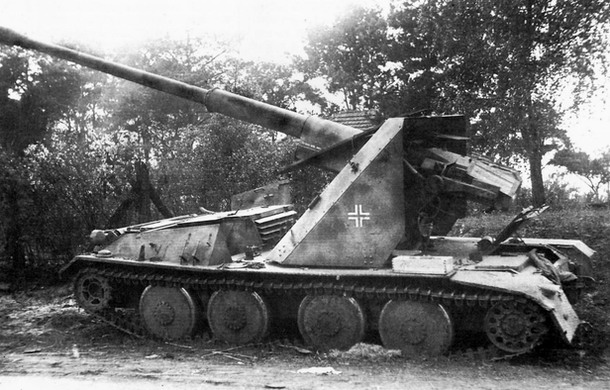
an abandoned "series-production" Krupp-Ardelt Waffenträger as found by Soviet soldiers; source: topwar.ru, edited
The tracks for the new vehicle were borrowed from the already-mentioned RSO tractor; the engine was the Maybach HL 42, producing 100 horsepower. In concept the vehicle followed the preceding Ardeltwerke design. The engine was at the front right, the driver at the front left. In the interest of maximum simplicity, the driver's station had only a small folding frontal shield with an observation slit, and no roof above the driver's head at all. On the right side of the gun shield hung a box containing a ready-use supply of six rounds. A further 36 rounds were stowed under the floor, bringing the total ammunition supply to 42 rounds. The crew could be either four strong — driver, gunner, and two loaders — or five with the addition of a commander. The driver alone sat inside the hull; the rest of the men had their stations at the gun. Of these, only the gunner had a seat, positioned to the left of the gun. The other soldiers stood while working, and apparently sat on the floor during travel.
Once the Waffenträger reached its firing position, the vehicle commander would probably stand beside the vehicle itself and — binoculars in hand — direct the fire. One loader passed the ammunition and the other loaded it into the gun, standing on a recessed step at the very rear of the hull. The fact that an open shield replaced a fully enclosed turret paradoxically created more working room for the gun crew — of course at the cost of reduced protection. The vehicle's armament was again the 88 mm Pak 43. Two gun sights were provided on board: one for direct fire and one for indirect fire.
The Ardeltwerke-Krupp prototype was apparently demonstrated to army representatives on 30 May 1944 under the designation "1. Versuchsgerät 8.8 cm Waffenträger Krupp-Ardelt". After evaluation, the Waffenamt requested certain further modifications and simultaneously ordered preparations to begin for the production of a pre-series run of 100 vehicles. Ardeltwerke and Krupp incorporated the military's feedback and in September 1944 presented a revised prototype designated "2. Versuchsgerät Ardelt Waffenträger". This version was already considered final. At first glance the 1st and 2nd Versuchsgerät look almost identical, but a careful observer will notice a whole series of differences.
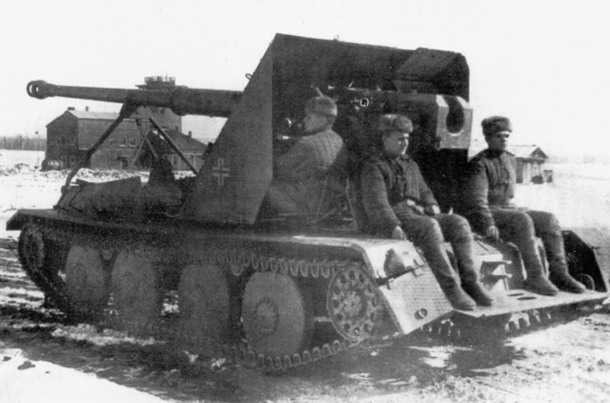
the "series-production" Krupp-Ardelt Waffenträger during Russian trials; this photograph nicely shows the transport position of the crew; source: topwar.ru, edited
The second Versuchsgerät received new drive and idler sprockets and different tracks. The nose of the hull, which was rounded on the 1st Versuchsgerät, now had a sharp edge. Other details of the hull armour were also changed — for example the left side panel, the driver's frontal shield, and the grille of the engine bay air intake. The towing rope hooks and the gun barrel travel rest were also of a different design (comparison photo HERE). A pair of folding-back seats was added to the floor of the fighting compartment behind the gun. The backs of these seats were formed from a metal plate, so when folded down they effectively "merged" with the floor and did not obstruct the loaders while working. During travel they were raised, allowing two soldiers to sit facing rearward with their legs hanging down on a step at the rear of the hull.
Production and Combat Deployment
As already noted, the army ordered 100 vehicles of the last-described Waffenträger version from Ardeltwerke and Krupp. Getting production of a new type of fighting vehicle — even a relatively primitive one — underway in the conditions of the second half of 1944 was a genuinely difficult task. It is no surprise, therefore, that delivery of the first series vehicles suffered one delay after another. Subcontractor deliveries of required components were falling behind, and Ardeltwerke managed with great effort to assemble only 7 Waffenträgers during January and February 1945. On 16 February 1945 an order was issued for these vehicles to be formed into the independent platoon Panzerjäger Alarmkompanie Eberswalde, which was to be immediately committed to the defensive fighting against the Red Army in the area of the town of Eberswalde, some 50 km north-east of Berlin.
Whether any of the Waffenträgers actually saw combat is not known. What is certain, however, is that at least one of them travelled from Eberswalde to Brandenburg an der Havel — roughly 100 km away (approximately 70 km west of Berlin) — by the end of April 1945. This is proven by a photograph of its wreck taken in front of the town hall there (photo HERE, source: flickr.com with permission of the publishing user and kids.kiddle.co, public domain, edited). Another vehicle, captured probably at Eberswalde, was taken away by the Soviets for testing. This example is today on display at the museum complex at Kubinka.
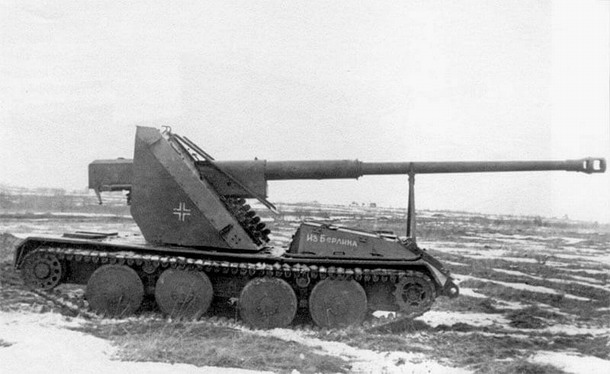
a captured "series-production" Krupp-Ardelt Waffenträger with the Russian inscription "from Berlin"; source: flickr.com with permission of the publishing user, edited
Further Development
Although the Waffenamt had ordered a run of a hundred vehicles, it did not consider even the last-described version of the Waffenträger to be a definitive design. What the officials particularly disliked was that the vehicle was tailored specifically for the 88 mm gun and was therefore not truly universal. Ardeltwerke, Steyr, and Krupp were therefore to collaborate on two further Waffenträger variants, designated as light (leichter) and medium (mittlerer). For the development work, components from the Hetzer tank destroyer chassis were again to be used; for future series production, however, elements of the planned Pz. 38 (D) tank chassis — sometimes also designated Pz. 38 "Reich" — including the Tatra T 103 diesel engine, were to be employed.
The leichter Waffenträger was again to have four road wheels on each side and be able to carry — according to operational need — either the Pak 43 gun, the 105 mm light howitzer leFH 18, or the 150 mm heavy infantry gun sIG 33. The mittlerer Waffenträger, by contrast, was to have six road wheels on each side and be capable of carrying either the 105 mm leFH 18 howitzer, the 128 mm Pak 80 gun, or the 150 mm heavy howitzer sFH 18. In the very final days of the war, at least one prototype of the medium weapon carrier — with six road wheels per side, armed with the 105 mm leFH 18 howitzer — was completed.
As a final note, for any reader who might consider the Waffenträger project an expression of pure desperation: other nations too developed fighting vehicles of similar construction — offering essentially no crew protection — both during and after the war. Notable examples include the Italian Semovente da 90/53, the Soviet SU-100P, and the American M56 Scorpion.
ARTICLE
CONTENTS:
Reproducing text from the Panzernet website without the written consent of the operator is prohibited.