LANDWASSERSCHLEPPER
an amphibious vehicle for the invasion of Britain
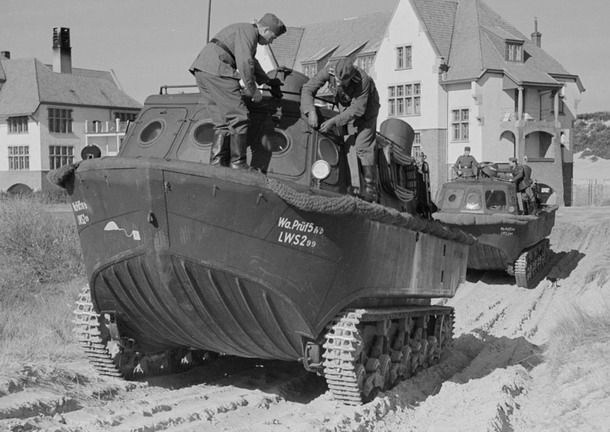
two early-production Landwasserschleppers with large front windows; soldiers are here seen fitting protective covers with circular cutouts over the windows, source: worldwarphotos.info with the permission of the site operator, edited
Origins of the vehicle
After Adolf Hitler came to power in 1933, Germany began gradually and increasingly violating the restrictions imposed on its armed forces by the Treaty of Versailles. The Germans began working intensively on the design and development of their own tanks, as well as many other types of military equipment. The supreme military command was considering not only the requirements of a potential war against its nearest neighbours — France above all — but also against Great Britain, which was substantially protected by the English Channel. Any land attack on this adversary would necessarily entail a large amphibious landing operation, requiring a whole range of specialised vehicles and equipment.
For the first waves of an invasion, equipment capable of entering combat immediately upon reaching the shore was essential. Purpose-built amphibious tanks — whether floating or submersible — were therefore to be prepared. At the same time, however, infantry, vehicles, artillery, half-track tractors, ammunition, fuel and a great deal of other materiel also had to be brought ashore on the invasion beaches. It was precisely for this purpose that a specialised amphibious cargo tractor needed to be developed. The requirements for such a vehicle were drawn up by the fifth weapons testing department (Waprüf 5) of the German Army Weapons Office (Waffenamt) as early as May 1935.
The vehicle was to be capable of driving into water and back out onto shore under its own power. On land, it had to cope with soft, sandy or muddy terrain. It also needed to handle extended travel on the water surface, including in light waves. Finally, the vehicle was to be able to carry soldiers or cargo directly on its deck while simultaneously towing additional cargo on a trailer behind it. These requirements made it immediately clear to everyone involved that this would be a highly complex machine, and its development was accordingly entrusted to a consortium of several experienced firms: Rheinmetall-Borsig, Alkett, Gebr. Sachsenberg, Hüttenwerke Sonthofen, Zahnradfabrik and Maybach Motorenbau.
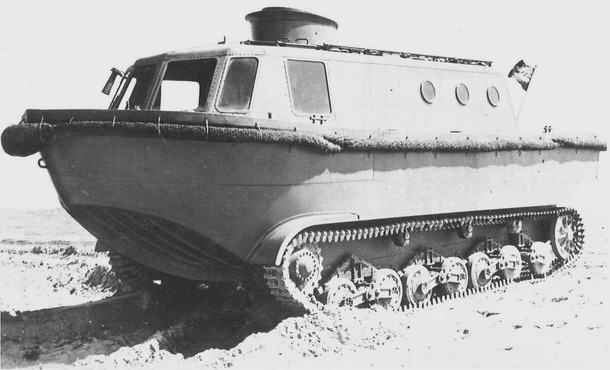
the first Landwasserschlepper built had a running gear with seven road wheels and track mudguards at the front, source: flickr.com with the permission of the publishing user, edited
Development work began in spring 1936 under the designation Landwasserschlepper (literally "land and water tractor"). Progress was, however, painfully slow, and when the Second World War broke out the vehicle still existed only on paper. Development gained fresh impetus when, on 3 September 1939, Great Britain and France declared war on Nazi Germany in response to the German invasion of Poland. The need to prepare for war against the island nation was now more pressing than ever, and the Waffenamt immediately ordered the construction of a first pre-production batch of four Landwasserschleppers. Getting production underway proved far from straightforward, however, and the first vehicle was not delivered until the summer of 1940, with the last one following only in the second half of December of that same year.
Design description
The Landwasserschlepper had a tracked running gear of broadly similar layout to that of the PzKpfw IV tank. On each side it consisted of eight road wheels with rubber-tyred rims around their circumference. Only the very first vehicle built — which we might call the prototype — had just seven road wheels on each side, for reasons that remain unclear. The wheels were paired on shared bogies suspended by semi-elliptical leaf springs (on the prototype, the last odd-numbered road wheel was independently mounted and sprung). At the front was a toothed drive sprocket of solid construction with a single row of teeth in the centre. At the rear was an idler wheel, most probably taken from the light tank PzKpfw II. The upper run of the track was supported by three small return rollers. The tracks were 310 mm wide.
Mounted on the running gear was an essentially conventional boat hull, welded from steel plate. The first prototype had mudguards over the tracks at the front of the hull; these were not fitted on subsequent vehicles. At the stern of the hull were two propellers with a diameter of 800 mm, each with a rudder positioned behind it. Between the two propellers was a towing attachment for connecting a trailer. Around the perimeter of the hull, a heavy mooring rope was secured to protect the hull when coming alongside a jetty. Rising from the deck above the hull was a substantial superstructure housing the crew cabin and the main cargo area. On the early vehicles, the front face of the superstructure was glazed with large rectangular windows. These could, however, be covered by bolted-on protective steel plates fitted with only small circular openings. The sides of the superstructure featured additional windows, this time circular. At the front of each side was one window of larger diameter, with three smaller ones further aft. The rear wall of the cabin had large double entry doors, also fitted with small circular portholes. A standard lifebuoy was mounted on the right side of the cabin, and a ship's anchor with a long rope on the left.
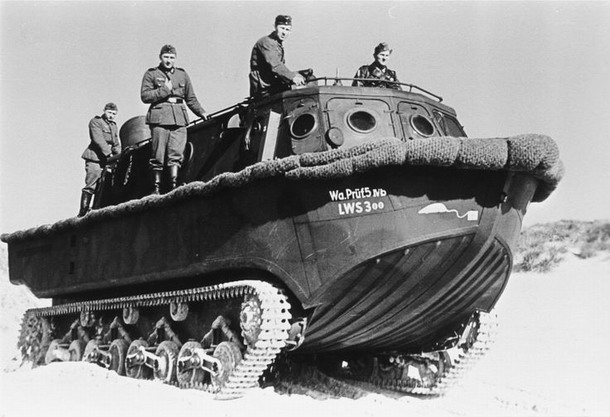
early-version Landwasserschlepper, again shown here with the sheet-metal covers fitted over the large front cabin windows, source: flickr.com with the permission of the publishing user, edited
On the early vehicles (excluding the prototype), three metal pipes curved gently rearward protruded above the cabin roof. The first of these, positioned centrally at the front of the roof, apparently served to supply and exhaust air to and from the engine and radiator. The remaining two, located at the rear corners of the roof, served as exhaust stacks — or chimneys, if you prefer — for the engine's combustion gases. In the centre of the cabin roof was a large hatch with a two-piece cover whose halves opened outward to the sides. Two further hatches were located in the forward section of the roof. All of these openings provided access from the cabin up onto the roof. At the rear of the deck, behind the cabin, a winch with a steel cable was installed, apparently used for towing loads that could not be connected to the standard towing hook, and also for pulling cargo from the water up onto the shore.
The Landwasserschlepper was powered by a Maybach HL 120 TRM twelve-cylinder petrol engine with a displacement of 11.9 litres, developing 300 horsepower at 3,000 rpm. The engine was located inside the hull beneath the cabin floor, roughly amidships. In front of it was a Zahnradfabrik SSG 76 gearbox with six forward speeds and one reverse, which connected to the final drives of the front track sprockets. Both the engine and the gearbox were the same types as used in the Panzer IV tank. Behind the engine, an additional transfer gearbox was fitted to transmit torque from the engine to the two propellers at the stern. The driver therefore had to switch drive between the tracks and the propellers as required.
As for the Landwasserschlepper's weight, some sources cite approximately 13 tonnes while others give 15 tonnes. The situation is unfortunately similar with its dimensions. Overall length is sometimes quoted as 8.6 metres and sometimes as a round 9 metres. Width is given as exactly 3 metres by some authors and 3.16 metres by others, and height is either 313 or 315 centimetres, again depending on which source one consults. To add to the contradictions, the maximum road speed is variously stated as 35 km/h or 40 km/h. The one figure on which sources do agree is the water speed, which was a respectable 12.5 km/h. The Landwasserschlepper's fuel tanks held 600 litres of petrol, reportedly sufficient for approximately six hours of travel on the water.
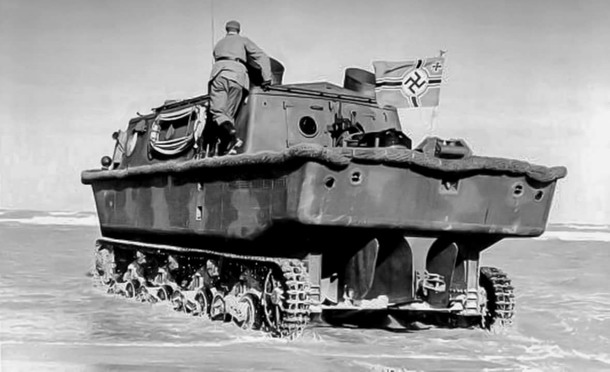
a fine rear view of an early-version Landwasserschlepper, source: flickr.com with the permission of the publishing user, edited
The vehicle's permanent crew consisted of just three men, who shared the roles of commander, driver and observer. These soldiers sat on three large padded seats arranged side by side in a single row at the front of the cabin. The driver sat on the left, the commander on the right and the observer in the middle. The driver had several sets of controls at his disposal: three foot pedals familiar from any standard tank or automobile — brake, throttle and clutch — as well as, of course, a gear lever and the classic steering levers for braking the tracks, just as in a tank. In addition, there were two large ball-topped levers for controlling the propellers, one for each, each apparently having three positions: forward, neutral and reverse. Finally, directly in front of the driver was an essentially standard steering wheel for turning the rudders behind the propellers. Beyond the permanent crew, the interior of the Landwasserschlepper could accommodate a further 20 soldiers, who could sit on simple benches made from metal tubes and sections.
None of the available sources makes mention of a radio, but photographs make it quite clear that at least some vehicles were fitted with a rod antenna on the right front section of the cabin roof (photos HERE, HERE, HERE and HERE). Radio operation was apparently the responsibility of the vehicle commander. The Landwasserschlepper was not a combat vehicle and therefore carried no integral armament and no armour. The crew did, however, bring at least an MG 34 machine gun on board, and possibly also an MP 40 submachine gun.
Even more significant than its capacity to carry a twenty-man landing party was the Landwasserschlepper's ability to tow a trailer with additional cargo. For this purpose, the firm of Kässbohrer from Ulm developed two amphibious cargo trailers. The lighter one had a payload capacity of 10 tonnes; the heavier one could carry as much as 20 tonnes, enough for an early-version PzKpfw IV tank. The trailers had wheeled running gear and were therefore also capable of moving on land. Their rear wall was hinged and functioned as a loading ramp. The trailer was coupled using two iron rods. Both trailer types passed army trials and proved to be operationally capable. However, given the cancellation of the entire Landwasserschlepper programme, production of the trailers was soon discontinued as well. In total, only four 10-tonne and two 20-tonne trailers were ever built.
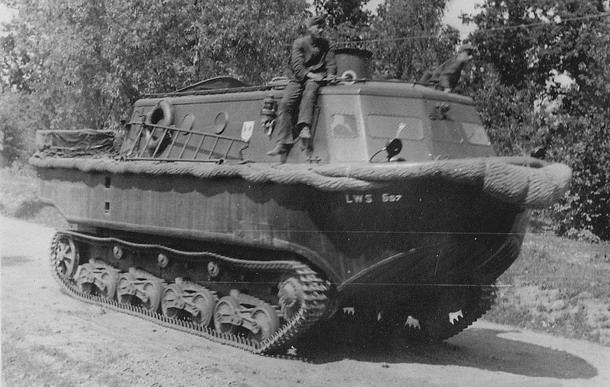
late-version Landwasserschlepper (though still fitted with the original track drive sprocket), source: Flickr.com with the permission of the publishing user, edited
Production
The first example of the amphibious vehicle was demonstrated to army representatives in August 1940 on the island of Sylt. The soldiers reportedly criticised its tall silhouette and lack of armour, but nonetheless considered it capable of fulfilling the expected tasks. Even before the first batch of four vehicles was complete, a second batch of eight was therefore ordered. These were to be delivered at a rate of two vehicles per month from March to June 1941. This plan apparently did not go smoothly, however, as a Waffenamt report from July 1942 states that only seven of the eight ordered Landwasserschleppers had been delivered by that point. A third and final order was placed for 14 vehicles, to be delivered between August 1942 and September 1943. This last batch was apparently not completed in full, as most sources state that only 21 LWS vehicles were built in total, compared to the 26 that had been ordered. Further production would have made little sense in any case, as at the turn of 1942 and 1943 the German army was certainly not planning any major amphibious landing operation.
Modifications
Considering how few were built, a remarkably large number of photographs of this vehicle have survived. These reveal just how many different changes and modifications were made — either from the factory or retrospectively — across those two dozen or so vehicles. Some received new spoked drive sprockets with two rings of teeth, similar to those used on the PzKpfw IV tanks. On certain vehicles, the number of return rollers was increased from three to four. Some machines received revised suspension, replacing the semi-elliptical leaf springs with quarter-elliptical ones similar to those of the PzKpfw II tank (a comparison of the various running gear configurations can be found HERE). Later vehicles had a redesigned front cabin wall, where the large windows were replaced by small rectangular portholes set into an otherwise plain sheet-metal front panel. On some vehicles the front windows were even fitted with windscreen wipers. The arrangement of the circular portholes on the cabin sides also changed over time (a comparison of the various window configurations can be found HERE).
On later vehicles, the two rear "exhaust stacks" disappeared from the cabin roof, and in place of the original front pipe a sheet-metal observation platform appeared. This served as a raised lookout position, which proved particularly useful when driving out of the water up a steep bank, when the vehicle's bow pointed skyward and the driver could see nothing but sky through the cabin windows rather than the terrain ahead. In such situations the observer on the roof could guide the driver by means of a voice pipe. The raised platform also offered a considerably better view than the cabin windows during rough water conditions. The original double doors in the rear cabin wall were replaced on later vehicles by a large entry hatch that extended not only through the rear wall but also deeply into the roof (a comparison of the various door configurations can be found HERE).
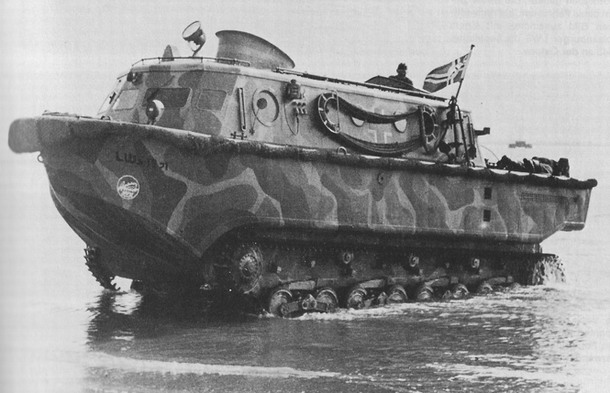
late-version Landwasserschlepper; note the windscreen wipers on the two front windows and the anchor hanging on the side of the cabin, source: Flickr.com with the permission of the publishing user, edited
Deployment
As already noted, the Landwasserschlepper was developed for the purposes of a land invasion of Great Britain. That operation, codenamed Unternehmen Seelöwe (Operation Sea Lion), was postponed indefinitely at the end of 1940 and never took place. Some Landwasserschleppers were nevertheless deployed operationally, albeit in entirely different theatres. The literature refers rather vaguely to their use on the Eastern Front, including on the Kerch Peninsula in Crimea. In August 1943, these vehicles were reportedly used to assist with the evacuation of German troops from Sicily to Italy. An unknown number of Landwasserschleppers were used by the Kriegsmarine for various support tasks, particularly for hauling midget submarines in and out of the water.
One or two LWS vehicles were sent to North Africa in spring 1942 as part of Pionier Landungs Kompanie 778 (778th Engineer Landing Company). Field Marshal Rommel decided to deploy one of them in a diversionary operation during the Battle of Bir Hakeim and Gazala. For this action, Kampfgruppe Hecker was formed, comprising German and Italian soldiers and equipped among other things with three captured British Cruiser tanks. This group was to travel by sea along the coast on 26 May, land on Egyptian territory behind enemy lines and attack the rear of British forces. The day before the operation, however, the group was spotted and attacked by British aircraft, forcing the mission to be cancelled.
The Landwasserschlepper was undoubtedly a technically fascinating vehicle. Its complexity and high production costs made large-scale manufacture essentially impossible, and its development dragged on so long that the need for it had largely vanished by the time it was ready. It is naturally difficult to judge how it might have performed had it actually been deployed en masse during Operation Sea Lion. Many historians, however, rightly point to some rather fundamental weaknesses: above all its considerable height, which made it an easy target, and its complete absence of armour. When we look back today and assess the Landwasserschlepper's contribution to the German war effort, we are compelled to conclude that it represented little more than wasted time and money.
Technical data
|
weight: |
13 or 15 t |
|
length: |
8.6 or 9.0 m |
|
width: |
3.0 or 3.16 m |
|
height: |
3.13 or 3.15 m |
|
engine: |
Maybach HL 120 TRM |
|
engine output: |
300 hp |
|
max. road speed: |
35 - 40 km/h |
|
max. water speed: |
12.5 km/h |
|
fuel capacity: |
600 l |
|
crew: |
3 + 20 men |
|
armour: |
- |
|
armament: |
- |
ARTICLE
CONTENTS:
Reproducing text from the Panzernet website without the written consent of the operator is prohibited.