GRILLE 17/21
a super-heavy self-propelled gun project
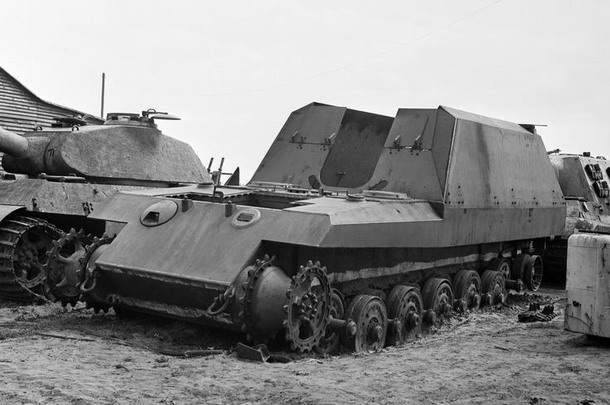
The unfinished Grille 17/21 self-propelled gun prototype was discovered by Allied forces at the Haustenbeck test centre near Paderborn, source: internet, Public domain, edited
The Grille/Heuschrecke Programme
After long discussions with representatives of the armoured forces, and following the first tentative early attempts, the German Ordnance Office threw itself properly into the subject of self-propelled guns — Selbstfahrlafetten — in the spring of 1942. That commitment took the form of a wide-ranging development programme covering self-propelled guns in several categories: a light 105 mm gun on the Leopard tank chassis, a medium 128 mm gun on the Panther chassis, and a heavy 150 mm gun also on the Panther chassis. The programme became known under the designation Grille (cricket) / Heuschrecke (grasshopper), which were also the cover names of the specific vehicles being developed (e.g. Grille 12). A fourth category was soon added to the original three: a super-heavy gun on the Tiger tank chassis, armed alternatively with either the 17 cm Kanone 18 gun or the 21 cm Mörser 18 howitzer. Although designated Grille 17/21, this vehicle stood rather apart from the Grille / Heuschrecke programme — both in its category, the chassis it used, and the fact that it eventually reached the prototype stage. For these reasons it deserves, in our view, to be described independently rather than merely as part of the programme mentioned above.
21 cm Mörser 18
Let us take a brief look at the two weapons being considered for the new self-propelled gun. The 21 cm Mörser 18 howitzer was designed in the first half of the 1930s. The number 18 in its designation did not correspond to the actual year of introduction, but was used purely to deceive the authorities monitoring compliance with the Treaty of Versailles. The weapon itself was not particularly innovative, but its carriage was very interesting. It incorporated an additional mechanism for braking the gun's recoil. The Mörser 18 thus had a conventional recoil mechanism directly connected to the barrel, and a second horizontal recoil mechanism built into the carriage. Despite the weapon's enormous power, the result was that firing produced only minimal movement of the entire carriage. This not only allowed very precise aiming, but also made it possible to mount the carriage on a special rotating platform, enabling the gun to change its direction of fire quickly and easily through any angle (photo HERE).
17 cm Kanone 18
The Mörser 18, however, also had two significant disadvantages. The first was its weight of 16.7 tonnes, which meant it had to be broken down into two separate loads for transport (barrel with breech, and the rest). This considerably lengthened the time required to bring the weapon into action and then move it again. The second weakness was its limited maximum range — the shell, weighing an astonishing 113 kg, could reach a maximum of 16.7 km. After the start of the Eastern campaign in 1941, the army began calling for a weapon of similar destructive power but with a substantially greater range (those wide Russian plains :-) ). The firm Krupp responded to this demand with a new weapon design that was to take the best of the Mörser 18 while better meeting the army's current needs. The result was the 17 cm Kanone 18 in 172.5 mm calibre. (Note: why the number 18 was used again is not clear from the sources. The Treaty of Versailles had long since been torn up, so this time it was probably simply a matter of designating both weapons in sequence.) What the new gun took as its best feature from the original Mörser 18 was precisely its carriage with the secondary recoil mechanism and rotating platform — reflected in the new weapon's full official designation: 17 cm Kanone 18 in Mörserlafette (photo HERE).
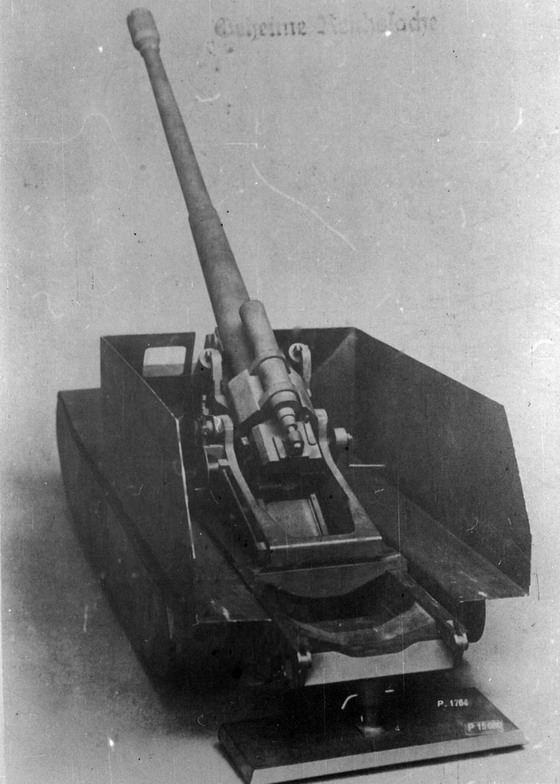
The wooden model from June 1942 showed, among other things, the method for sliding the gun out of the fighting compartment, source: internet, Public domain, edited
The 17 cm Kanone 18 fired shells weighing "only" 62.8 kg — yet could send them to a range of up to 29.6 km! Firing trials also showed that the destructive effect of the 113 kg shell from the Mörser 18 and the approximately half-weight shell from the Kanone 18 were not as drastically different as the weight difference might suggest. Production of the older Mörser 18 was therefore discontinued in 1942 and series production of the new Kanone 18 was launched instead. The range improvement with the new weapon was genuinely dramatic — but in terms of weight, matters were less encouraging. Although the new Kanone 18 fired much lighter shells, its overall weight actually increased compared to the Mörser 18. This unfortunately meant that for travel over longer distances the new gun also had to be broken down and transported in two separate loads. And so the idea arose: could this otherwise excellent weapon not be speeded up by mounting it on a self-propelled chassis (Selbstfahrlafette)? And that brings us back to the beginning of our account of the super-heavy self-propelled gun known as the Grille 17/21.
The Self-Propelled Gun Design
Krupp prepared the first design for the new self-propelled gun in June 1942. In July it was presented to the Ordnance Office, along with a reduced-scale wooden model. Thanks to the shared carriage, either the 21 cm Mörser 18 or the 17 cm Kanone 18 (or rather their modified versions, but more on that later) could be installed in the self-propelled gun — it was purely a matter of the customer's preference, the two weapons being entirely interchangeable in this respect. As with the other vehicles being developed under the Grille / Heuschrecke programme, the Ordnance Office required the Grille 17/21 to be capable of full 360-degree weapon traverse and to have the gun removable from the chassis for use in a static ground emplacement. Weapons as powerful and as large as the Mörser 18 and Kanone 18 could, however, in no way be mounted on a rotating platform. Krupp therefore came up with a very original solution: when preparing to fire, the entire vehicle would reverse onto a rotating platform placed on the ground between the tracks, and the whole vehicle would then rotate on this platform. Even a layman must immediately think of several questions — how exactly was the vehicle to be raised on the platform so it could rotate? How would the rotation itself be achieved, by running one set of tracks? The technical details are unfortunately not available, so these questions will probably remain unanswered. In any case, when Ordnance Office representatives heard this proposal, they reconsidered their requirement and "forgave" the designers the need for weapon traverse.
There remained, however, the required ability to easily remove the weapon from the chassis into a static ground emplacement. For such heavy weapons as the Mörser 18 and Kanone 18 to be removable from the chassis, they had to be positioned very low to the ground. Any arrangement involving lowering them down a sloping ramp (as planned for Grille 12 and Grille 15) was out of the question. The gun could therefore not be mounted above the engine under any circumstances, but had to be positioned either in front of or behind it. Positioning it in front of the engine was not feasible because the Kanone 18 had a barrel 8.5 metres long, and the overhang in front of the vehicle would have been unacceptable. It was therefore clear that the driver's compartment would be at the front, with the engine section behind it, and the fighting compartment with the gun at the rear, mounted as low as possible in the hull tub. The rear of the fighting compartment would be left open, allowing the weapon together with its mounting to be slid rearward out of the compartment and placed on a standard rotating platform on the ground. Once extracted from the chassis, the gun would in fact acquire the desired full 360-degree traverse capability. While inside the fighting compartment, however, it could traverse only 5 degrees to each side.
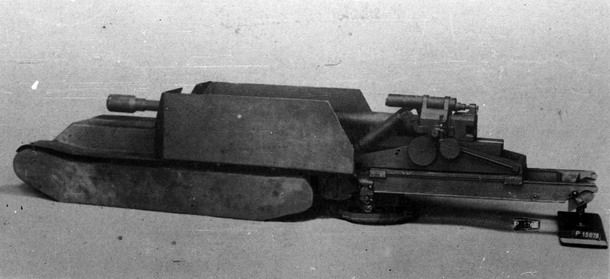
Another wooden model — here the gun is almost fully extended and placed on the rotating platform, source: internet, Public domain, edited
In November 1942, Krupp received an order for the construction of one verification prototype. The prototype was to be built using armour plates 30 mm thick at the front and 16 mm on the sides. For any future series production, however, the use of ordinary "soft" structural steel plates was envisaged. To maintain equivalent protection, the thickness of these plates would have to be increased — to 50 mm at the front and 30 mm on the sides. The designers estimated this would mean a weight increase of approximately 1.5 tonnes, which was not considered a fatal problem. November 1942 also saw another significant event: the selection of the winning design for the new heavy tank Tiger II. The Henschel design beat the competing Porsche design, and preparations for series production of the tank began. In connection with this, a decision was made that the Grille 17/21 self-propelled gun would be based not on the Tiger chassis but on that of the new Tiger II, also known as the Königstiger.
Such a change naturally had a significant impact on the development work. A great deal had to be modified, redesigned or conceived from scratch. Moreover, development of the Königstiger tank itself was not yet complete at that point — further change requests were still arriving concerning the engine, gearbox, tracks and other components. The engineers working on the Grille 17/21 self-propelled gun therefore had to wait until the Königstiger design was finalised before they could base their own work on the self-propelled gun upon it.
The Geschützwagen Tiger Chassis
It had been clear from the outset that this would not be a simple adoption of the tank chassis, but effectively the development of a new chassis using Tiger II components. One of the main reasons was the sheer length the planned self-propelled gun would require. The planned vehicle layout — with the fighting compartment behind the engine — placed enormous demands on the overall vehicle length. Even before the final design was settled, it was already abundantly clear that the Tiger II tank chassis in its standard form would be too short for the Grille 17/21.
The components that the Grille 17/21 was to inherit from the Tiger II included the 800 mm diameter road wheels along with their interleaved arrangement, suspension and torsion bar springing. The 800 mm wide combat tracks were also taken over, along with the engine, gearbox, steering system, drive sprockets and other elements. The first Königstiger prototype was not completed until November 1943, and delivery of the components needed for building the Grille 17/21 prototype was promised for January 1944. The prototype of the new self-propelled gun was then expected to be completed around the middle of 1944. As these things tend to go, that plan did not quite work out. According to a revised schedule from September 1944, the Grille 17/21 prototype was to be ready by the end of the year and ceremonially presented to Hitler on 15 January 1945. That revised plan also ultimately failed to be met — but more on that later.
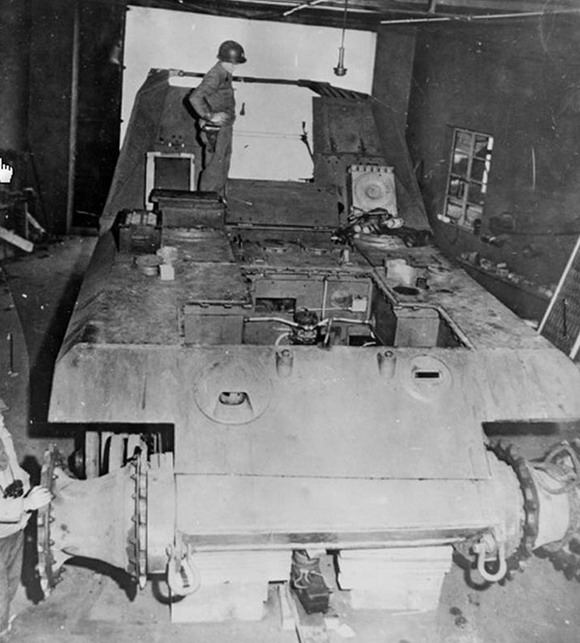
The unfinished Grille 17/21 self-propelled gun prototype, discovered by Allied forces at the Haustenbeck test centre near Paderborn, source: internet, Public domain, edited
Vehicle Description
The chassis for the Grille 17/21 self-propelled gun received the designation Geschützwagen Tiger — literally "gun carriage Tiger." The chassis had eleven axles for road wheels on each side (the Tiger II tank had only nine). Each axle carried two discs, fitted around their circumference with only a thin layer of rubber beneath a steel rim. The arrangement of the discs on the axles mirrored that of the tank — on odd-numbered axles the discs were closer to the hull and on even-numbered axles further from it — allowing the wheels to partially interleave. The exception was the wheel on the last axle, which was shifted significantly further rearward from its neighbour. Compared with the Tiger II, therefore, only two additional road wheel axles were added (11 vs. 9). The increase in overall vehicle length, however, was enormous: while the Tiger II measured 7.38 metres in length without gun overhang, the Grille 17/21 without its gun (i.e. the Geschützwagen Tiger hull alone) was 9.5 metres long!
With dimensions like these, the designers had to grapple with a specific problem: the ratio of the track contact length to the track gauge (i.e. the width of the track assembly). The larger this ratio, the harder it is for a tracked vehicle to turn, and beyond a certain critical threshold turning becomes practically impossible. The Grille 17/21 designers managed to keep the track contact length to 4.17 metres, giving an acceptable resulting ratio of 1.6. The 9.5-metre-long vehicle therefore touched the ground over only 4.17 metres — less than half its length. How was this achieved? The first and last road wheels were raised slightly above the level of the others. On firm road surfaces these wheels were in effect above the ground. In softer terrain, however, the vehicle would inevitably sink slightly and these two wheels would almost certainly make contact with the ground as well. At that point the effective length-to-width ratio would necessarily increase, making practical steering more demanding — for the driver, and especially for the components (increased strain on the wheels, tracks, final drives, and so on).
The overall layout of the Grille 17/21 self-propelled gun corresponded to the plan described above. At the front of the hull was the driver's station and alongside him his co-driver, who served as machine gunner and also assisted with operating the gun during firing. In the front plate of the hull, the driver had an observation vision port in front of him and his co-driver had a machine gun embrasure. Both men entered the vehicle through hatches directly above their heads. Between the driver and co-driver sat the Maybach Olvar OG 40 12 16 B gearbox — the same unit as in the Tiger II, offering 8 forward gears and 4 reverse. Behind both men's backs began the engine compartment, housing the fuel tanks, radiator and above all the twelve-cylinder Maybach HL 230 P30 petrol engine producing 700 horsepower.
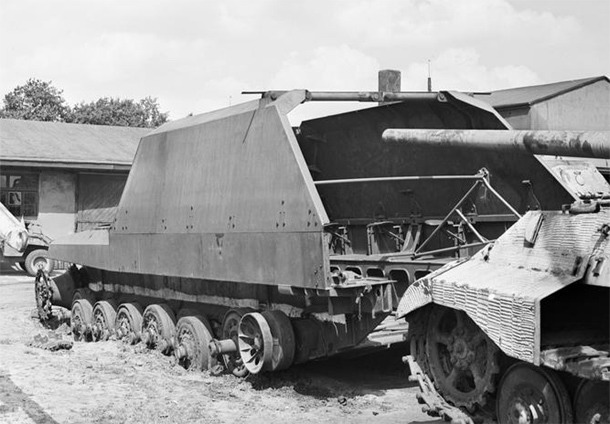
The sole unfinished prototype again, source: internet, Public domain, edited
Behind the engine section rose the walls of the enormous fighting compartment, which extended well beyond the running gear at the rear. The size of the compartment — including the substantial rearward overhang — was necessary simply to accommodate the massive gun and its mounting. The rear and the roof of the compartment were left open. Running along the centre of the fighting compartment floor was a kind of deep channel in which the gun mounting sat. This kept the weapon very low to the ground, which among other things made it easier to remove onto the ground. As already mentioned, thanks to the shared mounting, either the 17 cm Kanone 18 or the 21 cm Mörser 18/1 could be fitted to the self-propelled gun — it was simply a matter of choice. Along either side of the gun, the compartment had three seats for crew members on each side. The total crew of the Grille 17/21 was therefore eight men: the driver, the commander, and a six-man gun crew. There was not much room for anything else inside the vehicle — including ammunition, of which only 5 rounds could be carried when armed with the 17 cm Kanone 18 and a mere 3 rounds with the 21 cm Mörser 18. All additional ammunition had to be carried by an accompanying ammunition vehicle — or rather vehicles.
For use in the Grille self-propelled gun, the 17 cm Kanone 18 was to be fitted with a muzzle brake of an unusual design — one large chamber with a large number of small apertures. With this modification the weapon received a new designation: 17 cm Kanone 72. The 21 cm Mörser 18 also evidently required at least minor modifications (though it apparently did not receive a muzzle brake), and was likewise redesignated 21 cm Mörser 18/1. The full official designation of the self-propelled gun was therefore Geschützwagen Tiger für 17 cm Kanone 72 (Sfl.) for the Grille 17 variant and Geschützwagen Tiger für 21 cm Mörser 18/1 (Sfl.) for the Grille 21.
The Grille 17/21 weighed a round 60 tonnes and could achieve a top speed of around 45 km/h. The 1,000 litres of petrol in the fuel tanks was sufficient for approximately 250 km on road and 125 km cross-country. As already mentioned, the vehicle measured 9.5 metres in length without its armament. With the 21 cm Mörser 18/1 fitted, the overall length increased to 11 metres — a barrel overhang of 1.5 metres. Interestingly, virtually all drawings, visualisations and plastic model kits show the Grille 21 without any barrel overhang at all. With the 17 cm Kanone 72, the overall vehicle length reached a remarkable 13 metres — a barrel overhang of 3.5 metres! The vehicle's true length would have been increased still further by the rotating platform for the gun, which was to be carried secured to the rear of the fighting compartment. While inside the fighting compartment, the gun could traverse 5 degrees to each side. Vertical elevation ranged from -2° to +48° for the 170 mm gun and from -2° to +68° for the 210 mm mortar.
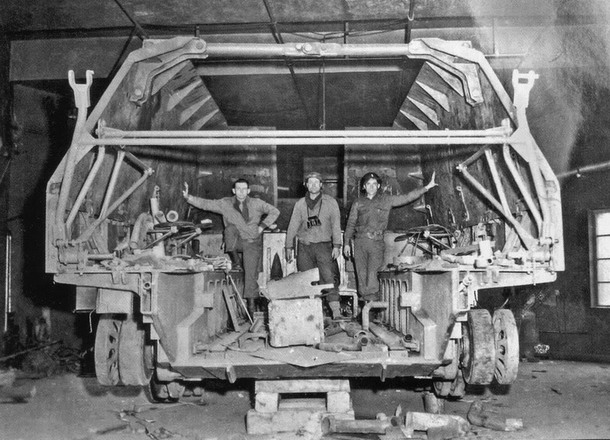
The unfinished Grille 17/21 prototype — a trio of American soldiers demonstrates the vehicle's extraordinary dimensions, source: internet, Public domain, edited
The Only Prototype
On 7 December 1944, Krupp reported that the first Grille 17/21 prototype was ready to be sent by rail to the Haustenbeck test centre near Paderborn. There, the final completion work was to take place — installation of the tracks, radiators, fuel system and above all the armament. For the planned demonstration to Hitler in January 1945, however, the vehicle could not be completed in time and the demonstration had to be cancelled. On 20 February 1945 the decision came to halt all further work on the Grille 17/21 project immediately. The sole prototype thus remained unfinished in Haustenbeck, where it was discovered by Allied soldiers some months later.
A series of photographs exists showing a simplified wooden mock-up of a fighting compartment with an incomplete gun inside. Information that these are photographs documenting the development of the fighting compartment for the Grille 17/21 is frequently encountered. This is, however, almost certainly a mistake. The incomplete gun placed inside the wooden mock-up is definitely not a 17 cm Kanone 18 nor a 21 cm Mörser 18. The central channel for the gun mounting, and indeed the entire compartment visible in the photographs, are also clearly far too small for the Grille 17/21. A comparison can be seen HERE. What vehicle was the wooden compartment actually intended for? According to some sources, it is a mock-up for an anti-aircraft version of the Panther tank. Whether this is true we have unfortunately been unable to establish, and we must therefore leave the reader in uncertainty on this point.
ARTICLE
CONTENTS:
Reproducing text from the Panzernet website without the written consent of the operator is prohibited.