VERSUCHSFLAKWAGEN
a Flakpanzer project on a new chassis
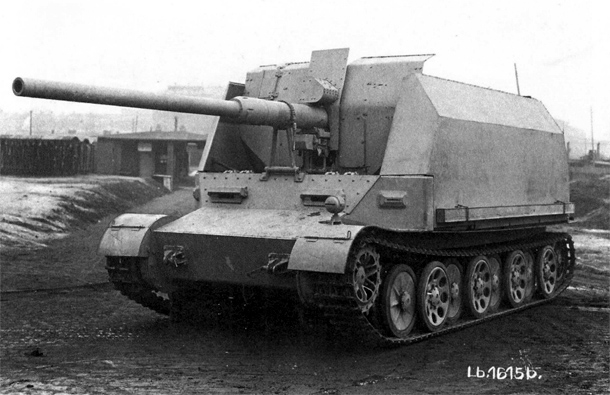
the sole prototype of the Versuchsflakwagen was originally fitted with the 88 mm Flak 41 L/74 gun; in this photograph the side panels of the fighting compartment are fully raised, source: Flickr.com with the permission of the publishing user, edited
A bunker-buster
The original intention of those who conceived this vehicle was not to produce an air defence weapon but a bunker-destroyer. It was to be another vehicle to assist German forces in breaching the French Maginot Line. The Germans were concerned about this system of bunkers and fortifications, and so towards the end of the 1930s they initiated the development of at least four "bunker-busters" — besides the vehicle described here, these included the Dicker Max, the Sturer Emil and the Flak 18 on the Sd.Kfz. 8 chassis. The vehicle that concerns us in this article was to be based on a newly developed tracked chassis designated Panzerselbstfahrlafette IVc, or Pz.Sfl. IVc. Its armament was to be the 88 mm Flak 37 gun with a barrel length of 56 calibres (L/56). Development work was entrusted to Krupp.
The sources do not give the precise date on which development began, but one thing is certain: it was too late. When German forces bypassed the Maginot Line in May 1940 and defeated France in a lightning campaign, this "bunker-buster" was still in the development phase. What was now to be done with a partially developed fighting vehicle whose primary purpose had already been achieved by other means? Like the other vehicles of similar designation mentioned above, this one too was to begin serving as a tank destroyer. It transpired, however, that the Pz.Sfl. IVc was not particularly well suited to this role, and so the entire project was quietly shelved for a time.
Or perhaps a Flakpanzer instead?
It was not until June 1942 that Krupp put forward the idea that the vehicle might find a useful role as an anti-aircraft tank (Flakpanzer), and fresh discussions with the army began.
Krupp also proposed at the same time rearming the vehicle for its new purpose with the new 8.8 cm Flak L/71 gun, which Krupp itself was developing for the Luftwaffe under the project designation Gerät 42. The army accepted the proposal and ordered the construction of two pre-production prototypes. The vehicle on order received the official designation 8,8 cm L/71 Versuchsflakwagen — Versuchsflakwagen meaning a trials or experimental anti-aircraft vehicle. The first prototype was to be delivered in April 1943 and the second a month later.
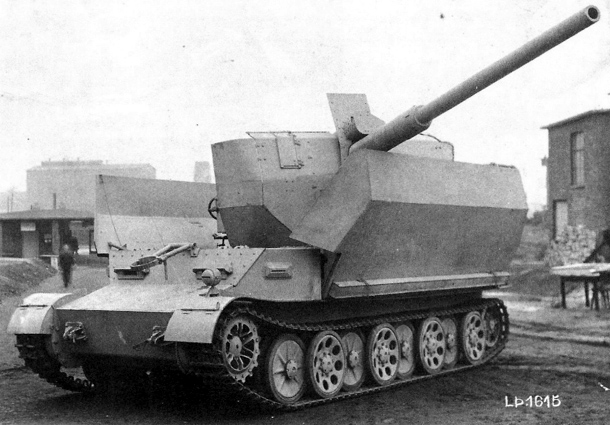
the side panels could also be fixed in a partially open position, source: Flickr.com with the permission of the publishing user, edited
Prototype construction
Production of the prototypes did not go as smoothly as initially hoped, and the agreed deadlines were ultimately missed by a considerable margin. Among other problems, it emerged that the originally specified gearbox and steering mechanism were insufficiently reliable and had to be replaced. A further complication was the cancellation of the Gerät 42 gun (the 8.8 cm Flak L/71) in favour of the more powerful Rheinmetall Flak 41 L/74. Krupp therefore had to adapt its vehicle for the installation of a weapon from a rival firm. Work on the prototypes was being carried out at Krupp's factories in Essen, but following Allied bombing raids in October 1943 it had to be relocated to a plant in Magdeburg. The army's patience was running out in the meantime, and on 5 November 1943 the order for the second prototype was cancelled. Only a single trials example was now to be delivered, and this was finally completed during November 1943.
Vehicle description
As already noted, the 88 mm Versuchsflakwagen was based on the chassis designated Pz.Sfl. IVc, which had eight road wheel axles on each side. Each axle carried two discs. The odd-numbered wheels had both discs mounted close together on the axle, while the discs of the even-numbered wheels had a gap between them. This arrangement allowed the odd and even wheels to partially overlap one another — a solution typical of German half-tracks and later tank types, which allowed more road wheels to fit along the side of the chassis and thereby improved the distribution of the vehicle's weight. The road wheels of the Versuchsflakwagen themselves closely resembled those used on German half-track tractors. The outer discs on the even-numbered axles were fitted with circular lightening holes, while the discs on the odd-numbered axles were solid. All road wheels had rubber tyres for a smoother ride and a uniform diameter of 700 mm. The tracks were 420 mm wide.
The powertrain layout followed the German standard: the engine was located at the rear and the gearbox at the front of the hull, placing the drive sprockets at the front and the idler wheels at the rear. The vehicle was powered by the Maybach HL 90, a liquid-cooled petrol engine developing a maximum of 360 horsepower — itself still a development and test unit at the time, and one that never entered series production. The engine was coupled to an SSG76 gearbox with eight forward speeds and one reverse.
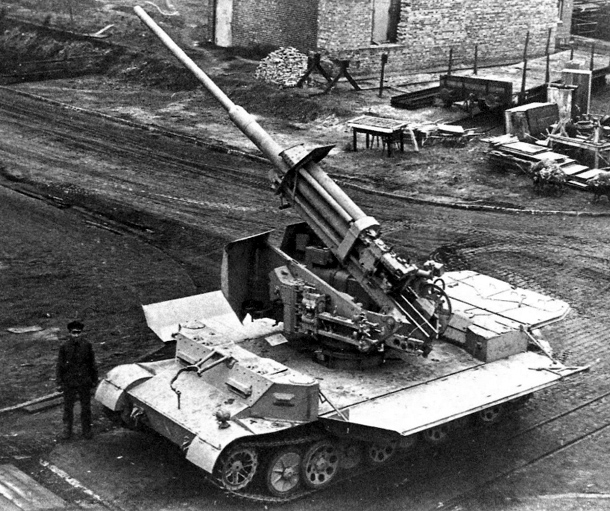
in this photograph the side panels (and the rear wall) are fully folded down to allow easier firing; a hand-crank mechanism was used to raise them again, source: Flickr.com with the permission of the publishing user, edited
At the front of the vehicle was a fully enclosed cab for the driver and co-driver. The front wall of the cab, with its pair of observation ports, was 20 mm thick. Both ports were of identical construction with an armoured shutter, and were most likely a modified version of the driver's vision port from the Panzer III or Panzer IV. Bolt heads are clearly visible around the perimeter of the cab's front wall in photographs. The literature does not state this explicitly, but it seems reasonable to conclude that this section of armour could be removed completely for easier maintenance access to the gearbox — a theory supported by the lifting eye welded to the centre of the front wall (see photo HERE). The soldiers in the enclosed cab accessed and exited their positions through hatches located directly above their seats.
Immediately behind the cab began the open loading platform, in the centre of which the already-mentioned 88 mm Flak 41 gun was mounted on a rotating pedestal. This weapon had been developed by Rheinmetall to a Luftwaffe specification calling for a gun capable of engaging enemy bombers at altitudes above 8,000 metres — the effective ceiling of the older 88 mm Flak guns. One of the additional requirements for the Flak 41 was a low silhouette when engaging ground targets, a requirement that the designers fulfilled very successfully. The Flak 41 could boast a maximum vertical range of approximately 15 km and an effective ceiling of 10.68 km. Against ground targets, its maximum range was around 19.7 km. The gun pedestal allowed unlimited 360° traverse and elevation from –5° to +90°.
The gun was installed complete with its original 12 mm front shield. Stowage bins in the floor of the fighting compartment were to hold 48 rounds for the gun — a surprisingly large number to fit in that space. The vehicle had no built-in secondary armament. The Versuchsflakwagen's crew was to consist of 9 men: the driver, the commander and a seven-man gun crew. During longer movements, up to five soldiers could use a bench located at the rear of the fighting compartment, while two more could sit on seats attached directly to the gun. The driver and commander of course sat inside the enclosed front armoured cab. During travel the fighting space was protected on all sides except the roof. Protection at the front was provided by the gun's own shield; the sides and rear were covered by folding armour walls. These walls consisted of two layers of 5 mm armour plate — 5 and 5 mm with a gap between the plates. As part of the preparation for firing, the side and rear walls were folded down to avoid obstructing the gun's traverse. Once folded, the walls were locked in the horizontal position, substantially increasing the floor area of the fighting compartment.

following firing trials of the prototype, a decision was taken to rearm it with the lighter Flak 37 gun of the same calibre, source: Flickr.com with the permission of the publishing user, edited
On the inner face of the side panels were racks for hanging small arms and backpacks. Raising the fully folded side panels again was no trivial matter, as each weighed in the order of several hundred kilograms. A raising mechanism driven by two hand cranks on each side was therefore provided — one crank at the front and one at the rear (photo HERE). In addition to the fully raised and fully folded positions, the side walls could also be fixed in a partially open position (photo HERE). As already noted, the roof of the fighting compartment remained open even with the side panels fully raised. In bad weather the soldiers could shelter under a waterproof tarpaulin pulled across the opening. Behind the fighting compartment was the engine section, almost the entire roof of which was louvred to improve airflow. The already-mentioned Maybach HL 90 petrol engine gave the 26-tonne vehicle a maximum speed of around 60 km/h. The 600-litre fuel tank provided a range of approximately 300 km on road and around 200 km cross-country.
As noted above, the sole prototype of the Versuchsflakwagen was completed — with a delay — in November 1943. As early as January 1944, before the army had even had a proper opportunity to test the delivered vehicle, Reich Armaments Minister Albert Speer ordered the further development of this vehicle to be terminated. The reasoning was fairly logical. Self-propelled anti-aircraft guns were self-propelled precisely so they could accompany other fighting vehicles and provide them with cover wherever and whenever it was needed. Anti-aircraft guns of 88 mm calibre were, by virtue of their power, intended primarily for destroying high-flying bombers. But this kind of threat was essentially non-existent for columns of German fighting vehicles moving on the battlefield. German forces in the field needed protection against fast, low-flying fighters and ground-attack aircraft — and for that purpose, guns of shorter range but higher rate of fire were far better suited.
Trials and rearming
In March 1944 the sole completed Versuchsflakwagen underwent driving and firing trials at the Oksbøl range in Denmark. The driving trials apparently went very well — the vehicle was reportedly able to sustain speeds of between 40 and 50 km/h for extended periods without any problems with the engine or running gear. The results of the firing trials were apparently somewhat less impressive. The details are not known, but the fact that on completion of the trials an order was given to rearm the Versuchsflakwagen with the lighter 88 mm Flak 37 gun speaks for itself. The relatively light chassis had most likely struggled with the enormous stresses generated by firing the powerful and heavy Flak 41.
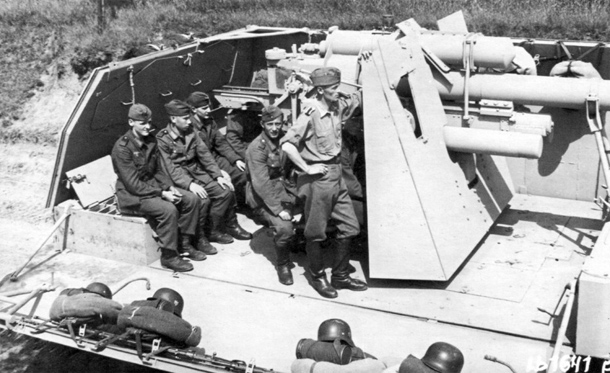
the Versuchsflakwagen's crew was to consist of 9 men: the driver, the commander and a seven-man gun crew, source: Flickr.com with the permission of the publishing user, edited
The lighter Flak 37 was installed again complete with its standard shield, which was however smaller than that of the Flak 41. The new weapon brought a modest reduction in the Versuchsflakwagen's firepower, as its effective ceiling and maximum range were somewhat lower — an effective altitude of approximately 8 km and a maximum ground range of around 14.8 km — but under practical combat conditions this was an entirely negligible difference. The Flak 37 also had a slightly lower maximum elevation, at "only" 85°.
"Combat" deployment
After rearming, the Versuchsflakwagen was experimentally assigned to Heeres Flakartillerie-Abteilung (Sf.) 304, which was subordinate to the 26th Panzer Division deployed in Italy. Given the cancellation of the entire project, the Versuchsflakwagen prototype with its 88 mm gun remained the only example of its kind. How and where it ended its service, and whether it ever saw action in combat, is unfortunately not known.

ARTICLE
CONTENTS:
Reproducing text from the Panzernet website without the written consent of the operator is prohibited.